Pakistan Food & Beverages Processing Equipment Market Summary
The pakistan food & beverages processing equipment market was estimated at USD 836 Million in 2025 and is projected to reach USD 1497 Million by 2032, growing at a CAGR of 10.0% from 2026 to 2032.
Pakistan Food & Beverages Processing Equipment Market Year-wise Growth Rate and Key Drivers
This graph highlights how the Pakistan Food & Beverages Processing Equipment Market has steadily grown over the past five years, supported by major growth factors.
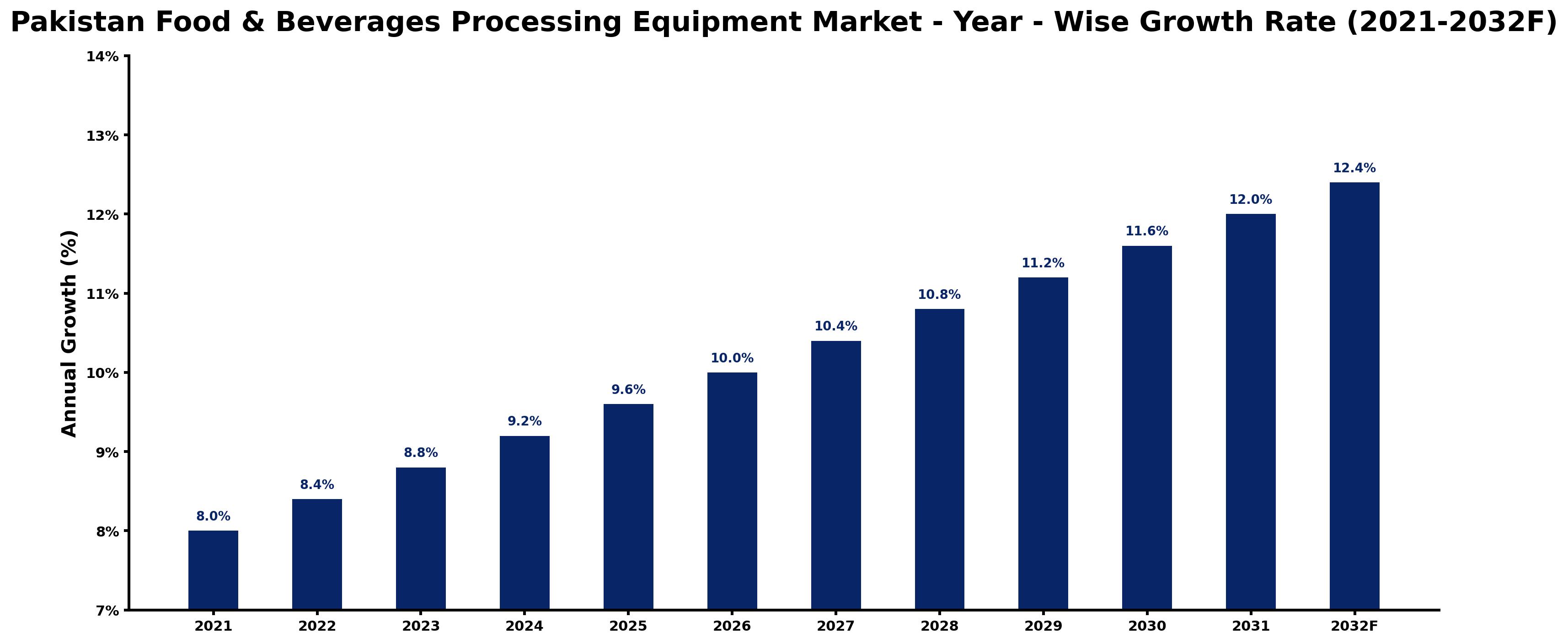
The table below presents the year wise growth rates along with the key drivers influencing the market
| Year | Growth Rate | Major Drivers |
| 2021 | 8.0% | Supply chain disruptions led to increased interest in local food processing capabilities. |
| 2022 | 8.4% | Consumer preferences shifted towards healthier, locally sourced food options in Pakistan. |
| 2023 | 8.8% | Technological integration in production processes enhanced efficiency across food sectors significantly. |
| 2024 | 9.2% | Investment in food safety standards prompted upgrades in processing equipment nationwide. |
| 2025 | 9.6% | Emerging e-commerce platforms transformed traditional distribution methods for food products. |
| 2026 | 10.0% | Urbanization led to changing dietary patterns, demanding modern processing technologies. |
| 2027 | 10.4% | Increased foreign investments stimulated advanced machinery imports for competitive edge. |
| 2028 | 10.8% | Export opportunities expanded as Pakistan aimed to strengthen its food export capabilities. |
| 2029 | 11.2% | Local manufacturers collaborated to innovate equipment tailored to regional food processing needs. |
| 2030 | 11.6% | The awareness of sustainability drove equipment development for eco-friendly processing methods. |
| 2031 | 12.0% | Rural electrification projects improved access to modern processing technologies in remote areas. |
| 2032 | 12.4% | Integration of AI in quality control influenced equipment design and operational efficiency. |
Note - Market size estimations and growth projections presented in this report are based on 6Wresearch's advanced forecasting approach, validated with industry datasets as of June 2026.
Pakistan Food & Beverages Processing Equipment Market Synopsis
The Pakistan Food Beverages Processing Equipment Market is projected to reach 10.0% and witness significant growth during the forecast period (2026-2032). This growth is primarily driven by an increasing demand for convenience food and ready-to-eat meals, bolstered by rising disposable incomes and a growing population. Urbanization trends in Pakistan further contribute to the market's expansion as higher investment in infrastructure development enhances distribution and accessibility across the country.
Pakistan Food & Beverages Processing Equipment Market Growth Drivers
Several key factors are fueling the growth of the Pakistan Food & Beverages Processing Equipment Market:
- Increased consumer demand for convenience foods, as busy lifestyles drive the popularity of ready-to-eat meal options.
- Elevated disposable income levels allow consumers to spend more on quality processed food items, further stimulating market growth.
- Urbanization is leading to altered eating habits, with a prominent shift towards dining out and consuming processed foods.
- The government's commitment to improving food processing infrastructure reflects positively on market dynamics, with investments in cold storage and logistics.
- Growing awareness of health benefits associated with processed foods encourages consumers to opt for healthier options, creating additional market opportunities.
Pakistan Food & Beverages Processing Equipment Market Challenges and Restraints
Despite the promising growth trajectory, the market faces several challenges that may hinder its progress:
- Poor storage infrastructure remains a significant barrier, as the country lacks adequate large-capacity refrigerated warehouses necessary for preserving perishable goods.
- The insufficient supply chain network complicates distribution, preventing efficient movement of products from manufacturers to consumers.
- High import tariffs on processing equipment can deter foreign investment and impede technological advancement in the sector.
- Regulatory hurdles can create delays in obtaining necessary approvals, limiting the speed at which new companies can enter the market.
- Economic fluctuations, such as inflation, may affect consumer spending power, impacting the overall demand for processed food products.
Pakistan Food & Beverages Processing Equipment Market Investment Opportunities
Given the current landscape, several investment opportunities are emerging within the Pakistan Food & Beverages Processing Equipment Market:
- Investment in cold chain logistics can enhance the quality and safety of perishable goods, improving overall market efficiency.
- Development of advanced processing technologies is essential for meeting consumer demands for health-focused and specialty food products.
- Exploration of partnerships with international players can introduce innovative solutions in food processing and technology.
- Government incentives for foreign direct investment offer a promising avenue for capitalizing on the growing market potential.
- Capacity expansion in existing processing facilities can help local manufacturers scale operations to meet rising food demand.
Pakistan Food & Beverages Processing Equipment Market Government Investment and Initiatives
The government of Pakistan has initiated various programs aimed at bolstering the food processing sector. Policies encouraging the establishment of cold chains, warehousing facilities, and improved transportation networks highlight the commitment to enhance production capacity. Investments in agricultural infrastructure, supported by favorable regulations for foreign investments, are designed to promote growth and efficiency within this sector. Additionally, initiatives to train a skilled workforce in food technology are essential to align with industry requirements and elevate production standards.
Pakistan Food & Beverages Processing Equipment Market Latest Developments (May 2025 - June 2026)
Recent developments in the Pakistan Food & Beverages Processing Equipment Market indicate a focused effort towards modernization and efficiency. There have been enhancements in production facilities, aimed at integrating automation and innovative processing technologies. The government has increased its support for local food processing companies, encouraging local sourcing of materials and technologies. Furthermore, the demand for healthier meal options has resulted in industry players pivoting to offer products that cater to health-conscious consumers. These trends signify a shift towards value-added processing, emphasizing quality and health benefits.
Pakistan Food & Beverages Processing Equipment Market - Key Attractiveness of the Report
- 10 Years of Market Numbers
- Historical Data Starting from 2022 to 2025
- Base Year: 2025
- Forecast Data until 2032
- Key Performance Indicators Impacting the Market
- Major Upcoming Developments and Projects
Key Highlights of the Report:
- Pakistan Food & Beverages Processing Equipment Market Outlook
- Market Size of Pakistan Food & Beverages Processing Equipment Market, 2025
- Forecast of Pakistan Food & Beverages Processing Equipment Market, 2032F
- Historical Data and Forecast of Pakistan Food & Beverages Processing Equipment Revenues & Volume for the Period 2022-2032F
- Pakistan Food & Beverages Processing Equipment Market Trend Evolution
- Pakistan Food & Beverages Processing Equipment Market Drivers and Challenges
- Pakistan Food & Beverages Processing Equipment Price Trends
- Pakistan Food & Beverages Processing Equipment Porter's Five Forces
- Pakistan Food & Beverages Processing Equipment Industry Life Cycle
- Historical Data and Forecast of Pakistan Food & Beverages Processing Equipment Market Revenues & Volume By Types for the Period 2022-2032F
- Historical Data and Forecast of Pakistan Food & Beverages Processing Equipment Market Revenues & Volume By Pre-processing Equipment for the Period 2022-2032F
- Historical Data and Forecast of Pakistan Food & Beverages Processing Equipment Market Revenues & Volume By Sorting & Grading for the Period 2022-2032F
- Historical Data and Forecast of Pakistan Food & Beverages Processing Equipment Market Revenues & Volume By Processing Equipment for the Period 2022-2032F
- Historical Data and Forecast of Pakistan Food & Beverages Processing Equipment Market Revenues & Volume By Mode of Operations for the Period 2022-2032F
- Historical Data and Forecast of Pakistan Food & Beverages Processing Equipment Market Revenues & Volume By Automatic for the Period 2022-2032F
- Historical Data and Forecast of Pakistan Food & Beverages Processing Equipment Market Revenues & Volume By Semi-Automatic for the Period 2022-2032F
- Historical Data and Forecast of Pakistan Food & Beverages Processing Equipment Market Revenues & Volume By Forms for the Period 2022-2032F
- Historical Data and Forecast of Pakistan Food & Beverages Processing Equipment Market Revenues & Volume By Liquid for the Period 2022-2032F
- Historical Data and Forecast of Pakistan Food & Beverages Processing Equipment Market Revenues & Volume By Solid for the Period 2022-2032F
- Historical Data and Forecast of Pakistan Food & Beverages Processing Equipment Market Revenues & Volume By Semi-Solid for the Period 2022-2032F
- Historical Data and Forecast of Pakistan Food & Beverages Processing Equipment Market Revenues & Volume By Applications for the Period 2022-2032F
- Historical Data and Forecast of Pakistan Food & Beverages Processing Equipment Market Revenues & Volume By Bakery & Confectionery Products for the Period 2022-2032F
- Historical Data and Forecast of Pakistan Food & Beverages Processing Equipment Market Revenues & Volume By Meat & Poultry Products for the Period 2022-2032F
- Historical Data and Forecast of Pakistan Food & Beverages Processing Equipment Market Revenues & Volume By Fish & Sea food for the Period 2022-2032F
- Historical Data and Forecast of Pakistan Food & Beverages Processing Equipment Market Revenues & Volume By Dairy Products for the Period 2022-2032F
- Historical Data and Forecast of Pakistan Food & Beverages Processing Equipment Market Revenues & Volume By Alcoholic Beverages for the Period 2022-2032F
- Historical Data and Forecast of Pakistan Food & Beverages Processing Equipment Market Revenues & Volume By Non-Alcoholic Beverages for the Period 2022-2032F
- Historical Data and Forecast of Pakistan Food & Beverages Processing Equipment Market Revenues & Volume By Others for the Period 2022-2032F
- Pakistan Food & Beverages Processing Equipment Import Export Trade Statistics
- Market Opportunity Assessment By Types
- Market Opportunity Assessment By Mode of Operations
- Market Opportunity Assessment By Forms
- Market Opportunity Assessment By Applications
- Pakistan Food & Beverages Processing Equipment Top Companies Market Share
- Pakistan Food & Beverages Processing Equipment Competitive Benchmarking By Technical and Operational Parameters
- Pakistan Food & Beverages Processing Equipment Company Profiles
- Pakistan Food & Beverages Processing Equipment Key Strategic Recommendations






































