Pakistan Food & Grocery Retail Market Size, Share & Growth Rate
The Pakistan Food & Grocery Retail Market was estimated at USD 600 Million in 2025 and is projected to reach USD 1017 Million by 2032, growing at a CAGR of 7.8% from 2026 to 2032. This growth trajectory is predominantly fueled by a burgeoning population and urbanization trends, which continue to reshape the consumer landscape. Moreover, evolving consumer preferences towards modern retail formats and healthier food choices significantly contribute to the expansion of this market.
Pakistan Food & Grocery Retail Market Year-wise Growth Rate and Key Drivers
This graph highlights how the Pakistan Food & Grocery Retail Market has steadily grown over the years, supported by major growth factors.
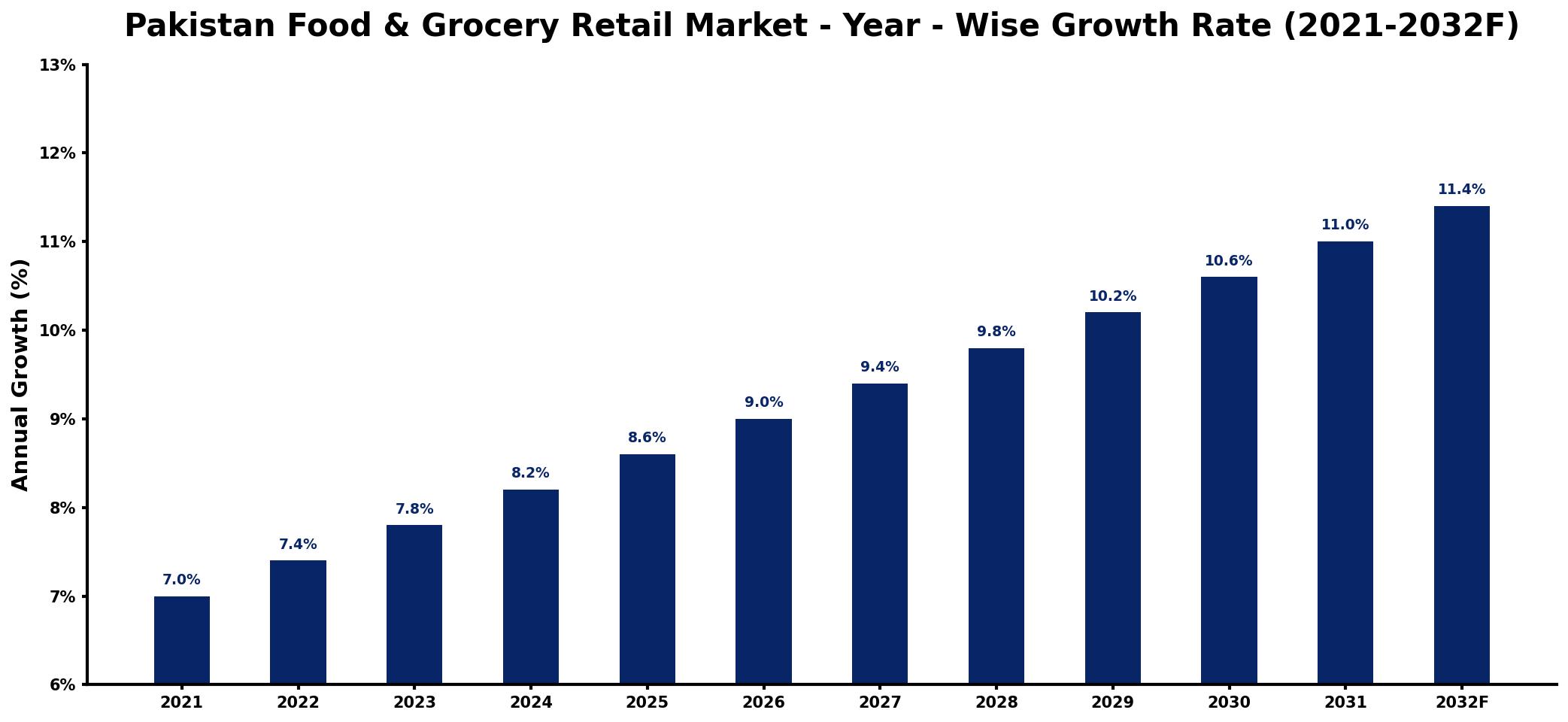
The table below presents the year‑wise growth rates along with the key drivers influencing the market
| Year | Growth Rate | Major Drivers |
| 2021 | 7.0% | Rising consumer disposable income |
| 2022 | 7.4% | Expansion of e-commerce platforms |
| 2023 | 7.8% | increased overall sector activity |
| 2024 | 8.2% | Growing health consciousness among consumers |
| 2025 | 8.6% | Investment in supply chain technology |
| 2026 | 9.0% | Diversification of product offerings |
| 2027 | 9.4% | Enhanced customer loyalty programs |
| 2028 | 9.8% | Strategic partnerships with local suppliers |
| 2029 | 10.2% | Adoption of sustainable practices |
| 2030 | 10.6% | Increasing penetration of digital payments |
| 2031 | 11.0% | Focus on convenience shopping experiences |
| 2032 | 11.4% | Rising popularity of private labels |
Note: Market size estimations and growth projections presented in this report are based on 6Wresearch's proprietary forecasting methodology, utilizing the latest available industry data, government publications, and primary research inputs.
Pakistan Food & Grocery Retail Market Synopsis
In recent years, the Pakistan Food & Grocery Retail Market has experienced notable momentum, largely propelled by an increase in disposable incomes and a shift towards organized retail formats. As traditional "kirana" stores remain prevalent, modern channels like supermarkets and e-commerce are establishing a solid foothold, especially in urban areas.
Looking ahead, the market is poised for transformative growth. The rising interest in organic products and online shopping reflects changing consumer behaviors, signaling a progressive shift towards contemporary retail dynamics. This evolution presents a blend of challenges and opportunities that stakeholders must navigate effectively.
- Modern retail formats are increasingly dominating the market landscape, especially in urban centers.
- E-commerce has emerged as a significant player, enhancing consumer convenience and accessibility.
- Health-conscious consumers are driving demand for organic and premium food options.
- Retailers are investing in omnichannel strategies to create seamless shopping experiences.
- Government initiatives aim to bolster food safety standards and support local production.
The Pakistan Food & Grocery Retail Market is confronted with several constraints that inhibit its growth potential. Supply chain inefficiencies often lead to delays and increased costs, complicating the logistics of delivering products efficiently. Additionally, high inflation rates are impacting consumer purchasing power, prompting them to be more selective in their spending. The lack of infrastructure, particularly regarding storage and transportation, further complicates the market landscape. Finally, regulatory hurdles and the inconsistent enforcement of food safety standards create uncertainty for retailers striving to meet compliance and operational benchmarks.
The market is witnessing several key trends shaping consumer behavior and retailer strategies. Notably, the popularity of online grocery shopping has surged, largely driven by the COVID-19 pandemic, as consumers seek convenience without compromising safety. Additionally, there is an increasing demand for organic, health-oriented food products as consumers become more health-conscious. Premium and imported food items are also gaining traction among affluent demographics, prompting retailers to diversify their offerings. Moreover, sustainability concerns are steering consumers towards eco-friendly packaging and locally sourced products, indicating a shift towards more responsible consumption.
Within the Pakistan Food & Grocery Retail Market, numerous investment opportunities are emerging. The acceleration of online grocery shopping presents a lucrative avenue, given the rise in internet penetration and shifting consumer habits. Investments in e-commerce platforms or technological innovations to enhance logistics could yield significant returns. Furthermore, the growing interest in organic and health-centric products allows for the establishment of specialty stores catering to this trend. Expanding retail footprints into tier 2 and tier 3 cities offers another compelling opportunity, tapping into a market segment that is still underdeveloped but rapidly evolving.
The Pakistan government has rolled out various initiatives aimed at regulating the Food & Grocery Retail Market. These policies focus on enhancing food safety and hygiene standards while fostering a competitive environment among retailers. Licensing requirements for food businesses ensure compliance with health regulations. Additionally, the establishment of the Pakistan Single National Food Safety Authority works towards streamlining food safety regulations. Supporting local farmers through sustainable agricultural practices also represents a significant government objective, contributing to market efficiency and consumer trust.
Looking ahead to 2026-2032, the Pakistan Food & Grocery Retail Market is expected to continue its upward trajectory, propelled by robust population growth and rising urbanization. The increasing prevalence of organized retail formats, like supermarkets and hypermarkets, will play a pivotal role in shaping consumer choices. Simultaneously, e-commerce is set to become an even more integral component of the retail landscape, aligning with global trends in convenience and accessibility. Despite facing infrastructure challenges and regulatory complexities, the market's overall outlook remains positive, presenting abundant opportunities for both traditional and modern retailers to adapt and thrive.
Recent industry developments highlight a significant shift towards technology integration within the retail sector, with various retailers embracing digital platforms to enhance consumer engagement and streamline operations. The demand for eco-friendly practices is leading many companies to reconsider their sourcing and packaging strategies. Additionally, there has been increased collaboration between retailers and local farmers, emphasizing the importance of sustainability in the supply chain. Overall, these trends reflect a market in flux, adapting to the needs and preferences of a modern consumer base.
- 10 Years of Market Numbers
- Historical Data Starting from 2022 to 2025
- Base Year: 2025
- Forecast Data until 2032
- Key Performance Indicators Impacting the Market
- Major Upcoming Developments and Projects
Key Highlights of the Report:
- Pakistan Food & Grocery Retail Market Outlook
- Market Size of Pakistan Food & Grocery Retail Market, 2025
- Forecast of Pakistan Food & Grocery Retail Market, 2032
- Historical Data and Forecast of Pakistan Food & Grocery Retail Revenues & Volume for the Period 2022-2032F
- Pakistan Food & Grocery Retail Market Trend Evolution
- Pakistan Food & Grocery Retail Market Drivers and Challenges
- Pakistan Food & Grocery Retail Price Trends
- Pakistan Food & Grocery Retail Porter's Five Forces
- Pakistan Food & Grocery Retail Industry Life Cycle
- Historical Data and Forecast of Pakistan Food & Grocery Retail Market Revenues & Volume By Product for the Period 2022-2032F
- Historical Data and Forecast of Pakistan Food & Grocery Retail Market Revenues & Volume By Fresh Food for the Period 2022-2032F
- Historical Data and Forecast of Pakistan Food & Grocery Retail Market Revenues & Volume By Frozen Food for the Period 2022-2032F
- Historical Data and Forecast of Pakistan Food & Grocery Retail Market Revenues & Volume By Food Cupboard for the Period 2022-2032F
- Historical Data and Forecast of Pakistan Food & Grocery Retail Market Revenues & Volume By Beverages for the Period 2022-2032F
- Historical Data and Forecast of Pakistan Food & Grocery Retail Market Revenues & Volume By Cleaning & Household for the Period 2022-2032F
- Historical Data and Forecast of Pakistan Food & Grocery Retail Market Revenues & Volume By Others for the Period 2022-2032F
- Historical Data and Forecast of Pakistan Food & Grocery Retail Market Revenues & Volume By Distribution Channel for the Period 2022-2032F
- Historical Data and Forecast of Pakistan Food & Grocery Retail Market Revenues & Volume By Supermarkets & Hypermarkets for the Period 2022-2032F
- Historical Data and Forecast of Pakistan Food & Grocery Retail Market Revenues & Volume By Convenience Stores for the Period 2022-2032F
- Historical Data and Forecast of Pakistan Food & Grocery Retail Market Revenues & Volume By Departmental Stores & Clubs for the Period 2022-2032F
- Historical Data and Forecast of Pakistan Food & Grocery Retail Market Revenues & Volume By Online for the Period 2022-2032F
- Pakistan Food & Grocery Retail Import Export Trade Statistics
- Market Opportunity Assessment By Product
- Market Opportunity Assessment By Distribution Channel
- Pakistan Food & Grocery Retail Top Companies Market Share
- Pakistan Food & Grocery Retail Competitive Benchmarking By Technical and Operational Parameters
- Pakistan Food & Grocery Retail Company Profiles
- Pakistan Food & Grocery Retail Key Strategic Recommendations






































