Pakistan Food Packaging Market Summary
The pakistan food packaging market was estimated at USD 447 Million in 2025 and is projected to reach USD 634 Million by 2032, growing at a CAGR of 6.0% from 2026 to 2032.
Pakistan Food Packaging Market Year-wise Growth Rate and Key Drivers
This graph highlights how the Pakistan Food Packaging Market has steadily grown over the past five years, supported by major growth factors.
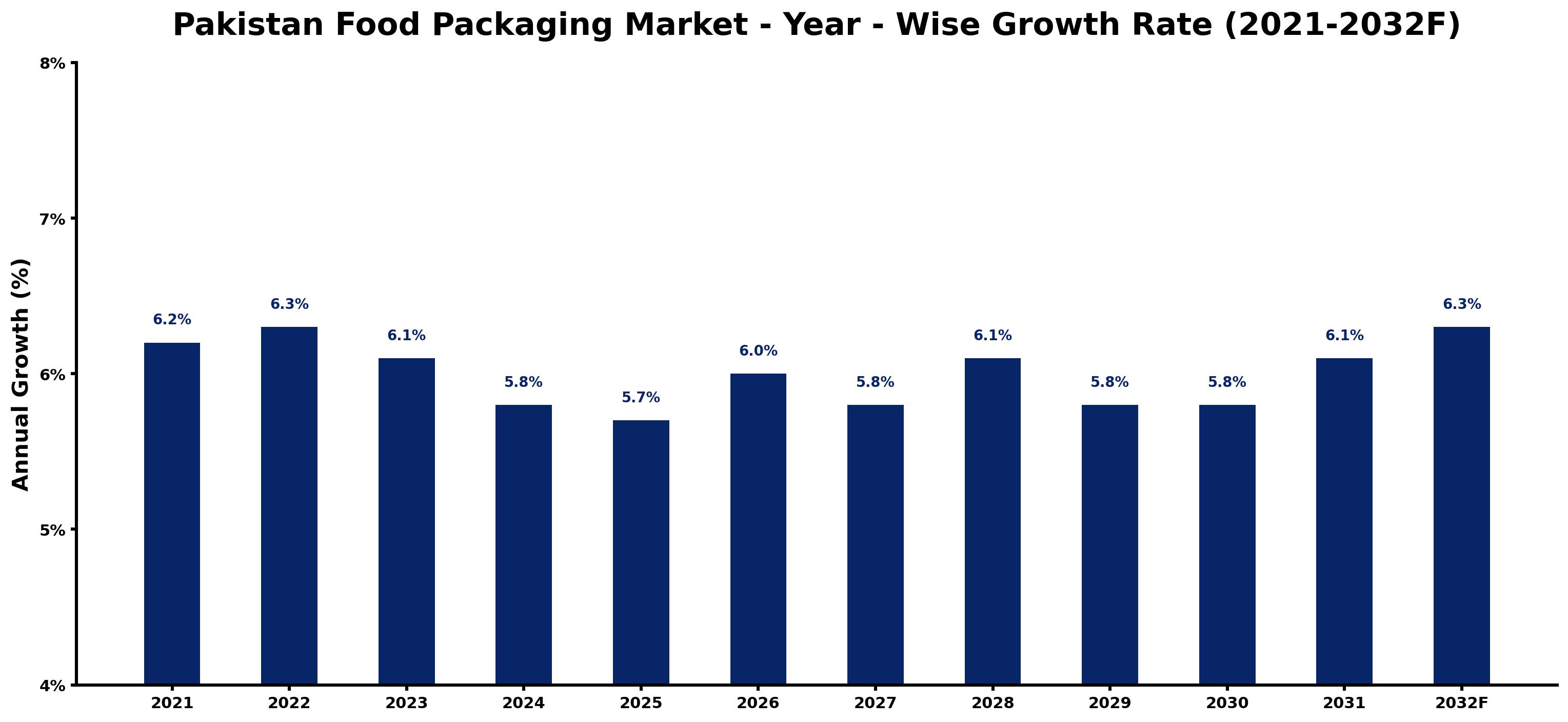
The table below presents the year wise growth rates along with the key drivers influencing the market
| Year | Growth Rate | Major Drivers |
| 2021 | 6.2% | E-commerce expansion catalyzes increased demand for convenient packaging solutions. |
| 2022 | 6.3% | Consumer preferences shift toward sustainable packaging materials and practices. |
| 2023 | 6.1% | Rising urbanization fuels the need for efficient food packaging innovations. |
| 2024 | 5.8% | Increased competition among food brands drives investment in attractive packaging designs. |
| 2025 | 5.7% | Technological advancements in packaging machinery enhance production efficiency significantly. |
| 2026 | 6.0% | Health consciousness among consumers encourages the use of eco-friendly packaging options. |
| 2027 | 5.8% | A growing middle class in urban areas boosts packaged food consumption rates. |
| 2028 | 6.1% | Rural market engagement sees food brands adapting packaging to local preferences. |
| 2029 | 5.8% | Emerging startups innovate with niche packaging solutions catering to diverse needs. |
| 2030 | 5.8% | Sustainability certifications influence packaging choices among top food manufacturers. |
| 2031 | 6.1% | Global supply chain improvements reduce costs and enhance packaging material availability. |
| 2032 | 6.3% | Increased investment in local manufacturing bolsters the overall packaging industry landscape. |
Note - Market size estimations and growth projections presented in this report are based on 6Wresearch's advanced forecasting approach, validated with industry datasets as of June 2026.
Pakistan Food Packaging Market Synopsis
The Pakistan Food Packaging Market is projected to reach 6.0% and witness significant growth during the forecast period (2026-2032). This sector is evolving rapidly, driven by urbanization, a shift in consumer preferences towards convenience, and an increasing demand for sustainable packaging solutions. The diverse range of materials utilized in food packaging, including plastics, paper paperboard, metal, and glass, reflects the industry's adaptability to market trends. Notably, flexible packaging is emerging as a dominant force due to its cost-effectiveness and ease of use, marking a significant trend in the market.
Pakistan Food Packaging Market Growth Drivers
The growth trajectory of the Pakistan Food Packaging Market is influenced by several key drivers:
- The rapid urbanization in Pakistan is reshaping lifestyles, driving the demand for more convenient and packaged food options.
- Changing consumer preferences towards ready-to-eat and on-the-go food solutions are leading to an increase in demand for innovative packaging designs.
- The rising awareness among consumers regarding environmental issues is propelling the demand for sustainable and eco-friendly packaging materials.
- The increasing utilization of advanced technologies in packaging processes, such as modified atmosphere packaging (MAP), is helping to extend the shelf life of perishable goods.
- The expansion of e-commerce and food delivery platforms necessitates the implementation of secure and efficient packaging solutions to ensure product safety and quality during transport.
Pakistan Food Packaging Market Trends and Opportunities
Current trends in the Pakistan Food Packaging Market underscore a shift towards sustainability and consumer-centric solutions:
- The trend towards sustainable packaging is manifesting in a growing demand for biodegradable and recyclable materials as consumers place greater emphasis on environmental stewardship.
- Innovative packaging designs are emerging, offering functionality combined with aesthetics, aimed at attracting consumers amid increasing competition on retail shelves.
- Technology is playing a crucial role, with many businesses adopting smart packaging solutions featuring QR codes to enhance traceability and consumer engagement.
- Customization of packaging is becoming essential for brands aiming to differentiate themselves and build a unique identity in a saturated market.
- The focus on health and safety is driving the development of packaging solutions that not only preserve food quality but also promote hygiene and freshness.
Pakistan Food Packaging Market Challenges and Restraints
Despite strong growth prospects, the Pakistan Food Packaging Market faces several challenges that could hinder its development:
- Inadequate infrastructure for packaging technology and processes leads to inefficiencies and compromises in quality.
- Variations in quality standards create inconsistencies, potentially affecting both product safety and consumer trust.
- The availability of sustainable packaging materials remains limited, restricting the shift towards eco-friendly solutions.
- A lack of consumer awareness regarding the benefits of proper food packaging poses a barrier to market expansion.
- Intense competition and pricing pressures may hinder innovation and investments necessary for market growth.
Pakistan Food Packaging Market Investment Opportunities
The evolving dynamics of the Pakistan Food Packaging Market present numerous avenues for investment:
- Investors are encouraged to explore the expansion of packaging facilities to meet the surging demand for packaged food products.
- Innovation in sustainable packaging is a lucrative area, particularly as consumer preferences increasingly gravitate towards eco-conscious alternatives.
- Enhancing packaging efficiency and safety through technological advancements offers promising returns on investment.
- Research and development efforts directed towards creating packaging solutions that prolong shelf life and maintain food quality could stimulate market growth.
- Collaborative opportunities with food manufacturers to deliver customized packaging solutions tailored to specific food products can foster strategic partnerships.
Pakistan Food Packaging Market Government Investment and Initiatives
The government of Pakistan is actively engaged in regulations and initiatives aimed at enhancing the food packaging landscape:
- The Pakistan Standards and Quality Control Authority (PSQCA) has established regulations governing food packaging materials to mitigate contamination risks and safeguard consumer health.
- The Pakistan Food Authority (PFA) plays a crucial role in enforcing compliance with food packaging regulations, addressing labeling issues, and ensuring quality standards.
- There is a governmental push to promote the use of eco-friendly packaging, with incentives for businesses that adopt sustainable practices.
- Public spending is being channeled towards the development of infrastructure that supports advanced packaging technologies, promoting efficiency and sustainability in the industry.
- Awareness campaigns targeted at both consumers and manufacturers seek to highlight the importance of safe and sustainable food packaging practices.
Pakistan Food Packaging Market Latest Developments (May 2025 - June 2026)
In the period from May 2025 to June 2026, the Pakistan Food Packaging Market has undergone notable developments:
- Significant strides have been made in the adoption of sustainable packaging solutions, with more manufacturers transitioning to biodegradable materials.
- The rise in online food delivery services has prompted packaging innovations focused on maintaining food integrity and safety during transit.
- Technological investments have surged, particularly in smart packaging systems that enhance product traceability and consumer interaction.
- Regulatory frameworks have been strengthened to ensure compliance with evolving food safety standards, reflecting a commitment to consumer protection.
- Industry collaborations have emerged, leading to improved access to quality materials and shared innovations across the food packaging value chain.
Pakistan Food Packaging Market - Key Attractiveness of the Report
- 10 Years of Market Numbers
- Historical Data Starting from 2022 to 2025
- Base Year: 2025
- Forecast Data until 2032
- Key Performance Indicators Impacting the Market
- Major Upcoming Developments and Projects
Flexible packaging, plastics, paper & paperboard, metal, and glass are commonly used, with flexible packaging leading due to its cost efficiency.
Key Highlights of the Report:
- Pakistan Food Packaging Market Outlook
- Market Size of Pakistan Food Packaging Market, 2025
- Forecast of Pakistan Food Packaging Market, 2032F
- Historical Data and Forecast of Pakistan Food Packaging Revenues & Volume for the Period 2022-2032F
- Pakistan Food Packaging Market Trend Evolution
- Pakistan Food Packaging Market Drivers and Challenges
- Pakistan Food Packaging Price Trends
- Pakistan Food Packaging Porter's Five Forces
- Pakistan Food Packaging Industry Life Cycle
- Historical Data and Forecast of Pakistan Food Packaging Market Revenues & Volume By Material Types for the Period 2022-2032F
- Historical Data and Forecast of Pakistan Food Packaging Market Revenues & Volume By Paper & board for the Period 2022-2032F
- Historical Data and Forecast of Pakistan Food Packaging Market Revenues & Volume By Plastic for the Period 2022-2032F
- Historical Data and Forecast of Pakistan Food Packaging Market Revenues & Volume By Metal for the Period 2022-2032F
- Historical Data and Forecast of Pakistan Food Packaging Market Revenues & Volume By Glass for the Period 2022-2032F
- Historical Data and Forecast of Pakistan Food Packaging Market Revenues & Volume By Others for the Period 2022-2032F
- Historical Data and Forecast of Pakistan Food Packaging Market Revenues & Volume By Product Types for the Period 2022-2032F
- Historical Data and Forecast of Pakistan Food Packaging Market Revenues & Volume By Rigid for the Period 2022-2032F
- Historical Data and Forecast of Pakistan Food Packaging Market Revenues & Volume By Semi-Rigid for the Period 2022-2032F
- Historical Data and Forecast of Pakistan Food Packaging Market Revenues & Volume By Flexible for the Period 2022-2032F
- Historical Data and Forecast of Pakistan Food Packaging Market Revenues & Volume By Applications for the Period 2022-2032F
- Historical Data and Forecast of Pakistan Food Packaging Market Revenues & Volume By Bakery & Confectionary for the Period 2022-2032F
- Historical Data and Forecast of Pakistan Food Packaging Market Revenues & Volume By Dairy Products for the Period 2022-2032F
- Historical Data and Forecast of Pakistan Food Packaging Market Revenues & Volume By Fruits & Vegetables for the Period 2022-2032F
- Historical Data and Forecast of Pakistan Food Packaging Market Revenues & Volume By Meat, Poultry, & Seafood for the Period 2022-2032F
- Historical Data and Forecast of Pakistan Food Packaging Market Revenues & Volume By Sauces & Dressings for the Period 2022-2032F
- Historical Data and Forecast of Pakistan Food Packaging Market Revenues & Volume By Others for the Period 2022-2032F
- Pakistan Food Packaging Import Export Trade Statistics
- Market Opportunity Assessment By Material Types
- Market Opportunity Assessment By Product Types
- Market Opportunity Assessment By Applications
- Pakistan Food Packaging Top Companies Market Share
- Pakistan Food Packaging Competitive Benchmarking By Technical and Operational Parameters
- Pakistan Food Packaging Company Profiles
- Pakistan Food Packaging Key Strategic Recommendations






































