Pakistan Gambling Market Summary
The pakistan gambling market was estimated at USD 359 Million in 2025 and is projected to reach USD 471 Million by 2032, growing at a CAGR of 4.9% from 2026 to 2032.
Pakistan Gambling Market Year-wise Growth Rate and Key Drivers
This graph highlights how the Pakistan Gambling Market has steadily grown over the past five years, supported by major growth factors.
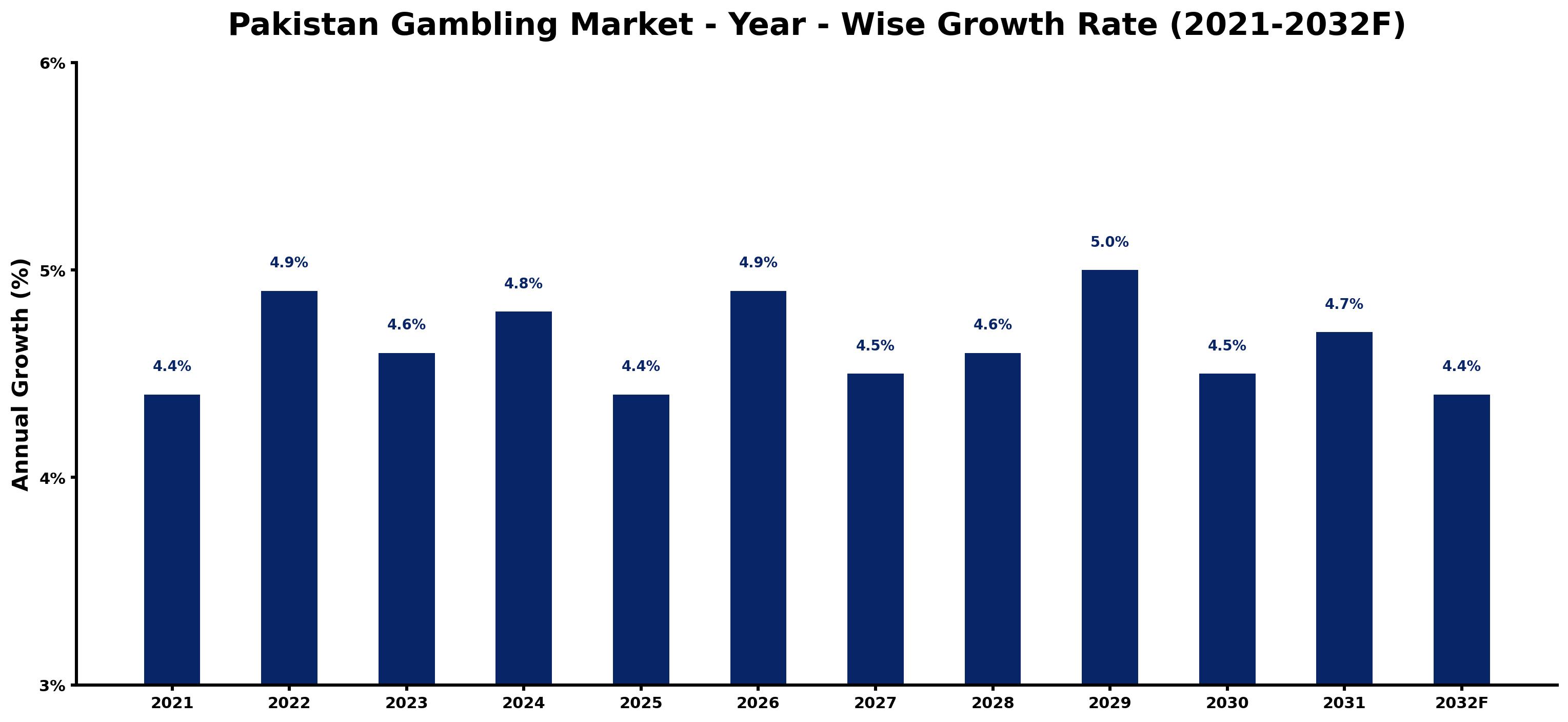
The table below presents the year wise growth rates along with the key drivers influencing the market
| Year | Growth Rate | Major Drivers |
| 2021 | 4.4% | A surge in online connectivity influenced interest in digital gambling platforms. |
| 2022 | 4.9% | Increased smartphone penetration opened avenues for mobile gaming experiences. |
| 2023 | 4.6% | Peer-to-peer betting gained traction, creating a vibrant community around gambling. |
| 2024 | 4.8% | Local cultural shifts began normalizing gambling as a leisure activity. |
| 2025 | 4.4% | Emergence of innovative payment solutions enhanced transaction convenience for gamblers. |
| 2026 | 4.9% | Social media platforms became essential tools for marketing gambling services. |
| 2027 | 4.5% | Collaboration among tech firms revitalized user interfaces, attracting diverse demographics. |
| 2028 | 4.6% | Legal ambiguity around gambling led to a burgeoning grey market for services. |
| 2029 | 5.0% | Consumer preference shifted towards sports betting, influenced by local sports events. |
| 2030 | 4.5% | Sustained urbanization drove the establishment of physical betting outlets in cities. |
| 2031 | 4.7% | Increased international investment stimulated the development of local gambling enterprises. |
| 2032 | 4.4% | Technological advancements, such as AI, began personalizing user experiences significantly. |
Note - Market size estimations and growth projections presented in this report are based on 6Wresearch's advanced forecasting approach, validated with industry datasets as of June 2026.
Pakistan Gambling Market Synopsis
The Pakistan Gambling Market is projected to reach 4.9% and witness significant growth during the forecast period (2026-2032). This anticipated expansion is underpinned by a combination of rising disposable incomes, increasing internet connectivity, and a marked shift towards mobile payment systems. As the regulatory landscape evolves, new provisions permitting online gambling are expected to further catalyze the market's growth. Coupled with the proliferation of gaming portals, the market is poised for robust development in the coming years.
Pakistan Gambling Market Growth Drivers
The growth trajectory of the Pakistan gambling market is influenced by several key factors:
- The increasing disposable income of consumers contributes to a greater willingness to engage in leisure activities, including gambling.
- With internet penetration rates steadily rising, more individuals are gaining access to online gambling platforms, enhancing participation.
- The adoption of mobile payment systems facilitates easier transactions, thereby removing barriers to entry for potential gamblers.
- New regulations around online gambling are set to create an environment where digital gambling can thrive, encouraging further market participation.
- The emergence of various gaming portals diversifies the gambling options available, appealing to a broader audience and driving market interest.
Pakistan Gambling Market Trends and Opportunities
Several trends are shaping the Pakistan gambling market, providing diverse opportunities for growth:
- The increasing integration of technology in gambling, such as virtual reality and augmented reality applications, is creating immersive gaming experiences that attract younger audiences.
- The shift towards responsible gambling initiatives is gaining traction, with public awareness campaigns aimed at promoting safe and ethical gambling practices.
- Partnerships between technology firms and gaming companies are becoming more commonplace, catalyzing innovation in gaming delivery and user experience.
- Mobile-first strategies are becoming essential, as more gamblers prefer playing on mobile devices, necessitating the development of user-friendly mobile platforms.
- Investment in cybersecurity measures is rising, ensuring that consumer data is protected, which is vital for building trust in the online gambling environment.
Pakistan Gambling Market Challenges and Restraints
Despite the promising outlook, the Pakistan gambling market faces several challenges that may hinder its growth:
- Stricter regulatory frameworks could potentially limit the scope of gambling activities, thereby affecting market participation.
- Public sentiment around gambling may remain negative, influenced by cultural and religious perspectives, which could impede market acceptance.
- The prevalence of unregulated gambling platforms poses risks both to consumers and legitimate operators, complicating the market dynamics.
- Economic fluctuations can impact disposable income levels, directly affecting consumer spending on gambling activities.
- Technological barriers, especially in rural areas, may limit access to online gambling services, thereby reducing potential market size.
Pakistan Gambling Market Government Investment and Initiatives
The Pakistani government is gradually recognizing the potential economic benefits of legalizing and regulating the gambling sector. Investment initiatives aimed at modernizing the gambling landscape include:
- Development of a regulatory framework that supports the establishment of licensed online gambling platforms, ensuring consumer protection and fair play.
- Public spending on awareness programs aimed at educating citizens about responsible gambling practices and the legal gambling ecosystem.
- Collaborations with international stakeholders to enhance regulatory frameworks and share best practices for market development.
- Implementation of tax incentives for local gambling operators, encouraging a shift from informal to regulated gambling environments.
- Efforts to promote tourism through integrated gambling experiences, further positioning Pakistan as an emerging gaming destination.
Pakistan Gambling Market Latest Developments (May 2025 - June 2026)
During the period from May 2025 to June 2026, notable developments have occurred in the Pakistan gambling market, indicating a shift towards a more structured sector:
- Newly introduced regulations have begun to take effect, allowing licensed operators to enter the online gambling space, reflecting a trend towards market liberalization.
- Increased investment in digital infrastructure aims to enhance the user experience, ensuring that potential gamblers have seamless access to gambling platforms.
- Public awareness initiatives have gained momentum, focusing on the importance of responsible gambling practices to mitigate associated risks.
- Technology-driven innovations, such as blockchain for secure transactions, are being explored to improve safety and transparency in the online gambling sector.
- Emerging partnerships between technology firms and the gambling industry highlight a growing trend of collaboration aimed at enhancing service delivery and customer engagement.
Pakistan Gambling Market - Key Attractiveness of the Report
- 10 Years of Market Numbers
- Historical Data Starting from 2022 to 2025
- Base Year: 2025
- Forecast Data until 2032
- Key Performance Indicators Impacting the Market
- Major Upcoming Developments and Projects
Key Highlights of the Report:
- Pakistan Gambling Market Outlook
- Market Size of Pakistan Gambling Market, 2025
- Forecast of Pakistan Gambling Market, 2032F
- Historical Data and Forecast of Pakistan Gambling Revenues & Volume for the Period 2022-2032F
- Pakistan Gambling Market Trend Evolution
- Pakistan Gambling Market Drivers and Challenges
- Pakistan Gambling Price Trends
- Pakistan Gambling Porter's Five Forces
- Pakistan Gambling Industry Life Cycle
- Historical Data and Forecast of Pakistan Gambling Market Revenues & Volume By Product Type for the Period 2022-2032F
- Historical Data and Forecast of Pakistan Gambling Market Revenues & Volume By Betting for the Period 2022-2032F
- Historical Data and Forecast of Pakistan Gambling Market Revenues & Volume By Casino for the Period 2022-2032F
- Historical Data and Forecast of Pakistan Gambling Market Revenues & Volume By Lottery for the Period 2022-2032F
- Historical Data and Forecast of Pakistan Gambling Market Revenues & Volume By Others for the Period 2022-2032F
- Historical Data and Forecast of Pakistan Gambling Market Revenues & Volume By Channel Type for the Period 2022-2032F
- Historical Data and Forecast of Pakistan Gambling Market Revenues & Volume By Offline for the Period 2022-2032F
- Historical Data and Forecast of Pakistan Gambling Market Revenues & Volume By Online for the Period 2022-2032F
- Historical Data and Forecast of Pakistan Gambling Market Revenues & Volume By Virtual Reality VR for the Period 2022-2032F
- Historical Data and Forecast of Pakistan Gambling Market Revenues & Volume By Platform for the Period 2022-2032F
- Historical Data and Forecast of Pakistan Gambling Market Revenues & Volume By Land-Based for the Period 2022-2032F
- Historical Data and Forecast of Pakistan Gambling Market Revenues & Volume By Online for the Period 2022-2032F
- Pakistan Gambling Import Export Trade Statistics
- Market Opportunity Assessment By Product Type
- Market Opportunity Assessment By Channel Type
- Market Opportunity Assessment By Platform
- Pakistan Gambling Top Companies Market Share
- Pakistan Gambling Competitive Benchmarking By Technical and Operational Parameters
- Pakistan Gambling Company Profiles
- Pakistan Gambling Key Strategic Recommendations






































