Pakistan Gas Equipment Market Size, Share & Growth Rate
The Pakistan Gas Equipment Market was estimated at USD 1329 Million in 2025 and is projected to reach USD 1917 Million by 2032, growing at a CAGR of 5.4% from 2026 to 2032. This growth is primarily fueled by increasing demand for natural gas across various sectors, including residential, industrial, and power generation. Government initiatives aimed at enhancing the gas infrastructure and promoting cleaner energy sources further bolster this optimistic trajectory.
Pakistan Gas Equipment Market Year-wise Growth Rate and Key Drivers
This graph highlights how the Pakistan Gas Equipment Market has steadily grown over the years, supported by major growth factors.
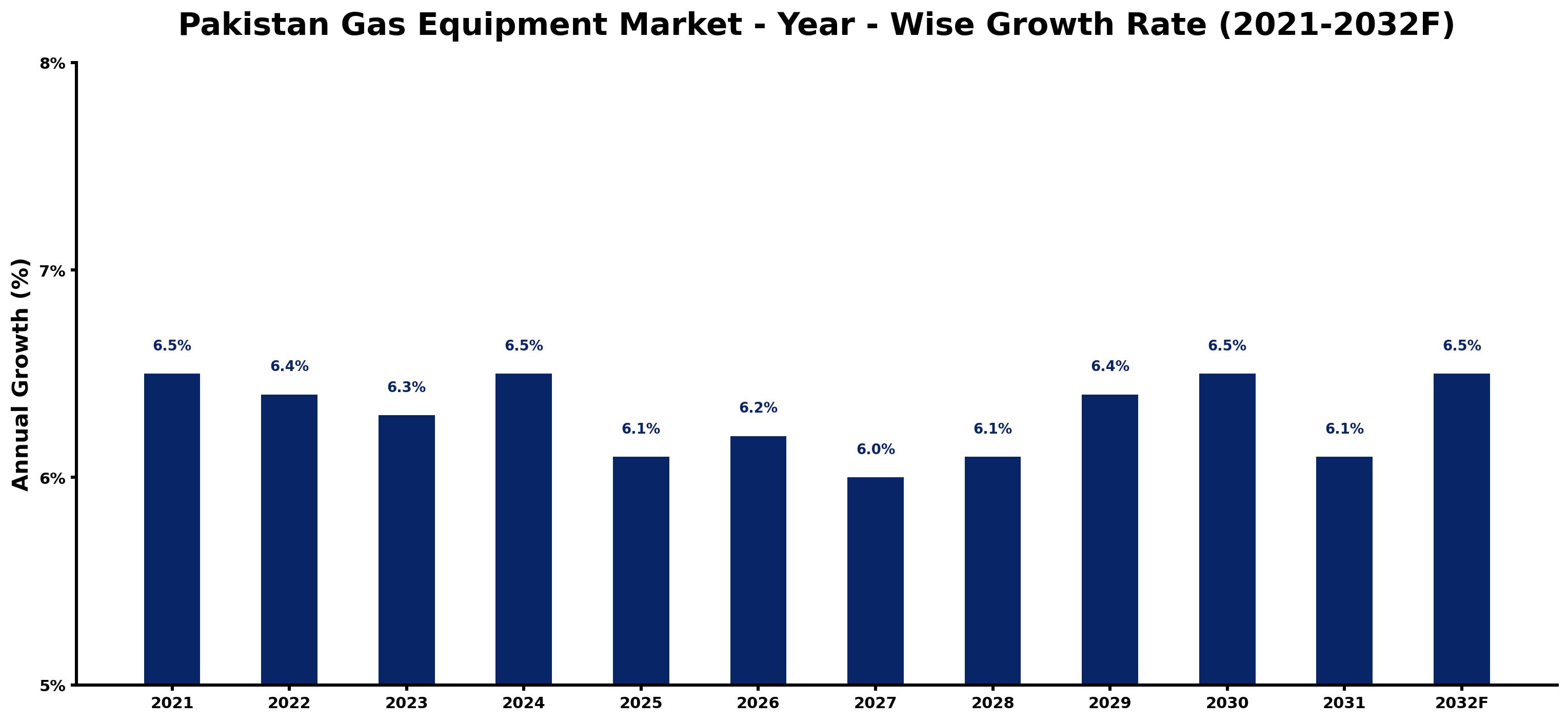
The table below presents the year‑wise growth rates along with the key drivers influencing the market
| Year | Growth Rate | Major Drivers |
| 2021 | 6.5% | Expansion of transportation and logistics networks |
| 2022 | 6.4% | Government infrastructure modernization initiatives |
| 2023 | 6.3% | Increasing industrial infrastructure investments |
| 2024 | 6.5% | Increasing smart city development projects |
| 2025 | 6.1% | Increasing industrial automation investments |
| 2026 | 6.2% | Increasing industrial infrastructure investments |
| 2027 | 6.0% | Expansion of commercial construction activities |
| 2028 | 6.1% | Expansion of manufacturing activities |
| 2029 | 6.4% | Growing renewable energy integration projects |
| 2030 | 6.5% | Increasing industrial infrastructure investments |
| 2031 | 6.1% | Rising electricity demand across industries |
| 2032 | 6.5% | Growing urbanization and commercial development |
Note - Market size estimations and growth projections presented in this report are based on 6Wresearch’s advanced forecasting approach, validated with industry datasets as of June 2026.
Pakistan Gas Equipment Market Synopsis
The landscape of the Pakistan Gas Equipment Market is evolving, driven by a surge in natural gas adoption throughout the country. With households and industries increasingly relying on natural gas for efficiency and sustainability, the market is poised for significant advancements in product offerings.
This market encompasses a diverse range of products, including gas cylinders, regulators, valves, and meters, each tailored to meet the varying needs of consumers. A focus on energy efficiency and eco-friendliness is leading to the development of innovative solutions, thus enhancing the attractiveness of the market for both consumers and investors alike.
Pakistan Gas Equipment Market Key Takeaways
- The market is witnessing a robust growth trajectory, driven by rising natural gas demand across industries.
- Technological advancements such as smart meters and IoT devices are shaping the future of gas equipment.
- Government initiatives are fostering an environment conducive to market growth and investment.
- Environmental concerns are leading to increased demand for sustainable gas equipment solutions.
- Investment opportunities abound in manufacturing and distributing innovative gas products.
Evaluation of Restraints in Pakistan Gas Equipment Market
While the Pakistan Gas Equipment Market is poised for growth, several real challenges hinder its potential. Regulatory uncertainties pose significant difficulties for businesses, impacting their ability to navigate compliance and licensing requirements efficiently. Moreover, the inconsistent supply of natural gas continues to disrupt market dynamics, leading to fluctuations in demand for gas equipment. Additionally, competition from international manufacturers offering lower-priced products places further pressure on domestic players. To thrive, companies must remain agile, closely monitor regulatory changes, and enhance their operational efficiencies.
Pakistan Gas Equipment Market Trends
Current trends in the Pakistan Gas Equipment Market indicate a shift towards energy-efficient and environmentally friendly technologies. The growing consumer emphasis on sustainability drives the demand for gas equipment that minimizes carbon emissions while maximizing efficiency. Additionally, the integration of smart technologies is becoming prevalent, with devices that allow for better monitoring and control of gas usage rapidly gaining popularity.
Notably, gas-powered generators and appliances are gaining traction in both residential and commercial sectors, catering to a consumer base eager for reliable and efficient solutions. The market is evolving to align with the preferences of a more environmentally conscious demographic, reflecting broader global shifts towards sustainable energy practices.
Pakistan Gas Equipment Market Opportunities
The potential for investment in the Pakistan Gas Equipment Market is substantial, particularly as the government prioritizes natural gas as a key component of its energy strategy. Opportunities exist in manufacturing and distributing essential equipment like pipelines, valves, and regulators, as well as in developing infrastructure for gas storage and transportation. The increasing emphasis on improving gas distribution networks opens doors for innovative solutions, creating a fertile ground for investors to partner with local businesses and capitalize on the market's growth.
Government Initiatives in the Pakistan Gas Equipment Market
The government of Pakistan is actively promoting the gas equipment sector through various initiatives and policies. The establishment of the Gas Utility Regulatory Authority (Amendment) Act 2012 set the foundation for a regulatory framework aimed at ensuring fair competition and consumer protection within the gas market. Additionally, the introduction of the Gas Infrastructure Development Cess (GIDC) aims to fund and accelerate the development of critical gas infrastructure across the country. These efforts are complemented by the Pakistan Energy Efficiency and Conservation Act 2016, which underscores the importance of energy-efficient practices in gas usage.
Future Insights of the Pakistan Gas Equipment Market
Looking ahead to 2026-2032, the Pakistan Gas Equipment Market appears to be on a promising trajectory. The ongoing efforts to increase natural gas's share in the national energy mix, coupled with substantial infrastructure development projects, are expected to drive market growth. Furthermore, the government's commitment to promoting cleaner fuel sources aligns well with global sustainability trends, paving the way for technological advancements that prioritize safety and energy efficiency. Overall, the future of the market is bright, presenting numerous opportunities for both manufacturers and suppliers.
Pakistan Gas Equipment Market Latest Developments (May 2025 - June 2026)
Recent developments in the Pakistan Gas Equipment Market indicate a strong focus on innovation and modernization. Industry players are increasingly exploring collaborations to enhance product offerings while navigating the complex regulatory landscape. There has also been a noticeable uptick in the rollout of advanced technologies, including IoT-enabled devices, aimed at improving monitoring and management of gas usage. As the market continues to evolve, consumer demand for sustainable solutions remains at the forefront of industry efforts.
Pakistan Gas Equipment Market - Key Attractiveness of the Report
- 10 Years of Market Numbers
- Historical Data Starting from 2022 to 2025
- Base Year: 2025
- Forecast Data until 2032
- Key Performance Indicators Impacting the Market
- Major Upcoming Developments and Projects
Key Highlights of the Report:
- Pakistan Gas Equipment Market Outlook
- Market Size of Pakistan Gas Equipment Market, 2025
- Forecast of Pakistan Gas Equipment Market, 2032
- Historical Data and Forecast of Pakistan Gas Equipment Revenues & Volume for the Period 2022-2032F
- Pakistan Gas Equipment Market Trend Evolution
- Pakistan Gas Equipment Market Drivers and Challenges
- Pakistan Gas Equipment Price Trends
- Pakistan Gas Equipment Porter's Five Forces
- Pakistan Gas Equipment Industry Life Cycle
- Historical Data and Forecast of Pakistan Gas Equipment Market Revenues & Volume By Equipment Type for the Period 2022-2032F
- Historical Data and Forecast of Pakistan Gas Equipment Market Revenues & Volume By Gas Delivery Systems for the Period 2022-2032F
- Historical Data and Forecast of Pakistan Gas Equipment Market Revenues & Volume By Gas Regulators for the Period 2022-2032F
- Historical Data and Forecast of Pakistan Gas Equipment Market Revenues & Volume By Flow Devices for the Period 2022-2032F
- Historical Data and Forecast of Pakistan Gas Equipment Market Revenues & Volume By Purifiers & Filters for the Period 2022-2032F
- Historical Data and Forecast of Pakistan Gas Equipment Market Revenues & Volume By Gas Generating Systems for the Period 2022-2032F
- Historical Data and Forecast of Pakistan Gas Equipment Market Revenues & Volume By Gas Detection Systems for the Period 2022-2032F
- Historical Data and Forecast of Pakistan Gas Equipment Market Revenues & Volume By Cryogenic Products for the Period 2022-2032F
- Historical Data and Forecast of Pakistan Gas Delivery Systems Gas Equipment Market Revenues & Volume By Accessories for the Period 2022-2032F
- Historical Data and Forecast of Pakistan Gas Equipment Market Revenues & Volume By Process for the Period 2022-2032F
- Historical Data and Forecast of Pakistan Gas Equipment Market Revenues & Volume By Gas Generation for the Period 2022-2032F
- Historical Data and Forecast of Pakistan Gas Equipment Market Revenues & Volume By Gas Storage for the Period 2022-2032F
- Historical Data and Forecast of Pakistan Gas Equipment Market Revenues & Volume By Gas Detection for the Period 2022-2032F
- Historical Data and Forecast of Pakistan Gas Equipment Market Revenues & Volume By Gas Transportation for the Period 2022-2032F
- Historical Data and Forecast of Pakistan Gas Equipment Market Revenues & Volume By End-Gas for the Period 2022-2032F
- Historical Data and Forecast of Pakistan Gas Equipment Market Revenues & Volume By Nitrogen for the Period 2022-2032F
- Historical Data and Forecast of Pakistan Gas Equipment Market Revenues & Volume By Hydrogen for the Period 2022-2032F
- Historical Data and Forecast of Pakistan Gas Equipment Market Revenues & Volume By Helium for the Period 2022-2032F
- Historical Data and Forecast of Pakistan Gas Equipment Market Revenues & Volume By Oxygen for the Period 2022-2032F
- Historical Data and Forecast of Pakistan Gas Equipment Market Revenues & Volume By Carbon Dioxide for the Period 2022-2032F
- Historical Data and Forecast of Pakistan Gas Equipment Market Revenues & Volume By Others for the Period 2022-2032F
- Historical Data and Forecast of Pakistan Gas Equipment Market Revenues & Volume By End-Users for the Period 2022-2032F
- Historical Data and Forecast of Pakistan Gas Equipment Market Revenues & Volume By Metal Fabrication for the Period 2022-2032F
- Historical Data and Forecast of Pakistan Gas Equipment Market Revenues & Volume By Chemicals for the Period 2022-2032F
- Historical Data and Forecast of Pakistan Gas Equipment Market Revenues & Volume By Healthcare for the Period 2022-2032F
- Historical Data and Forecast of Pakistan Gas Equipment Market Revenues & Volume By Oil and Gas for the Period 2022-2032F
- Historical Data and Forecast of Pakistan Gas Equipment Market Revenues & Volume By Food and Beverage for the Period 2022-2032F
- Historical Data and Forecast of Pakistan Gas Equipment Market Revenues & Volume By Others for the Period 2022-2032F
- Pakistan Gas Equipment Import Export Trade Statistics
- Market Opportunity Assessment By Equipment Type
- Market Opportunity Assessment By Process
- Market Opportunity Assessment By End-Gas
- Market Opportunity Assessment By End-Users
- Pakistan Gas Equipment Top Companies Market Share
- Pakistan Gas Equipment Competitive Benchmarking By Technical and Operational Parameters
- Pakistan Gas Equipment Company Profiles
- Pakistan Gas Equipment Key Strategic Recommendations






































