Pakistan Ghee Market: Import Trend Analysis
Pakistan ghee market witnessed a significant decline in imports from 2023 to 2024, with a growth rate of -50.99%. However, the compound annual growth rate (CAGR) for imports from 2020 to 2024 stood at a robust 62.51%. This drastic shift could be attributed to changes in consumer preferences or shifts in trade policies impacting import volumes.
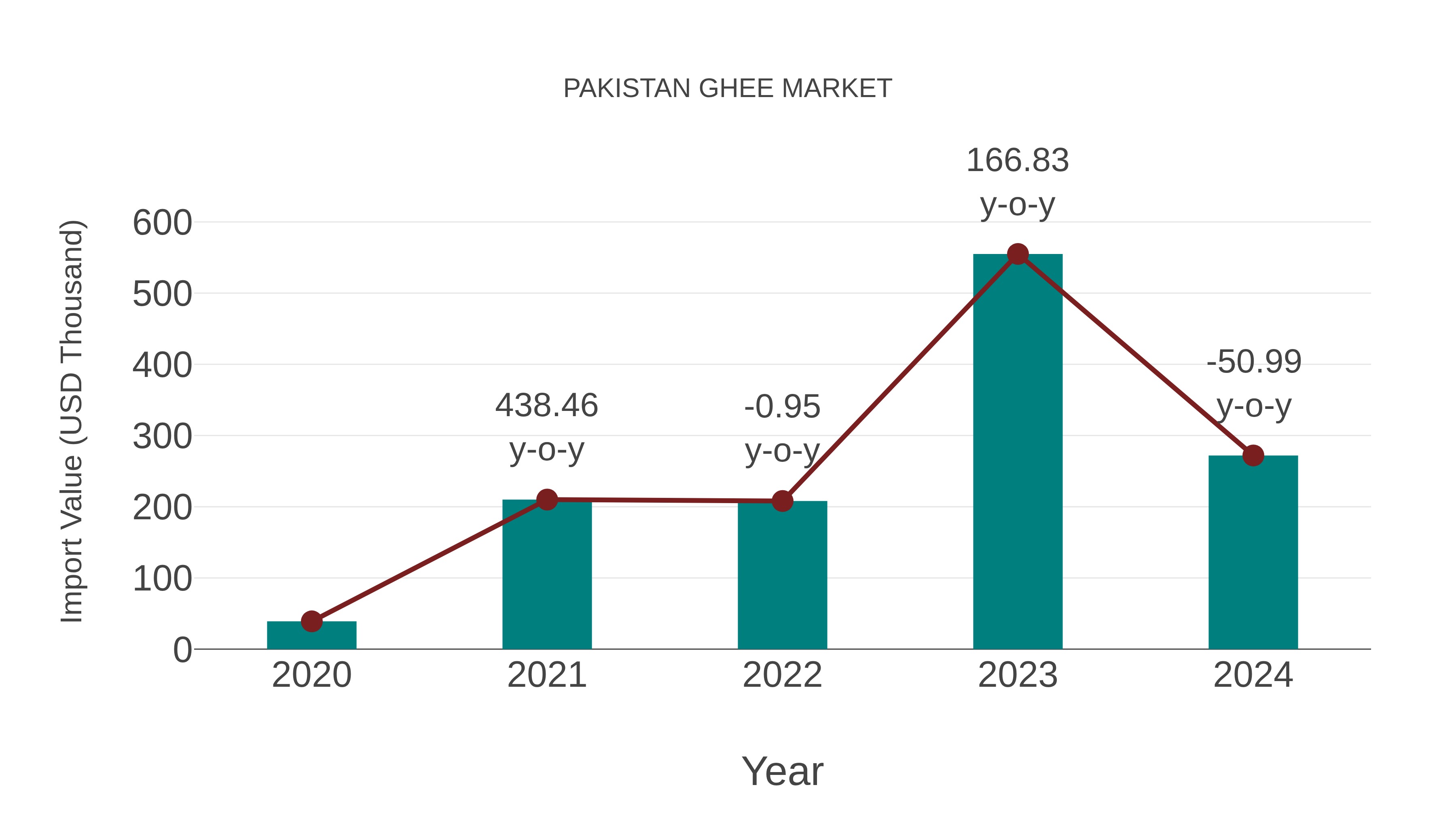
Pakistan Ghee Market Growth Rate
According to 6Wresearch internal database and industry insights, the Pakistan Ghee Market is projected to grow at a compound annual growth rate (CAGR) of 4.8% during the forecast period from 2026 to 2032.
Topics Covered in the Pakistan Ghee Market Report
The Pakistan Ghee Market report thoroughly covers the market by source, end-use, and distribution channel. It provides an unbiased and detailed analysis of ongoing market trends, opportunities, challenges, and market drivers, helping stakeholders align their strategies with current and future market dynamics.
Pakistan Ghee Market Highlights
| Report Name | Pakistan Ghee Market |
| Forecast Period | 2026–2032 |
| CAGR | 4.8% |
| Growing Sector | Fast-Moving Consumer Goods (FMCG) |
Pakistan Ghee Market Synopsis
Pakistan Ghee Market holds strong cultural and economic importance, compelled by its association with traditional cuisine and daily household consumption. Ghee is majorly used in cooking and performs as an important ingredient in various recipes, making it a common ingredient in kitchens. The ghee market in Pakistan has experienced considerable growth in recent years, it is majorly driven by rising consumer demand and evolving dietary preferences. In addition, the consumer preference, the increasing urbanization and lifestyle changes have shifted the demand for packaged and branded ghee products, ensuring better quality and convenience for consumers.
Evaluation of Growth Drivers in the Pakistan Ghee Market
Below mentioned are some prominent drivers and their impact on the Pakistan Ghee Market dynamics:
| Drivers | Primary Segment Affected | Why It Matters (Evidence) |
| Cultural Culinary Roots | All Segments | Ghee remains a staple ingredient in Pakistani cuisine, used extensively in festive cooking and daily meals. |
| Livestock Development Programs | Source (Buffalo/Cow) | Subsidies from the Punjab Livestock & Dairy Development Board (PLDDB) help farmers to enhance milk and fat yields. |
| Health Awareness (Desi Ghee) | Retail Segment | A shift back to traditional fats over processed oils is driving the demand for pure, unadulterated "Desi" ghee. |
| Food Service Expansion | Institutional | The rapid development of traditional restaurants and street style food vendors will greatly increase the volume of ghee consumed. |
| Packaging Innovation | Distribution Channels | Modern sachet and tin packaging make ghee more accessible to various income groups across the country. |
Pakistan Ghee Market is projected to grow at a CAGR of 4.8% from 2026 to 2032. The growth of this market is projected to be influenced by factors such as cultural importance, culinary use, and the nutritional properties of ghee. The food processing industry and consumer choice for traditional ingredients are also projected to contribute to the Pakistan ghee market growth. Ghee is the main ingredient in Pakistani cuisine which is experiencing balanced market growth. The demand for ghee is influenced by its traditional use in cooking, baking, and medicinal purposes. The expanding retail infrastructure and the rising popularity of e-commerce platforms are also contributing to the Pakistan Ghee Market Growth.
Evaluation of Restraints in the Pakistan Ghee Market
Below mentioned are some major restraints and their influence on the Pakistan Ghee Market dynamics:
| Restraints | Primary Segment Affected | What This Means (Evidence) |
| Price Volatility | All Segments | Fluctuations in raw milk prices and inflation can make branded ghee expensive for lower-income households. |
| Adulteration Issues | Retail Segment | The presence of counterfeit or low-quality "Vanaspati" sold as pure ghee hampers consumer trust in the market. |
| Logistical Challenges | Distribution Channels | Poor cold chain infrastructure in remote places might cause quality degradation during transportation. |
| Competition from Vegetable Oils | All Segments | The availability of cheaper alternative cooking oils and margarines deters price-sensitive consumers. |
| Stringent Food Regulations | Institutional | Strict quality checks by authorities like the Punjab Food Authority (PFA) can lead to production delays for non-compliant units. |
Pakistan Ghee Market Challenges
Pakistan Ghee Industry faces many challenges such as high initial investment prices for automated filtration plants, limited availability of high-yield cattle breeds, and regulatory difficulties that may delay factory certifications. Inconsistency in milk fat content due to seasonal variations can reduce the production efficiency of ghee refineries. Despite all these challenges, the government support for the dairy industry and with new advancements in hygiene testing is likely to continue to drive demand in this market. Increasing awareness about the difference between hydrogenated fats and pure ghee is pushing more consumers and businesses to invest in high-quality ghee solutions.
Emerging Trends in the Pakistan Ghee Market
One of the leading trends in Pakistan Ghee Market is the growing preference of organic and chemical free ghee among consumers. This change is driven by an increased awareness of food safety and environmental sustainability. Another leading trend is flavourful and infused ghee that serves the diverse audience’s preference. In addition to the trends of Pakistan ghee industry, the rise of e- commerce has also changed the consumer’s preference of purchasing ghee and the accessibility of wide range available brands.
Investment Opportunities in the Pakistan Ghee Sector
Pakistan ghee market offers notable investment potential due to its status as a main product in households and the food industry. Population growth is occurring rapidly in developing urban areas, which creates great potential to increase the demand for ghee products on a continuous basis throughout this period of rapid growth of the world population. Local manufacture continues to dominate the market, but there is plenty of room for innovation through improved quality, branding, and packaging. Moreover, as customers become more health-conscious, introducing healthier ghee options may attract a larger proportion. By capitalizing on these trends and influencing market demands, investors can position themselves for long-term success in this thriving business.
Top 5 Leading Players in the Pakistan Ghee Market
Below is the list of prominent companies leading in the Pakistan Ghee Market:
1. Dalda Foods Limited
| Company Name | Dalda Foods Limited |
| Headquarter | Karachi, Pakistan |
| Established Year | 2004 |
| Website | - |
Dalda Foods is a leading edible oil and ghee manufacturer in Pakistan offering a wide portfolio of consumer and institutional products with strong brand recognition.
2. Sufi Oil and Ghee
| Company Name | Sufi Oil and Ghee |
| Headquarter | Lahore, Pakistan |
| Established Year | 1998 |
| Website | - |
Sufi Oil and Ghee is known for premium quality ghee products and strong distribution networks across urban and rural markets.
3. Kausar Ghee Mills
| Company Name | Kausar Ghee Mills |
| Headquarter | Lahore, Pakistan |
| Established Year | 1984 |
| Website | - |
Kausar Ghee Mills offers a range of edible oil and ghee products catering to both retail consumers and institutional buyers.
4. Mezan Group
| Company Name | Mezan Group |
| Headquarter | Karachi, Pakistan |
| Established Year | 1951 |
| Website | - |
Mezan Group produces cooking oils and ghee products with a focus on quality assurance, innovation, and nationwide distribution.
5. Habib Oil Mills (Pvt) Ltd.
| Company Name | Habib Oil Mills (Pvt) Ltd. |
| Headquarter | Karachi, Pakistan |
| Established Year | 1954 |
| Website | - |
Habib Oil Mills manufactures a wide range of edible oils and ghee products, serving retail, food service, and industrial customers.
Government Regulations Introduced in the Pakistan Ghee Market
There are some regulations established for standard ghee production, such as permissible levels of trans fats and the use of specific additives, to protect public health. In addition, the government imposes taxes and duties on raw materials and finished products, which impact production costs and pricing strategies. However, acquiescence with these regulations shows up with challenges for smaller producers, who often struggle to meet perfect quality standards while maintaining competitive pricing. Policies promoting food reinforcement especially with essential vitamins like A and D, have also been compelled to address broader nutritional deficiencies. On the other hand, such regulations create a level playing field and encourage large-scale manufacturers to innovate and invest in quality assurance systems.
Future Insights of the Pakistan Ghee Market
Pakistan Ghee Market Share is expected to witness a strong growth in the upcoming years with the help of substantial investments in dairy infrastructure, government support for small-scale farmers, and new advancements in shelf-stable packaging. The decreasing cost of automated dairy processing, increasing usage of digital supply chain tracking, and a high demand for organic dairy products will continue to push this market in the forward direction. The large-scale dairy farm projects and new innovations in traditional churning methods will be main contributors in this market growth in the coming years.
Market Segmentation Analysis
The report offers a comprehensive study of the following market segments and their leading categories:
By Source - Buffalo to dominate the market
According to Ekta, Senior Research Analyst, 6Wresearch, buffalo-based ghee is projected to experience significant growth in the coming years on account of consumer choices for its better taste and creamier texture. Also, buffalo ghee has high nutritional value specifically in terms of fat content to provide individuals energy dense options.
By End-use - Retail to dominate the market
The retail segment is the dominant application for ghee in Pakistan as it is driven by massive household consumption across both urban and rural areas. Ghee is an essential part of the daily diet in the majority of Pakistani homes, ensuring that retail sales through local shops and supermarkets remain the largest part of the market.
By Distribution Channel - Convenience Stores to dominate the market
Convenience stores (locally known as Kiryana stores) dominate the distribution landscape because of their widespread presence in every neighborhood. While supermarkets are growing in major cities, the majority of the population still relies on nearby convenience stores for their daily dairy and fat requirements, making this the primary distribution segment.
Key Attractiveness of the Report
- 10 Years of Market Numbers
- Historical Data Starting from 2022 to 2025
- Base Year: 2025
- Forecast Data until 2032
- Key Performance Indicators Impacting the Market
- Major Upcoming Developments and Projects
Key Highlights of the Report:
- Pakistan Ghee Market Outlook
- Market Size of Pakistan Ghee Market, 2025
- Forecast of Pakistan Ghee Market, 2032
- Historical Data and Forecast of Pakistan Ghee Revenues & Volume for the Period 2022-2032F
- Pakistan Ghee Market Trend Evolution
- Pakistan Ghee Market Drivers and Challenges
- Pakistan Ghee Price Trends
- Pakistan Ghee Porter's Five Forces
- Pakistan Ghee Industry Life Cycle
- Historical Data and Forecast of Pakistan Ghee Market Revenues & Volume By Source for the Period 2022-2032F
- Historical Data and Forecast of Pakistan Ghee Market Revenues & Volume By Cow for the Period 2022-2032F
- Historical Data and Forecast of Pakistan Ghee Market Revenues & Volume By Buffalo for the Period 2022-2032F
- Historical Data and Forecast of Pakistan Ghee Market Revenues & Volume By Mixed for the Period 2022-2032F
- Historical Data and Forecast of Pakistan Ghee Market Revenues & Volume By End-use for the Period 2022-2032F
- Historical Data and Forecast of Pakistan Ghee Market Revenues & Volume By Retail for the Period 2022-2032F
- Historical Data and Forecast of Pakistan Ghee Market Revenues & Volume By Institutional for the Period 2022-2032F
- Historical Data and Forecast of Pakistan Ghee Market Revenues & Volume By Distribution Channel for the Period 2022-2032F
- Historical Data and Forecast of Pakistan Ghee Market Revenues & Volume By Supermarkets/Hypermarkets for the Period 2022-2032F
- Historical Data and Forecast of Pakistan Ghee Market Revenues & Volume By Convenience Stores for the Period 2022-2032F
- Historical Data and Forecast of Pakistan Ghee Market Revenues & Volume By Specialty Stores for the Period 2022-2032F
- Historical Data and Forecast of Pakistan Ghee Market Revenues & Volume By Online for the Period 2022-2032F
- Historical Data and Forecast of Pakistan Ghee Market Revenues & Volume By Others for the Period 2022-2032F
- Pakistan Ghee Import Export Trade Statistics
- Market Opportunity Assessment By Source
- Market Opportunity Assessment By End-use
- Market Opportunity Assessment By Distribution Channel
- Pakistan Ghee Top Companies Market Share
- Pakistan Ghee Competitive Benchmarking By Technical and Operational Parameters
- Pakistan Ghee Company Profiles
- Pakistan Ghee Key Strategic Recommendations
Market Segmentation
The market report covers a detailed analysis of the following market segments:
By Source
- Cow
- Buffalo
- Mixed
By End-Use
- Retail
- Institutional
By Distribution Channel
- Supermarkets/Hypermarkets
- Convenience Stores
- Specialty Stores
- Online
- Others






































