Pakistan Hams Market Size, Share & Growth Rate
The Pakistan Hams Market was estimated at USD 157 Million in 2025 and is projected to reach USD 206 Million by 2032, growing at a CAGR of 4.0% from 2026 to 2032. This growth trajectory is primarily fueled by the increasing consumer demand for convenient, ready-to-eat protein options, as well as a rising preference for high-quality and flavorful hams. As urban lifestyles evolve, consumers are more inclined towards innovative and varied products, further driving market expansion.
Pakistan Hams Market Year-wise Growth Rate and Key Drivers
This graph highlights how the Pakistan Hams Market has steadily grown over the years, supported by major growth factors.
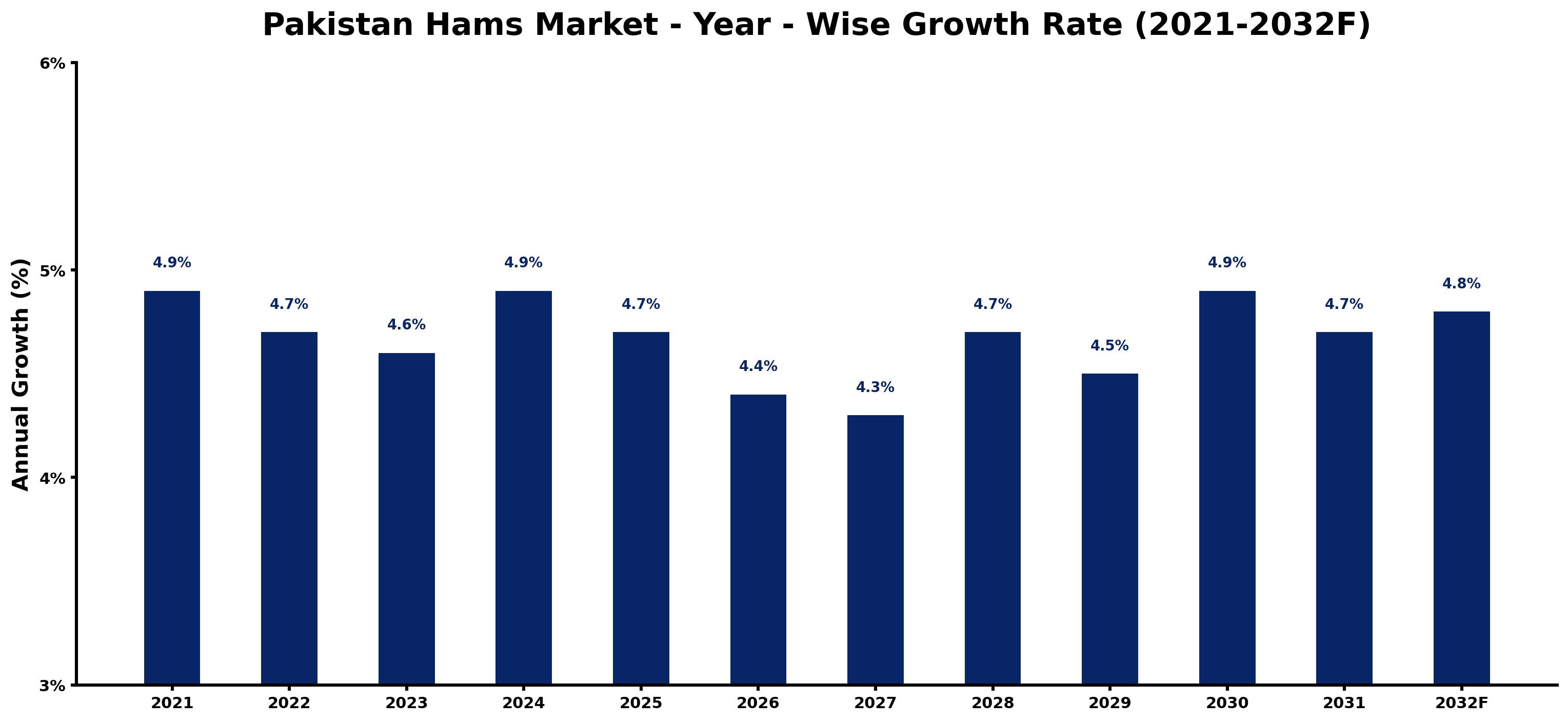
The table below presents the year‑wise growth rates along with the key drivers influencing the market
| Year | Growth Rate | Major Drivers |
| 2021 | 4.9% | Rapid growth in telecom and data center sectors |
| 2022 | 4.7% | Increasing adoption of advanced technologies |
| 2023 | 4.6% | Increasing industrial infrastructure investments |
| 2024 | 4.9% | Increasing adoption of advanced technologies |
| 2025 | 4.7% | Expansion of transportation and logistics networks |
| 2026 | 4.4% | Government infrastructure modernization initiatives |
| 2027 | 4.3% | Expansion of commercial construction activities |
| 2028 | 4.7% | Expansion of manufacturing activities |
| 2029 | 4.5% | Expansion of manufacturing activities |
| 2030 | 4.9% | Rapid growth in telecom and data center sectors |
| 2031 | 4.7% | Increasing adoption of advanced technologies |
| 2032 | 4.8% | Increasing industrial infrastructure investments |
Note - Market size estimations and growth projections presented in this report are based on 6Wresearch’s advanced forecasting approach, validated with industry datasets as of June 2026.
Pakistan Hams Market Synopsis
Recent momentum in the Pakistan Hams Market reflects a shift towards premium and high-quality offerings, as consumers become more discerning about the meat products they purchase. With the increasing availability of diverse ham varieties and flavors, the market is poised to transition from traditional options to a broader array of gourmet choices.
Looking ahead, the market is set to benefit from enhanced online shopping experiences and innovative marketing strategies that engage the evolving consumer base. This momentum positions the Pakistan Hams Market for substantial growth, as consumers seek both quality and convenience in their food choices.
Pakistan Hams Market Key Takeaways
- The market is on track for significant growth, with a projected CAGR of 4.0% from 2026 to 2032.
- Increasing urbanization and lifestyle changes are driving demand for convenient and ready-to-eat hams.
- Shifts towards premium product offerings are prompting innovations in flavors and production methods.
- Health-conscious consumers are actively seeking low-sodium and organic ham alternatives.
- The rise of e-commerce is making a wider range of ham products more accessible to consumers.
Evaluation of Restraints in Pakistan Hams Market
Despite the favorable growth prospects, the Pakistan Hams Market faces several restraints. Fluctuating raw material prices pose a risk to producers, impacting profitability and product pricing. Additionally, challenges related to inconsistent supply chain infrastructures hinder timely product availability, which can affect consumer satisfaction. Local producers also contend with competition from imported hams, complicating market dynamics. Furthermore, shifting consumer preferences towards healthier alternatives necessitate strategic adjustments by manufacturers, creating a challenging environment for maintaining traditional offerings.
Pakistan Hams Market Trends
Current trends indicate a pronounced consumer focus on high-quality, minimally processed hams. Consumers are increasingly inclined to choose hams from trusted suppliers that prioritize traditional production methods and cleaner ingredients. Additionally, innovative flavor profiles are gaining traction, enticing consumers to explore gourmet options. Health-conscious choices are becoming more prominent, leading to increased interest in organic and low-sodium hams, reflecting broader dietary trends in the market.
Pakistan Hams Market Opportunities
The Pakistan Hams Market is ripe for investment, driven by a growing population and rising disposable incomes. Companies can capitalize on the demand for high-quality processed meat products by introducing innovative and diverse offerings that cater to varying consumer preferences. Collaborations with local suppliers can enhance market entry strategies, while leveraging e-commerce platforms can significantly expand distribution reach, providing opportunities for growth and profitability.
Government Initiatives in the Pakistan Hams Market
Government policies play a pivotal role in the Pakistan Hams Market, as the Pakistan Standards and Quality Control Authority (PSQCA) establishes essential quality and safety standards for ham production. The imposition of import tariffs aims to shield local producers and promote domestic manufacturing. Furthermore, the Pakistan Food Authority (PFA) actively oversees food safety regulations, ensuring compliance with hygiene standards that safeguard consumer interests.
Future Insights of the Pakistan Hams Market
The future outlook for the Pakistan Hams Market is optimistic, with steady growth anticipated from 2026 to 2032. Increasing consumer demand for convenient meat products, combined with rising urbanization and disposable income, will likely stimulate the market. Moreover, as lifestyle preferences shift towards Western eating habits, hams are expected to become a staple choice for meals and snacks. Market players who prioritize quality, safety, and innovative marketing strategies will be well-positioned to capture a significant share of this evolving market.
Pakistan Hams Market Latest Developments (May 2025 - June 2026)
Recent developments in the Pakistan Hams Market indicate a notable uptick in product innovation, with manufacturers introducing a variety of new flavors to meet changing consumer preferences. Moreover, there has been a growing emphasis on sustainability and ethical sourcing, as companies adapt to rising consumer demands for transparency in food production. The shift towards e-commerce has also been accelerated, enabling retailers to reach a broader audience with greater ease.
Pakistan Hams Market - Key Attractiveness of the Report
- 10 Years of Market Numbers
- Historical Data Starting from 2022 to 2025
- Base Year: 2025
- Forecast Data until 2032
- Key Performance Indicators Impacting the Market
- Major Upcoming Developments and Projects
Key Highlights of the Report:
- Pakistan Hams Market Outlook
- Market Size of Pakistan Hams Market, 2025
- Forecast of Pakistan Hams Market, 2032
- Historical Data and Forecast of Pakistan Hams Revenues & Volume for the Period 2022-2032F
- Pakistan Hams Market Trend Evolution
- Pakistan Hams Market Drivers and Challenges
- Pakistan Hams Price Trends
- Pakistan Hams Porter's Five Forces
- Pakistan Hams Industry Life Cycle
- Historical Data and Forecast of Pakistan Hams Market Revenues & Volume By Type for the Period 2022-2032F
- Historical Data and Forecast of Pakistan Hams Market Revenues & Volume By Air Dried Cured Hams for the Period 2022-2032F
- Historical Data and Forecast of Pakistan Hams Market Revenues & Volume By Smoked Hams for the Period 2022-2032F
- Historical Data and Forecast of Pakistan Hams Market Revenues & Volume By Applications for the Period 2022-2032F
- Historical Data and Forecast of Pakistan Hams Market Revenues & Volume By Supermarkets and Hypermarkets for the Period 2022-2032F
- Historical Data and Forecast of Pakistan Hams Market Revenues & Volume By Independent Retailers for the Period 2022-2032F
- Historical Data and Forecast of Pakistan Hams Market Revenues & Volume By Convenience Stores for the Period 2022-2032F
- Historical Data and Forecast of Pakistan Hams Market Revenues & Volume By Specialist Retailers for the Period 2022-2032F
- Historical Data and Forecast of Pakistan Hams Market Revenues & Volume By Online Retailers for the Period 2022-2032F
- Pakistan Hams Import Export Trade Statistics
- Market Opportunity Assessment By Type
- Market Opportunity Assessment By Applications
- Pakistan Hams Top Companies Market Share
- Pakistan Hams Competitive Benchmarking By Technical and Operational Parameters
- Pakistan Hams Company Profiles
- Pakistan Hams Key Strategic Recommendations






































