Pakistan Heating Pad Market Size, Share & Growth Rate
The Pakistan Heating Pad Market was estimated at USD 361 Million in 2025 and is projected to reach USD 494 Million by 2032, growing at a CAGR of 4.6% from 2026 to 2032. The upward trajectory of this market is primarily fueled by the rising prevalence of musculoskeletal disorders, alongside a growing shift towards non-pharmaceutical methods for pain management. As more consumers recognize the therapeutic benefits of heat therapy, the demand for diverse and innovative heating pad solutions continues to escalate.
Pakistan Heating Pad Market Year-wise Growth Rate and Key Drivers
This graph highlights how the Pakistan Heating Pad Market has steadily grown over the years, supported by major growth factors.
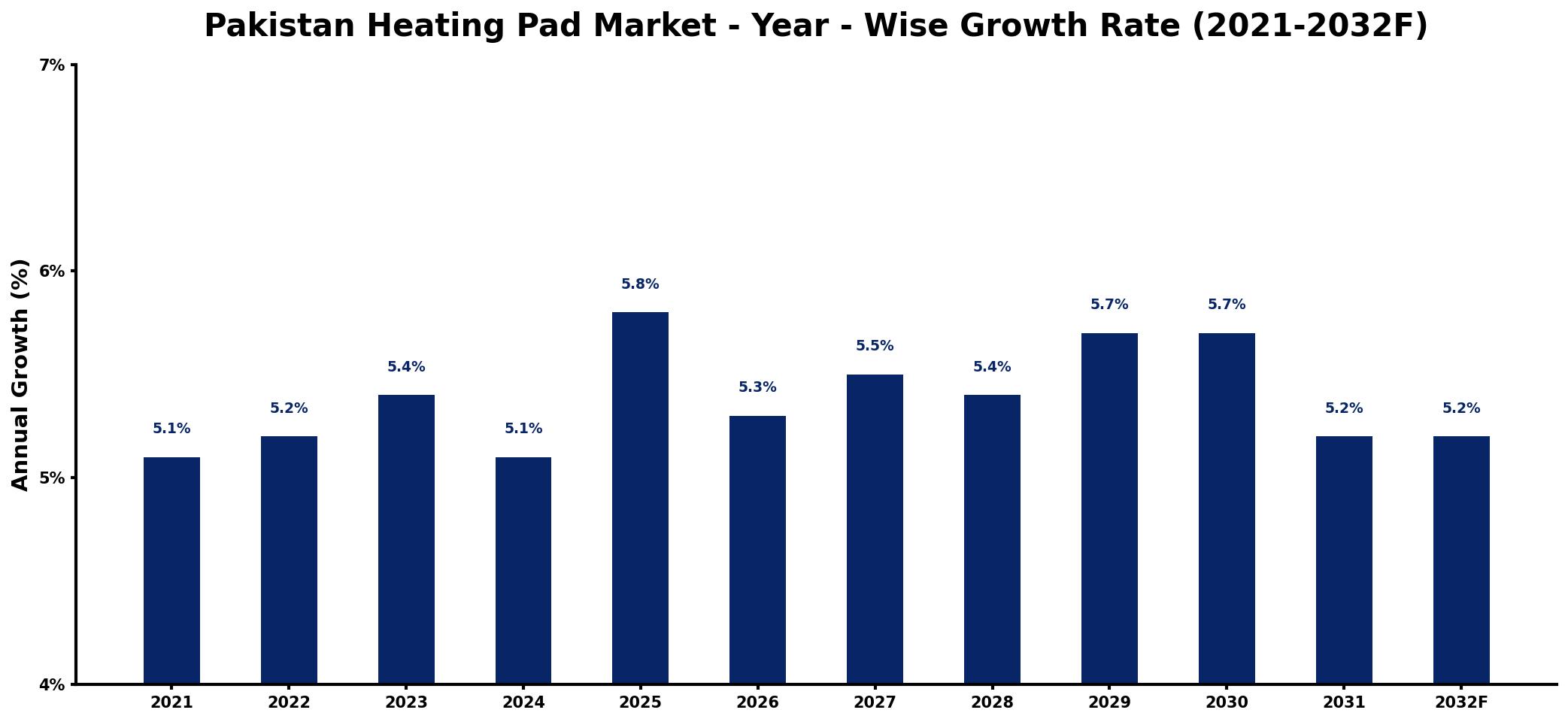
The table below presents the year‑wise growth rates along with the key drivers influencing the market
| Year | Growth Rate | Major Drivers |
| 2021 | 5.1% | Rising consumer health awareness |
| 2022 | 5.2% | Increased disposable income levels |
| 2023 | 5.4% | Growing demand for wellness solutions |
| 2024 | 5.1% | Expansion of online retail platforms |
| 2025 | 5.8% | Increased adoption of home therapies |
| 2026 | 5.3% | Surge in elderly population demand |
| 2027 | 5.5% | Growing interest in natural remedies |
| 2028 | 5.4% | Increase in healthcare spending |
| 2029 | 5.7% | increased capital investment inflows |
| 2030 | 5.7% | Rising popularity of self-care products |
| 2031 | 5.2% | Growth in urban lifestyle changes |
| 2032 | 5.2% | rising export shipment volumes |
Note: Market size estimations and growth projections presented in this report are based on 6Wresearch's proprietary forecasting methodology, utilizing the latest available industry data, government publications, and primary research inputs.
Pakistan Heating Pad Market Synopsis
The demand for heating pads in Pakistan is increasingly driven by health-conscious consumers searching for effective pain relief alternatives. With a heightened awareness surrounding muscle pain and arthritis, many are turning to heating pads as a convenient and drug-free solution.
On the supply side, manufacturers are responding to market needs by introducing a variety of heating pads including electric, microwavable, and reusable options. This variety not only caters to individual preferences but also signifies an evolving market that is adapting to contemporary consumer demands.
Pakistan Heating Pad Market Key Takeaways
- The market is experiencing robust growth driven by increased awareness of heat therapy benefits.
- Product innovation is vital, with ergonomic designs and advanced heating technologies emerging as key differentiators.
- Electric heating pads are gaining preference over traditional methods, highlighting a shift in consumer habits.
- The rise of e-commerce platforms is enhancing accessibility, particularly in underserved regions.
- Investment opportunities are plentiful, particularly in the development of eco-friendly and high-quality products.
Evaluation of Restraints in Pakistan Heating Pad Market
Despite the positive market growth, several restraints hinder further expansion. A significant barrier is the limited awareness among consumers about the specific benefits and proper usage of heating pads. This lack of understanding can lead to underutilization of available products. Furthermore, the market suffers from inconsistencies in product quality due to inadequate regulatory enforcement, which sometimes results in substandard products being available. Finally, price sensitivity remains a critical issue, limiting accessibility for lower-income consumers and allowing competition from alternative pain relief solutions.
Pakistan Heating Pad Market Trends
Current trends show a rising consumer preference for portable and versatile heating pads equipped with various settings and features. Automatic shut-off functions and ergonomic designs are increasingly sought after as consumers prioritize safety and comfort. Technological advancements have also led to the emergence of infrared heating pads, which offer quicker and deeper heat penetration, enhancing the efficacy of thermal therapy.
Furthermore, as sustainability becomes a priority, manufacturers are focusing on incorporating eco-friendly materials and ensuring compliance with relevant quality standards. This evolution not only meets consumer demand for safer and more sustainable products but also aligns with global trends in product development.
Pakistan Heating Pad Market Opportunities
The future holds promising investment opportunities, particularly as the population ages and the prevalence of conditions such as arthritis increases. Companies could gain a competitive advantage by developing innovative, high-quality heating pads that cater to varying consumer needs. Collaborating with healthcare professionals to validate product efficacy can boost credibility and acceptance among consumers. Moreover, leveraging the expanding e-commerce landscape to reach a broader audience can enhance market penetration and growth potential.
Government Initiatives in the Pakistan Heating Pad Market
The regulatory environment in Pakistan is structured to ensure the safety and efficacy of heating pads classified as medical devices. The Drug Regulatory Authority of Pakistan (DRAP) mandates strict guidelines for manufacturing, labeling, and marketing, protecting consumer health. This oversight fosters a market focused on quality and safety, which is crucial for enhancing consumer confidence and promoting a healthier marketplace.
Future Insights of the Pakistan Heating Pad Market
Looking ahead to 2026-2032, the Pakistan heating pad market is set to experience sustained growth, bolstered by ongoing awareness of heat therapy benefits. With an increasing elderly population and a rising number of individuals with musculoskeletal issues, demand is anticipated to rise consistently. Continuous technological advancements are likely to result in more efficient heating products, while the growth of online retail channels will enhance accessibility for consumers across the country. Overall, the market's trajectory appears optimistic, supported by a favorable economic and health-focused environment.
Pakistan Heating Pad Market Latest Developments (2025 - 2026)
Recent developments in the Pakistan heating pad market have focused on product innovation and safety. Manufacturers are increasingly investing in research and development to introduce cutting-edge designs that enhance user experience. The surge of online shopping has led to more brands establishing a robust digital presence, catering to a growing demographic that prefers convenient purchasing options. Overall, the market is evolving in response to both consumer demand and technological advancements.
Pakistan Heating Pad Market - Key Attractiveness of the Report
- 10 Years of Market Numbers
- Historical Data Starting from 2022 to 2025
- Base Year: 2025
- Forecast Data until 2032
- Key Performance Indicators Impacting the Market
- Major Upcoming Developments and Projects
Key Highlights of the Report:
- Pakistan Heating Pad Market Outlook
- Market Size of Pakistan Heating Pad Market, 2025
- Forecast of Pakistan Heating Pad Market, 2032
- Historical Data and Forecast of Pakistan Heating Pad Revenues & Volume for the Period 2022-2032F
- Pakistan Heating Pad Market Trend Evolution
- Pakistan Heating Pad Market Drivers and Challenges
- Pakistan Heating Pad Price Trends
- Pakistan Heating Pad Porter's Five Forces
- Pakistan Heating Pad Industry Life Cycle
- Historical Data and Forecast of Pakistan Heating Pad Market Revenues & Volume By Product for the Period 2022-2032F
- Historical Data and Forecast of Pakistan Heating Pad Market Revenues & Volume By Microwavable Heating Pad for the Period 2022-2032F
- Historical Data and Forecast of Pakistan Heating Pad Market Revenues & Volume By Water Heating Pad for the Period 2022-2032F
- Historical Data and Forecast of Pakistan Heating Pad Market Revenues & Volume By Electric Heating Pad for the Period 2022-2032F
- Historical Data and Forecast of Pakistan Heating Pad Market Revenues & Volume By Chemical Heating Pad for the Period 2022-2032F
- Historical Data and Forecast of Pakistan Heating Pad Market Revenues & Volume By Infrared Heating Pad for the Period 2022-2032F
- Historical Data and Forecast of Pakistan Heating Pad Market Revenues & Volume By Others for the Period 2022-2032F
- Historical Data and Forecast of Pakistan Heating Pad Market Revenues & Volume By Application for the Period 2022-2032F
- Historical Data and Forecast of Pakistan Heating Pad Market Revenues & Volume By Home for the Period 2022-2032F
- Historical Data and Forecast of Pakistan Heating Pad Market Revenues & Volume By Medical for the Period 2022-2032F
- Historical Data and Forecast of Pakistan Heating Pad Market Revenues & Volume By Commercial for the Period 2022-2032F
- Historical Data and Forecast of Pakistan Heating Pad Market Revenues & Volume By Others for the Period 2022-2032F
- Historical Data and Forecast of Pakistan Heating Pad Market Revenues & Volume By Selling Channel for the Period 2022-2032F
- Historical Data and Forecast of Pakistan Heating Pad Market Revenues & Volume By Direct for the Period 2022-2032F
- Historical Data and Forecast of Pakistan Heating Pad Market Revenues & Volume By Indirect for the Period 2022-2032F
- Pakistan Heating Pad Import Export Trade Statistics
- Market Opportunity Assessment By Product
- Market Opportunity Assessment By Application
- Market Opportunity Assessment By Selling Channel
- Pakistan Heating Pad Top Companies Market Share
- Pakistan Heating Pad Competitive Benchmarking By Technical and Operational Parameters
- Pakistan Heating Pad Company Profiles
- Pakistan Heating Pad Key Strategic Recommendations






































