Pakistan Helicopter Market Size, Share & Growth Rate
The Pakistan Helicopter Market was estimated at USD 239 Million in 2025 and is projected to reach USD 324 Million by 2032, growing at a CAGR of 4.4% from 2026 to 2032. This growth is primarily fueled by an increasing demand for helicopter services across various sectors, including tourism, oil and gas exploration, and emergency medical services. Moreover, government initiatives to enhance infrastructure and connectivity in remote regions are significantly driving market expansion.
Pakistan Helicopter Market Year-wise Growth Rate and Key Drivers
This graph highlights how the Pakistan Helicopter Market has steadily grown over the years, supported by major growth factors.
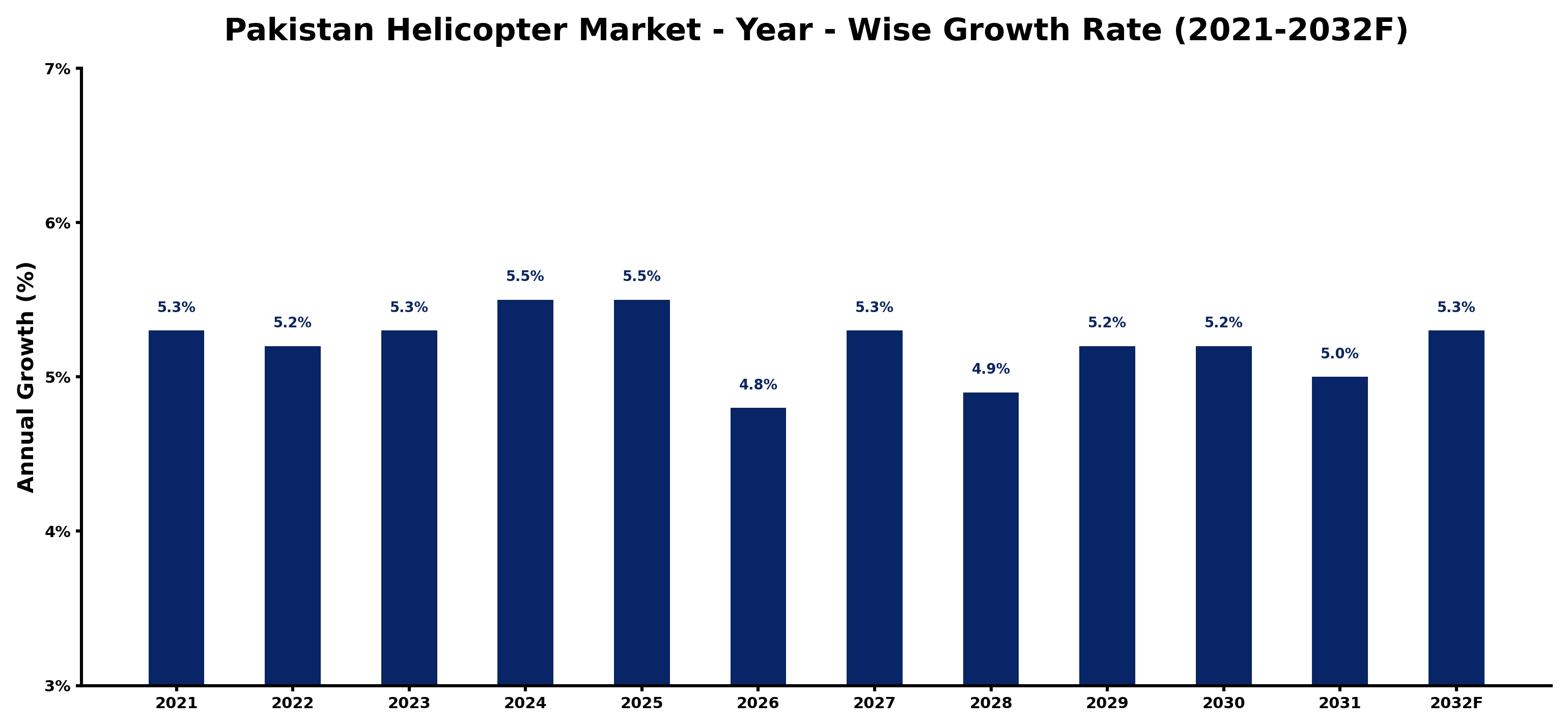
The table below presents the year‑wise growth rates along with the key drivers influencing the market
| Year | Growth Rate | Major Drivers |
| 2021 | 5.3% | Helicopter maintenance contracts boosted precision parts manufacturing demand |
| 2022 | 5.2% | Local assembly plants boosted helicopter component manufacturing capabilities |
| 2023 | 5.3% | Helicopter assembly line upgrades boosted local aerospace component sourcing |
| 2024 | 5.5% | Helicopter assembly upgrades boost local supply chain resilience |
| 2025 | 5.5% | Investment in advanced composites boosted local helicopter manufacturing capabilities |
| 2026 | 4.8% | Increased oil exploration projects boost helicopter fleet demand expansion |
| 2027 | 5.3% | Local helicopter assembly investments boosted supply chain resilience and growth |
| 2028 | 4.9% | Helicopter maintenance contracts boost local parts manufacturing capabilities |
| 2029 | 5.2% | Manufacturing investments in aerospace components boost local helicopter assembly capabilities |
| 2030 | 5.2% | Domestic helicopter fleet upgrades boosted component manufacturing demand |
| 2031 | 5.0% | Advanced avionics integration boosted local helicopter manufacturing capabilities |
| 2032 | 5.3% | New manufacturing partnerships enhance local helicopter assembly capabilities |
Note - Market size estimations and growth projections presented in this report are based on 6Wresearch’s advanced forecasting approach, validated with industry datasets as of June 2026.
Pakistan Helicopter Market Synopsis
The demand for helicopters in Pakistan is steadily increasing, particularly for medical evacuations and disaster relief operations. As the need for rapid response in emergencies grows, so does the importance of helicopters in supporting public health and safety initiatives.
Furthermore, military operations and modernization efforts are propelling the market forward. With a focus on enhancing operational capabilities, the military is keen on expanding its fleet, which in turn boosts demand for both light and medium-lift helicopters.
Pakistan Helicopter Market Key Takeaways
- The market is experiencing a dual surge in demand from both military and civilian sectors.
- Light and medium-lift helicopters are in particularly high demand due to their versatility.
- There is an increasing trend towards utilizing helicopters for disaster management and healthcare services.
- Investment opportunities abound in sectors like tourism, agriculture, and emergency services.
- Government policies are fostering a conducive environment for market growth through incentives and regulatory frameworks.
Evaluation of Restraints in Pakistan Helicopter Market
Despite the promising outlook, the Pakistan helicopter market grapples with significant constraints. Regulatory hurdles present a complex landscape for operators, often leading to delays in obtaining necessary approvals. Additionally, inadequate infrastructure, particularly in remote regions, limits operational effectiveness. Security concerns, stemming from political instability and terrorism, further complicate the market dynamics. Lastly, a shortage of skilled pilots and maintenance personnel continues to hinder operational efficiency, posing challenges that need addressing for sustained growth.
Pakistan Helicopter Market Trends
Current trends in the Pakistan helicopter market highlight a notable shift towards utilizing helicopters for diverse applications. Not only is there an increased focus on medical evacuations and surveillance, but there is also growing interest in deploying unmanned aerial vehicles (UAVs) for intelligence and reconnaissance missions. This diversification of applications reflects a broader trend toward leveraging aviation technology to meet evolving operational requirements across multiple sectors.
Pakistan Helicopter Market Opportunities
Investment opportunities in the Pakistan helicopter market are substantial, especially in tourism, healthcare, and agriculture. Helicopters are increasingly recognized as a viable solution for providing access to remote tourist destinations, while air ambulance services are becoming critical for efficient medical transport. In agriculture, helicopters are proving effective for crop spraying, addressing both yield and efficiency challenges. These sectors collectively present a promising landscape for investors looking to capitalize on the growing demand for helicopter services.
Government Initiatives in the Pakistan Helicopter Market
Government policies are playing a crucial role in shaping the Pakistan helicopter market. The Civil Aviation Authority oversees regulatory compliance, ensuring safety standards are maintained. To stimulate growth, the government is providing tax incentives and subsidies for helicopter operations, particularly in sectors that align with national priorities like tourism and emergency services. Additionally, initiatives to improve infrastructure and promote private investment are integral to fostering a competitive market landscape.
Future Insights of the Pakistan Helicopter Market
Looking ahead to 2026-2032, the Pakistan helicopter market is positioned for steady growth. Enhanced demand for helicopters across diverse sectors such as healthcare, tourism, and law enforcement is expected to drive the market forward. Ongoing government efforts to modernize the fleet and boost air connectivity, especially in rural areas, will further support market expansion. However, addressing existing challenges will be crucial to unlocking the full potential of the market in the coming years.
Pakistan Helicopter Market Latest Developments (May 2025 - June 2026)
In recent months, the Pakistan helicopter market has witnessed a shift towards modernization with several key initiatives aimed at improving operational capabilities. There has been a marked increase in partnerships between public and private sectors to enhance service delivery, particularly in emergency response scenarios. Additionally, ongoing discussions regarding regulatory reforms have emerged, with the intent to streamline processes and encourage foreign investment in the aviation sector.
Pakistan Helicopter Market - Key Attractiveness of the Report
- 10 Years of Market Numbers
- Historical Data Starting from 2022 to 2025
- Base Year: 2025
- Forecast Data until 2032
- Key Performance Indicators Impacting the Market
- Major Upcoming Developments and Projects
Key Highlights of the Report:
- Pakistan Helicopter Market Outlook
- Market Size of Pakistan Helicopter Market, 2025
- Forecast of Pakistan Helicopter Market, 2032
- Historical Data and Forecast of Pakistan Helicopter Revenues & Volume for the Period 2022-2032F
- Pakistan Helicopter Market Trend Evolution
- Pakistan Helicopter Market Drivers and Challenges
- Pakistan Helicopter Price Trends
- Pakistan Helicopter Porter's Five Forces
- Pakistan Helicopter Industry Life Cycle
- Historical Data and Forecast of Pakistan Helicopter Market Revenues & Volume By End-users for the Period 2022-2032F
- Historical Data and Forecast of Pakistan Helicopter Market Revenues & Volume By Commercial for the Period 2022-2032F
- Historical Data and Forecast of Pakistan Helicopter Market Revenues & Volume By Military for the Period 2022-2032F
- Historical Data and Forecast of Pakistan Helicopter Market Revenues & Volume By Component for the Period 2022-2032F
- Historical Data and Forecast of Pakistan Helicopter Market Revenues & Volume By Aerostructures/Airframes for the Period 2022-2032F
- Historical Data and Forecast of Pakistan Helicopter Market Revenues & Volume By Rotary System for the Period 2022-2032F
- Historical Data and Forecast of Pakistan Helicopter Market Revenues & Volume By Engine for the Period 2022-2032F
- Historical Data and Forecast of Pakistan Helicopter Market Revenues & Volume By Undercarriage for the Period 2022-2032F
- Historical Data and Forecast of Pakistan Helicopter Market Revenues & Volume By Avionics for the Period 2022-2032F
- Historical Data and Forecast of Pakistan Helicopter Market Revenues & Volume By Cabin Interiors for the Period 2022-2032F
- Historical Data and Forecast of Pakistan Helicopter Market Revenues & Volume By Environmental Control System for the Period 2022-2032F
- Historical Data and Forecast of Pakistan Helicopter Market Revenues & Volume By Sales Channels for the Period 2022-2032F
- Historical Data and Forecast of Pakistan Helicopter Market Revenues & Volume By OEM for the Period 2022-2032F
- Historical Data and Forecast of Pakistan Helicopter Market Revenues & Volume By Maintenance for the Period 2022-2032F
- Historical Data and Forecast of Pakistan Helicopter Market Revenues & Volume By Repair for the Period 2022-2032F
- Historical Data and Forecast of Pakistan Helicopter Market Revenues & Volume By Overhaul for the Period 2022-2032F
- Pakistan Helicopter Import Export Trade Statistics
- Market Opportunity Assessment By End-users
- Market Opportunity Assessment By Component
- Market Opportunity Assessment By Sales Channels
- Pakistan Helicopter Top Companies Market Share
- Pakistan Helicopter Competitive Benchmarking By Technical and Operational Parameters
- Pakistan Helicopter Company Profiles
- Pakistan Helicopter Key Strategic Recommendations






































