Pakistan Higher Education Market Size & Growth Rate (2026-2032)
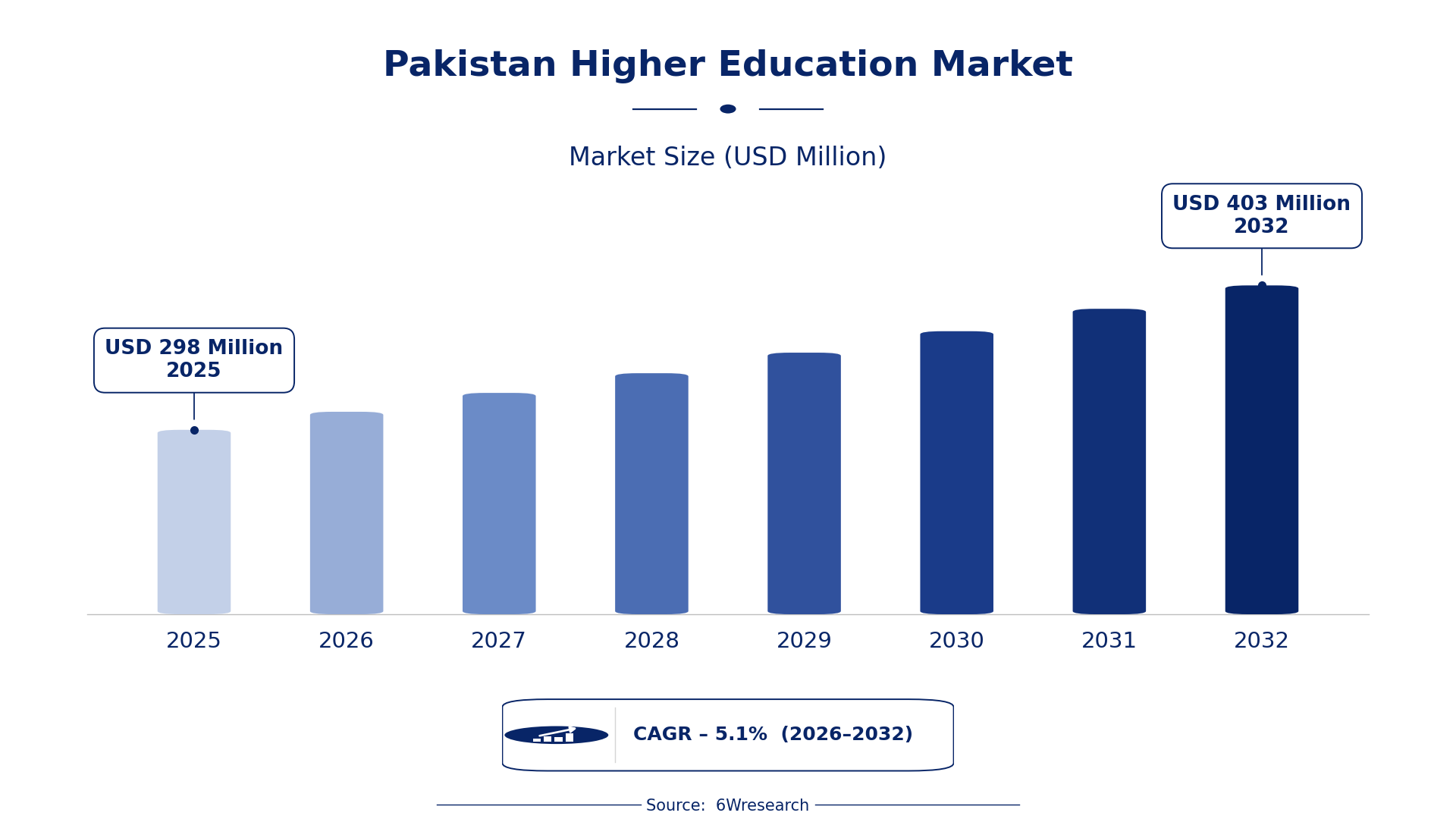
The Pakistan Higher Education Market was estimated at USD 298 Million in 2025 and is projected to reach USD 403 Million by 2032, growing at a CAGR of 5.1% from 2026 to 2032.
Pakistan Higher Education Market Synopsis
The higher education sector in Pakistan is experiencing a notable surge, driven by a growing demand for quality education and an increasing number of institutions. As the job market shifts toward requiring skilled professionals, the urgency for advanced educational offerings has never been clearer.
Government policies aimed at enhancing educational standards and access are contributing to this growth. Factors such as rising literacy rates and technological advancements are also playing a crucial role, creating an environment ripe for innovation and research.
Pakistan Higher Education Market Year-wise Growth Rate and Key Drivers
This graph illustrates the annual growth rates of the Pakistan Higher Education Market from 2021 to 2032, highlighting a steady upward trajectory and projected expansion over the forecast period.
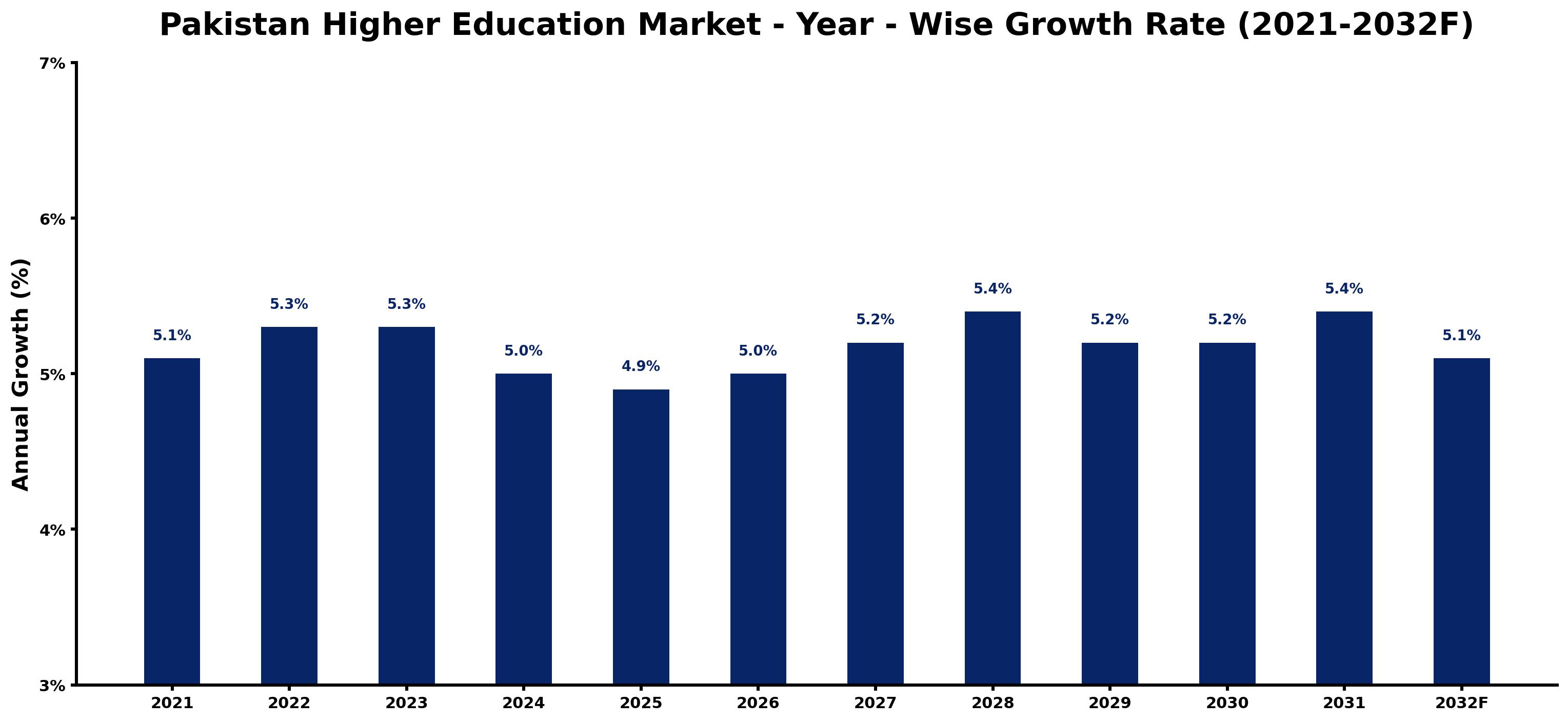
The table below presents the year‑wise growth rates along with the key drivers influencing the market
| Year | Growth Rate | Major Drivers |
| 2021 | 5.1% | Increased government scholarships for underprivileged students |
| 2022 | 5.3% | Launch of new universities under Higher Education Commission |
| 2023 | 5.3% | Growth in online degree programs due to pandemic |
| 2024 | 5.0% | Investment in research funding by international partnerships |
| 2025 | 4.9% | Emphasis on STEM education by government initiatives |
| 2026 | 5.0% | Rising private sector collaboration with educational institutions |
| 2027 | 5.2% | Introduction of university rankings promoting quality improvements |
| 2028 | 5.4% | Increased student interest in foreign university collaborations |
| 2029 | 5.2% | Boost in local entrepreneurship education programs |
| 2030 | 5.2% | Government incentives for technical and vocational education |
| 2031 | 5.4% | Expanded campus facilities and infrastructure investments |
| 2032 | 5.1% | Enhanced focus on digital education resources in curriculum |
Note: Market size estimations and growth projections presented in this report are based on 6Wresearch's proprietary forecasting methodology, utilizing the latest available industry data, government publications, and primary research inputs.
Pakistan Higher Education Market Key Takeaways
Below are some of the specific key takeaways from the market, including:
- The increasing enrollment in higher education institutions reflects a strong demand for skilled labor.
- Technological advancements are reshaping curricula and teaching methods across universities.
- Government initiatives are focused on improving the quality and accessibility of higher education.
- Collaboration with international educational institutions is enhancing competitiveness.
- Challenges remain, particularly in funding, quality assurance, and infrastructure development.
Evaluation of Restraints in Pakistan Higher Education Market
Despite its growth, the higher education market in Pakistan faces several constraints. Funding remains a significant challenge, with many institutions struggling to secure adequate resources for development and innovation. Quality assurance is another pressing issue, as outdated curricula and insufficient research funding hinder progress. The brain drain of talented academics further exacerbates these problems, limiting the potential for local institutions to thrive. To truly enhance the education landscape, reforms addressing accessibility, relevance, and institutional quality are essential.
Pakistan Higher Education Market Trends
Emerging trends indicate a strong shift towards technology integration in education. Blended learning models are gaining traction, allowing for more flexible educational experiences. Additionally, the emphasis on research and innovation is creating opportunities for universities to partner with industries, aligning educational outcomes with market needs. As globalization continues to influence education, Pakistani institutions are increasingly looking to establish international collaborations.
Pakistan Higher Education Market Opportunities
The market offers several growth opportunities, particularly in vocational education and technical training. With a rising demand for skilled labor, institutions focusing on these areas can attract both domestic and international students. on top of that, investment in digital infrastructure will enhance access to education, enabling institutions to reach a broader audience. Public-private partnerships can also play a vital role in expanding educational offerings and improving institutional quality.
Government Initiatives in the Pakistan Higher Education Market
The government of Pakistan is actively reshaping the higher education market through targeted initiatives aimed at improving quality and accessibility. Recent policies highlight a commitment to enhancing educational standards and promoting research. This involvement is crucial for positioning Pakistani institutions on the global stage, as a well-structured educational framework can significantly impact national development.
- A national scholarship program launched in early 2025 aims to support underprivileged students pursuing higher education.
- Current initiatives include a comprehensive review of university curricula to align educational outcomes with industry demands.
- A planned public-private initiative is set to enhance digital infrastructure across universities by 2026.
- Ongoing investment in research grants is expected to boost innovation and academic collaboration.
- The establishment of regulatory bodies to ensure quality assurance in education is underway.
Future Insights of the Pakistan Higher Education Market
Looking ahead to 2026-2032, the Pakistan higher education market is positioned for continued growth. As government initiatives take root and institutional quality improves, we can expect higher enrollment rates and increased global competitiveness. The focus on research and innovation will also play a critical role in shaping the market, fostering an environment where local talent can thrive and contribute meaningfully to the economy.
Pakistan Higher Education Market Latest Developments
Recent developments in the Pakistan higher education sector reflect a dynamic approach to addressing educational needs. Over the past year, institutions have begun implementing significant changes to enhance learning experiences and expand access. This progress is essential for adapting to evolving market demands and improving the overall quality of education.
- A leading university announced the launch of a new digital learning platform in Q1 2025, aimed at enhancing student engagement.
- A major technology vendor partnered with several universities in early 2025 to upgrade their IT infrastructure.
- A university initiated a research collaboration with international institutions in mid-2025, focusing on sustainable development.
- A national conference on higher education reform is planned for late 2026 to discuss challenges and solutions.
- A pilot program for vocational training in collaboration with local industries is currently underway and expected to complete by the end of 2025.
Pakistan Higher Education Market - Key Attractiveness of the Report
- 10 Years of Market Numbers
- Historical Data Starting from 2022 to 2025
- Base Year: 2025
- Forecast Data until 2032
- Key Performance Indicators Impacting the Market
- Major Upcoming Developments and Projects
Key Highlights of the Report:
- Pakistan Higher Education Market Outlook
- Market Size of Pakistan Higher Education Market, 2025
- Forecast of Pakistan Higher Education Market, 2032
- Historical Data and Forecast of Pakistan Higher Education Revenues & Volume for the Period 2022-2032F
- Pakistan Higher Education Market Trend Evolution
- Pakistan Higher Education Market Drivers and Challenges
- Pakistan Higher Education Price Trends
- Pakistan Higher Education Porter's Five Forces
- Pakistan Higher Education Industry Life Cycle
- Historical Data and Forecast of Pakistan Higher Education Market Revenues & Volume By Component for the Period 2022-2032F
- Historical Data and Forecast of Pakistan Higher Education Market Revenues & Volume By Solutions for the Period 2022-2032F
- Historical Data and Forecast of Pakistan Higher Education Market Revenues & Volume By Services for the Period 2022-2032F
- Historical Data and Forecast of Pakistan Higher Education Market Revenues & Volume By Deployment Type for the Period 2022-2032F
- Historical Data and Forecast of Pakistan Higher Education Market Revenues & Volume By On-premises for the Period 2022-2032F
- Historical Data and Forecast of Pakistan Higher Education Market Revenues & Volume By Cloud for the Period 2022-2032F
- Historical Data and Forecast of Pakistan Higher Education Market Revenues & Volume By Vertical for the Period 2022-2032F
- Historical Data and Forecast of Pakistan Higher Education Market Revenues & Volume By State Universities for the Period 2022-2032F
- Historical Data and Forecast of Pakistan Higher Education Market Revenues & Volume By Community Colleges for the Period 2022-2032F
- Historical Data and Forecast of Pakistan Higher Education Market Revenues & Volume By Private Colleges for the Period 2022-2032F
- Pakistan Higher Education Import Export Trade Statistics
- Market Opportunity Assessment By Component
- Market Opportunity Assessment By Deployment Type
- Market Opportunity Assessment By Vertical
- Pakistan Higher Education Top Companies Market Share
- Pakistan Higher Education Competitive Benchmarking By Technical and Operational Parameters
- Pakistan Higher Education Company Profiles
- Pakistan Higher Education Key Strategic Recommendations






































