Pakistan Intelligent Automation Market Size, Share & Growth Rate
The Pakistan Intelligent Automation Market was estimated at USD 873 Million in 2025 and is projected to reach USD 1480 Million by 2032, growing at a CAGR of 7.8% from 2026 to 2032. This growth trajectory is largely driven by the increasing adoption of advanced technologies like artificial intelligence, machine learning, and robotic process automation. Organizations across various sectors are prioritizing operational efficiency and cost reduction, which is fostering a robust demand for intelligent automation solutions.
Pakistan Intelligent Automation Market Year-wise Growth Rate and Key Drivers
This graph highlights how the Pakistan Intelligent Automation Market has steadily grown over the years, supported by major growth factors.
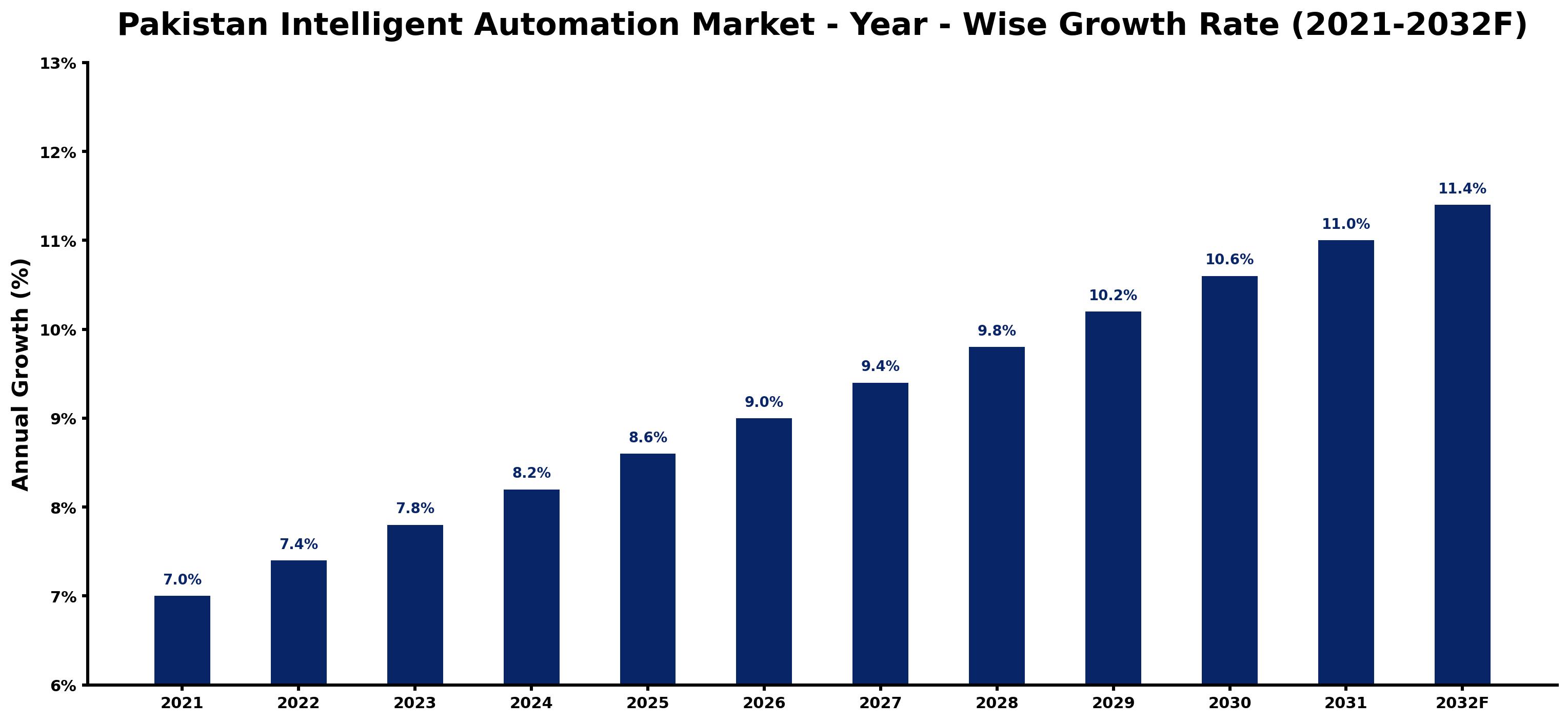
The table below presents the year‑wise growth rates along with the key drivers influencing the market
| Year | Growth Rate | Major Drivers |
| 2021 | 7.0% | Government infrastructure modernization initiatives |
| 2022 | 7.4% | Increasing industrial infrastructure investments |
| 2023 | 7.8% | Expansion of transportation and logistics networks |
| 2024 | 8.2% | Increasing adoption of advanced technologies |
| 2025 | 8.6% | Expansion of commercial construction activities |
| 2026 | 9.0% | Increasing smart city development projects |
| 2027 | 9.4% | Increasing industrial automation investments |
| 2028 | 9.8% | Growing urbanization and commercial development |
| 2029 | 10.2% | Increasing industrial infrastructure investments |
| 2030 | 10.6% | Expansion of commercial construction activities |
| 2031 | 11.0% | Rising electricity demand across industries |
| 2032 | 11.4% | Growing renewable energy integration projects |
Note - Market size estimations and growth projections presented in this report are based on 6Wresearch’s advanced forecasting approach, validated with industry datasets as of June 2026.
Pakistan Intelligent Automation Market Synopsis
The surge in demand for intelligent automation in Pakistan is particularly evident in the financial services and telecommunications sectors. These industries are leveraging RPA and cognitive automation to streamline processes, enhance customer experiences, and gain competitive advantage.
However, the penetration of intelligent automation solutions remains uneven across various industries. While some sectors are quick to adopt these technologies, traditional industries continue to face cultural resistance, which limits the broader application of these advanced solutions.
Pakistan Intelligent Automation Market Key Takeaways
- The intelligent automation landscape in Pakistan is evolving rapidly, with significant investments in AI and RPA technologies.
- Cost optimization and process improvement are primary motivators driving market growth across various sectors.
- Challenges such as resource limitations and cultural resistance to change hinder widespread adoption.
- Government initiatives aimed at fostering technological innovation present new avenues for growth.
- The market is expected to witness substantial advancements in automation technologies by 2032.
Evaluation of Restraints in Pakistan Intelligent Automation Market
Despite the promising growth trajectory, the intelligent automation market in Pakistan faces significant restraints. The initial investment required for deploying advanced automation solutions often poses a barrier for many organizations, particularly smaller enterprises that lack the necessary capital. Furthermore, the skills gap is a pressing concern; many businesses struggle to find professionals equipped with the expertise to implement and maintain these technologies effectively. The cultural hesitance towards embracing change, especially within legacy industries, serves to further complicate the adoption process. Additionally, a weak regulatory framework can stifle innovation and deter investment, thereby impacting overall market growth.
Pakistan Intelligent Automation Market Trends
Current trends indicate a growing integration of AI and machine learning with traditional RPA solutions. This hybrid approach enhances the capabilities of automation tools, enabling organizations to automate increasingly complex tasks. Moreover, businesses are emphasizing the importance of data analytics within automation frameworks, seeking not just to automate but also to derive actionable insights from processes.
The rise of Industry 4.0 is also driving demand for intelligent automation technologies, as businesses look to leverage connected devices and smart systems. As a result, sectors such as manufacturing and logistics are increasingly adopting automation solutions to enhance operational agility and responsiveness.
Pakistan Intelligent Automation Market Opportunities
The potential for growth in the Pakistan Intelligent Automation Market is substantial, particularly in sectors ripe for disruption through automation. Financial services and healthcare are leading the charge, with opportunities for developing tailored solutions that address specific operational challenges. Moreover, the push for digital transformation in government sectors opens avenues for public-private partnerships, where intelligent automation can play a pivotal role in service delivery improvements.
Investments in R&D to innovate automation technologies present another significant opportunity. Companies that can successfully navigate the challenges related to implementation will find themselves well-positioned to capitalize on the increasing demand for efficiency and process optimization.
Government Initiatives in the Pakistan Intelligent Automation Market
The Pakistani government has recognized the importance of intelligent automation in driving economic growth and competitiveness. Initiatives aimed at enhancing digital literacy, as well as investments in technology infrastructure, are key components of the government's strategy. By encouraging collaboration between the public and private sectors, the government seeks to create an environment conducive to the adoption of automation technologies. These efforts are further bolstered by various programs designed to support startups and innovation hubs focusing on technology development.
Future Insights of the Pakistan Intelligent Automation Market
Looking ahead to 2026-2032, the Pakistan Intelligent Automation Market is poised for transformative growth. As more organizations embrace digital transformation, intelligent automation will become a cornerstone of operational strategies across sectors. The focus will likely shift towards developing scalable solutions that integrate seamlessly with existing systems. Additionally, advancements in AI will enable more sophisticated automation capabilities, driving demand for innovations that go beyond traditional RPA.
Pakistan Intelligent Automation Market Latest Developments (May 2025 - June 2026)
Recent developments in the Pakistan Intelligent Automation Market highlight a growing trend towards collaborations and partnerships aimed at accelerating the adoption of automation technologies. Various companies have initiated pilot projects focusing on RPA and AI-driven solutions, demonstrating the tangible benefits of automating business processes. Additionally, industry seminars and conferences have become platforms for showcasing innovations and best practices in intelligent automation, fostering a community dedicated to advancing technology in Pakistan.
Pakistan Intelligent Automation Market - Key Attractiveness of the Report
- 10 Years of Market Numbers
- Historical Data Starting from 2022 to 2025
- Base Year: 2025
- Forecast Data until 2032
- Key Performance Indicators Impacting the Market
- Major Upcoming Developments and Projects
Key Highlights of the Report:
- Pakistan Intelligent Automation Market Outlook
- Market Size of Pakistan Intelligent Automation Market, 2025
- Forecast of Pakistan Intelligent Automation Market, 2032
- Historical Data and Forecast of Pakistan Intelligent Automation Revenues & Volume for the Period 2022-2032F
- Pakistan Intelligent Automation Market Trend Evolution
- Pakistan Intelligent Automation Market Drivers and Challenges
- Pakistan Intelligent Automation Price Trends
- Pakistan Intelligent Automation Porter's Five Forces
- Pakistan Intelligent Automation Industry Life Cycle
- Historical Data and Forecast of Pakistan Intelligent Automation Market Revenues & Volume By Component for the Period 2022-2032F
- Historical Data and Forecast of Pakistan Intelligent Automation Market Revenues & Volume By Solutions for the Period 2022-2032F
- Historical Data and Forecast of Pakistan Intelligent Automation Market Revenues & Volume By Services for the Period 2022-2032F
- Historical Data and Forecast of Pakistan Intelligent Automation Market Revenues & Volume By Managed Services for the Period 2022-2032F
- Historical Data and Forecast of Pakistan Intelligent Automation Market Revenues & Volume By Verticals for the Period 2022-2032F
- Historical Data and Forecast of Pakistan Intelligent Automation Market Revenues & Volume By BFSI for the Period 2022-2032F
- Historical Data and Forecast of Pakistan Intelligent Automation Market Revenues & Volume By Healthcare for the Period 2022-2032F
- Historical Data and Forecast of Pakistan Intelligent Automation Market Revenues & Volume By Retail for the Period 2022-2032F
- Historical Data and Forecast of Pakistan Intelligent Automation Market Revenues & Volume By Government for the Period 2022-2032F
- Historical Data and Forecast of Pakistan Intelligent Automation Market Revenues & Volume By Telecommunication for the Period 2022-2032F
- Historical Data and Forecast of Pakistan Intelligent Automation Market Revenues & Volume By Utilities for the Period 2022-2032F
- Historical Data and Forecast of Pakistan Intelligent Automation Market Revenues & Volume By Others for the Period 2022-2032F
- Historical Data and Forecast of Pakistan Intelligent Automation Market Revenues & Volume By End users for the Period 2022-2032F
- Historical Data and Forecast of Pakistan Intelligent Automation Market Revenues & Volume By Natural Language Processing for the Period 2022-2032F
- Historical Data and Forecast of Pakistan Intelligent Automation Market Revenues & Volume By Machine & Deep Learning for the Period 2022-2032F
- Historical Data and Forecast of Pakistan Intelligent Automation Market Revenues & Volume By Virtual Agents for the Period 2022-2032F
- Historical Data and Forecast of Pakistan Intelligent Automation Market Revenues & Volume By Mini Bots & RPA for the Period 2022-2032F
- Historical Data and Forecast of Pakistan Intelligent Automation Market Revenues & Volume By Computer Vision for the Period 2022-2032F
- Historical Data and Forecast of Pakistan Intelligent Automation Market Revenues & Volume By Others for the Period 2022-2032F
- Pakistan Intelligent Automation Import Export Trade Statistics
- Market Opportunity Assessment By Component
- Market Opportunity Assessment By Verticals
- Market Opportunity Assessment By End users
- Pakistan Intelligent Automation Top Companies Market Share
- Pakistan Intelligent Automation Competitive Benchmarking By Technical and Operational Parameters
- Pakistan Intelligent Automation Company Profiles
- Pakistan Intelligent Automation Key Strategic Recommendations






































