Pakistan Letterpress Printing Machinery Market Size, Share & Growth Rate
The Pakistan Letterpress Printing Machinery Market was estimated at USD 290 Million in 2025 and is projected to reach USD 380 Million by 2032, growing at a CAGR of 3.9% from 2026 to 2032. This growth trajectory can be attributed to the burgeoning demand for high-quality printed materials across various sectors, including packaging, publishing, and advertising. The rise of small and medium-sized enterprises further supports this trend, as they seek to leverage advanced printing technologies to enhance their offerings and improve operational efficiency.
Pakistan Letterpress Printing Machinery Market Year-wise Growth Rate and Key Drivers
This graph highlights how the Pakistan Letterpress Printing Machinery Market has steadily grown over the years, supported by major growth factors.
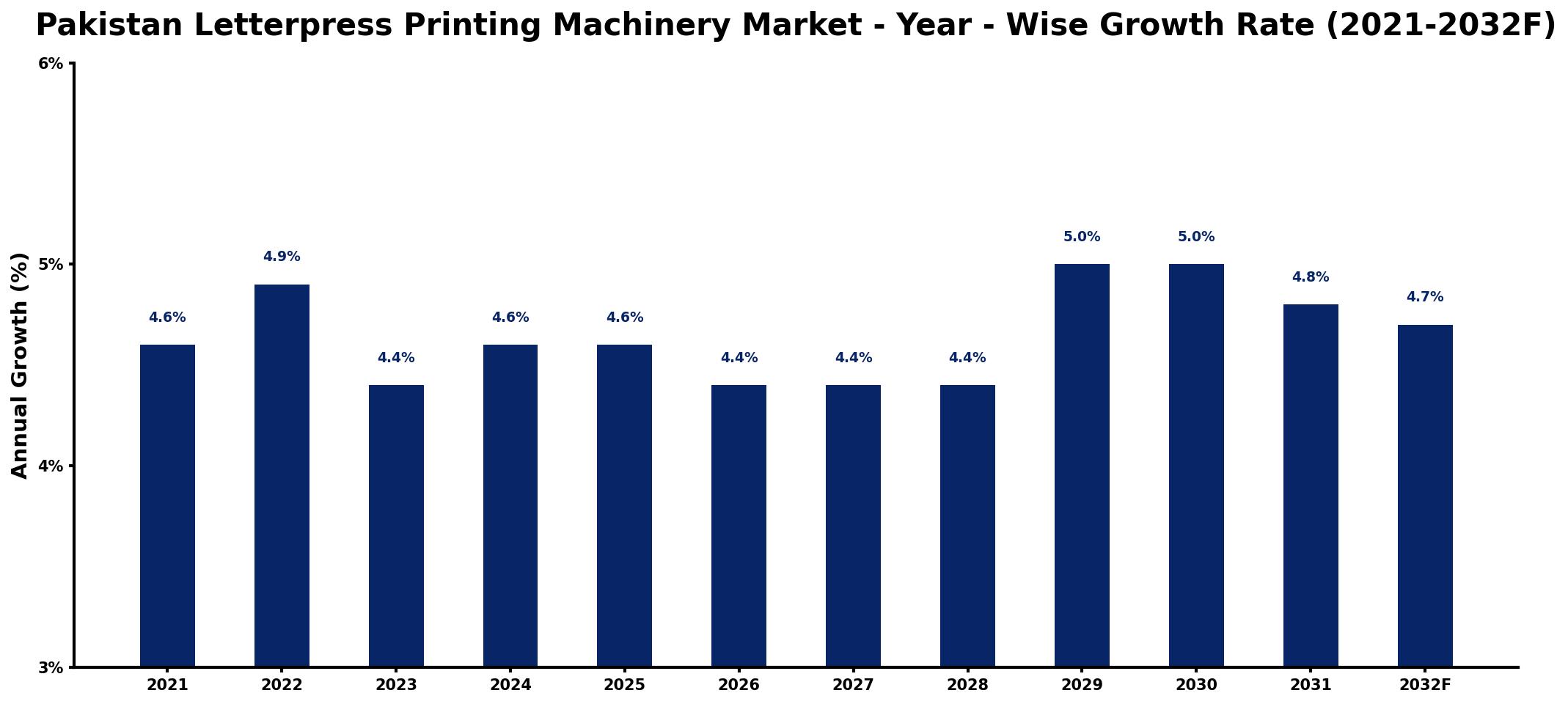
The table below presents the year‑wise growth rates along with the key drivers influencing the market
| Year | Growth Rate | Major Drivers |
| 2021 | 4.6% | Rising demand for customized solutions |
| 2022 | 4.9% | Growth in packaging industry needs |
| 2023 | 4.4% | Increased investment in technology |
| 2024 | 4.6% | Expansion of small business sector |
| 2025 | 4.6% | Higher consumer spending on quality |
| 2026 | 4.4% | Emergence of eco-friendly materials |
| 2027 | 4.4% | Development of local supply chains |
| 2028 | 4.4% | Integration of digital technologies |
| 2029 | 5.0% | Surge in e-commerce activities |
| 2030 | 5.0% | Strengthening of export markets |
| 2031 | 4.8% | growing automotive sector requirements |
| 2032 | 4.7% | Increase in regional trade agreements |
Note: Market size estimations and growth projections presented in this report are based on 6Wresearch's proprietary forecasting methodology, utilizing the latest available industry data, government publications, and primary research inputs.
Pakistan Letterpress Printing Machinery Market Synopsis
The demand for letterpress printing in Pakistan is distinctly driven by its reputation for producing crisp, clear prints, making it a preferred choice among businesses. The technology's versatility allows for use on a wide range of materials, expanding its appeal across diverse industry applications.
As companies increasingly focus on sustainability, the market is seeing a shift toward energy-efficient and eco-friendly machinery options. This trend aligns with global demands for environmentally responsible practices, which enhances the market's appeal to conscientious buyers.
Pakistan Letterpress Printing Machinery Market Key Takeaways
- The market is projected to grow steadily, driven by a diverse range of applications in various industries.
- Growing interest in sustainable printing practices is influencing purchasing decisions among businesses.
- Technological innovations are leading to enhanced functionality and efficiency in letterpress machinery.
- Small and medium-sized enterprises are the primary drivers of market demand.
- Government support through policies and incentives is fostering local manufacturing and industry growth.
Evaluation of Restraints in Pakistan Letterpress Printing Machinery Market
While the Pakistan Letterpress Printing Machinery Market shows promise, it faces several constraints that could impede growth. The rising costs of raw materials and components pose a significant challenge, impacting the profitability of businesses within this sector. Additionally, the rapid advancements in digital printing technology have shifted consumer preferences, forcing traditional letterpress operations to adapt or risk obsolescence. The limited access to financing for small and medium-sized enterprises further exacerbates these challenges, hindering their ability to invest in modern machinery. Lastly, the lack of skilled labor can compromise production quality and operational efficiency, creating additional hurdles for market participants.
Pakistan Letterpress Printing Machinery Market Trends
Several key trends are shaping the Pakistan Letterpress Printing Machinery Market. The demand for sustainable and eco-friendly printing solutions is at the forefront, with businesses actively seeking technologies that minimize waste and energy consumption. Additionally, there is a noticeable interest in integrating digital technologies within letterpress printing machinery, fostering automation and improving overall operational efficiency. As the market evolves, smaller, more compact machines are gaining traction, catering specifically to startups and smaller printing businesses looking to optimize space without sacrificing performance.
Pakistan Letterpress Printing Machinery Market Opportunities
The landscape of the Pakistan Letterpress Printing Machinery Market is ripe with investment opportunities, particularly as the demand for high-quality printed materials continues to grow. Companies that focus on producing innovative machinery with enhanced productivity and sustainability features are well-positioned for success. Additionally, the ongoing shift toward customized printing solutions presents a unique opportunity for manufacturers and distributors to cater to the evolving needs of the printing sector. With the right strategy, stakeholders can capitalize on the increasing interest in artisanal and craft products that leverage traditional printing techniques.
Government Initiatives in the Pakistan Letterpress Printing Machinery Market
The Pakistani government is actively promoting the growth of the Letterpress Printing Machinery Market through a variety of initiatives. These include tax incentives aimed at local manufacturers, subsidies for machinery production, and import duty exemptions for critical components. Moreover, the government is investing in skill development programs to enhance the capabilities of the workforce within the printing industry. Such policies not only support local production but also aim to foster innovation and ensure compliance with quality standards and environmental sustainability.
Future Insights of the Pakistan Letterpress Printing Machinery Market
Looking ahead to 2026-2032, the Pakistan Letterpress Printing Machinery Market is poised for moderate growth. While digital printing technologies continue to gain traction, there remains a distinct appreciation for the tactile and visual characteristics that letterpress printing provides, particularly in niche segments. Factors driving future growth will include technological advancements, an emphasis on sustainable practices, and a growing market for customized products. Companies will need to innovate continually and adapt to changing consumer demands to maintain a competitive edge in this evolving landscape.
Pakistan Letterpress Printing Machinery Market Latest Developments (2025 - 2026)
Recent developments in the Pakistan Letterpress Printing Machinery Market indicate a strong focus on innovation and eco-friendly practices. Manufacturers are increasingly adopting smart technologies to enhance automation and streamline production processes. Additionally, there is a concerted effort among industry players to promote sustainable printing solutions that align with global environmental standards. This direction not only responds to market demands but also positions the industry favorably in the context of emerging sustainability regulations.
Pakistan Letterpress Printing Machinery Market - Key Attractiveness of the Report
- 10 Years of Market Numbers
- Historical Data Starting from 2022 to 2025
- Base Year: 2025
- Forecast Data until 2032
- Key Performance Indicators Impacting the Market
- Major Upcoming Developments and Projects
Key Highlights of the Report:
- Pakistan Letterpress Printing Machinery Market Outlook
- Market Size of Pakistan Letterpress Printing Machinery Market, 2025
- Forecast of Pakistan Letterpress Printing Machinery Market, 2032
- Historical Data and Forecast of Pakistan Letterpress Printing Machinery Revenues & Volume for the Period 2022-2032F
- Pakistan Letterpress Printing Machinery Market Trend Evolution
- Pakistan Letterpress Printing Machinery Market Drivers and Challenges
- Pakistan Letterpress Printing Machinery Price Trends
- Pakistan Letterpress Printing Machinery Porter's Five Forces
- Pakistan Letterpress Printing Machinery Industry Life Cycle
- Historical Data and Forecast of Pakistan Letterpress Printing Machinery Market Revenues & Volume By Type for the Period 2022-2032F
- Historical Data and Forecast of Pakistan Letterpress Printing Machinery Market Revenues & Volume By Rotary Letterpress Machine for the Period 2022-2032F
- Historical Data and Forecast of Pakistan Letterpress Printing Machinery Market Revenues & Volume By Other for the Period 2022-2032F
- Historical Data and Forecast of Pakistan Letterpress Printing Machinery Market Revenues & Volume By Application for the Period 2022-2032F
- Historical Data and Forecast of Pakistan Letterpress Printing Machinery Market Revenues & Volume By Securities for the Period 2022-2032F
- Historical Data and Forecast of Pakistan Letterpress Printing Machinery Market Revenues & Volume By Invitation Card for the Period 2022-2032F
- Historical Data and Forecast of Pakistan Letterpress Printing Machinery Market Revenues & Volume By Other for the Period 2022-2032F
- Pakistan Letterpress Printing Machinery Import Export Trade Statistics
- Market Opportunity Assessment By Type
- Market Opportunity Assessment By Application
- Pakistan Letterpress Printing Machinery Top Companies Market Share
- Pakistan Letterpress Printing Machinery Competitive Benchmarking By Technical and Operational Parameters
- Pakistan Letterpress Printing Machinery Company Profiles
- Pakistan Letterpress Printing Machinery Key Strategic Recommendations






































