Pakistan Managed Security Services Market Summary
The pakistan managed security services market was estimated at USD 840 Million in 2025 and is projected to reach USD 1202 Million by 2032, growing at a CAGR of 5.8% from 2026 to 2032.
Pakistan Managed Security Services Market Year-wise Growth Rate and Key Drivers
This graph highlights how the Pakistan Managed Security Services Market has steadily grown over the past five years, supported by major growth factors.
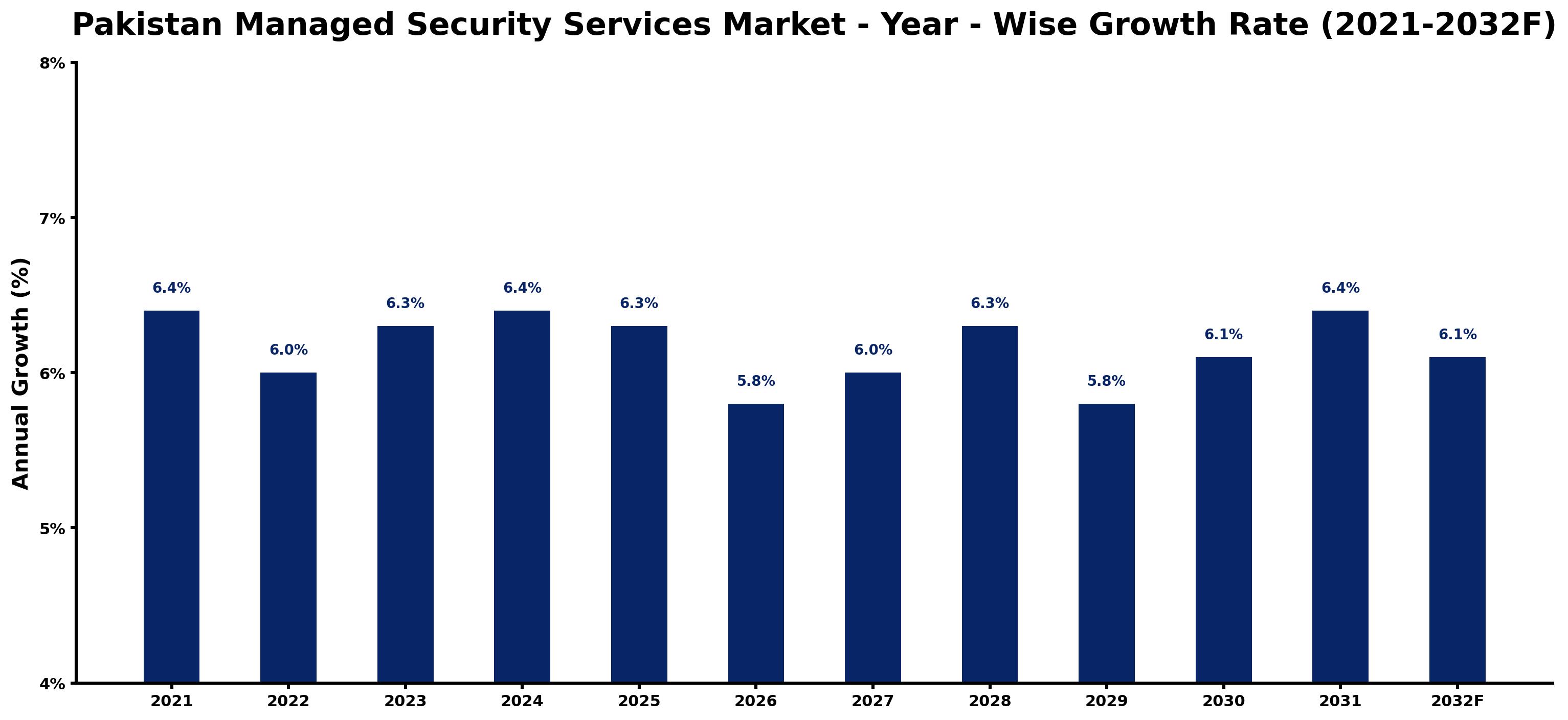
The table below presents the year wise growth rates along with the key drivers influencing the market
| Year | Growth Rate | Major Drivers |
| 2021 | 6.4% | Cyber threats prompted businesses to reassess their security investment priorities. |
| 2022 | 6.0% | Local enterprises started realizing the cost-effectiveness of outsourcing security management. |
| 2023 | 6.3% | Increased digital transformation accelerated the need for robust security solutions. |
| 2024 | 6.4% | Emerging startups adopted innovative security technologies to compete in the market. |
| 2025 | 6.3% | Public awareness about data breaches spurred demand for managed security services. |
| 2026 | 5.8% | International corporations entering Pakistan sought reliable security partnerships for operations. |
| 2027 | 6.0% | Local telecommunications firms expanded offerings, incorporating managed security options for clients. |
| 2028 | 6.3% | Automation in security services began reducing operational costs for many companies. |
| 2029 | 5.8% | A rise in remote work created new vulnerabilities requiring enhanced security measures. |
| 2030 | 6.1% | Investment in infrastructure projects necessitated improved cybersecurity risk management strategies. |
| 2031 | 6.4% | Increased collaboration between tech firms and security providers improved service delivery. |
| 2032 | 6.1% | Growing awareness about compliance obligations encouraged more businesses to seek managed services. |
Note - Market size estimations and growth projections presented in this report are based on 6Wresearch's advanced forecasting approach, validated with industry datasets as of June 2026.
Pakistan Managed Security Services Market Synopsis
The Pakistan Managed Security Services Market is projected to reach 5.8% and witness significant growth during the forecast period (2026-2032). Forecasted to expand at a compound annual growth rate (CAGR) of 16.9%, the growth of the market is driven by a multitude of factors including enhanced government initiatives aimed at fortifying the nation's cybersecurity landscape, as well as an increasing demand for robust security solutions from small and medium enterprises (SMEs). As organizations grow increasingly aware of the cybersecurity challenges they face, there is an escalating need for managed security services that can mitigate these risks effectively.
Pakistan Managed Security Services Market Growth Drivers
The primary factors propelling the growth of the Pakistan Managed Security Services Market are multi-faceted, reflecting both market demands and policy initiatives. Major growth drivers include:
- Government initiatives focusing on enhanced cybersecurity measures are instrumental in establishing reliable frameworks that support managed security services.
- There is a significant rise in cybersecurity threat awareness among organizations, particularly SMEs, which drives the demand for comprehensive security solutions.
- Investment in advanced technologies and cloud-based solutions is increasing, enabling service providers to offer innovative security measures to their clients.
- The proliferation of digital platforms and e-governance systems necessitates heightened cybersecurity, thus fostering the growth of managed security services.
- Growing venture capital investments in local startups focused on security technology are expected to stimulate market growth and innovation in security solutions.
Pakistan Managed Security Services Market Government Investment and Initiatives
The Government of Pakistan is taking notable steps to enhance the cybersecurity framework, reflecting its commitment to secure digital transformation. These initiatives encompass:
- The establishment of policies aimed at strengthening the nation's cybersecurity infrastructure through the introduction of regulatory measures and compliance standards.
- Investments in training programs that enhance the skill sets of cybersecurity professionals, thus creating a robust workforce capable of addressing complex security challenges.
- Creation of dedicated agencies and task forces responsible for monitoring cybersecurity threats and assisting organizations in implementing effective security measures.
- Encouragement of public-private partnerships that aim to develop and deploy innovative security technologies and solutions tailored for local businesses.
- The release of reports and guidelines that provide insights into digital crimes, supporting businesses in navigating the evolving landscape of cybersecurity.
Pakistan Managed Security Services Market Trends and Opportunities
The evolving dynamics of the Pakistan Managed Security Services Market present a range of trends that appear promising for stakeholders. Key trends include:
- Adoption of advanced technologies, including artificial intelligence and machine learning, that enhance the capacity of managed security services to detect and respond to threats.
- Increased customization of services tailored to meet the unique needs of SMEs, highlighting the recognition of their critical role in the economy.
- Growing emphasis on compliance with international cybersecurity standards, which promotes the adoption of best practices across various sectors.
- Expansion of cloud-based security solutions that offer scalability and flexibility, appealing to businesses seeking cost-effective security alternatives.
- The rise of awareness campaigns and educational initiatives that focus on cybersecurity hygiene, fostering proactive measures among organizations and employees alike.
Pakistan Managed Security Services Market Latest Developments (May 2025 - June 2026)
The period from May 2025 to June 2026 is characterized by several notable developments within the Pakistan Managed Security Services Market. Significant movements include:
- Increased collaboration among industry stakeholders, including technology providers and government agencies, to unify cybersecurity efforts against growing threats.
- Launch of new initiatives aimed at raising awareness about cybersecurity among the general public and organizations, underscoring the importance of proactive measures.
- Expansion of service offerings by managed security service providers, integrating more sophisticated threat detection and response capabilities into their portfolios.
- Investment in research and development to cultivate innovative solutions that address emerging cybersecurity challenges, a trend increasingly prioritized by stakeholders.
- Enhanced focus on compliance with local and international cybersecurity regulations, as businesses recognize the importance of safeguarding sensitive data.
Pakistan Managed Security Services Market - Key Attractiveness of the Report
- 10 Years of Market Numbers
- Historical Data Starting from 2022 to 2025
- Base Year: 2025
- Forecast Data until 2032
- Key Performance Indicators Impacting the Market
- Major Upcoming Developments and Projects
Key Highlights of the Report:
- Pakistan Managed Security Services Market Outlook
- Market Size of Pakistan Managed Security Services Market, 2025
- Forecast of Pakistan Managed Security Services Market, 2032
- Historical Data and Forecast of Pakistan Managed Security Services Revenues & Volume for the Period 2022-2032
- Pakistan Managed Security Services Market Trend Evolution
- Pakistan Managed Security Services Market Drivers and Challenges
- Pakistan Managed Security Services Price Trends
- Pakistan Managed Security Services Porter's Five Forces
- Pakistan Managed Security Services Industry Life Cycle
- Historical Data and Forecast of Pakistan Managed Security Services Market Revenues & Volume By Type for the Period 2022-2032
- Historical Data and Forecast of Pakistan Managed Security Services Market Revenues & Volume By Unified threat management for the Period 2022-2032
- Historical Data and Forecast of Pakistan Managed Security Services Market Revenues & Volume By DDoS for the Period 2022-2032
- Historical Data and Forecast of Pakistan Managed Security Services Market Revenues & Volume By Managed SIEM for the Period 2022-2032
- Historical Data and Forecast of Pakistan Managed Security Services Market Revenues & Volume By Managed endpoint threat detection for the Period 2022-2032
- Historical Data and Forecast of Pakistan Managed Security Services Market Revenues & Volume By Managed two factor authentication for the Period 2022-2032
- Historical Data and Forecast of Pakistan Managed Security Services Market Revenues & Volume By Compliance management for the Period 2022-2032
- Historical Data and Forecast of Pakistan Managed Security Services Market Revenues & Volume By Vulnerability management for the Period 2022-2032
- Historical Data and Forecast of Pakistan Unified threat management Managed Security Services Market Revenues & Volume By Others for the Period 2022-2032
- Historical Data and Forecast of Pakistan Managed Security Services Market Revenues & Volume By Deployment for the Period 2022-2032
- Historical Data and Forecast of Pakistan Managed Security Services Market Revenues & Volume By Cloud-based for the Period 2022-2032
- Historical Data and Forecast of Pakistan Managed Security Services Market Revenues & Volume By On-premise for the Period 2022-2032
- Historical Data and Forecast of Pakistan Managed Security Services Market Revenues & Volume By Organization for the Period 2022-2032
- Historical Data and Forecast of Pakistan Managed Security Services Market Revenues & Volume By Small and medium enterprises for the Period 2022-2032
- Historical Data and Forecast of Pakistan Managed Security Services Market Revenues & Volume By Large enterprises for the Period 2022-2032
- Historical Data and Forecast of Pakistan Managed Security Services Market Revenues & Volume By Applications for the Period 2022-2032
- Historical Data and Forecast of Pakistan Managed Security Services Market Revenues & Volume By BFSI for the Period 2022-2032
- Historical Data and Forecast of Pakistan Managed Security Services Market Revenues & Volume By Government/defense for the Period 2022-2032
- Historical Data and Forecast of Pakistan Managed Security Services Market Revenues & Volume By Healthcare for the Period 2022-2032
- Historical Data and Forecast of Pakistan Managed Security Services Market Revenues & Volume By Manufacturing for the Period 2022-2032
- Historical Data and Forecast of Pakistan Managed Security Services Market Revenues & Volume By Telecom & IT for the Period 2022-2032
- Historical Data and Forecast of Pakistan Managed Security Services Market Revenues & Volume By Retail for the Period 2022-2032
- Historical Data and Forecast of Pakistan Managed Security Services Market Revenues & Volume By Others for the Period 2022-2032
- Pakistan Managed Security Services Import Export Trade Statistics
- Market Opportunity Assessment By Type
- Market Opportunity Assessment By Deployment
- Market Opportunity Assessment By Organization
- Market Opportunity Assessment By Applications
- Pakistan Managed Security Services Top Companies Market Share
- Pakistan Managed Security Services Competitive Benchmarking By Technical and Operational Parameters
- Pakistan Managed Security Services Company Profiles
- Pakistan Managed Security Services Key Strategic Recommendations






































