Pakistan Military Radar Market Size, Share & Growth Rate
The Pakistan Military Radar Market was estimated at USD 167 Million in 2025 and is projected to reach USD 222 Million by 2032, growing at a CAGR of 4.2% from 2026 to 2032. This growth trajectory can be attributed to the increasing demand for advanced surveillance and reconnaissance capabilities, driven by evolving security threats in the region. The emphasis on air defense and border security further reinforces the need for modern radar systems that can operate effectively across diverse environments.
Pakistan Military Radar Market Year-wise Growth Rate and Key Drivers
This graph highlights how the Pakistan Military Radar Market has steadily grown over the years, supported by major growth factors.
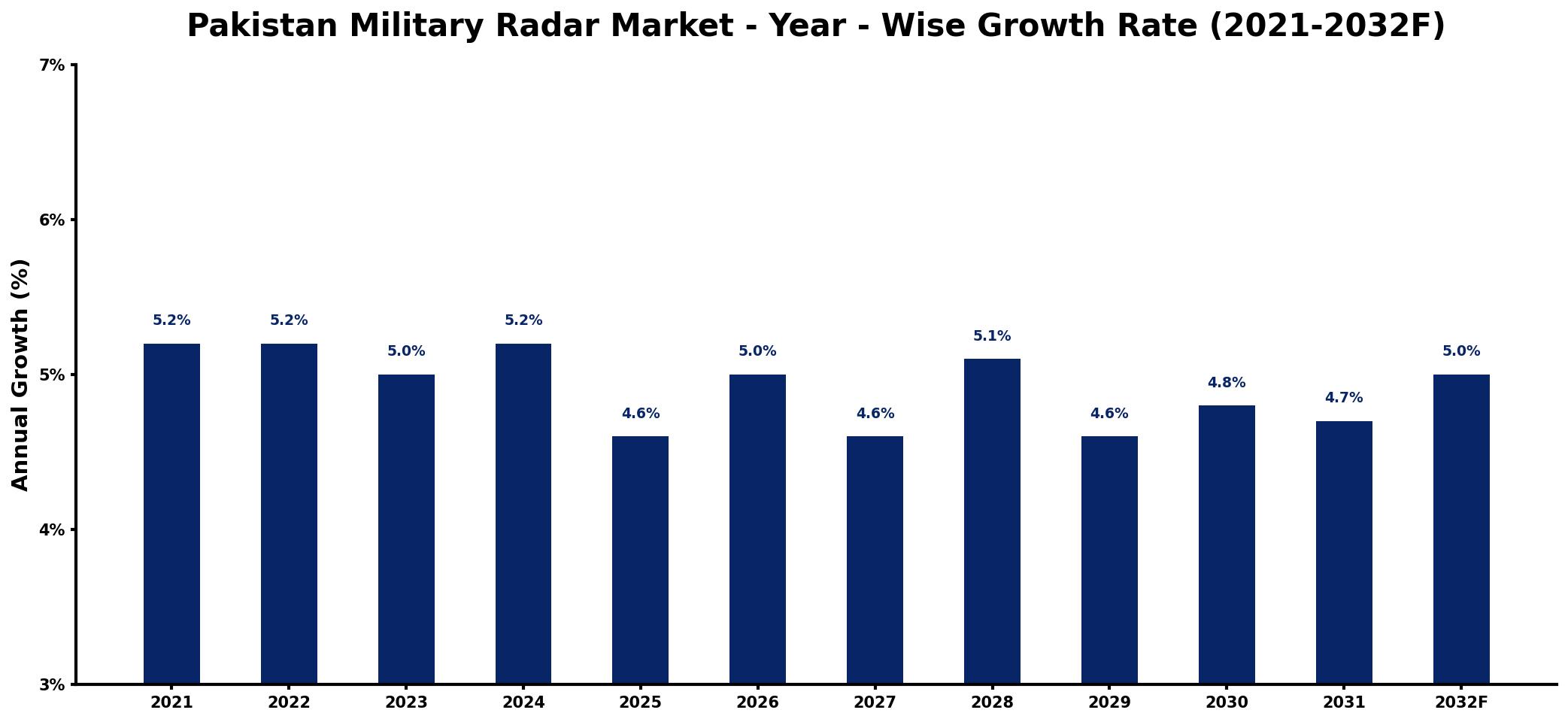
The table below presents the year‑wise growth rates along with the key drivers influencing the market
| Year | Growth Rate | Major Drivers |
| 2021 | 5.2% | improved processing technologies adoption |
| 2022 | 5.2% | Rising geopolitical tensions globally |
| 2023 | 5.0% | Growing demand for surveillance technology |
| 2024 | 5.2% | Expansion of defense partnerships |
| 2025 | 4.6% | Investment in advanced technologies |
| 2026 | 5.0% | Enhanced focus on border security |
| 2027 | 4.6% | Emergence of new defense contracts |
| 2028 | 5.1% | Integration of innovative systems |
| 2029 | 4.6% | Strengthened regional defense collaborations |
| 2030 | 4.8% | Development of indigenous capabilities |
| 2031 | 4.7% | Upgrades to existing infrastructure |
| 2032 | 5.0% | Focus on modernization initiatives |
Note: Market size estimations and growth projections presented in this report are based on 6Wresearch's proprietary forecasting methodology, utilizing the latest available industry data, government publications, and primary research inputs.
Pakistan Military Radar Market Synopsis
The most significant force shaping the Pakistan Military Radar Market is the escalating demand for enhanced situational awareness in defense operations. With rising geopolitical tensions and the growing presence of aerial threats, Pakistan's military is keenly focused on upgrading its radar capabilities for efficient target detection and tracking.
Moreover, advancements in radar technologies such as phased array and synthetic aperture radar are facilitating the development of more sophisticated systems. The integration of these technologies into existing military frameworks promises to bolster Pakistan's operational readiness and enhance its defense capabilities.
Pakistan Military Radar Market Key Takeaways
- The market is projected to grow significantly, reflecting an increased focus on surveillance and reconnaissance.
- Advancements in radar technology are crucial for improving detection capabilities and operational efficiency.
- The integration of multi-sensor systems is enhancing the effectiveness of military radars.
- Government policies actively support the development of indigenous radar technologies.
- Challenges in developing advanced radar technologies highlight the competitive landscape for manufacturers.
Evaluation of Restraints in Pakistan Military Radar Market
Despite its growth potential, the Pakistan Military Radar Market faces several restraints. The complexity involved in developing advanced radar systems capable of long-range coverage and high resolution is a significant challenge. Manufacturers must also address the need for these systems to resist electronic countermeasures, which complicates the design and production process. Additionally, ensuring that radar systems can integrate seamlessly with existing military platforms presents ongoing hurdles for developers.
Pakistan Military Radar Market Trends
Current trends in the Pakistan Military Radar Market point towards an increased focus on modernizing existing radar systems. The shift towards digital and software-defined radars allows for greater flexibility and adaptability in various operational contexts. Moreover, the convergence of radar technology with electronic warfare capabilities is becoming more pronounced, fostering a new era of integrated defense solutions.
Pakistan Military Radar Market Opportunities
There are considerable opportunities for growth and investment in the Pakistan Military Radar Market. The ongoing modernization of military assets creates a demand for advanced radar systems that can meet the evolving defense landscape. Additionally, partnerships with technology providers for joint development initiatives can enhance indigenous manufacturing capabilities, allowing for more cost-effective solutions tailored to local requirements.
Government Initiatives in the Pakistan Military Radar Market
The Pakistani government plays a pivotal role in promoting radar technology advancements. Policies aimed at improving defense capabilities through technological development are in place, focusing on enhancing situational awareness for military operations. Spectrum management initiatives also support the efficient deployment of radar systems while interoperability standards are being established to facilitate integration with existing military platforms.
Future Insights of the Pakistan Military Radar Market
Looking ahead to 2026-2032, the Pakistan Military Radar Market is expected to continue its upward trajectory. The increasing complexity of threats necessitates that military radar systems evolve to meet new challenges. This evolution will likely include investments in next-generation radar technologies and enhanced integration with other defense systems, positioning Pakistans military to effectively counter aerial threats and ensure national security.
Pakistan Military Radar Market Latest Developments (2025 - 2026)
Recent developments in the Pakistan Military Radar Market highlight a strong trend towards modernization. There is a notable emphasis on enhancing radar capabilities to improve the detection and tracking of aerial threats. Collaborations between local manufacturers and international technology firms have been observed, indicating a move towards more integrated defense solutions. These initiatives are set to bolster the technological landscape of Pakistan's military radar capabilities.
Pakistan Military Radar Market - Key Attractiveness of the Report
- 10 Years of Market Numbers
- Historical Data Starting from 2022 to 2025
- Base Year: 2025
- Forecast Data until 2032
- Key Performance Indicators Impacting the Market
- Major Upcoming Developments and Projects
Key Highlights of the Report:
- Pakistan Military Radar Market Outlook
- Market Size of Pakistan Military Radar Market, 2025
- Forecast of Pakistan Military Radar Market, 2032
- Historical Data and Forecast of Pakistan Military Radar Revenues & Volume for the Period 2022-2032F
- Pakistan Military Radar Market Trend Evolution
- Pakistan Military Radar Market Drivers and Challenges
- Pakistan Military Radar Price Trends
- Pakistan Military Radar Porter's Five Forces
- Pakistan Military Radar Industry Life Cycle
- Historical Data and Forecast of Pakistan Military Radar Market Revenues & Volume By Platform for the Period 2022-2032F
- Historical Data and Forecast of Pakistan Military Radar Market Revenues & Volume By Airborne Radar for the Period 2022-2032F
- Historical Data and Forecast of Pakistan Military Radar Market Revenues & Volume By Land Radar for the Period 2022-2032F
- Historical Data and Forecast of Pakistan Military Radar Market Revenues & Volume By Naval Radar for the Period 2022-2032F
- Historical Data and Forecast of Pakistan Military Radar Market Revenues & Volume By Range for the Period 2022-2032F
- Historical Data and Forecast of Pakistan Military Radar Market Revenues & Volume By Long for the Period 2022-2032F
- Historical Data and Forecast of Pakistan Military Radar Market Revenues & Volume By Medium for the Period 2022-2032F
- Historical Data and Forecast of Pakistan Military Radar Market Revenues & Volume By Short for the Period 2022-2032F
- Historical Data and Forecast of Pakistan Military Radar Market Revenues & Volume By Very Short for the Period 2022-2032F
- Historical Data and Forecast of Pakistan Military Radar Market Revenues & Volume By Application for the Period 2022-2032F
- Historical Data and Forecast of Pakistan Military Radar Market Revenues & Volume By Weapon Guidance for the Period 2022-2032F
- Historical Data and Forecast of Pakistan Military Radar Market Revenues & Volume By Airspace Monitoring & Traffic Management for the Period 2022-2032F
- Historical Data and Forecast of Pakistan Military Radar Market Revenues & Volume By Airborne Mapping for the Period 2022-2032F
- Historical Data and Forecast of Pakistan Military Radar Market Revenues & Volume By Ground Surveillance & Intruder Detection for the Period 2022-2032F
- Historical Data and Forecast of Pakistan Military Radar Market Revenues & Volume By Navigation for the Period 2022-2032F
- Historical Data and Forecast of Pakistan Military Radar Market Revenues & Volume By Others for the Period 2022-2032F
- Historical Data and Forecast of Pakistan Military Radar Market Revenues & Volume By Frequency for the Period 2022-2032F
- Historical Data and Forecast of Pakistan Military Radar Market Revenues & Volume By C-Band for the Period 2022-2032F
- Historical Data and Forecast of Pakistan Military Radar Market Revenues & Volume By S-Band for the Period 2022-2032F
- Historical Data and Forecast of Pakistan Military Radar Market Revenues & Volume By X-Band for the Period 2022-2032F
- Historical Data and Forecast of Pakistan Military Radar Market Revenues & Volume By L-Band for the Period 2022-2032F
- Historical Data and Forecast of Pakistan Military Radar Market Revenues & Volume By UHF/VHF for the Period 2022-2032F
- Historical Data and Forecast of Pakistan Military Radar Market Revenues & Volume By Ku/K/Ka-Band for the Period 2022-2032F
- Historical Data and Forecast of Pakistan Military Radar Market Revenues & Volume By Component for the Period 2022-2032F
- Historical Data and Forecast of Pakistan Military Radar Market Revenues & Volume By Transmitter for the Period 2022-2032F
- Historical Data and Forecast of Pakistan Military Radar Market Revenues & Volume By Antenna for the Period 2022-2032F
- Historical Data and Forecast of Pakistan Military Radar Market Revenues & Volume By Receiver for the Period 2022-2032F
- Historical Data and Forecast of Pakistan Military Radar Market Revenues & Volume By Duplexer for the Period 2022-2032F
- Historical Data and Forecast of Pakistan Military Radar Market Revenues & Volume By Others for the Period 2022-2032F
- Pakistan Military Radar Import Export Trade Statistics
- Market Opportunity Assessment By Platform
- Market Opportunity Assessment By Range
- Market Opportunity Assessment By Application
- Market Opportunity Assessment By Frequency
- Market Opportunity Assessment By Component
- Pakistan Military Radar Top Companies Market Share
- Pakistan Military Radar Competitive Benchmarking By Technical and Operational Parameters
- Pakistan Military Radar Company Profiles
- Pakistan Military Radar Key Strategic Recommendations






































