Pakistan Modified Starch Market Year-wise Growth Rate (2021-2031F)
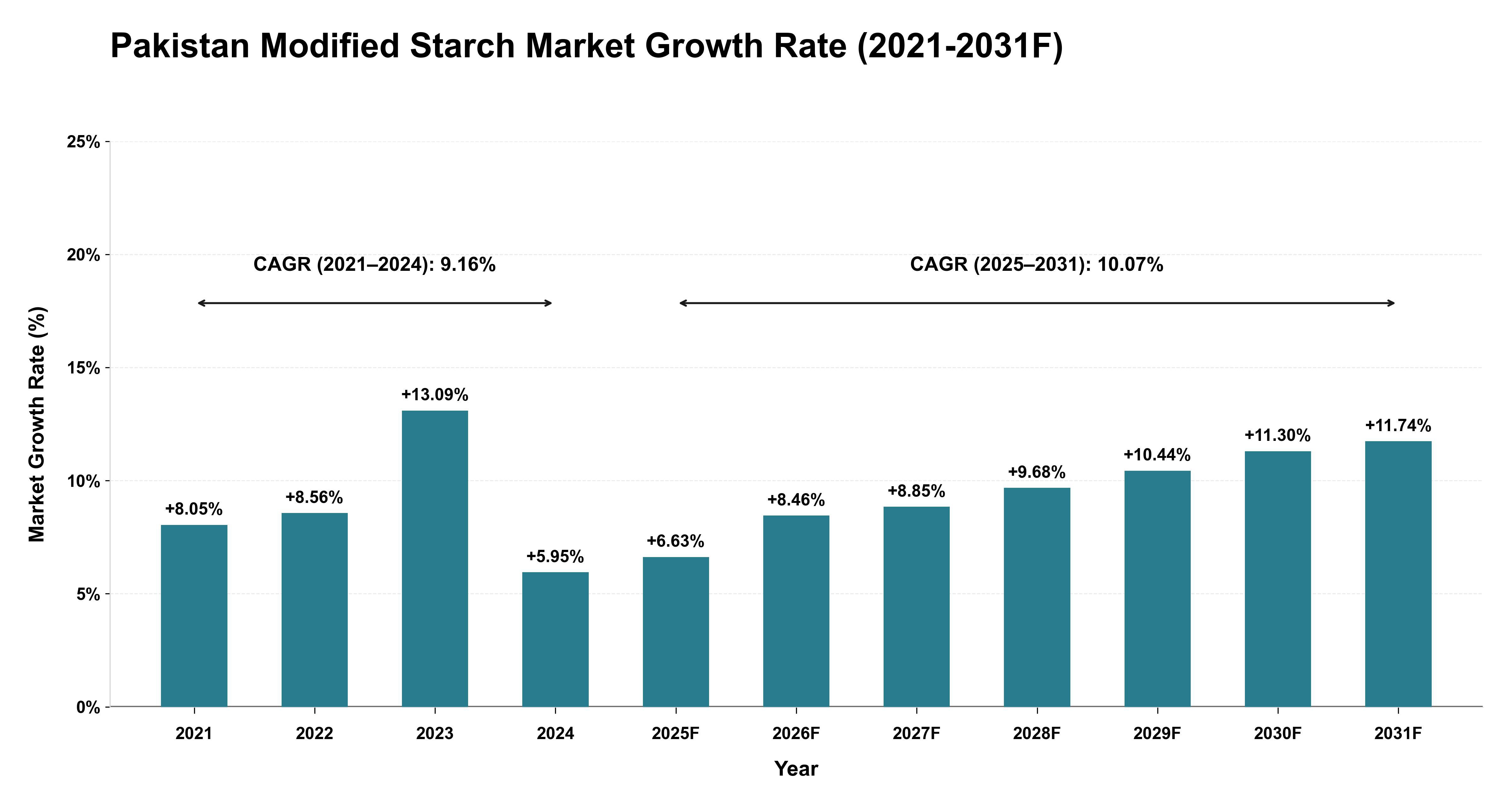
The Pakistan Modified Starch Market experienced moderate growth from 2021 to 2024, with a CAGR of 9.16%. This growth was driven by increasing demand from the food processing, textile, and pharmaceutical industries, supported by advancements in starch modification technologies. However, the market faced some volatility, particularly in 2024 when growth dipped to 5.95%. Looking ahead to 2025-2031, the market is expected to maintain a positive trajectory with a forecasted CAGR of 10.07%. This growth will be fueled by growing awareness of modified starch benefits, expanding applications in various end-use industries, and favorable government regulations promoting the use of starch-based products. The steady acceleration in growth rates from 2025 onwards indicates a robust and evolving market landscape for modified starch in Pakistan.
Pakistan Modified Starch Market Overview
The Pakistan Modified Starch Market is experiencing steady growth due to increasing demand from various industries such as food and beverage, pharmaceuticals, textiles, and paper. Modified starch is widely used as a thickening agent, stabilizer, and emulsifier in food products, contributing to its significant market share in the food industry. Additionally, the pharmaceutical sector is utilizing modified starch for drug delivery systems, further driving market growth. The textile industry is also a key consumer of modified starch for sizing and finishing processes. Market players in Pakistan are focusing on product innovation and expanding their product portfolio to cater to diverse industry requirements. With the growing industrial applications and favorable government regulations, the Pakistan Modified Starch Market is expected to continue its growth trajectory in the coming years.
Pakistan Modified Starch Market Trends
The Pakistan modified starch market is experiencing growth driven by increasing demand from various industries such as food and beverage, pharmaceuticals, and textile. The food industry is a key driver, with modified starch being used as a thickening agent, stabilizer, and emulsifier in a wide range of products. Consumers are also increasingly seeking out clean label ingredients, prompting manufacturers to develop modified starches with natural and organic certifications. Additionally, the growing awareness of the benefits of modified starch, such as improved texture, shelf-life extension, and cost-effectiveness, is driving its adoption in various applications. The market is witnessing innovation in product development to cater to specific industry requirements and preferences, such as gluten-free and non-GMO options, indicating a promising outlook for the Pakistan modified starch market.
Pakistan Modified Starch Market Challenges
In the Pakistan Modified Starch Market, some key challenges include limited awareness and understanding of the benefits of modified starch among end-users and manufacturers, leading to slow adoption rates. Additionally, the lack of advanced technology and infrastructure for the production and processing of modified starch poses a hurdle for the market growth. The inconsistent quality of raw materials and fluctuating prices also impact the overall stability of the market. Regulatory complexities and a relatively fragmented market landscape further add to the challenges faced by industry players in Pakistan. Overcoming these obstacles will require investment in education and awareness campaigns, technological advancements, quality control measures, and regulatory harmonization to drive the growth of the modified starch market in Pakistan.
Pakistan Modified Starch Market Investment Opportunities
The Pakistan Modified Starch Market offers promising investment opportunities due to the increasing demand for modified starch in various industries such as food and beverage, pharmaceuticals, and textiles. With a growing population and changing consumer preferences, there is a rising need for innovative ingredients to enhance product quality and functionality. Investing in companies that specialize in the production and distribution of modified starch in Pakistan could prove lucrative. Additionally, the government`s focus on promoting the agriculture sector and supporting local industries provides a favorable environment for investment in this market. With the potential for expansion and diversification, investing in the Pakistan Modified Starch Market could offer attractive returns for investors looking to capitalize on the country`s growing industrial sector.
Pakistan Modified Starch Market Government Policy
The Pakistan government has implemented various policies related to the Modified Starch Market to promote domestic production and reduce dependency on imports. These policies include providing subsidies to local manufacturers, promoting research and development in the industry, and imposing tariffs on imported modified starch products to protect domestic producers. Additionally, the government has encouraged the use of modified starch in various sectors such as food and beverages, pharmaceuticals, and textiles to boost demand and market growth. Overall, these policies aim to strengthen the competitiveness of the Pakistan Modified Starch Market, support local industries, and enhance self-sufficiency in the production of modified starch products within the country.
Pakistan Modified Starch Market Future Outlook
The Pakistan Modified Starch Market is expected to witness steady growth in the coming years driven by increasing demand from various industries such as food, pharmaceuticals, and textiles. Factors contributing to this growth include the rising awareness about the benefits of modified starch in food processing, the growing consumption of convenience foods, and the expanding pharmaceutical sector in the country. Additionally, the government`s initiatives to promote agricultural production and processing are likely to further boost the demand for modified starch as a key ingredient in various applications. With manufacturers focusing on innovation and product development to meet the evolving consumer preferences, the Pakistan Modified Starch Market is poised for expansion and diversification in the foreseeable future.
Key Highlights of the Report:
- Pakistan Modified Starch Market Outlook
- Market Size of Pakistan Modified Starch Market, 2021
- Forecast of Pakistan Modified Starch Market, 2031
- Historical Data and Forecast of Pakistan Modified Starch Revenues & Volume for the Period 2018 - 2031
- Pakistan Modified Starch Market Trend Evolution
- Pakistan Modified Starch Market Drivers and Challenges
- Pakistan Modified Starch Price Trends
- Pakistan Modified Starch Porter's Five Forces
- Pakistan Modified Starch Industry Life Cycle
- Historical Data and Forecast of Pakistan Modified Starch Market Revenues & Volume By Source for the Period 2018 - 2031
- Historical Data and Forecast of Pakistan Modified Starch Market Revenues & Volume By Corn for the Period 2018 - 2031
- Historical Data and Forecast of Pakistan Modified Starch Market Revenues & Volume By Wheat for the Period 2018 - 2031
- Historical Data and Forecast of Pakistan Modified Starch Market Revenues & Volume By Cassava for the Period 2018 - 2031
- Historical Data and Forecast of Pakistan Modified Starch Market Revenues & Volume By Potato for the Period 2018 - 2031
- Historical Data and Forecast of Pakistan Modified Starch Market Revenues & Volume By Application for the Period 2018 - 2031
- Historical Data and Forecast of Pakistan Modified Starch Market Revenues & Volume By Food & Beverages for the Period 2018 - 2031
- Historical Data and Forecast of Pakistan Modified Starch Market Revenues & Volume By Animal Feed for the Period 2018 - 2031
- Historical Data and Forecast of Pakistan Modified Starch Market Revenues & Volume By Others for the Period 2018 - 2031
- Pakistan Modified Starch Import Export Trade Statistics
- Market Opportunity Assessment By Source
- Market Opportunity Assessment By Application
- Pakistan Modified Starch Top Companies Market Share
- Pakistan Modified Starch Competitive Benchmarking By Technical and Operational Parameters
- Pakistan Modified Starch Company Profiles
- Pakistan Modified Starch Key Strategic Recommendations






































