Pakistan Motherboard Market Growth Rate Analysis (2025 - 2031)
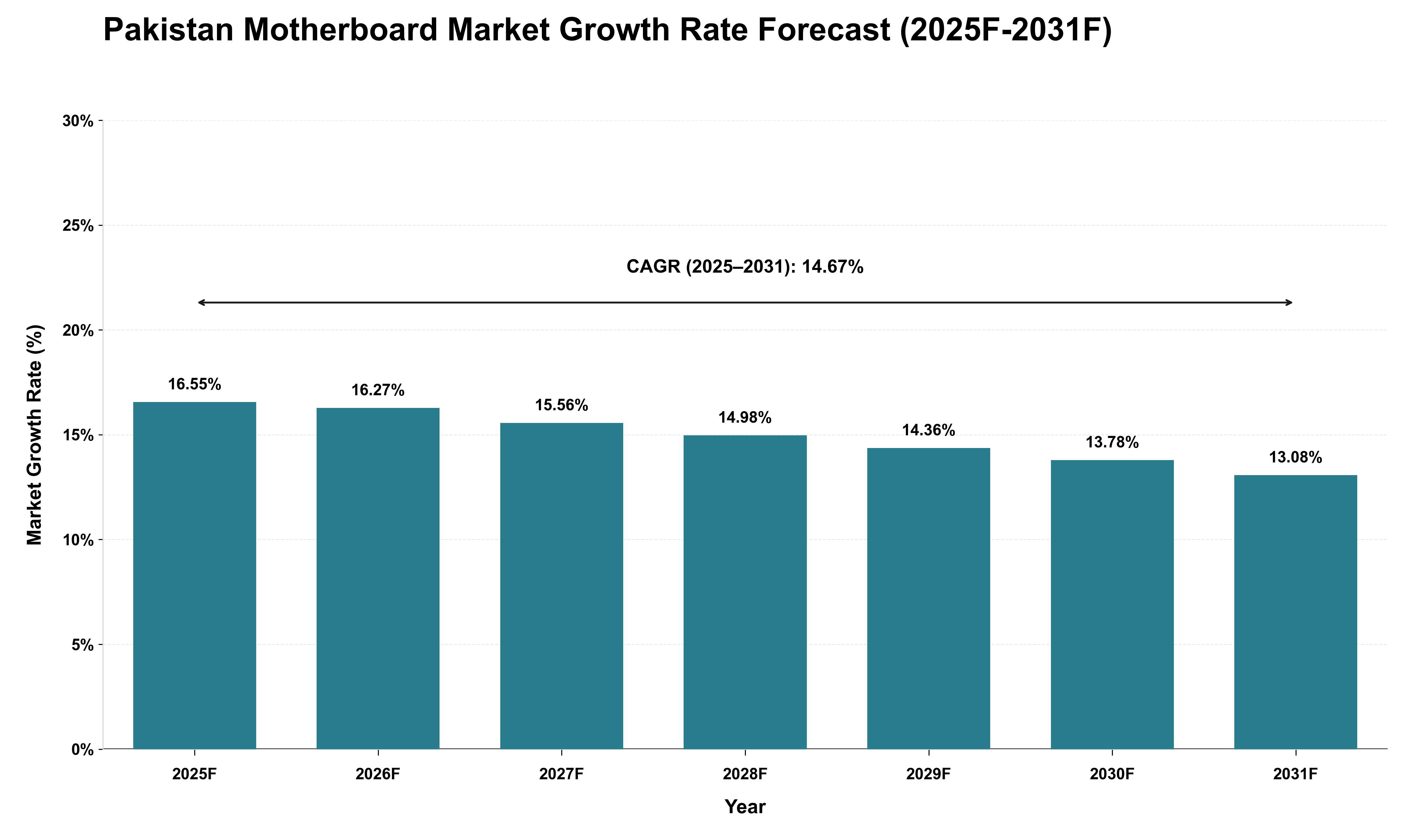
The Pakistan motherboard market is projected to experience a robust compound annual growth rate of 14.67% from 2025 to 2031, driven by increasing demand for computing devices and advancements in technology. The anticipated annual growth rates, peaking at 16.55% in 2025 and gradually tapering to 13.08% by 2031, reflect a dynamic interplay between supply chain efficiencies and input costs. As global semiconductor shortages stabilize, manufacturers will likely benefit from improved access to critical components, which will mitigate production delays and enhance output capacity. Additionally, fluctuations in import dependencies for raw materials could influence pricing strategies; however, the overall trend suggests that competitive pricing and innovation will sustain market momentum. The cyclical nature of technology adoption will further support this growth trajectory as consumer preferences shift towards more advanced computing solutions throughout the forecast period.
Key Highlights of the Report:
- Pakistan Motherboard Market Outlook
- Market Size of Pakistan Motherboard Market, 2025
- Forecast of Pakistan Motherboard Market, 2032
- Historical Data and Forecast of Pakistan Motherboard Revenues & Volume for the Period 2022-2032F
- Pakistan Motherboard Market Trend Evolution
- Pakistan Motherboard Market Drivers and Challenges
- Pakistan Motherboard Price Trends
- Pakistan Motherboard Porter's Five Forces
- Pakistan Motherboard Industry Life Cycle
- Historical Data and Forecast of Pakistan Motherboard Market Revenues & Volume By Form for the Period 2022-2032F
- Historical Data and Forecast of Pakistan Motherboard Market Revenues & Volume By ATX for the Period 2022-2032F
- Historical Data and Forecast of Pakistan Motherboard Market Revenues & Volume By Micro-ATX for the Period 2022-2032F
- Historical Data and Forecast of Pakistan Motherboard Market Revenues & Volume By Mini ITX for the Period 2022-2032F
- Historical Data and Forecast of Pakistan Motherboard Market Revenues & Volume By Model for the Period 2022-2032F
- Historical Data and Forecast of Pakistan Motherboard Market Revenues & Volume By Industrial for the Period 2022-2032F
- Historical Data and Forecast of Pakistan Motherboard Market Revenues & Volume By Commercial for the Period 2022-2032F
- Pakistan Motherboard Import Export Trade Statistics
- Market Opportunity Assessment By Form
- Market Opportunity Assessment By Model
- Pakistan Motherboard Top Companies Market Share
- Pakistan Motherboard Competitive Benchmarking By Technical and Operational Parameters
- Pakistan Motherboard Company Profiles
- Pakistan Motherboard Key Strategic Recommendations






































