Pakistan Motorcycle components Market Size, Share & Growth Rate
The Pakistan Motorcycle components Market was estimated at USD 267 Million in 2025 and is projected to reach USD 351 Million by 2032, growing at a CAGR of 4.0% from 2026 to 2032. This growth is driven primarily by an increasing preference for high-speed and performance motorcycles among the youth, reflecting a cultural shift towards motorcycling as a lifestyle choice. Furthermore, substantial investments from major motorcycle manufacturers are enhancing local production capabilities, effectively addressing the burgeoning demand for quality components.
Pakistan Motorcycle components Market Growth Rate Analysis (2021-2032)
The Pakistan motorcycle components market has displayed stable growth, with annual increases varying between 4.3% and 4.9% from 2021 to 2032. Following a 4.8% growth in 2021 and 4.6% in 2022, the sector rebounded to 4.8% in 2023, boosted by rising consumer demand and significant investments in local manufacturing capabilities. The forecasted growth of 4.9% in 2024 reflects enhancements in infrastructure and technology, alongside supportive government policies aimed at encouraging domestic production. However, expected declines to 4.3% by 2027 may arise from external economic pressures and shifts toward electric mobility. Nevertheless, the market shows resilience, gearing up for further expansion, especially with digitalization efforts in the supply chain.
Pakistan Motorcycle components Market Year-wise Growth Rate and Key Drivers
This graph highlights how the Pakistan Motorcycle components Market has steadily grown over the past five years, supported by major growth factors.
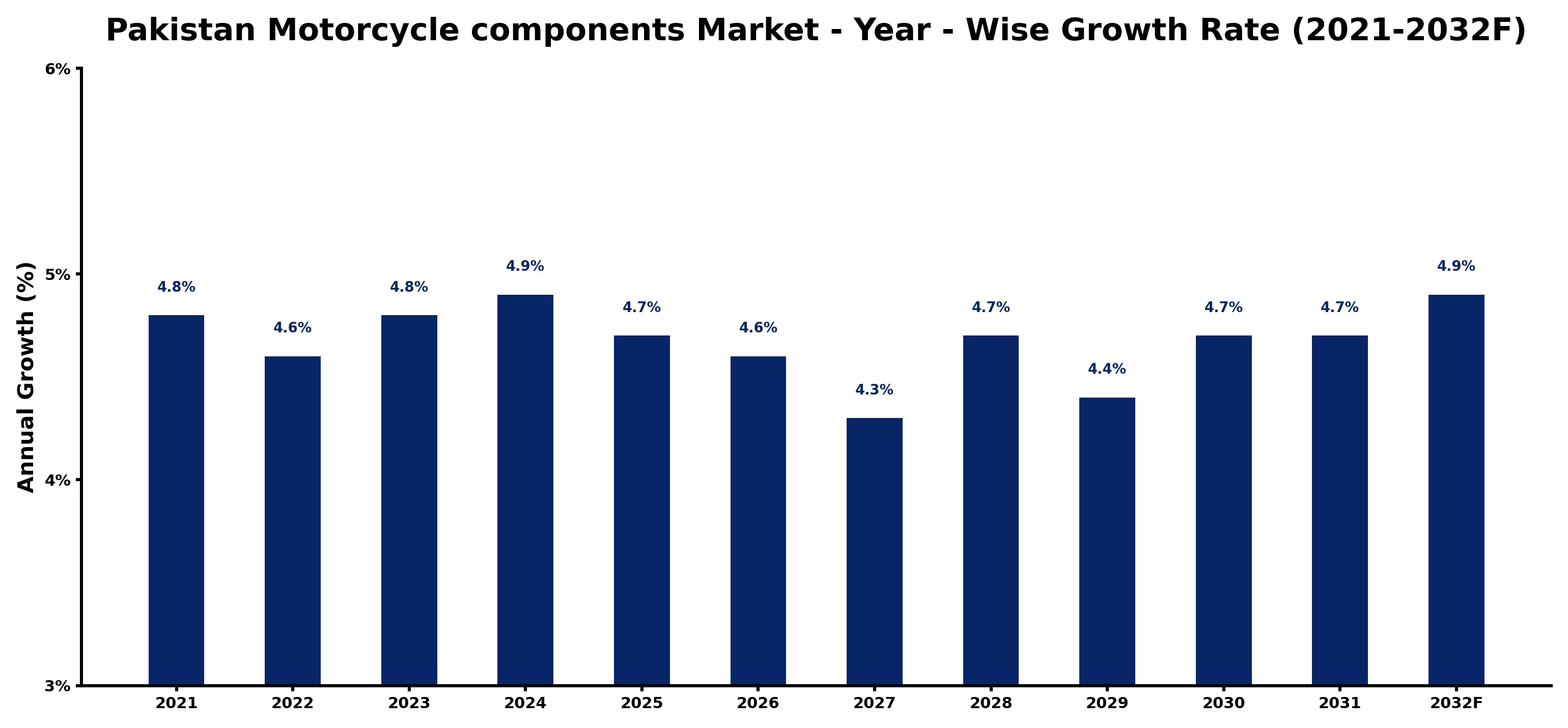
The table below presents the year‑wise growth rates along with the key drivers influencing the market
| Year | Growth Rate | Major Drivers |
| 2021 | 4.8% | Local manufacturers boost capacity through targeted supply chain enhancements |
| 2022 | 4.6% | Local suppliers invest in advanced machinery for motorcycle component production |
| 2023 | 4.8% | Local suppliers adopting advanced machining technologies boost component production efficiency |
| 2024 | 4.9% | Localized sourcing of motorcycle parts boosted assembly line efficiencies |
| 2025 | 4.7% | OEM collaborations enhanced motorcycle component production efficiency in Pakistan |
| 2026 | 4.6% | Local assembly plants optimized processes to enhance component production efficiency |
| 2027 | 4.3% | Increased local motorcycle assembly stimulates component supply chain activity |
| 2028 | 4.7% | Export driven local assembly plants boosted motorcycle component manufacturing capacity |
| 2029 | 4.4% | Domestic motorcycle manufacturers adopted advanced robotics for assembly efficiency |
| 2030 | 4.7% | Optimized supply chains enhanced local motorcycle parts production efficiency |
| 2031 | 4.7% | New supplier partnerships bolstered motorcycle component manufacturing efficiency |
| 2032 | 4.9% | Local suppliers adopting digital tools optimize motorcycle component production |
Note - Market size estimations and growth projections presented in this report are based on 6Wresearch’s advanced forecasting approach, validated with industry datasets as of June 2026.
Pakistan Motorcycle components Market Synopsis
The rising awareness around safety standards is significantly influencing the Pakistan Motorcycle components Market. Consumers are increasingly prioritizing quality components such as engine kits, brakes, and tyres, responding to both performance needs and safety concerns. This trend is supported by a shift in consumer preferences towards longer-lasting and more efficient motorcycle parts.
Moreover, local manufacturing is gaining traction as a viable solution to reduce dependency on imports and mitigate supply chain vulnerabilities. This not only aligns with national economic goals but also encourages innovation within the sector as local manufacturers adapt to the specific needs of Pakistani consumers.
Pakistan Motorcycle components Market Key Takeaways
- The market is experiencing strong growth fueled by youth demand for high-performance motorcycles.
- Major manufacturers are increasingly investing in local production capabilities, enhancing supply chains.
- Government incentives are helping reduce import costs for motorcycle components.
- Consumer awareness about safety and environment is driving demand for high-quality parts.
- The market is projected to grow steadily at a CAGR of 4.0% from 2026 to 2032.
Evaluation of Restraints in Pakistan Motorcycle components Market
Despite its growth potential, the Pakistan Motorcycle components Market faces certain restraints that could temper its expansion. One significant challenge is the inconsistent quality of locally manufactured components, which may deter consumers accustomed to higher-quality imports. Additionally, fluctuating raw material prices can affect production costs, leading to potential price increases for end consumers. Regulatory hurdles related to compliance and quality standards could also impede rapid growth, as manufacturers navigate the complexities of both domestic and international regulations.
Pakistan Motorcycle components Market Trends
A prominent trend in the Pakistan Motorcycle components Market is the increasing adoption of eco-friendly materials and technologies. As consumers become more environmentally conscious, manufacturers are exploring alternative materials for components that reduce environmental impact. Furthermore, advancements in technology, such as smart motorcycle components, are gaining traction, providing enhanced safety features and connectivity options for the tech-savvy demographic.
Pakistan Motorcycle components Market Opportunities
Opportunities for growth in the Pakistan Motorcycle components Market are manifold, particularly in the realm of electric and hybrid motorcycles. As the government pushes for greener transportation solutions, there is a burgeoning market for components specifically designed for electric vehicles. Moreover, expanding e-commerce platforms provide a fertile ground for aftermarket sales, allowing consumers easier access to a wider variety of components and accessories.
Government Initiatives in the Pakistan Motorcycle components Market
The Pakistani government has implemented various initiatives aimed at boosting the motorcycle components market. Policies such as preferential taxes on imported parts are designed to encourage local manufacturing and reduce costs for consumers. Additionally, public spending on infrastructure improvement is expected to enhance road safety and increase motorcycle usage, thus benefiting component manufacturers. These initiatives collectively provide a conducive environment for market growth and investment.
Future Insights of the Pakistan Motorcycle components Market
Looking towards 2026-2032, the Pakistan Motorcycle components Market is poised for steady growth, underpinned by evolving consumer preferences and heightened safety awareness. As urbanization accelerates and the motorcycle culture continues to flourish, the demand for innovative and quality components is likely to increase. Furthermore, ongoing advancements in technology, coupled with supportive government policies, present a favorable outlook for both existing players and new entrants in this dynamic market.
Pakistan Motorcycle components Market Latest Developments (May 2025 - June 2026)
Recent developments in the Pakistan Motorcycle components Market indicate a shift towards collaborative ventures between local manufacturers and international firms. These partnerships aim to enhance product quality and diversify offerings, responding to the evolving demands of consumers. Furthermore, there has been a noticeable increase in community-focused initiatives, emphasizing road safety and sustainable practices, which align with the growing consumer preference for eco-friendly solutions.
Pakistan Motorcycle components Market - Key Attractiveness of the Report
- 10 Years of Market Numbers
- Historical Data Starting from 2022 to 2025
- Base Year: 2025
- Forecast Data until 2032
- Key Performance Indicators Impacting the Market
- Major Upcoming Developments and Projects
Key Highlights of the Report:
- Pakistan Motorcycle components Market Outlook
- Market Size of Pakistan Motorcycle components Market, 2025
- Forecast of Pakistan Motorcycle components Market, 2032F
- Historical Data and Forecast of Pakistan Motorcycle components Revenues & Volume for the Period 2022-2032F
- Pakistan Motorcycle components Market Trend Evolution
- Pakistan Motorcycle components Market Drivers and Challenges
- Pakistan Motorcycle components Price Trends
- Pakistan Motorcycle components Porter's Five Forces
- Pakistan Motorcycle components Industry Life Cycle
- Historical Data and Forecast of Pakistan Motorcycle components Market Revenues & Volume By Type for the Period 2022-2032F
- Historical Data and Forecast of Pakistan Motorcycle components Market Revenues & Volume By Engine & Drivetrain for the Period 2022-2032F
- Historical Data and Forecast of Pakistan Motorcycle components Market Revenues & Volume By Tires for the Period 2022-2032F
- Historical Data and Forecast of Pakistan Motorcycle components Market Revenues & Volume By Structural for the Period 2022-2032F
- Historical Data and Forecast of Pakistan Motorcycle components Market Revenues & Volume By Electrical and Electronic for the Period 2022-2032F
- Historical Data and Forecast of Pakistan Motorcycle components Market Revenues & Volume By Other for the Period 2022-2032F
- Historical Data and Forecast of Pakistan Motorcycle components Market Revenues & Volume By Applications for the Period 2022-2032F
- Historical Data and Forecast of Pakistan Motorcycle components Market Revenues & Volume By Electric Bicycles for the Period 2022-2032F
- Historical Data and Forecast of Pakistan Motorcycle components Market Revenues & Volume By Motorcycles for the Period 2022-2032F
- Pakistan Motorcycle components Import Export Trade Statistics
- Market Opportunity Assessment By Type
- Market Opportunity Assessment By Applications
- Pakistan Motorcycle components Top Companies Market Share
- Pakistan Motorcycle components Competitive Benchmarking By Technical and Operational Parameters
- Pakistan Motorcycle components Company Profiles
- Pakistan Motorcycle components Key Strategic Recommendations






































