Pakistan Network Slicing Market Size, Share & Growth Rate
The Pakistan Network Slicing Market was estimated at USD 274 Million in 2025 and is projected to reach USD 367 Million by 2032, growing at a CAGR of 4.3% from 2026 to 2032. This growth trajectory is significantly driven by the nationwide deployment of 5G networks, which have established a robust framework for innovative connectivity solutions. Furthermore, the increasing proliferation of IoT devices and the rising demand for tailored network services are propelling operators to adopt network slicing to efficiently manage diverse applications across various sectors.
Pakistan Network Slicing Market Year-wise Growth Rate and Key Drivers
This graph highlights how the Pakistan Network Slicing Market has steadily grown over the years, supported by major growth factors.
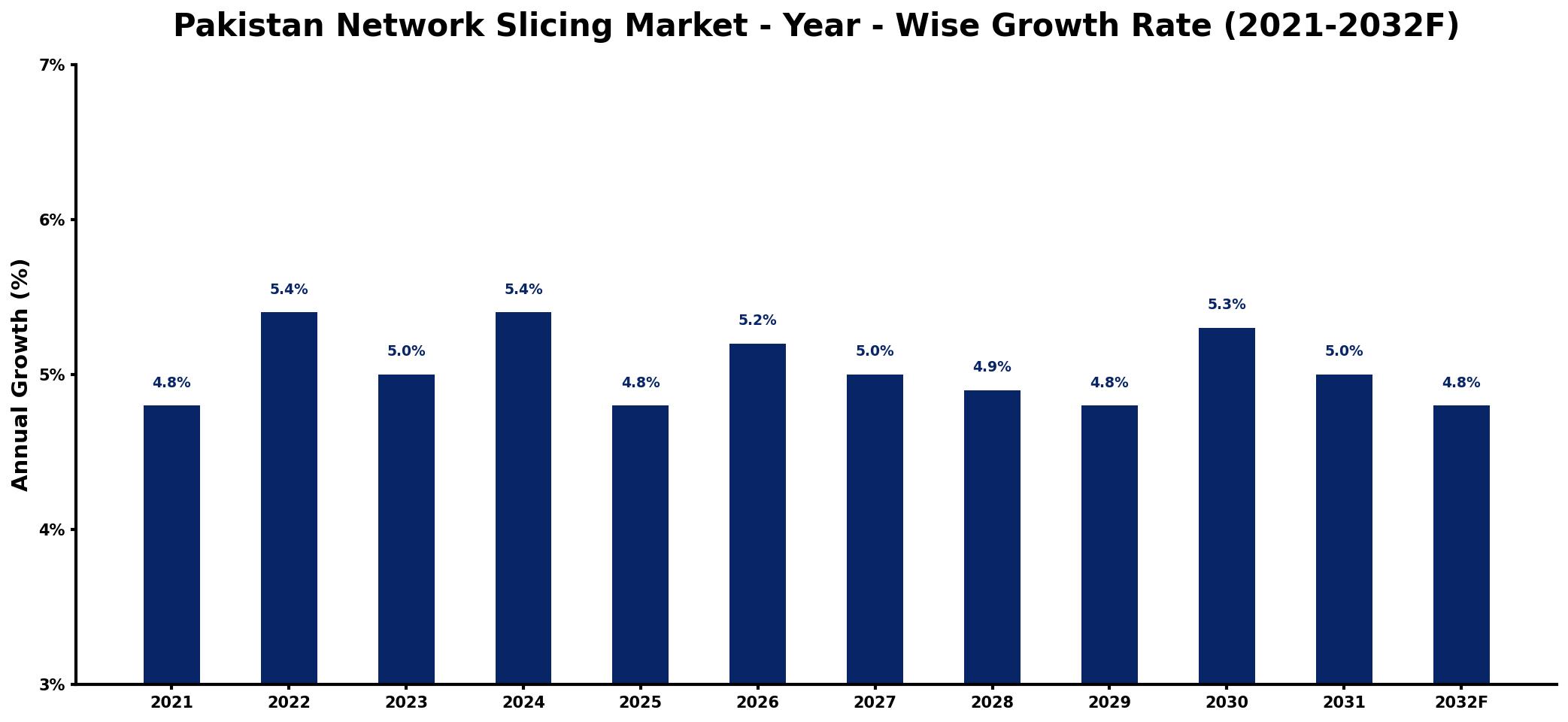
The table below presents the year‑wise growth rates along with the key drivers influencing the market
| Year | Growth Rate | Major Drivers |
| 2021 | 4.8% | increased mobile data consumption |
| 2022 | 5.4% | growth in IoT applications |
| 2023 | 5.0% | rising demand for 5G |
| 2024 | 5.4% | expansion of cloud services |
| 2025 | 4.8% | investments in digital infrastructure |
| 2026 | 5.2% | enhanced user experience expectations |
| 2027 | 5.0% | adoption of smart technologies |
| 2028 | 4.9% | increased production capacity utilization |
| 2029 | 4.8% | demand for reliable connectivity |
| 2030 | 5.3% | surge in streaming services |
| 2031 | 5.0% | increased automation in industries |
| 2032 | 4.8% | growing commercial sector adoption |
Note: Market size estimations and growth projections presented in this report are based on 6Wresearch's proprietary forecasting methodology, utilizing the latest available industry data, government publications, and primary research inputs.
Pakistan Network Slicing Market Synopsis
In Pakistan, the demand for network slicing is spurred by the critical need for enhanced mobile broadband and ultra-reliable low-latency communications. As industries such as healthcare and transportation seek to leverage advanced connectivity, the ability to create virtualized networks tailored to specific requirements becomes essential.
Additionally, the surge in mobile users coupled with the rapid expansion of smart devices necessitates the implementation of network slicing solutions. These technologies not only optimize bandwidth but also support mission-critical communications, thus fostering a more agile and responsive digital ecosystem.
Pakistan Network Slicing Market Key Takeaways
- The market is significantly influenced by the deployment of 5G infrastructure.
- Key applications include IoT connectivity, enhanced mobile broadband, and emergency services.
- Network slicing enhances operational efficiency by enabling tailored services.
- Collaboration among government, telecom operators, and tech providers is pivotal for market growth.
- The flexibility and scalability of network slicing solutions are major competitive advantages.
Evaluation of Restraints in Pakistan Network Slicing Market
The market is currently facing several restraints that hinder its rapid expansion. One of the primary challenges is the complexity associated with implementing network slicing on existing infrastructure, which may require significant upgrades and investments. Furthermore, ensuring robust security and privacy standards within these virtual networks remains a critical concern. The lack of regulatory frameworks to support these technologies adds another layer of difficulty, as operators often need clarity on compliance and governance. Lastly, the high costs associated with deploying advanced network slicing solutions can deter smaller players from entering the market, limiting competition and innovation.
Pakistan Network Slicing Market Trends
Several trends are emerging within the Pakistan Network Slicing Market. The integration of edge computing with network slicing is gaining traction, allowing for reduced latency and improved user experiences in real-time applications. Moreover, the increasing interest in smart cities and connected infrastructures propels the demand for specialized network slices to address unique connectivity requirements. Another trend is the focus on developing standardized frameworks for network slicing, fostering interoperability among different operators and technology providers.
Pakistan Network Slicing Market Opportunities
The opportunities within the Pakistan Network Slicing Market are vast. As sectors like healthcare and manufacturing increasingly adopt 5G technologies, there is a significant demand for customized network solutions that can support specific applications. Moreover, government initiatives aimed at enhancing digital infrastructure present lucrative investment avenues for telecommunications companies. The rising trend of automation and Industry 4.0 also creates potential for specialized network slices to support new business models and enhance operational efficiencies.
Government Initiatives in the Pakistan Network Slicing Market
The government of Pakistan is actively fostering the growth of the network slicing market by introducing supportive policies and initiatives. These include facilitating spectrum allocation for 5G services, investing in digital infrastructure, and establishing regulatory frameworks that encourage innovation in telecommunications. Collaboration among various stakeholders, including government agencies, telecom operators, and technology providers, is being emphasized to drive forward the deployment of network slicing capabilities, ultimately aiding in economic growth and digital transformation.
Future Insights of the Pakistan Network Slicing Market
Looking ahead to 2026-2032, the Pakistan Network Slicing Market is poised for significant evolution. As 5G networks become more entrenched, the demand for nuanced, application-specific network solutions will grow. The ongoing advancements in machine learning and artificial intelligence are expected to play a key role in optimizing network slicing capabilities, thereby providing operators with enhanced analytical tools for performance management. The increasing collaboration between public and private sectors will also lead to innovative solutions tailored to local challenges, ensuring the market adapts and flourishes in the changing digital landscape.
Pakistan Network Slicing Market Latest Developments (2025 - 2026)
Recently, there has been a marked shift in the industry direction toward enhancing the capabilities of network slicing solutions, particularly with the advancement of 5G technologies. Collaborative projects focusing on interoperability and standardization among various telecom operators are gaining momentum, aimed at streamlining deployment processes and enhancing customer experiences. Additionally, early adopters of network slicing in critical sectors are sharing case studies demonstrating the technologys efficacy, further encouraging industry stakeholders to embrace these transformative solutions.
Pakistan Network Slicing Market - Key Attractiveness of the Report
- 10 Years of Market Numbers
- Historical Data Starting from 2022 to 2025
- Base Year: 2025
- Forecast Data until 2032
- Key Performance Indicators Impacting the Market
- Major Upcoming Developments and Projects
Key Highlights of the Report:
- Pakistan Network Slicing Market Outlook
- Market Size of Pakistan Network Slicing Market, 2025
- Forecast of Pakistan Network Slicing Market, 2032
- Historical Data and Forecast of Pakistan Network Slicing Revenues & Volume for the Period 2022-2032F
- Pakistan Network Slicing Market Trend Evolution
- Pakistan Network Slicing Market Drivers and Challenges
- Pakistan Network Slicing Price Trends
- Pakistan Network Slicing Porter's Five Forces
- Pakistan Network Slicing Industry Life Cycle
- Historical Data and Forecast of Pakistan Network Slicing Market Revenues & Volume By Component for the Period 2022-2032F
- Historical Data and Forecast of Pakistan Network Slicing Market Revenues & Volume By Solution for the Period 2022-2032F
- Historical Data and Forecast of Pakistan Network Slicing Market Revenues & Volume By Services (Professional & Managed) for the Period 2022-2032F
- Historical Data and Forecast of Pakistan Network Slicing Market Revenues & Volume By End User for the Period 2022-2032F
- Historical Data and Forecast of Pakistan Network Slicing Market Revenues & Volume By Telecom Operators for the Period 2022-2032F
- Historical Data and Forecast of Pakistan Network Slicing Market Revenues & Volume By Enterprises for the Period 2022-2032F
- Historical Data and Forecast of Pakistan Network Slicing Market Revenues & Volume By Application for the Period 2022-2032F
- Historical Data and Forecast of Pakistan Network Slicing Market Revenues & Volume By Manufacturing for the Period 2022-2032F
- Historical Data and Forecast of Pakistan Network Slicing Market Revenues & Volume By Government for the Period 2022-2032F
- Historical Data and Forecast of Pakistan Network Slicing Market Revenues & Volume By Automotive for the Period 2022-2032F
- Historical Data and Forecast of Pakistan Network Slicing Market Revenues & Volume By Media and Entertainment for the Period 2022-2032F
- Pakistan Network Slicing Import Export Trade Statistics
- Market Opportunity Assessment By Component
- Market Opportunity Assessment By End User
- Market Opportunity Assessment By Application
- Pakistan Network Slicing Top Companies Market Share
- Pakistan Network Slicing Competitive Benchmarking By Technical and Operational Parameters
- Pakistan Network Slicing Company Profiles
- Pakistan Network Slicing Key Strategic Recommendations






































