Pakistan Organic Cotton Market Size, Share & Growth Rate
The Pakistan Organic Cotton Market was estimated at USD 1042 Million in 2025 and is projected to reach USD 1504 Million by 2032, growing at a CAGR of 5.4% from 2026 to 2032. This growth trajectory is primarily driven by a global surge in consumer preference for sustainable and eco-friendly products, which is increasingly reflected in the textile industry. The favorable climate conditions for organic cotton cultivation in Pakistan, coupled with government initiatives to bolster organic farming, position the country as a competitive player in the international market for sustainable textiles.
Pakistan Organic Cotton Market Year-wise Growth Rate and Key Drivers
This graph highlights how the Pakistan Organic Cotton Market has steadily grown over the years, supported by major growth factors.
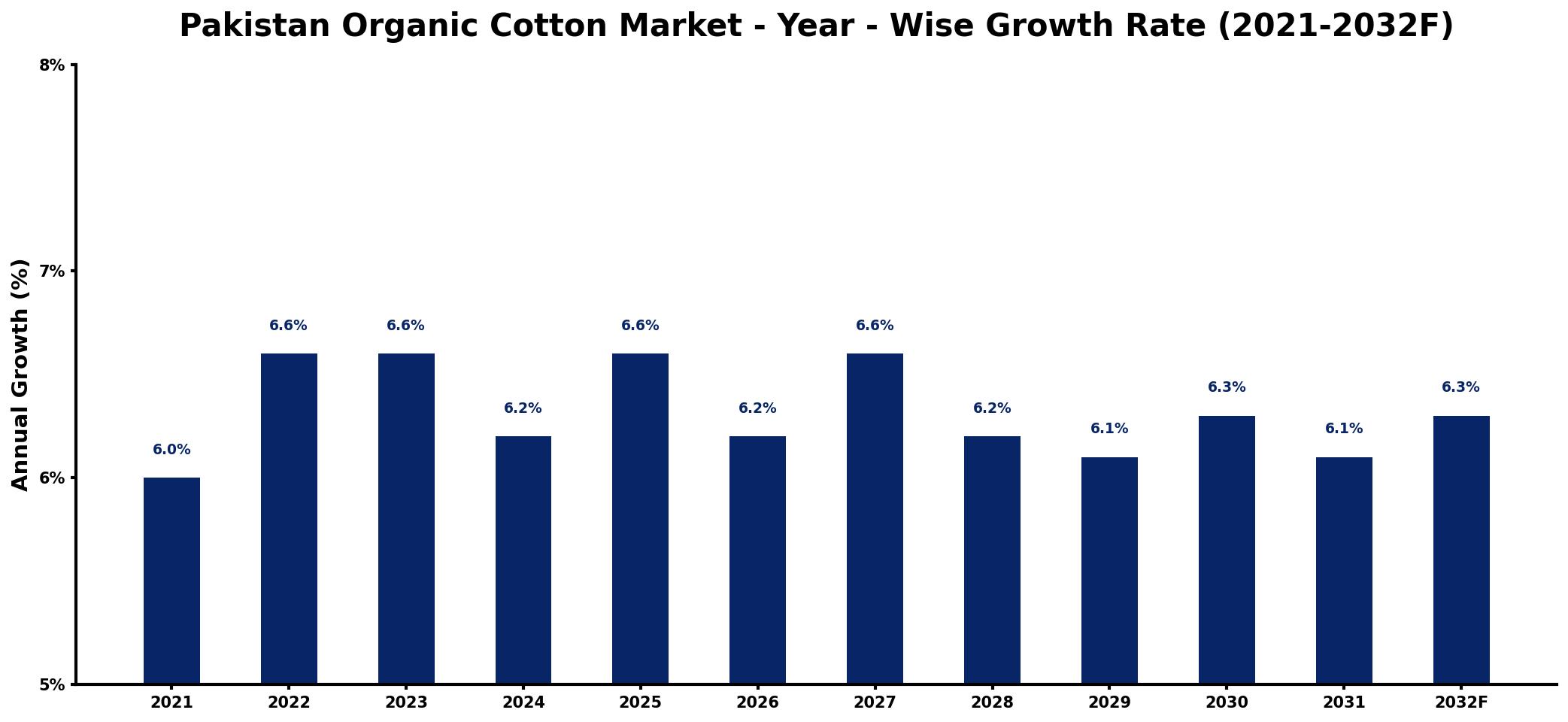
The table below presents the year‑wise growth rates along with the key drivers influencing the market
| Year | Growth Rate | Major Drivers |
| 2021 | 6.0% | Rising consumer health awareness |
| 2022 | 6.6% | Increased investment in sustainability |
| 2023 | 6.6% | Growing eco-friendly fashion trends |
| 2024 | 6.2% | Expansion of retail distribution channels |
| 2025 | 6.6% | Surge in ethical sourcing initiatives |
| 2026 | 6.2% | Strengthening of local farming communities |
| 2027 | 6.6% | Increase in government support programs |
| 2028 | 6.2% | Enhanced global trade agreements |
| 2029 | 6.1% | Growth in e-commerce platforms |
| 2030 | 6.3% | Rising popularity of lifestyle brands |
| 2031 | 6.1% | Development of innovative farming techniques |
| 2032 | 6.3% | Strengthened consumer education campaigns |
Note: Market size estimations and growth projections presented in this report are based on 6Wresearch's proprietary forecasting methodology, utilizing the latest available industry data, government publications, and primary research inputs.
Pakistan Organic Cotton Market Synopsis
In recent years, the Pakistan Organic Cotton Market has witnessed a significant shift towards sustainable practices, driven by rising consumer awareness of environmental issues. Farmers are increasingly adopting organic methods to align with this growing demand, while various stakeholders are championing organic farming practices to ensure product authenticity and quality.
The market's expansion is supported by government policies that aim to promote organic agriculture. Such initiatives not only provide financial assistance but also enhance the overall infrastructure for organic farming, paving the way for increased production and export opportunities in the textile sector.
Pakistan Organic Cotton Market Key Takeaways
- The demand for organic cotton is accelerating due to heightened environmental consciousness among consumers.
- Government initiatives are crucial in promoting organic farming through subsidies and training programs.
- Infrastructure improvements for organic certification are necessary to bolster market access.
- Investment opportunities in organic farming and textile processing are on the rise.
- The market is expected to thrive with increasing global trends towards sustainable textiles.
Evaluation of Restraints in Pakistan Organic Cotton Market
Despite its promising outlook, the Pakistan Organic Cotton Market faces several critical challenges. Limited awareness among farmers regarding organic farming practices can hinder the shift from conventional methods. Additionally, the lack of comprehensive infrastructure for organic certification presents barriers to entry for many producers. The high costs associated with adopting organic farming techniques can also deter potential growers. Furthermore, issues surrounding the availability of certified organic seeds and inefficient pricing mechanisms continue to restrict market growth. Addressing these concerns will be vital for the long-term sustainability of this burgeoning market.
Pakistan Organic Cotton Market Trends
A notable trend within the Pakistan Organic Cotton Market is the increasing demand for eco-friendly textiles, driven by both consumer preferences and evolving fashion industry standards. The health benefits associated with organic cotton, along with its reduced environmental footprint, are increasingly influencing consumer choices. Moreover, the growing commitment of local farmers to transition towards organic practices reflects a broader societal shift toward sustainable living.
Pakistan Organic Cotton Market Opportunities
Investors looking into the Pakistan Organic Cotton Market have abundant opportunities as the demand for sustainable textiles rises globally. The potential for capital investment in organic cotton farming, processing facilities, and textile manufacturing is strong, especially as international fashion brands seek to source ethically produced materials. This market also presents avenues for partnerships and collaborations with government programs that incentivize organic production, creating a win-win for farmers and investors alike.
Government Initiatives in the Pakistan Organic Cotton Market
The Pakistani government has established several initiatives aimed at bolstering the organic cotton market. Through the Organic Farming Policy, farmers are encouraged to adopt sustainable practices via subsidies, technical assistance, and training programs. The Pakistan Central Cotton Committee (PCCC) plays a pivotal role in regulating organic cotton production and certification, ensuring that the quality of organic products meets international standards. These policies not only foster sustainable agriculture but also aim to improve the competitiveness of Pakistan's organic cotton sector on a global scale.
Future Insights of the Pakistan Organic Cotton Market
Looking ahead to 2026-2032, the future of the Pakistan Organic Cotton Market appears promising. As global consumers become more discerning about the origins of their products, the demand for organic cotton is expected to grow. With government support and increased investments in organic farming technologies, Pakistan can enhance its production capabilities and position itself favorably within the sustainable textiles market. This will not only benefit farmers and local economies but also align with global sustainability goals.
Pakistan Organic Cotton Market Latest Developments (2025 - 2026)
In the recent months, the Pakistan Organic Cotton Market has seen several significant developments. Efforts to enhance organic certification processes are underway, with new partnerships forming between farmers and international organizations aimed at improving standards. Additionally, awareness campaigns promoting the benefits of organic cotton are being launched to educate consumers and increase market demand. These initiatives signal a robust commitment to expanding the organic cotton sector and responding to emerging trends in sustainable fashion.
Pakistan Organic Cotton Market - Key Attractiveness of the Report
- 10 Years of Market Numbers
- Historical Data Starting from 2022 to 2025
- Base Year: 2025
- Forecast Data until 2032
- Key Performance Indicators Impacting the Market
- Major Upcoming Developments and Projects
Key Highlights of the Report:
- Pakistan Organic Cotton Market Outlook
- Market Size of Pakistan Organic Cotton Market, 2025
- Forecast of Pakistan Organic Cotton Market, 2032
- Historical Data and Forecast of Pakistan Organic Cotton Revenues & Volume for the Period 2022-2032F
- Pakistan Organic Cotton Market Trend Evolution
- Pakistan Organic Cotton Market Drivers and Challenges
- Pakistan Organic Cotton Price Trends
- Pakistan Organic Cotton Porter's Five Forces
- Pakistan Organic Cotton Industry Life Cycle
- Historical Data and Forecast of Pakistan Organic Cotton Market Revenues & Volume By Type for the Period 2022-2032F
- Historical Data and Forecast of Pakistan Organic Cotton Market Revenues & Volume By Long-Staple Cotton for the Period 2022-2032F
- Historical Data and Forecast of Pakistan Organic Cotton Market Revenues & Volume By Short-Staple Cotton for the Period 2022-2032F
- Historical Data and Forecast of Pakistan Organic Cotton Market Revenues & Volume By Middle Staple Cotton for the Period 2022-2032F
- Historical Data and Forecast of Pakistan Organic Cotton Market Revenues & Volume By Extra-long Staple Cotton for the Period 2022-2032F
- Historical Data and Forecast of Pakistan Organic Cotton Market Revenues & Volume By Others for the Period 2022-2032F
- Historical Data and Forecast of Pakistan Organic Cotton Market Revenues & Volume By Quality Type for the Period 2022-2032F
- Historical Data and Forecast of Pakistan Organic Cotton Market Revenues & Volume By Supima/Pima for the Period 2022-2032F
- Historical Data and Forecast of Pakistan Organic Cotton Market Revenues & Volume By Upland for the Period 2022-2032F
- Historical Data and Forecast of Pakistan Organic Cotton Market Revenues & Volume By Giza for the Period 2022-2032F
- Historical Data and Forecast of Pakistan Organic Cotton Market Revenues & Volume By Others for the Period 2022-2032F
- Historical Data and Forecast of Pakistan Organic Cotton Market Revenues & Volume By Application for the Period 2022-2032F
- Historical Data and Forecast of Pakistan Organic Cotton Market Revenues & Volume By Apparel for the Period 2022-2032F
- Historical Data and Forecast of Pakistan Organic Cotton Market Revenues & Volume By Packaging for the Period 2022-2032F
- Historical Data and Forecast of Pakistan Organic Cotton Market Revenues & Volume By Others for the Period 2022-2032F
- Pakistan Organic Cotton Import Export Trade Statistics
- Market Opportunity Assessment By Type
- Market Opportunity Assessment By Quality Type
- Market Opportunity Assessment By Application
- Pakistan Organic Cotton Top Companies Market Share
- Pakistan Organic Cotton Competitive Benchmarking By Technical and Operational Parameters
- Pakistan Organic Cotton Company Profiles
- Pakistan Organic Cotton Key Strategic Recommendations






































