Pakistan Pearl Jewelry Market Size, Share & Growth Rate
The Pakistan Pearl Jewelry Market was estimated at USD 696 Million in 2025 and is projected to reach USD 1001 Million by 2032, growing at a CAGR of 5.3% from 2026 to 2032. This growth trajectory is propelled by a cultural affinity for pearls, symbolizing grace and sophistication within Pakistani society. The increasing incorporation of contemporary designs by local artisans is attracting a younger audience, further stimulating demand across diverse consumer segments.
Pakistan Pearl Jewelry Market Year-wise Growth Rate and Key Drivers
This graph highlights how the Pakistan Pearl Jewelry Market has steadily grown over the years, supported by major growth factors.
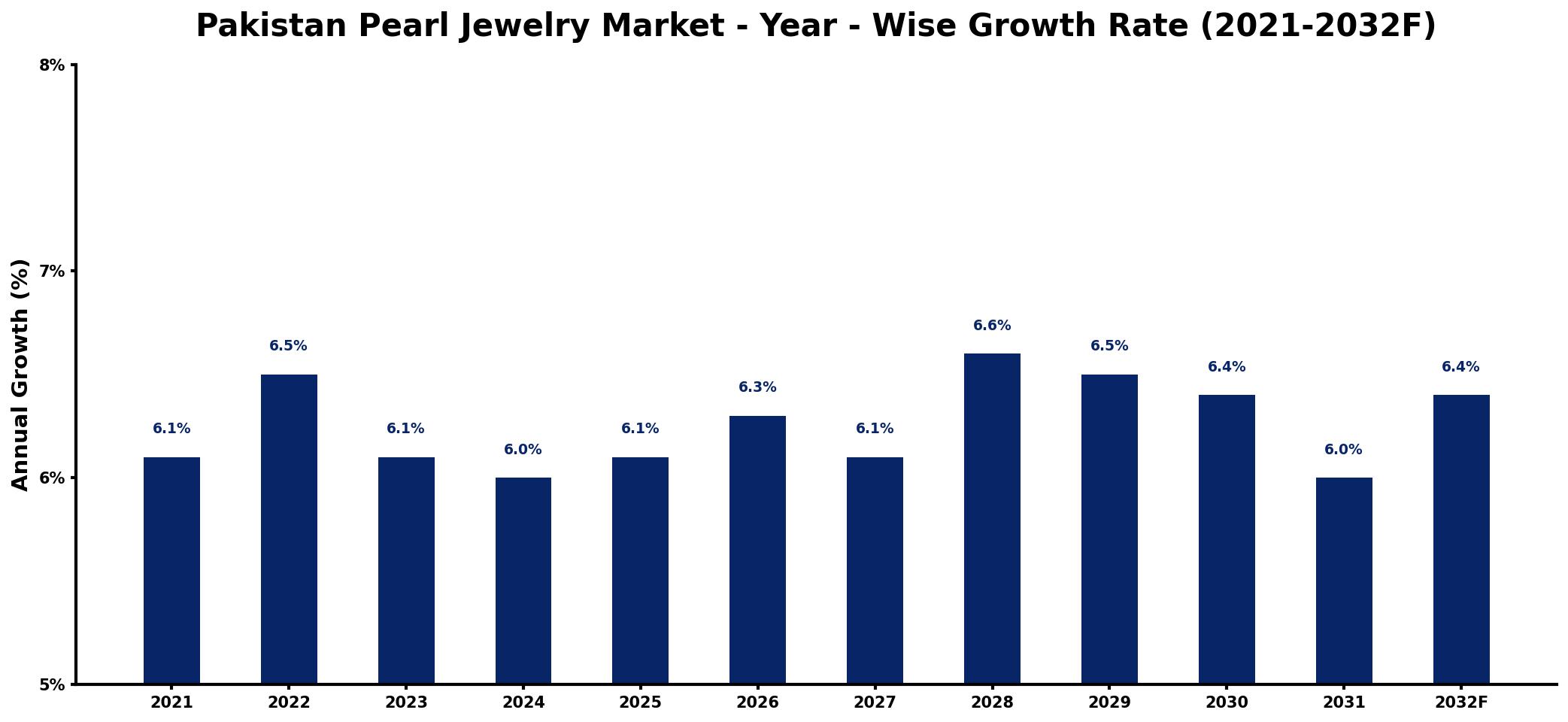
The table below presents the year‑wise growth rates along with the key drivers influencing the market
| Year | Growth Rate | Major Drivers |
| 2021 | 6.1% | Rising consumer spending trends |
| 2022 | 6.5% | Increased luxury market investments |
| 2023 | 6.1% | Growing online retail platforms |
| 2024 | 6.0% | Expansion of artisanal craftsmanship |
| 2025 | 6.1% | Surge in cultural celebrations |
| 2026 | 6.3% | Enhanced marketing strategies adopted |
| 2027 | 6.1% | Diversification of product offerings |
| 2028 | 6.6% | Emergence of sustainable sourcing |
| 2029 | 6.5% | Strengthening global trade relations |
| 2030 | 6.4% | Growing interest in heritage crafts |
| 2031 | 6.0% | Increased tourism boosting demand |
| 2032 | 6.4% | Rising influence of social media |
Note: Market size estimations and growth projections presented in this report are based on 6Wresearch's proprietary forecasting methodology, utilizing the latest available industry data, government publications, and primary research inputs.
Pakistan Pearl Jewelry Market Synopsis
In Pakistan, the unique craftsmanship surrounding pearl jewelry is not merely a trade but a vital expression of the nation's rich cultural heritage. Local artisans are increasingly integrating pearls into modern designs, thereby appealing to a demographic that values both tradition and contemporary aesthetics. This unique blend of styles is essential for attracting younger consumers, eager for authenticity in their jewelry choices.
The market is notably characterized by a wide array of offerings, including necklaces, earrings, bracelets, and rings. This diversity caters to various consumer preferences, with rising demand for ethically sourced and sustainable pieces. As e-commerce platforms expand their reach, customers are enjoying unprecedented access to a broader selection of high-quality pearl jewelry, further enhancing market growth.
Pakistan Pearl Jewelry Market Key Takeaways
- The market is driven by a strong cultural significance of pearls, representing grace and elegance in Pakistani society.
- Modern design integration by local artisans is attracting a younger customer base.
- Growth in e-commerce platforms facilitates access to a diverse range of pearl jewelry.
- Consumers are increasingly prioritizing sustainable and ethically sourced jewelry options.
- The government is implementing supportive policies to enhance the competitiveness of the pearl jewelry sector.
Evaluation of Restraints in Pakistan Pearl Jewelry Market
Despite its growth potential, the Pakistan Pearl Jewelry Market faces notable challenges. One significant constraint is the reliance on imported high-quality pearls, which can lead to inconsistencies in product quality. Moreover, there is a prevailing lack of consumer awareness regarding the authenticity and grading of pearls, raising trust issues within the market. These elements, compounded by the presence of counterfeit products, highlight the necessity for improved quality control measures and consumer education initiatives.
Pakistan Pearl Jewelry Market Trends
Emerging trends within the Pakistan Pearl Jewelry Market point towards a growing consumer preference for modern, minimalist designs. This shift is especially pronounced among younger audiences seeking unique, high-quality pieces that resonate with their ethical values. Additionally, the increasing awareness of sustainable practices is fueling demand for natural and renewable pearl options. Artisans are actively responding to this trend by innovating their offerings, ensuring they remain relevant in a rapidly evolving market landscape.
Pakistan Pearl Jewelry Market Opportunities
The landscape of the Pakistan Pearl Jewelry Market is ripe with investment opportunities, particularly in the realms of manufacturing and retail. Given the cultural significance of pearl jewelry and the growing demand for distinct pieces, there is substantial potential for profitable ventures. E-commerce is emerging as a pivotal channel for reaching both domestic and international customers, providing a platform for broader distribution. Collaborating with local artisans to craft innovative designs could also cater to niche markets seeking unique offerings.
Government Initiatives in the Pakistan Pearl Jewelry Market
The government of Pakistan is actively promoting the pearl jewelry market through a variety of initiatives aimed at enhancing production and export. Policies have been put in place to offer incentives such as tax breaks and subsidies to pearl farmers and jewelers, encouraging industry growth. Furthermore, the regulatory framework is being streamlined to ensure adherence to quality standards, while sustainable practices in pearl farming are being promoted to ensure long-term viability of the sector.
Future Insights of the Pakistan Pearl Jewelry Market
Looking ahead to 2026-2032, the Pakistan Pearl Jewelry Market is set for consistent expansion, driven by increasing consumer interest in both traditional and sustainable jewelry options. As online shopping continues to gain traction, the market will benefit from enhanced accessibility to pearl jewelry. With a strong cultural heritage underpinning its appeal and a commitment to quality craftsmanship, Pakistan is well-positioned to carve a significant niche in the global pearl jewelry arena.
Pakistan Pearl Jewelry Market Latest Developments (2025 - 2026)
Recent developments in the Pakistan Pearl Jewelry Market reflect a broader trend towards sustainability and ethical sourcing. Local designers are increasingly collaborating with artisans to produce collections that highlight traditional techniques while embracing modern aesthetics. Additionally, awareness campaigns aimed at educating consumers about pearl authenticity and grading are being launched, further reinforcing market integrity and trust.
Pakistan Pearl Jewelry Market - Key Attractiveness of the Report
- 10 Years of Market Numbers
- Historical Data Starting from 2022 to 2025
- Base Year: 2025
- Forecast Data until 2032
- Key Performance Indicators Impacting the Market
- Major Upcoming Developments and Projects
Key Highlights of the Report:
- Pakistan Pearl Jewelry Market Outlook
- Market Size of Pakistan Pearl Jewelry Market, 2025
- Forecast of Pakistan Pearl Jewelry Market, 2032
- Historical Data and Forecast of Pakistan Pearl Jewelry Revenues & Volume for the Period 2022-2032F
- Pakistan Pearl Jewelry Market Trend Evolution
- Pakistan Pearl Jewelry Market Drivers and Challenges
- Pakistan Pearl Jewelry Price Trends
- Pakistan Pearl Jewelry Porter's Five Forces
- Pakistan Pearl Jewelry Industry Life Cycle
- Historical Data and Forecast of Pakistan Pearl Jewelry Market Revenues & Volume By Pearl Type for the Period 2022-2032F
- Historical Data and Forecast of Pakistan Pearl Jewelry Market Revenues & Volume By Freshwater for the Period 2022-2032F
- Historical Data and Forecast of Pakistan Pearl Jewelry Market Revenues & Volume By Saltwater for the Period 2022-2032F
- Historical Data and Forecast of Pakistan Pearl Jewelry Market Revenues & Volume By Material Type for the Period 2022-2032F
- Historical Data and Forecast of Pakistan Pearl Jewelry Market Revenues & Volume By Gold for the Period 2022-2032F
- Historical Data and Forecast of Pakistan Pearl Jewelry Market Revenues & Volume By Silver for the Period 2022-2032F
- Historical Data and Forecast of Pakistan Pearl Jewelry Market Revenues & Volume By Others for the Period 2022-2032F
- Historical Data and Forecast of Pakistan Pearl Jewelry Market Revenues & Volume By Jewelry Type for the Period 2022-2032F
- Historical Data and Forecast of Pakistan Pearl Jewelry Market Revenues & Volume By Necklace for the Period 2022-2032F
- Historical Data and Forecast of Pakistan Pearl Jewelry Market Revenues & Volume By Earrings for the Period 2022-2032F
- Historical Data and Forecast of Pakistan Pearl Jewelry Market Revenues & Volume By Rings for the Period 2022-2032F
- Historical Data and Forecast of Pakistan Pearl Jewelry Market Revenues & Volume By Others for the Period 2022-2032F
- Pakistan Pearl Jewelry Import Export Trade Statistics
- Market Opportunity Assessment By Pearl Type
- Market Opportunity Assessment By Material Type
- Market Opportunity Assessment By Jewelry Type
- Pakistan Pearl Jewelry Top Companies Market Share
- Pakistan Pearl Jewelry Competitive Benchmarking By Technical and Operational Parameters
- Pakistan Pearl Jewelry Company Profiles
- Pakistan Pearl Jewelry Key Strategic Recommendations






































