Pakistan Personal Computers Market: Import Trend Analysis
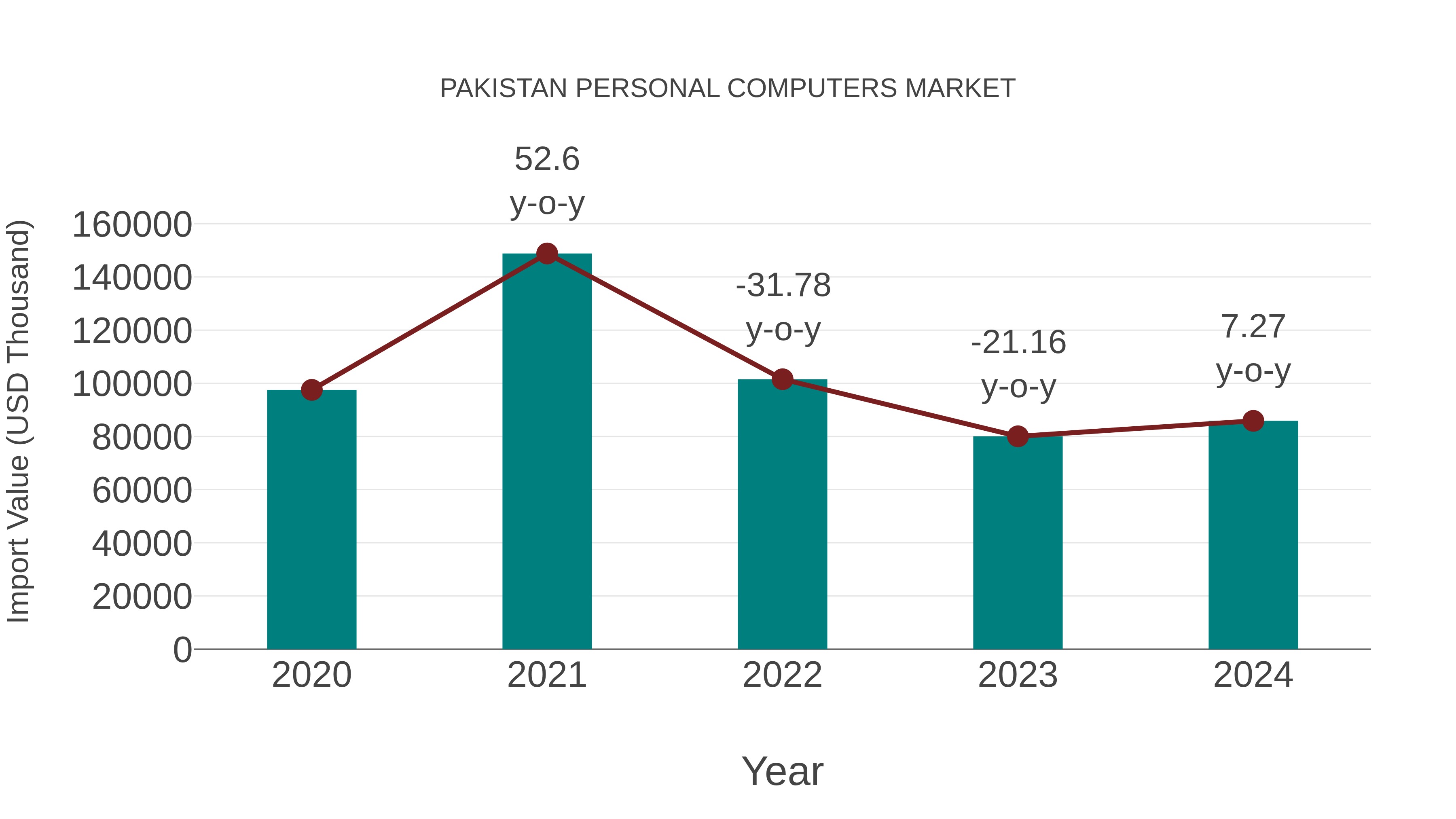
In the Pakistan personal computers market, the import trend from 2023 to 2024 showed a growth rate of 7.27%. However, the compound annual growth rate (CAGR) for imports from 2020 to 2024 stood at -3.13%. This fluctuation may be attributed to shifts in consumer demand or changes in trade policies impacting the market.
Pakistan Personal Computers Market Synopsis
The Pakistan personal computers market is witnessing steady growth driven by increasing digitalization, adoption of remote work practices, and rising demand for technology products. The market is characterized by a mix of domestic and international brands offering a wide range of products to cater to the diverse consumer base. Key players in the market include Dell, HP, Lenovo, and Acer among others. Factors such as affordable pricing, government initiatives promoting digital literacy, and expanding internet connectivity are fueling market growth. Additionally, the education sector`s increasing focus on e-learning and the gaming community`s rising interest in high-performance PCs are contributing to the market`s expansion. As consumer preferences evolve towards mobility and performance, there is a growing demand for laptops and ultra-portable devices in addition to traditional desktop PCs.
Pakistan Personal Computers Market Trends
The Pakistan Personal Computers Market is currently experiencing a shift towards more compact and portable devices such as laptops and tablets, driven by the increasing demand for convenience and mobility. There is a growing interest in gaming laptops among the younger population, leading to a surge in sales of high-performance devices with advanced graphics capabilities. Additionally, there is a rising adoption of all-in-one PCs in both residential and commercial sectors due to their space-saving design and integrated features. Cloud computing and remote work trends have also contributed to the increasing demand for personal computers with enhanced connectivity options and security features. Overall, the market is witnessing a trend towards smarter and more versatile computing solutions that cater to the evolving needs of consumers in Pakistan.
Pakistan Personal Computers Market Challenges
In the Pakistan Personal Computers Market, some key challenges include low purchasing power among the general population, resulting in limited demand for high-end computing devices. Additionally, the presence of a significant market for used and refurbished computers poses a challenge for manufacturers and retailers trying to promote new products. Infrastructure issues such as unreliable electricity supply and limited internet connectivity also hinder the widespread adoption of personal computers in Pakistan. Furthermore, the prevalence of counterfeit products in the market creates trust and quality concerns among consumers, impacting their willingness to invest in personal computers. Overall, addressing these challenges will require a combination of initiatives focused on improving affordability, infrastructure development, and consumer education to drive growth in the Pakistan Personal Computers Market.
Pakistan Personal Computers Market Investment Opportunities
The Pakistan Personal Computers Market presents several investment opportunities due to the country`s growing population, increasing internet penetration, and rising demand for technological solutions. With a large young demographic driving the adoption of digital technologies, investments in affordable and quality personal computers targeting students, professionals, and businesses have significant potential for growth. Additionally, there is a growing trend towards remote work and online education, further boosting the demand for personal computers in Pakistan. Investors could explore opportunities in manufacturing or importing PCs, developing software solutions tailored to local needs, or providing after-sales services and support to capitalize on the expanding market. Overall, the Pakistan Personal Computers Market offers a promising landscape for investors looking to tap into the country`s evolving tech ecosystem.
Jordan Agar Market Government Policies
The Pakistan government has implemented various policies to support the growth of the Personal Computers Market. These policies include reducing import duties on computer hardware to make them more affordable for consumers, providing tax incentives for local assembly of computers to promote domestic manufacturing, and offering subsidies for the establishment of computer training centers to increase digital literacy. Additionally, the government has initiated programs to improve internet connectivity and infrastructure to further stimulate the demand for personal computers in the country. Overall, these policies aim to boost the accessibility and affordability of personal computers in Pakistan, drive economic growth, and enhance the technological capabilities of the population.
Pakistan Personal Computers Market Future Outlook
The future outlook for the Pakistan Personal Computers Market appears promising, driven by factors such as the increasing adoption of technology across various sectors, rising demand for remote working and online education solutions, and a growing young population with a high affinity for digital devices. The shift towards e-commerce and digitalization of businesses is also expected to boost the demand for personal computers in Pakistan. Furthermore, government initiatives to promote digital literacy and connectivity in rural areas are likely to contribute to market growth. However, challenges such as economic uncertainty, fluctuating currency values, and intense competition from mobile devices may impact the market dynamics. Overall, the Pakistan Personal Computers Market is anticipated to witness steady growth in the coming years, provided companies innovate and adapt to changing consumer preferences and technological advancements.
Key Highlights of the Report:
- Pakistan Personal Computers Market Outlook
- Market Size of Pakistan Personal Computers Market, 2025
- Forecast of Pakistan Personal Computers Market, 2032
- Historical Data and Forecast of Pakistan Personal Computers Revenues & Volume for the Period 2022 - 2032F
- Pakistan Personal Computers Market Trend Evolution
- Pakistan Personal Computers Market Drivers and Challenges
- Pakistan Personal Computers Price Trends
- Pakistan Personal Computers Porter's Five Forces
- Pakistan Personal Computers Industry Life Cycle
- Historical Data and Forecast of Pakistan Personal Computers Market Revenues & Volume By Product Type for the Period 2022 - 2032F
- Historical Data and Forecast of Pakistan Personal Computers Market Revenues & Volume By Desktop for the Period 2022 - 2032F
- Historical Data and Forecast of Pakistan Personal Computers Market Revenues & Volume By Notebook for the Period 2022 - 2032F
- Historical Data and Forecast of Pakistan Personal Computers Market Revenues & Volume By Workstation for the Period 2022 - 2032F
- Historical Data and Forecast of Pakistan Personal Computers Market Revenues & Volume By Others for the Period 2022 - 2032F
- Historical Data and Forecast of Pakistan Personal Computers Market Revenues & Volume By Distribution Channel for the Period 2022 - 2032F
- Historical Data and Forecast of Pakistan Personal Computers Market Revenues & Volume By Business-To-Business (B2B) for the Period 2022 - 2032F
- Historical Data and Forecast of Pakistan Personal Computers Market Revenues & Volume By Business-To-Consumer (B2C) for the Period 2022 - 2032F
- Historical Data and Forecast of Pakistan Personal Computers Market Revenues & Volume By Application for the Period 2022 - 2032F
- Historical Data and Forecast of Pakistan Personal Computers Market Revenues & Volume By Consumer for the Period 2022 - 2032F
- Historical Data and Forecast of Pakistan Personal Computers Market Revenues & Volume By Commercial for the Period 2022 - 2032F
- Historical Data and Forecast of Pakistan Personal Computers Market Revenues & Volume By Industrial for the Period 2022 - 2032F
- Pakistan Personal Computers Import Export Trade Statistics
- Market Opportunity Assessment By Product Type
- Market Opportunity Assessment By Distribution Channel
- Market Opportunity Assessment By Application
- Pakistan Personal Computers Top Companies Market Share
- Pakistan Personal Computers Competitive Benchmarking By Technical and Operational Parameters
- Pakistan Personal Computers Company Profiles
- Pakistan Personal Computers Key Strategic Recommendations






































