Pakistan Pest Control Market: Import Trend Analysis
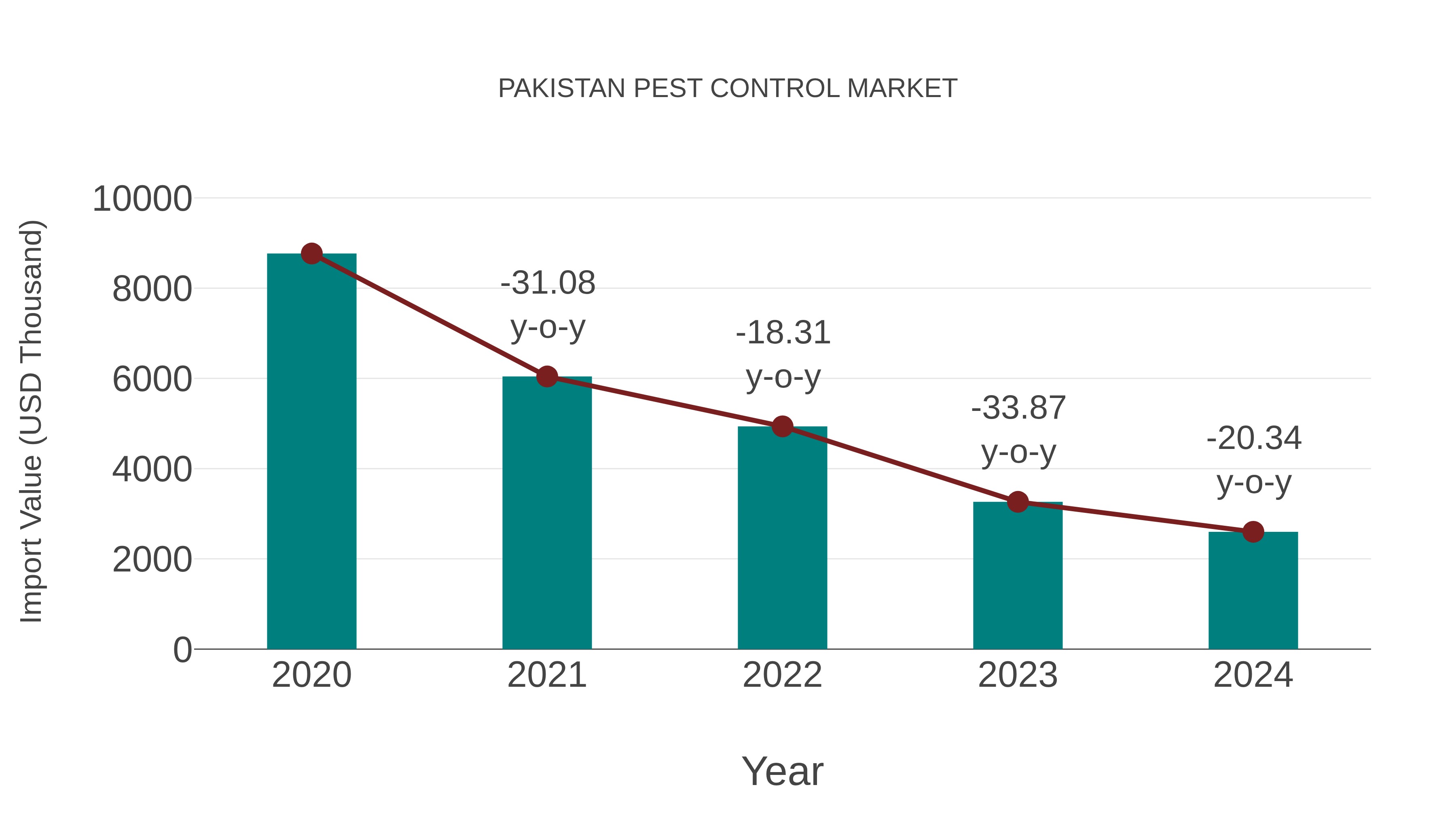
Pakistan import trend for the pest control market experienced a decline, with a growth rate of -20.34% from 2023 to 2024. The compound annual growth rate (CAGR) for 2020-2024 stood at -26.2%. This decline could be attributed to shifts in consumer preferences or changes in trade policies impacting the market dynamics.
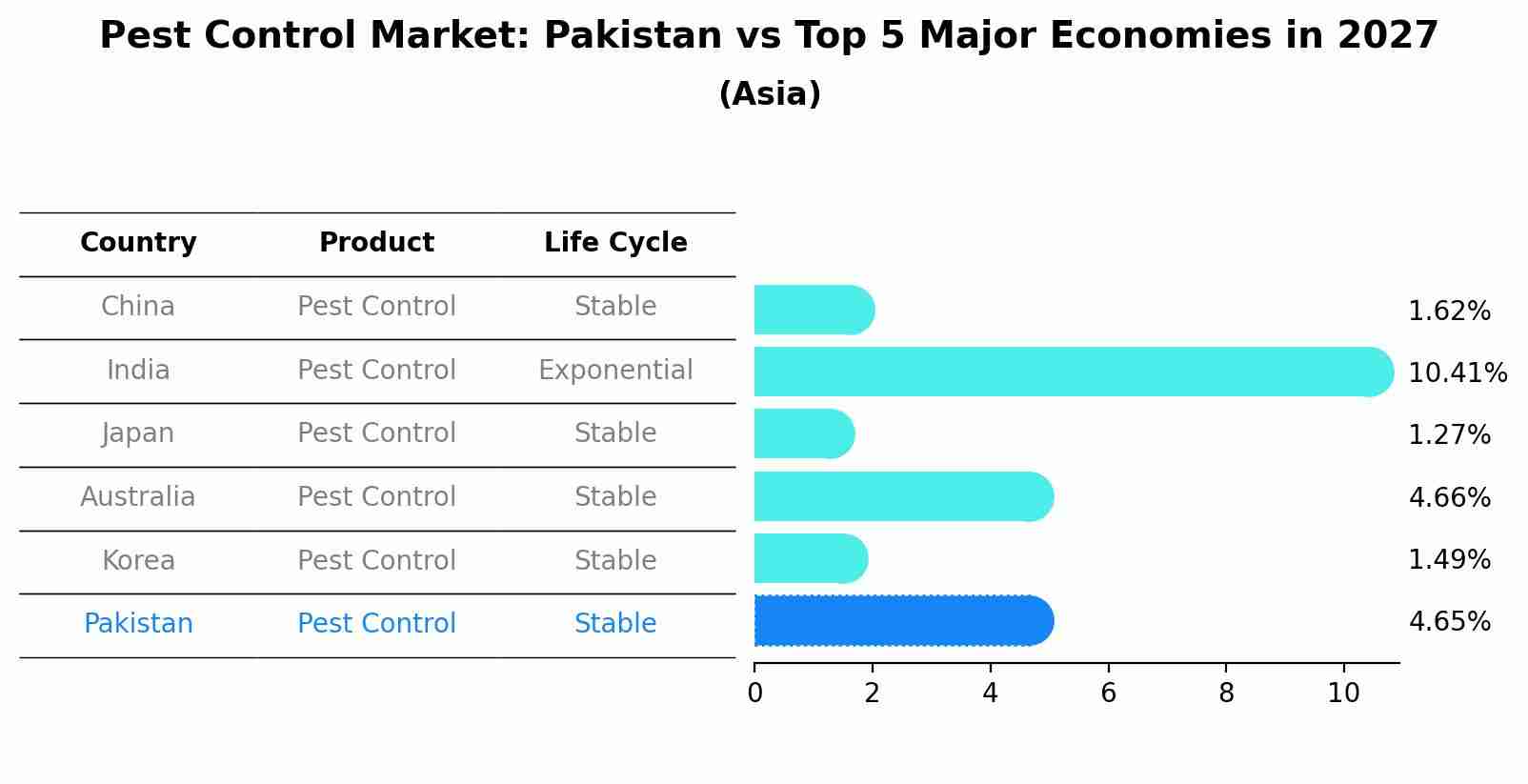
Pest Control Market: Pakistan vs Top 5 Major Economies in 2027 (Asia)
By 2027, the Pest Control market in Pakistan is anticipated to reach a growth rate of 4.65%, as part of an increasingly competitive Asia region, where China remains at the forefront, supported by India, Japan, Australia and South Korea, driving innovations and market adoption across sectors.
Pakistan Pest Control Market Synopsis
The Pakistan pest control market is experiencing steady growth driven by factors such as increasing awareness about health and hygiene, rapid urbanization, and rising pest infestations in residential, commercial, and industrial sectors. The market is characterized by a variety of pest control services including insect control, rodent control, fumigation, and termite control. Key players in the market offer a range of solutions utilizing both chemical and non-chemical methods to address pest issues effectively. Government regulations focusing on environmental sustainability and safety are influencing market trends, leading to the adoption of more eco-friendly pest control practices. With a growing emphasis on preventive measures and the importance of pest management in ensuring public health, the Pakistan pest control market is expected to continue its upward trajectory in the coming years.
Pakistan Pest Control Market Trends
The Pakistan pest control market is experiencing a growing demand for eco-friendly and sustainable pest control solutions due to increased awareness of environmental issues and health concerns. Integrated Pest Management (IPM) practices are gaining popularity as they focus on reducing pesticide usage and promoting natural pest control methods. The market is also witnessing a rise in demand for tech-driven solutions such as smart traps and remote monitoring systems, providing more efficient and targeted pest control services. With a focus on preventive measures and ongoing maintenance programs, pest control companies in Pakistan are emphasizing long-term solutions to ensure customer satisfaction and retention. Overall, the market is evolving towards more environmentally conscious and innovative approaches to pest management.
Pakistan Pest Control Market Challenges
In the Pakistan Pest Control Market, some key challenges include lack of awareness about the importance of professional pest control services among a significant portion of the population, leading to a preference for DIY methods or traditional remedies. Another challenge is the presence of unlicensed and unregulated operators offering substandard services, which tarnishes the reputation of the industry as a whole. Additionally, the industry faces issues related to the availability and affordability of safe and effective pest control products, as well as the need for continuous training and certification of technicians to ensure quality service delivery. Economic factors and seasonal variations in pest populations also impact the demand for pest control services, making it necessary for companies to adopt flexible strategies to address these challenges and maintain a competitive edge in the market.
Pakistan Pest Control Market Investment Opportunities
The Pakistan Pest Control Market presents lucrative investment opportunities due to the increasing awareness and demand for pest management services across residential, commercial, and industrial sectors. With the country`s growing population and urbanization, there is a rising need for effective pest control solutions to ensure public health and safety. Investing in innovative pest control technologies, eco-friendly products, and integrated pest management services can be a strategic move to capitalize on this market. Additionally, offering specialized services targeting specific industries such as agriculture, food processing, and healthcare can further drive growth and profitability in the sector. Collaborating with local authorities and businesses to address pest-related challenges and promoting sustainable practices can also enhance market presence and long-term success in the Pakistan Pest Control Market.
Pakistan Pest Control Market Future Outlook
The Pakistan pest control market is expected to witness steady growth in the coming years due to increasing urbanization, growing awareness about the importance of pest control for health and sanitation, and stricter regulations on pest management in commercial and residential settings. With a rising middle class population and expanding commercial sectors such as hospitality and food processing, the demand for pest control services is projected to increase. Integrated pest management approaches, eco-friendly solutions, and digital technologies are likely to gain traction in the market as consumers become more conscious of environmental impact and seek efficient and sustainable pest control solutions. Overall, the Pakistan pest control market is poised for growth opportunities driven by changing consumer preferences and regulatory requirements.
Key Highlights of the Report:
- Pakistan Pest Control Market Outlook
- Market Size of Pakistan Pest Control Market, 2021
- Forecast of Pakistan Pest Control Market, 2031
- Historical Data and Forecast of Pakistan Pest Control Revenues & Volume for the Period 2018 - 2031
- Pakistan Pest Control Market Trend Evolution
- Pakistan Pest Control Market Drivers and Challenges
- Pakistan Pest Control Price Trends
- Pakistan Pest Control Porter's Five Forces
- Pakistan Pest Control Industry Life Cycle
- Historical Data and Forecast of Pakistan Pest Control Market Revenues & Volume By Pest Type for the Period 2018 - 2031
- Historical Data and Forecast of Pakistan Pest Control Market Revenues & Volume By Insects for the Period 2018 - 2031
- Historical Data and Forecast of Pakistan Pest Control Market Revenues & Volume By Termites for the Period 2018 - 2031
- Historical Data and Forecast of Pakistan Pest Control Market Revenues & Volume By Rodents for the Period 2018 - 2031
- Historical Data and Forecast of Pakistan Pest Control Market Revenues & Volume By Wildlife for the Period 2018 - 2031
- Historical Data and Forecast of Pakistan Pest Control Market Revenues & Volume By Other pest types (birds, reptiles, and mollusks) for the Period 2018 - 2031
- Historical Data and Forecast of Pakistan Pest Control Market Revenues & Volume By Control Method for the Period 2018 - 2031
- Historical Data and Forecast of Pakistan Pest Control Market Revenues & Volume By Chemical for the Period 2018 - 2031
- Historical Data and Forecast of Pakistan Pest Control Market Revenues & Volume By Biological for the Period 2018 - 2031
- Historical Data and Forecast of Pakistan Pest Control Market Revenues & Volume By Mechanical for the Period 2018 - 2031
- Historical Data and Forecast of Pakistan Pest Control Market Revenues & Volume By Software & services for the Period 2018 - 2031
- Historical Data and Forecast of Pakistan Pest Control Market Revenues & Volume By Mode of Application for the Period 2018 - 2031
- Historical Data and Forecast of Pakistan Pest Control Market Revenues & Volume By Powder for the Period 2018 - 2031
- Historical Data and Forecast of Pakistan Pest Control Market Revenues & Volume By Sprays for the Period 2018 - 2031
- Historical Data and Forecast of Pakistan Pest Control Market Revenues & Volume By Pellets for the Period 2018 - 2031
- Historical Data and Forecast of Pakistan Pest Control Market Revenues & Volume By Traps for the Period 2018 - 2031
- Historical Data and Forecast of Pakistan Pest Control Market Revenues & Volume By Baits for the Period 2018 - 2031
- Historical Data and Forecast of Pakistan Pest Control Market Revenues & Volume By Application: for the Period 2018 - 2031
- Historical Data and Forecast of Pakistan Pest Control Market Revenues & Volume By Residential for the Period 2018 - 2031
- Historical Data and Forecast of Pakistan Pest Control Market Revenues & Volume By Commercial for the Period 2018 - 2031
- Historical Data and Forecast of Pakistan Pest Control Market Revenues & Volume By Livestock for the Period 2018 - 2031
- Historical Data and Forecast of Pakistan Pest Control Market Revenues & Volume By Industrial for the Period 2018 - 2031
- Historical Data and Forecast of Pakistan Pest Control Market Revenues & Volume By Other applications (non-commercial institutions, storage & transport facilities, and public landscapes) for the Period 2018 - 2031
- Pakistan Pest Control Import Export Trade Statistics
- Market Opportunity Assessment By Pest Type
- Market Opportunity Assessment By Control Method
- Market Opportunity Assessment By Mode of Application
- Market Opportunity Assessment By Application:
- Pakistan Pest Control Top Companies Market Share
- Pakistan Pest Control Competitive Benchmarking By Technical and Operational Parameters
- Pakistan Pest Control Company Profiles
- Pakistan Pest Control Key Strategic Recommendations






































