Pakistan Physical Security Market Size & Growth Rate (2026-2032)
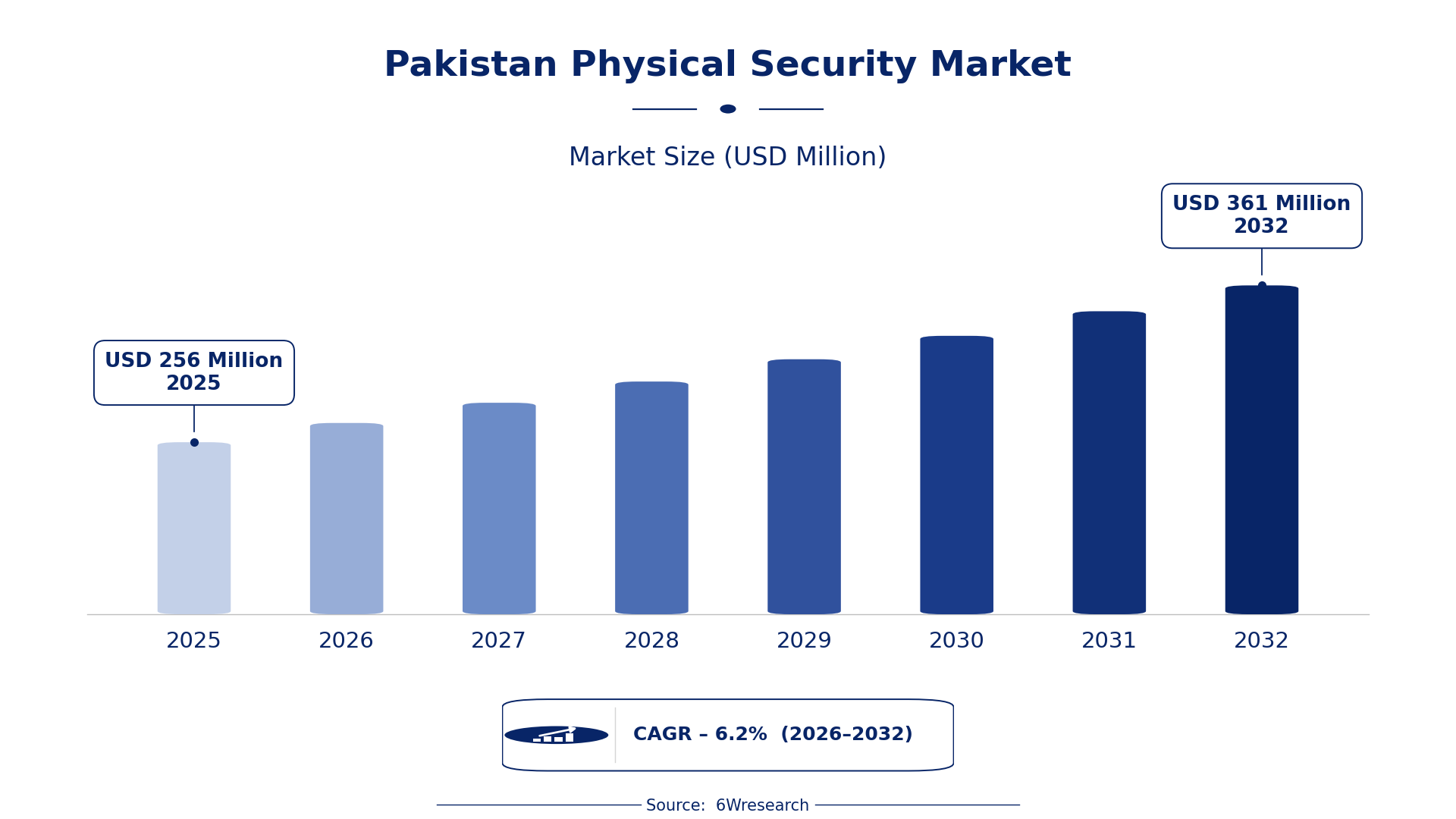
The Pakistan Physical Security Market was estimated at USD 256 Million in 2025 and is projected to reach USD 361 Million by 2032, growing at a CAGR of 6.2% from 2026 to 2032.
Pakistan Physical Security Market Synopsis
In Pakistan, the demand for physical security solutions is surging as public and private sectors prioritize safety. The market is currently witnessing increased investments in video surveillance systems and access control technologies, driven by urban expansion and a growing need for protection against rising criminal activities.
As the security landscape in Pakistan evolves, advanced technological solutions have become pivotal. Not only are businesses investing in perimeter security and intruder detection systems, but government initiatives are actively supporting infrastructure development aimed at enhancing public safety measures across urban areas.
Pakistan Physical Security Market Year-wise Growth Rate and Key Drivers
This graph illustrates the annual growth rates of the Pakistan Physical Security Market from 2021 to 2032, highlighting a steady upward trajectory and projected expansion over the forecast period.
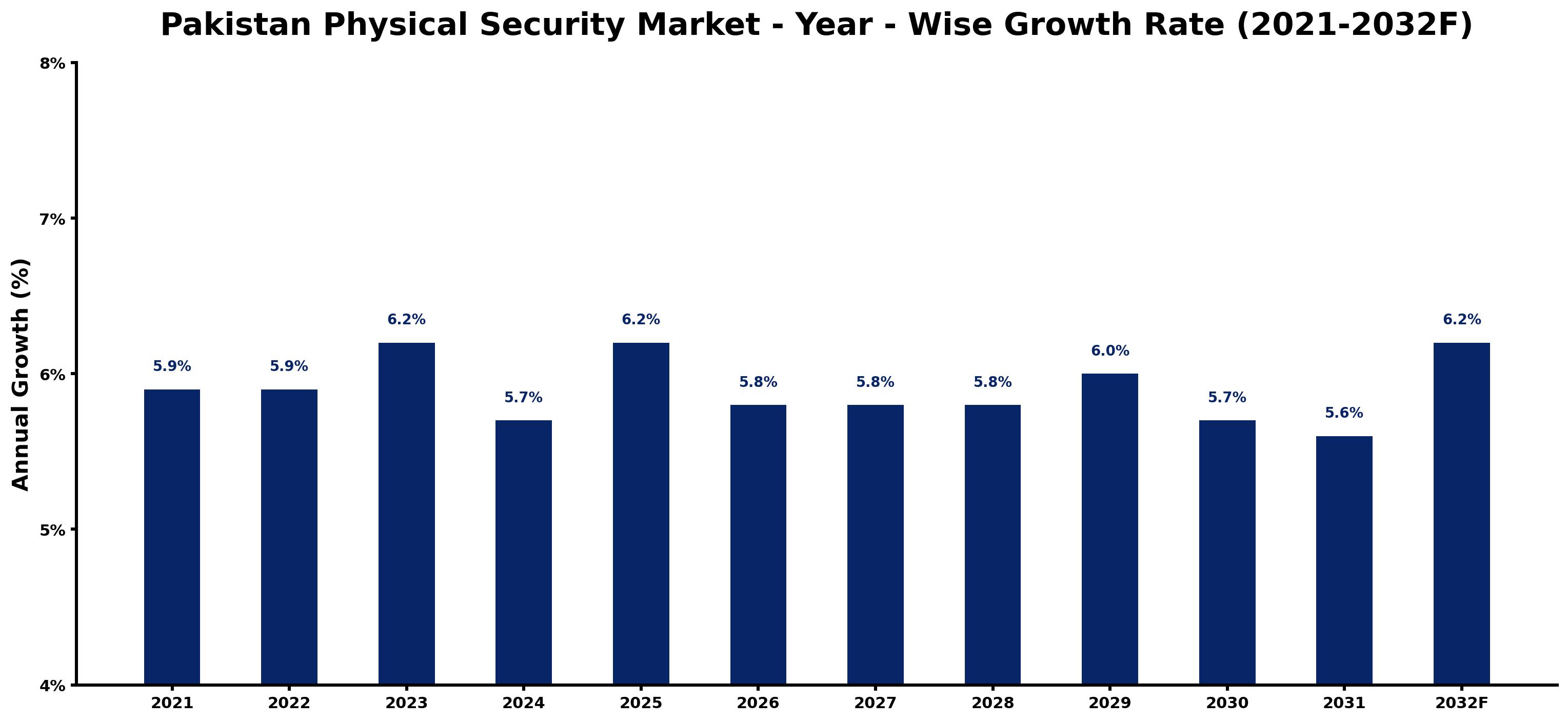
The table below presents the year‑wise growth rates along with the key drivers influencing the market
| Year | Growth Rate | Major Drivers |
| 2021 | 5.9% | Rising terrorism concerns prompting advanced security solutions. |
| 2022 | 5.9% | Increased urbanization driving demand for surveillance systems. |
| 2023 | 6.2% | Local businesses investing in perimeter security enhancements. |
| 2024 | 5.7% | Regulatory focus on protecting critical infrastructure assets. |
| 2025 | 6.2% | Growth in high-net-worth individuals seeking bespoke security. |
| 2026 | 5.8% | Government initiatives for safer public spaces boosting services. |
| 2027 | 5.8% | Surge in international events requiring enhanced safety measures. |
| 2028 | 5.8% | Demand from educational institutions for improved security systems. |
| 2029 | 6.0% | Local manufacturing of security equipment reducing import reliance. |
| 2030 | 5.7% | Increased awareness of personal safety in urban areas. |
| 2031 | 5.6% | Government support for public-private partnerships in security. |
| 2032 | 6.2% | Rising crime rates accelerating adoption of security technologies. |
Note: Market size estimations and growth projections presented in this report are based on 6Wresearch's proprietary forecasting methodology, utilizing the latest available industry data, government publications, and primary research inputs.
Pakistan Physical Security Market Key Takeaways
Below are some of the specific key takeaways from the market, including:
- Increasing integration of AI technologies in surveillance systems is reshaping security protocols.
- Rising urbanization fuels demand for comprehensive security solutions across sectors.
- Government regulations are pushing for more robust physical security measures nationwide.
- The shift toward cloud-based security solutions is enhancing operational efficiency.
- Investment opportunities are emerging in innovative security technologies.
Evaluation of Restraints in Pakistan Physical Security Market
The Pakistan Physical Security Market encounters hurdles that stifle growth potential. One major constraint is inadequate infrastructure, which impedes the deployment of advanced security systems in both urban and rural settings. Political instability further complicates investment strategies, with uncertainties making stakeholders hesitant. The high crime rates in certain regions amplify the urgency for effective security measures, yet these very conditions reflect the challenges market participants face in implementing comprehensive solutions.
Pakistan Physical Security Market Trends
The adoption of AI-driven technologies is accelerating within the Pakistan Physical Security Market. AI-powered video analytics and facial recognition systems are on the rise, enhancing the ability to detect and respond to threats quickly. Alongside this, the demand for integrated security solutions that merge access control, video surveillance, and intrusion detection is intensifying, enabling organizations to achieve a multi-layered defense approach.
Additionally, a notable trend is the growing focus on cybersecurity within physical security frameworks, particularly as cyber threats increasingly target physical assets. This convergence of physical and cyber security signifies a critical shift in how organizations approach their security strategy, pushing for cohesive solutions that address vulnerabilities across both domains.
Pakistan Physical Security Market Opportunities
Emerging investment opportunities in Pakistan’s physical security market are promising. As government initiatives ramp up efforts to enhance public safety, there’s a clear increase in demand for advanced security solutions such as surveillance systems and biometric access controls. Sectors such as commercial real estate and residential developments are also looking to bolster security measures, creating avenues for technology providers to expand their offerings. Investors can capitalize by backing firms that focus on innovative security technologies or those involved in major infrastructure projects prioritizing security enhancement.
Government Initiatives in the Pakistan Physical Security Market
Government actions are significantly shaping the dynamics of the Pakistan Physical Security Market. Through a combination of regulations and initiatives aimed at bolstering public safety, the government is setting the stage for a more secure environment. These efforts reflect the country's commitment to addressing security threats while promoting the adoption of modern technologies in safeguarding critical infrastructure.
- A national initiative launched in early 2025 mandates the installation of surveillance cameras in high-traffic public areas, including transport hubs.
- Current regulations promoting the adoption of biometric access systems are now being enforced across government facilities.
- Ongoing public-private partnerships are focused on upgrading critical infrastructure to meet enhanced security standards.
- Plans for a comprehensive security technology rollout are expected to be announced in late 2026, targeting educational institutions and healthcare facilities.
Future Insights of the Pakistan Physical Security Market
Looking ahead to 2026-2032, the Pakistan Physical Security Market is set to evolve significantly. An increase in urbanization will drive demand for advanced security solutions tailored to protect growing populations. Technological advancements will continue to influence market dynamics, with stakeholders increasingly seeking integrated solutions that combine both physical and cybersecurity measures. As government initiatives unfold to enhance public safety and infrastructure security, the market is expected to experience steady growth fueled by a heightened focus on security across all sectors.
Pakistan Physical Security Market Latest Developments
In the past year, the Pakistan Physical Security Market has seen a flurry of activity reflecting a clear commitment to enhancing security measures. Companies are increasingly focused on integrating cutting-edge technologies to address the pressing security demands faced by both public and private sectors.
- A major technology vendor successfully launched a cloud-based surveillance platform in Q1 2025, enabling remote security monitoring capabilities.
- In mid-2025, a leading regional operator initiated a comprehensive upgrade of its access control systems across multiple commercial properties.
- A planned public-private collaboration is set to kick off in early 2026, focusing on deploying advanced perimeter security solutions in urban areas.
- An initiative to standardize physical security protocols for schools and hospitals has begun its rollout phase, enhancing safety in vulnerable settings.
Pakistan Physical Security Market - Key Attractiveness of the Report
- 10 Years of Market Numbers
- Historical Data Starting from 2022 to 2025
- Base Year: 2025
- Forecast Data until 2032
- Key Performance Indicators Impacting the Market
- Major Upcoming Developments and Projects
Key Highlights of the Report:
- Pakistan Physical Security Market Outlook
- Market Size of Pakistan Physical Security Market, 2025
- Forecast of Pakistan Physical Security Market, 2032
- Historical Data and Forecast of Pakistan Physical Security Revenues & Volume for the Period 2022-2032F
- Pakistan Physical Security Market Trend Evolution
- Pakistan Physical Security Market Drivers and Challenges
- Pakistan Physical Security Price Trends
- Pakistan Physical Security Porter's Five Forces
- Pakistan Physical Security Industry Life Cycle
- Historical Data and Forecast of Pakistan Physical Security Market Revenues & Volume By Component for the Period 2022-2032F
- Historical Data and Forecast of Pakistan Physical Security Market Revenues & Volume By Systems (PACS, PSIM, PIAM, Video Surveillance, Fire and Life Safety) for the Period 2022-2032F
- Historical Data and Forecast of Pakistan Physical Security Market Revenues & Volume By Services for the Period 2022-2032F
- Historical Data and Forecast of Pakistan Physical Security Market Revenues & Volume By Vertical for the Period 2022-2032F
- Historical Data and Forecast of Pakistan Physical Security Market Revenues & Volume By BFSI for the Period 2022-2032F
- Historical Data and Forecast of Pakistan Physical Security Market Revenues & Volume By Government for the Period 2022-2032F
- Historical Data and Forecast of Pakistan Physical Security Market Revenues & Volume By Retail for the Period 2022-2032F
- Historical Data and Forecast of Pakistan Physical Security Market Revenues & Volume By Transportation for the Period 2022-2032F
- Historical Data and Forecast of Pakistan Physical Security Market Revenues & Volume By Residential for the Period 2022-2032F
- Historical Data and Forecast of Pakistan Physical Security Market Revenues & Volume By Telecom and IT for the Period 2022-2032F
- Historical Data and Forecast of Pakistan Physical Security Market Revenues & Volume By Other Verticals (Healthcare, Manufacturing, Energy and Utilities, and Education). for the Period 2022-2032F
- Historical Data and Forecast of Pakistan Physical Security Market Revenues & Volume By Organization Size for the Period 2022-2032F
- Historical Data and Forecast of Pakistan Physical Security Market Revenues & Volume By SMEs for the Period 2022-2032F
- Historical Data and Forecast of Pakistan Physical Security Market Revenues & Volume By Large Enterprises for the Period 2022-2032F
- Pakistan Physical Security Import Export Trade Statistics
- Market Opportunity Assessment By Component
- Market Opportunity Assessment By Vertical
- Market Opportunity Assessment By Organization Size
- Pakistan Physical Security Top Companies Market Share
- Pakistan Physical Security Competitive Benchmarking By Technical and Operational Parameters
- Pakistan Physical Security Company Profiles
- Pakistan Physical Security Key Strategic Recommendations






































