Pakistan Planting Equipment Market Size, Share & Growth Rate
The Pakistan Planting Equipment Market was estimated at USD 1347 Million in 2025 and is projected to reach USD 1949 Million by 2032, growing at a CAGR of 5.4% from 2026 to 2032. This growth trajectory is primarily fueled by the increasing integration of technology in agriculture, such as precision farming practices and enhanced mechanization. Government initiatives aimed at promoting sustainable agricultural methods and improving food security are further cementing the market's potential.
Pakistan Planting Equipment Market Year-wise Growth Rate and Key Drivers
This graph highlights how the Pakistan Planting Equipment Market has steadily grown over the years, supported by major growth factors.
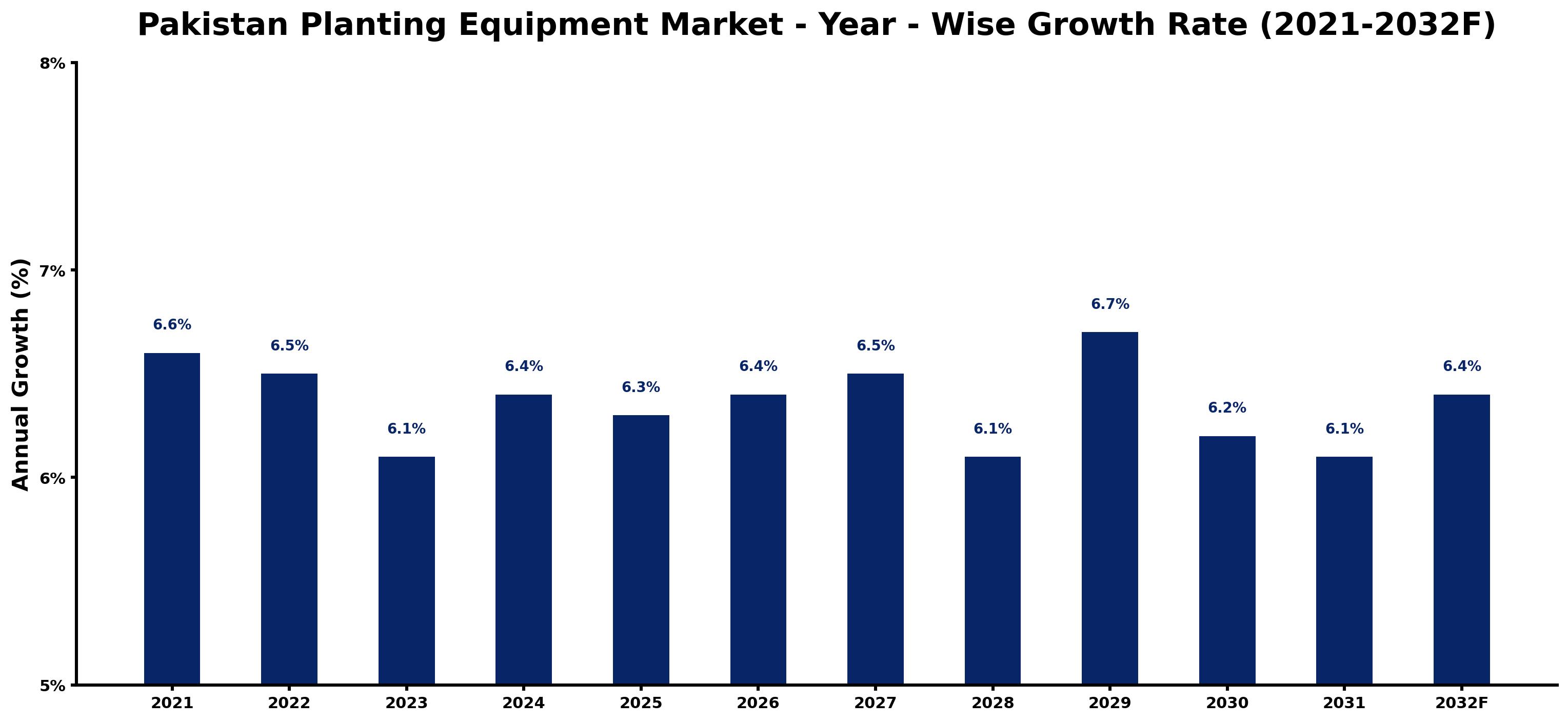
The table below presents the year‑wise growth rates along with the key drivers influencing the market
| Year | Growth Rate | Major Drivers |
| 2021 | 6.6% | Increasing industrial infrastructure investments |
| 2022 | 6.5% | Expansion of commercial construction activities |
| 2023 | 6.1% | Growing renewable energy integration projects |
| 2024 | 6.4% | Growing urbanization and commercial development |
| 2025 | 6.3% | Expansion of manufacturing activities |
| 2026 | 6.4% | Expansion of manufacturing activities |
| 2027 | 6.5% | Expansion of manufacturing activities |
| 2028 | 6.1% | Expansion of commercial construction activities |
| 2029 | 6.7% | Expansion of transportation and logistics networks |
| 2030 | 6.2% | Rising electricity demand across industries |
| 2031 | 6.1% | Growing renewable energy integration projects |
| 2032 | 6.4% | Expansion of transportation and logistics networks |
Note - Market size estimations and growth projections presented in this report are based on 6Wresearch's advanced forecasting approach, validated with industry datasets as of June 2026.
Pakistan Planting Equipment Market Synopsis
The demand for efficient planting solutions is being driven by the need for higher crop yields in Pakistan. With the country's agricultural sector under pressure from a growing population, innovative planting equipment, including seeders and planters, is becoming indispensable for modern farming practices.
Moreover, an increasing number of farmers are recognizing the operational advantages of modern planting technologies. This is leading to a shift towards advanced planting machinery equipped with features like GPS guidance and variable rate seeding, which significantly enhance productivity and reduce labor costs.
Pakistan Planting Equipment Market Key Takeaways
- The market is supported by favorable government policies and subsidies aimed at promoting agricultural mechanization.
- Technological advancements are driving the demand for precision planting equipment and smart farming solutions.
- There is a growing awareness among farmers about the benefits of advanced planting technologies for improving crop yield.
- The market is expanding due to a gradual shift towards larger-scale farming operations requiring higher-capacity equipment.
- Investment opportunities exist for local manufacturers and investors looking to introduce tailored solutions for Pakistani farmers.
Evaluation of Restraints in Pakistan Planting Equipment Market
Despite the positive outlook, the Pakistan Planting Equipment Market faces significant restraints that limit its growth potential. One major challenge is the high cost of importing advanced machinery, which restricts access for many small-scale farmers. Additionally, a lack of technical knowledge regarding modern planting practices and inadequate infrastructure, such as irrigation systems, further complicate the effective use of planting equipment. These factors collectively hinder the widespread adoption and utilization of advanced planting technologies across the agricultural sector.
Pakistan Planting Equipment Market Trends
Current trends indicate a marked shift towards sustainable and environmentally friendly planting equipment. Farmers are increasingly seeking solutions that not only boost productivity but also mitigate environmental impacts. Features like automated control systems and data analytics are gaining traction as they allow for smarter decision-making in planting practices. Furthermore, the mechanization trend is facilitating a move towards larger, more efficient farming operations, which will continue to elevate the demand for high-capacity planting equipment.
Pakistan Planting Equipment Market Opportunities
The Pakistan Planting Equipment Market presents substantial investment opportunities, particularly in technology-driven solutions that enhance planting efficiency. Investors can capitalize on the growing demand for precision planters and seed drills that minimize labor costs while maximizing output. Moreover, partnerships with local manufacturers can facilitate the introduction of customized planting equipment that meets the specific needs of Pakistani farmers, aligning with the market's evolving demands.
Government Initiatives in the Pakistan Planting Equipment Market
The government of Pakistan is actively promoting modern agricultural practices to enhance productivity in the planting equipment market. Various subsidies and incentives are in place to encourage farmers to invest in machinery, such as seed drills and transplanters. Additionally, initiatives aimed at increasing access to credit for purchasing advanced planting technologies are helping to bridge the gap for many farmers. These policies collectively aim to modernize farming practices and support sustainable agricultural development.
Future Insights of the Pakistan Planting Equipment Market
Looking ahead to 2026-2032, the Pakistan Planting Equipment Market is expected to undergo robust growth, underpinned by a deeper integration of mechanization in agriculture. As awareness of advanced planting solutions continues to rise, coupled with ongoing government support, farmers will likely embrace modern technologies to enhance yield and efficiency. Innovations in planting equipment, such as GPS-guided systems and automated planting technologies, will play a crucial role in shaping the future landscape of the market.
Pakistan Planting Equipment Market Latest Developments (May 2025 - June 2026)
In recent months, the Pakistan Planting Equipment Market has witnessed several significant developments aimed at enhancing operational efficiency in agriculture. There has been an uptick in collaborations between technology firms and agricultural stakeholders to introduce advanced machinery designed for precision farming. Additionally, training programs focusing on the effective use of modern planting technologies have been initiated to bridge the knowledge gap among farmers.
Pakistan Planting Equipment Market - Key Attractiveness of the Report
- 10 Years of Market Numbers
- Historical Data Starting from 2022 to 2025
- Base Year: 2025
- Forecast Data until 2032
- Key Performance Indicators Impacting the Market
- Major Upcoming Developments and Projects
Key Highlights of the Report:
- Pakistan Planting Equipment Market Outlook
- Market Size of Pakistan Planting Equipment Market, 2025
- Forecast of Pakistan Planting Equipment Market, 2032
- Historical Data and Forecast of Pakistan Planting Equipment Revenues & Volume for the Period 2022-2032F
- Pakistan Planting Equipment Market Trend Evolution
- Pakistan Planting Equipment Market Drivers and Challenges
- Pakistan Planting Equipment Price Trends
- Pakistan Planting Equipment Porter's Five Forces
- Pakistan Planting Equipment Industry Life Cycle
- Historical Data and Forecast of Pakistan Planting Equipment Market Revenues & Volume By Type for the Period 2022-2032F
- Historical Data and Forecast of Pakistan Planting Equipment Market Revenues & Volume By Air seeders for the Period 2022-2032F
- Historical Data and Forecast of Pakistan Planting Equipment Market Revenues & Volume By Seed drills for the Period 2022-2032F
- Historical Data and Forecast of Pakistan Planting Equipment Market Revenues & Volume By Planters for the Period 2022-2032F
- Historical Data and Forecast of Pakistan Planting Equipment Market Revenues & Volume By Others for the Period 2022-2032F
- Historical Data and Forecast of Pakistan Planting Equipment Market Revenues & Volume By Design for the Period 2022-2032F
- Historical Data and Forecast of Pakistan Planting Equipment Market Revenues & Volume By Mechanical for the Period 2022-2032F
- Historical Data and Forecast of Pakistan Planting Equipment Market Revenues & Volume By Automatic for the Period 2022-2032F
- Historical Data and Forecast of Pakistan Planting Equipment Market Revenues & Volume By Crop Type for the Period 2022-2032F
- Historical Data and Forecast of Pakistan Planting Equipment Market Revenues & Volume By Cereals & grains for the Period 2022-2032F
- Historical Data and Forecast of Pakistan Planting Equipment Market Revenues & Volume By Oilseeds & pulses for the Period 2022-2032F
- Historical Data and Forecast of Pakistan Planting Equipment Market Revenues & Volume By Fruits & vegetables for the Period 2022-2032F
- Historical Data and Forecast of Pakistan Planting Equipment Market Revenues & Volume By Others for the Period 2022-2032F
- Pakistan Planting Equipment Import Export Trade Statistics
- Market Opportunity Assessment By Type
- Market Opportunity Assessment By Design
- Market Opportunity Assessment By Crop Type
- Pakistan Planting Equipment Top Companies Market Share
- Pakistan Planting Equipment Competitive Benchmarking By Technical and Operational Parameters
- Pakistan Planting Equipment Company Profiles
- Pakistan Planting Equipment Key Strategic Recommendations






































