Pakistan Plastics Products Market Summary
The pakistan plastics products market was estimated at USD 460 Million in 2025 and is projected to reach USD 603 Million by 2032, growing at a CAGR of 4.7% from 2026 to 2032.
Pakistan Plastics Products Market Year-wise Growth Rate and Key Drivers
This graph highlights how the Pakistan Plastics Products Market has steadily grown over the past five years, supported by major growth factors.
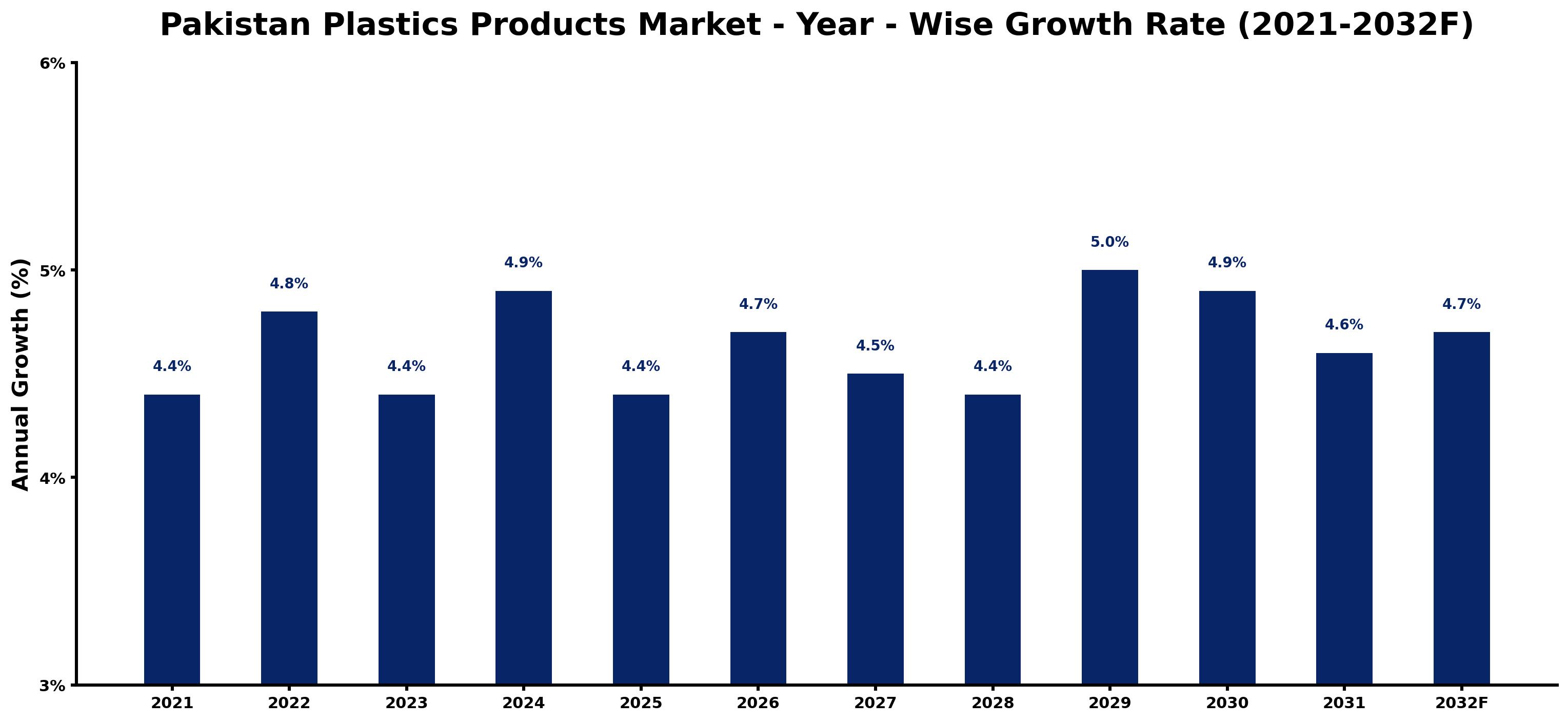
The table below presents the year wise growth rates along with the key drivers influencing the market
| Year | Growth Rate | Major Drivers |
| 2021 | 4.4% | E-commerce penetration increased dramatically, influencing packaging trends across multiple sectors. |
| 2022 | 4.8% | Local manufacturers shifted focus towards biodegradable materials amid global sustainability pressures. |
| 2023 | 4.4% | Consumer preferences evolved, favoring lightweight and flexible plastic products for convenience. |
| 2024 | 4.9% | Urbanization accelerated infrastructure development, boosting demand for construction-related plastic applications. |
| 2025 | 4.4% | The automotive sector explored innovative lightweight plastics to enhance fuel efficiency standards. |
| 2026 | 4.7% | Packaging advancements integrated smart technologies, attracting investments from tech-savvy startups. |
| 2027 | 4.5% | Rural market expansions revealed untapped potential for agricultural plastic solutions nationwide. |
| 2028 | 4.4% | Export opportunities soared as global brands sought local partnerships for customized plastic products. |
| 2029 | 5.0% | Investments in recycling technologies gained momentum, addressing waste management concerns effectively. |
| 2030 | 4.9% | Health sector advancements required specialized plastic products, paving avenues for medical applications. |
| 2031 | 4.6% | Climate resilience initiatives promoted the use of innovative materials designed for extreme weather. |
| 2032 | 4.7% | Cross-border trade agreements unlocked new markets, stimulating competition within the plastic manufacturing sector. |
Note - Market size estimations and growth projections presented in this report are based on 6Wresearch's advanced forecasting approach, validated with industry datasets as of June 2026.
Pakistan Plastics Products Market Synopsis
The Pakistan Plastics Products Market is projected to reach 4.7% and witness significant growth during the forecast period (2026-2032). The growth trajectory of this market is primarily influenced by several factors, including increasing population density, rising disposable income levels, and accelerated urbanization across the country. These dynamics are propelling the demand for plastic products, which have become essential in multiple sectors such as construction, packaging, and consumer goods. Additionally, initiatives aimed at infrastructure development, notably the China-Pakistan Economic Corridor (CPEC), are set to further stimulate demand for plastic products during this period.
Pakistan Plastics Products Market Growth Drivers
Several key drivers are shaping the Pakistan Plastics Products Market. Among them, the rapid urbanization and population growth are creating a robust demand for plastic products. As more citizens migrate to urban centers, the need for housing, infrastructure, and consumer goods rises sharply.
- Increasing disposable income levels of the Pakistani population are enabling consumers to spend on a wider array of plastic products, particularly those that are convenience-oriented such as packaging and household goods.
- Government infrastructure initiatives, particularly those under CPEC, are expected to enhance the construction sector, which heavily relies on plastic products for various applications, thereby stimulating market growth.
- Technological advancements and innovations in material science are encouraging manufacturers to explore new eco-friendly and cost-effective plastics that cater to evolving consumer preferences.
- The packaging industry, a significant segment of the plastics market, is experiencing growth due to rising e-commerce trends and consumer demand for safe and sustainable packaging solutions.
Pakistan Plastics Products Market Trends and Opportunities
The Pakistan Plastics Products Market is witnessing several notable trends and opportunities. A prominent trend is the increasing focus on sustainability, with many manufacturers exploring biodegradable and recyclable plastics to align with global environmental standards. This shift is not only a response to consumer demand but also to regulatory changes aimed at reducing plastic waste.
- Innovative product designs and variations are emerging in the market, catering to diverse consumer needs, including customized solutions in packaging and industrial applications.
- There is a growing trend towards automation in plastic manufacturing processes, which enhances efficiency and reduces production costs, thus enabling competitive pricing.
- The hospitality and food service sectors are increasingly adopting plastic products for their operational efficiency, particularly in disposable tableware and packaging solutions.
- Investment in R&D is on the rise, with firms focusing on developing stronger, lighter, and more sustainable plastic products, thereby expanding application areas.
Pakistan Plastics Products Market Challenges and Restraints
Despite the positive outlook for the Pakistan Plastics Products Market, there are challenges that could impede growth. One of the most pressing concerns is the increasing environmental scrutiny on plastic usage. Regulations aimed at reducing plastic waste threaten the traditional plastic manufacturing landscape.
- The volatility of raw material prices can significantly impact production costs, leading to challenges in maintaining profit margins for manufacturers.
- Competition from alternative materials, such as metal, glass, and sustainable composites, poses a threat to the market share of conventional plastic products.
- Consumer awareness regarding the environmental impact of plastic can lead to decreased demand for certain plastic products, particularly single-use items.
- The existing infrastructure for recycling and waste management remains underdeveloped, leading to inefficient processing of plastic waste, which continues to affect public perception.
Pakistan Plastics Products Market Government Investment and Initiatives
The Government of Pakistan plays a crucial role in shaping the plastics landscape through various initiatives aimed at enhancing the industry. Public spending on infrastructure projects is expected to benefit the plastics sector directly, especially with ongoing developments under CPEC. These developments are likely to create new demand for plastic materials in construction and other industries.
- Government regulations that promote sustainability are encouraging manufacturers to innovate and adopt new technologies aimed at producing environmentally friendly plastic products.
- Investment incentives for recycling facilities are being considered to improve waste management practices, enhancing the sustainability of the plastics industry.
- Public-private partnerships are fostering collaboration between government entities and private manufacturers to enhance production capabilities and drive innovation in the plastics sector.
- Educational initiatives aimed at raising awareness about the responsible usage and disposal of plastic products are also being promoted by governmental bodies.
Pakistan Plastics Products Market Latest Developments (May 2025 - June 2026)
Recent developments in the Pakistan Plastics Products Market from May 2025 to June 2026 illustrate a dynamic industry landscape. Manufacturers are increasingly investing in sustainable practices, with many shifting towards renewable resources to produce biodegradable plastics. This aligns with global trends emphasizing sustainability.
- There has been an uptick in collaborative efforts between local governments and industry stakeholders to develop frameworks that support recycling and waste management initiatives.
- Technological upgrades in manufacturing processes are being adopted to improve efficiency and lower carbon footprints, with many companies aiming to achieve production certifications.
- The demand for innovative packaging solutions is growing, particularly in response to the rising e-commerce sector, driving manufacturers to adapt their product offerings.
- Public awareness campaigns aimed at encouraging responsible consumption and disposal of plastic products are gaining traction, supported by both governmental and non-governmental organizations.
Pakistan Plastics Products Market - Key Attractiveness of the Report
- 10 Years of Market Numbers
- Historical Data Starting from 2022 to 2025
- Base Year: 2025
- Forecast Data until 2032
- Key Performance Indicators Impacting the Market
- Major Upcoming Developments and Projects
Key Highlights of the Report:
- Pakistan Plastics Products Market Outlook
- Market Size of Pakistan Plastics Products Market, 2025
- Forecast of Pakistan Plastics Products Market, 2032F
- Historical Data and Forecast of Pakistan Plastics Products Revenues & Volume for the Period 2022-2032F
- Pakistan Plastics Products Market Trend Evolution
- Pakistan Plastics Products Market Drivers and Challenges
- Pakistan Plastics Products Price Trends
- Pakistan Plastics Products Porter's Five Forces
- Pakistan Plastics Products Industry Life Cycle
- Historical Data and Forecast of Pakistan Plastics Products Market Revenues & Volume By Types for the Period 2022-2032F
- Historical Data and Forecast of Pakistan Plastics Products Market Revenues & Volume By Plastics Packaging Materials And Unlaminated Film And Sheet for the Period 2022-2032F
- Historical Data and Forecast of Pakistan Plastics Products Market Revenues & Volume By Plastic Pipes And Shapes for the Period 2022-2032F
- Historical Data and Forecast of Pakistan Plastics Products Market Revenues & Volume By Laminated Plastics Plate, Sheet, And Shape for the Period 2022-2032F
- Historical Data and Forecast of Pakistan Plastics Products Market Revenues & Volume By Plastics Bottle for the Period 2022-2032F
- Historical Data and Forecast of Pakistan Plastics Products Market Revenues & Volume By Urethane And Other Foam Product for the Period 2022-2032F
- Historical Data and Forecast of Pakistan Plastics Products Market Revenues & Volume By Polystyrene Foam Product for the Period 2022-2032F
- Historical Data and Forecast of Pakistan Plastics Products Market Revenues & Volume By Other Plastics Product ? ? for the Period 2022-2032F
- Historical Data and Forecast of Pakistan Plastics Products Market Revenues & Volume By End-users for the Period 2022-2032F
- Historical Data and Forecast of Pakistan Plastics Products Market Revenues & Volume By Automotive & Transportation for the Period 2022-2032F
- Historical Data and Forecast of Pakistan Plastics Products Market Revenues & Volume By Electrical & Electronics for the Period 2022-2032F
- Historical Data and Forecast of Pakistan Plastics Products Market Revenues & Volume By Medical for the Period 2022-2032F
- Historical Data and Forecast of Pakistan Plastics Products Market Revenues & Volume By Construction for the Period 2022-2032F
- Historical Data and Forecast of Pakistan Plastics Products Market Revenues & Volume By Others for the Period 2022-2032F
- Pakistan Plastics Products Import Export Trade Statistics
- Market Opportunity Assessment By Types
- Market Opportunity Assessment By End-users
- Pakistan Plastics Products Top Companies Market Share
- Pakistan Plastics Products Competitive Benchmarking By Technical and Operational Parameters
- Pakistan Plastics Products Company Profiles
- Pakistan Plastics Products Key Strategic Recommendations






































