Pakistan Policy Management in Telecom Market Size & Growth Rate (2026-2032)
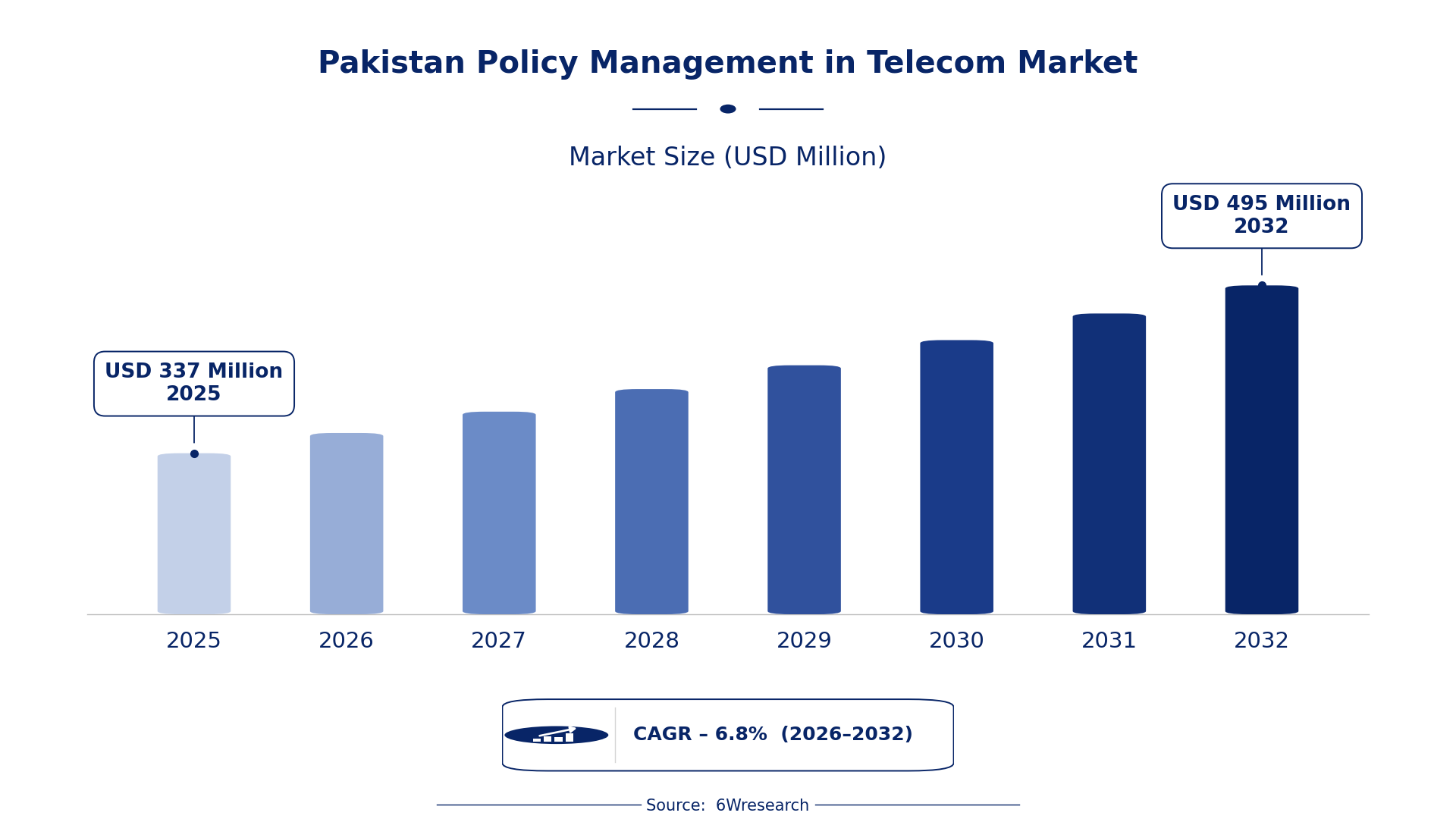
The Pakistan Policy Management in Telecom Market was estimated at USD 337 Million in 2025 and is projected to reach USD 495 Million by 2032, growing at a CAGR of 6.8% from 2026 to 2032.
Pakistan Policy Management in Telecom Market Synopsis
A driving force in the Pakistan Policy Management in Telecom Market is the increasing complexity of regulatory requirements. As the telecommunications landscape evolves with new technologies, the necessity for robust policy management solutions becomes even more critical. Operators must ensure they meet compliance demands while delivering high-quality service to customers.
Alongside regulatory pressures, the demand for efficient network management is rising. Telecom providers are seeking solutions that allow them to allocate resources effectively and maintain service quality amidst increasing data usage and the deployment of 5G and IoT services. This intersection of compliance and customer satisfaction will shape the market for years to come.
Pakistan Policy Management in Telecom Market Year-wise Growth Rate and Key Drivers
This graph illustrates the annual growth rates of the Pakistan Policy Management in Telecom Market from 2021 to 2032, highlighting a steady upward trajectory and projected expansion over the forecast period.
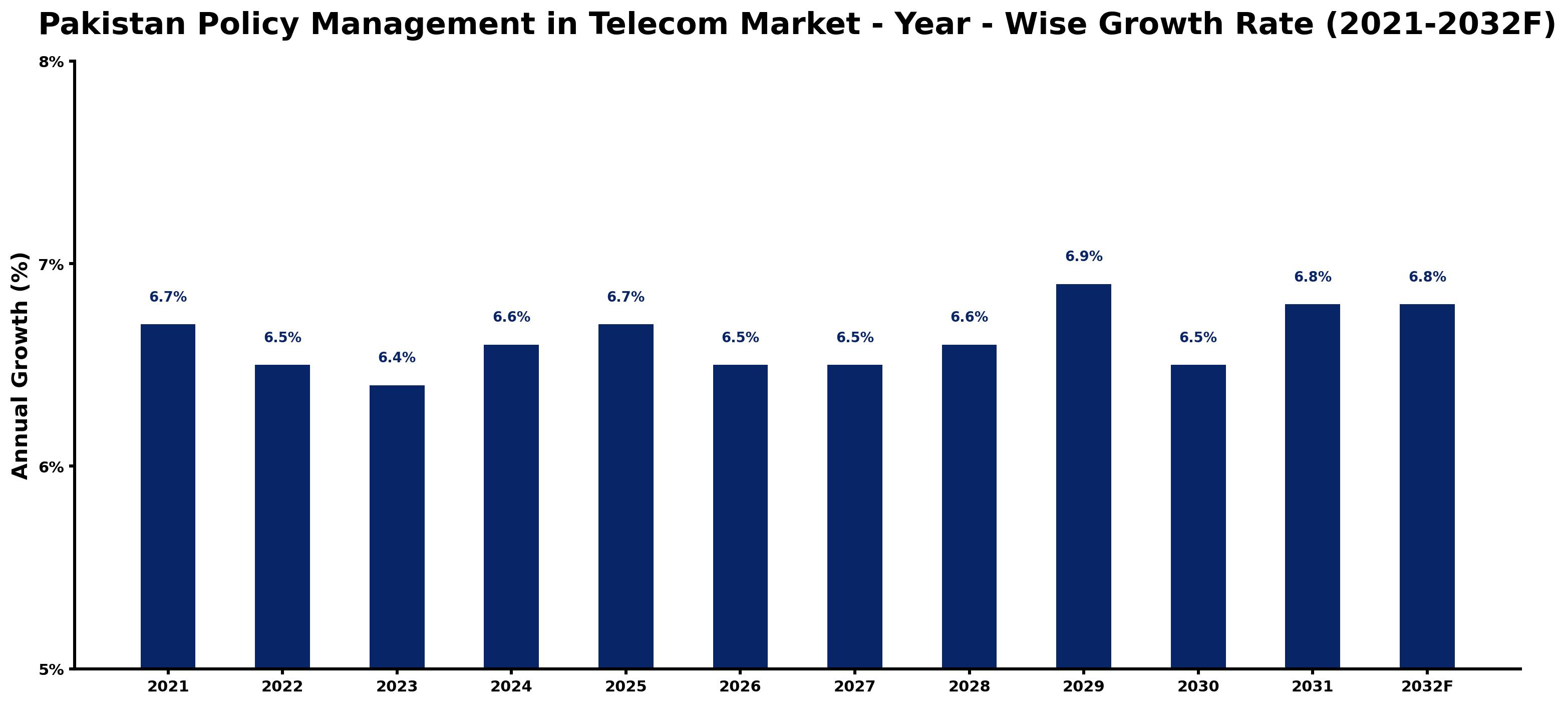
The table below presents the year‑wise growth rates along with the key drivers influencing the market
| Year | Growth Rate | Major Drivers |
| 2021 | 6.7% | PTA's initiatives for increased telecommunications transparency |
| 2022 | 6.5% | Government push for nationwide 5G rollout strategies |
| 2023 | 6.4% | Regulatory compliance on telecom consumer protection laws |
| 2024 | 6.6% | Investment in rural connectivity programs by IT Ministry |
| 2025 | 6.7% | Focus on reducing call drop rates by regulators |
| 2026 | 6.5% | Introduction of new telecom policy attracting FDI |
| 2027 | 6.5% | Launch of digital Pakistan vision stimulating sector growth |
| 2028 | 6.6% | Incentives for local tech startups in telecom sector |
| 2029 | 6.9% | Public-private partnerships enhancing broadband infrastructure |
| 2030 | 6.5% | Enhanced cybersecurity regulations supporting telecom investments |
| 2031 | 6.8% | Evolving digital identity regulations driving market expansion |
| 2032 | 6.8% | Focus on sustainability in telecom operations mandated by policy |
Note: Market size estimations and growth projections presented in this report are based on 6Wresearch's proprietary forecasting methodology, utilizing the latest available industry data, government publications, and primary research inputs.
Pakistan Policy Management in Telecom Market Key Takeaways
Below are some of the specific key takeaways from the market, including:
- Regulatory initiatives are reshaping compliance requirements for telecom operators.
- Technological advancements in 5G and IoT are driving demand for agile policy management solutions.
- Challenges in network complexity necessitate tailored approaches for smaller operators.
- Government support plays a crucial role in promoting infrastructure development.
- The market's growth trajectory indicates a significant opportunity for investment and innovation.
Evaluation of Restraints in Pakistan Policy Management in Telecom Market
The Pakistan Policy Management in Telecom Market faces substantial restraints stemming from complex regulatory frameworks. Smaller operators often struggle to keep pace with stringent compliance demands, diverting resources from innovation and service enhancement. Additionally, the rapid technological changes in telecommunications introduce a continual need for system updates, which can overwhelm existing infrastructures. This situation creates a disparity where only larger, well-resourced companies thrive, potentially stifling competition and market diversity.
Pakistan Policy Management in Telecom Market Trends
Several trends are reshaping the Pakistan Policy Management in Telecom Market. First, the rollout of 5G technology is forcing operators to adopt advanced policy management systems that can handle increased traffic and ensure quality of service. Second, the growing prevalence of IoT devices creates a demand for policies that secure user privacy and manage resource allocation efficiently. Finally, the increasing expectation from consumers for transparency and reliability drives operators to implement more stringent service policies.
Pakistan Policy Management in Telecom Market Opportunities
The market presents multiple avenues for growth and investment. One significant opportunity lies in the development of next-generation policy management solutions tailored to meet the specific needs of 5G and IoT environments. Additionally, partnerships between telecom operators and technology providers can accelerate infrastructure upgrades and enhance service offerings. There is also potential in government collaboration to create streamlined compliance processes, reducing the burden on smaller operators and fostering a more competitive environment.
Government Initiatives in the Pakistan Policy Management in Telecom Market
The government of Pakistan plays a vital role in shaping the Policy Management in Telecom Market. Its initiatives are focused on fostering an environment conducive to technological advancement and regulatory compliance. By supporting telecom infrastructure projects and enhancing collaborative efforts with operators and technology providers, the government aims to improve service delivery and customer satisfaction.
- A recently completed initiative involved the rollout of a national digital infrastructure upgrade programme to enhance network capabilities across urban and rural areas.
- Currently underway is a comprehensive regulatory review process aimed at simplifying compliance for telecom operators, which is expected to streamline operations by mid-2026.
- A planned public-private initiative is in the works, expected to expand telecom infrastructure access by 2028, particularly in underserved regions.
- The introduction of a new regulatory framework in 2025 mandating billing transparency aims to enhance consumer trust and service accountability.
- Ongoing partnerships with international technology providers are focused on developing advanced policy management systems tailored for emerging technologies.
Future Insights of the Pakistan Policy Management in Telecom Market
From 2026 to 2032, the Pakistan Policy Management in Telecom Market is expected to evolve significantly. As operators adapt to increasing regulatory pressures and technological changes, there will be a pronounced shift toward integrating sophisticated policy management solutions. The emphasis on service quality and compliance will drive innovation, allowing telecom companies to respond swiftly to the demands of their consumers while navigating the complexities of the regulatory environment. This dynamic will foster opportunities for new entrants and existing players alike, setting the stage for a more competitive landscape.
Pakistan Policy Management in Telecom Market Latest Developments
Recent activity in the Pakistan Policy Management in Telecom Market indicates a strong focus on enhancing operational efficiency and compliance. Over the past year, operators have increasingly recognized the importance of adopting advanced policy management systems to address the growing complexities of regulation and service delivery.
- A major technology vendor launched an innovative policy management solution in early 2025, aimed at helping telecom operators streamline compliance processes.
- An initiative began in mid-2025 focusing on developing training programs for smaller operators to better understand and implement regulatory standards.
- A partnership was announced in Q4 2025 between a leading telecom operator and a technology provider to co-develop solutions for managing IoT traffic effectively.
- Rollout of a pilot project for a new compliance tracking tool is expected to begin in the second half of 2026.
- A national conference focusing on best practices in telecom policy management took place in early 2025, attracting key stakeholders across the industry.
Pakistan Policy Management in Telecom Market - Key Attractiveness of the Report
- 10 Years of Market Numbers
- Historical Data Starting from 2022 to 2025
- Base Year: 2025
- Forecast Data until 2032
- Key Performance Indicators Impacting the Market
- Major Upcoming Developments and Projects
Key Highlights of the Report:
- Pakistan Policy Management in Telecom Market Outlook
- Market Size of Pakistan Policy Management in Telecom Market, 2025
- Forecast of Pakistan Policy Management in Telecom Market, 2032
- Historical Data and Forecast of Pakistan Policy Management in Telecom Revenues & Volume for the Period 2022-2032F
- Pakistan Policy Management in Telecom Market Trend Evolution
- Pakistan Policy Management in Telecom Market Drivers and Challenges
- Pakistan Policy Management in Telecom Price Trends
- Pakistan Policy Management in Telecom Porter's Five Forces
- Pakistan Policy Management in Telecom Industry Life Cycle
- Historical Data and Forecast of Pakistan Policy Management in Telecom Market Revenues & Volume By Network for the Period 2022-2032F
- Historical Data and Forecast of Pakistan Policy Management in Telecom Market Revenues & Volume By Fixed for the Period 2022-2032F
- Historical Data and Forecast of Pakistan Policy Management in Telecom Market Revenues & Volume By Wireless for the Period 2022-2032F
- Historical Data and Forecast of Pakistan Policy Management in Telecom Market Revenues & Volume By Component for the Period 2022-2032F
- Historical Data and Forecast of Pakistan Policy Management in Telecom Market Revenues & Volume By Solutions for the Period 2022-2032F
- Historical Data and Forecast of Pakistan Policy Management in Telecom Market Revenues & Volume By Services for the Period 2022-2032F
- Historical Data and Forecast of Pakistan Policy Management in Telecom Market Revenues & Volume By Deployment for the Period 2022-2032F
- Historical Data and Forecast of Pakistan Policy Management in Telecom Market Revenues & Volume By Cloud for the Period 2022-2032F
- Historical Data and Forecast of Pakistan Policy Management in Telecom Market Revenues & Volume By On-Premises for the Period 2022-2032F
- Pakistan Policy Management in Telecom Import Export Trade Statistics
- Market Opportunity Assessment By Network
- Market Opportunity Assessment By Component
- Market Opportunity Assessment By Deployment
- Pakistan Policy Management in Telecom Top Companies Market Share
- Pakistan Policy Management in Telecom Competitive Benchmarking By Technical and Operational Parameters
- Pakistan Policy Management in Telecom Company Profiles
- Pakistan Policy Management in Telecom Key Strategic Recommendations






































