Pakistan Prescriptive Analytics Market Size & Growth Rate (2026-2032)
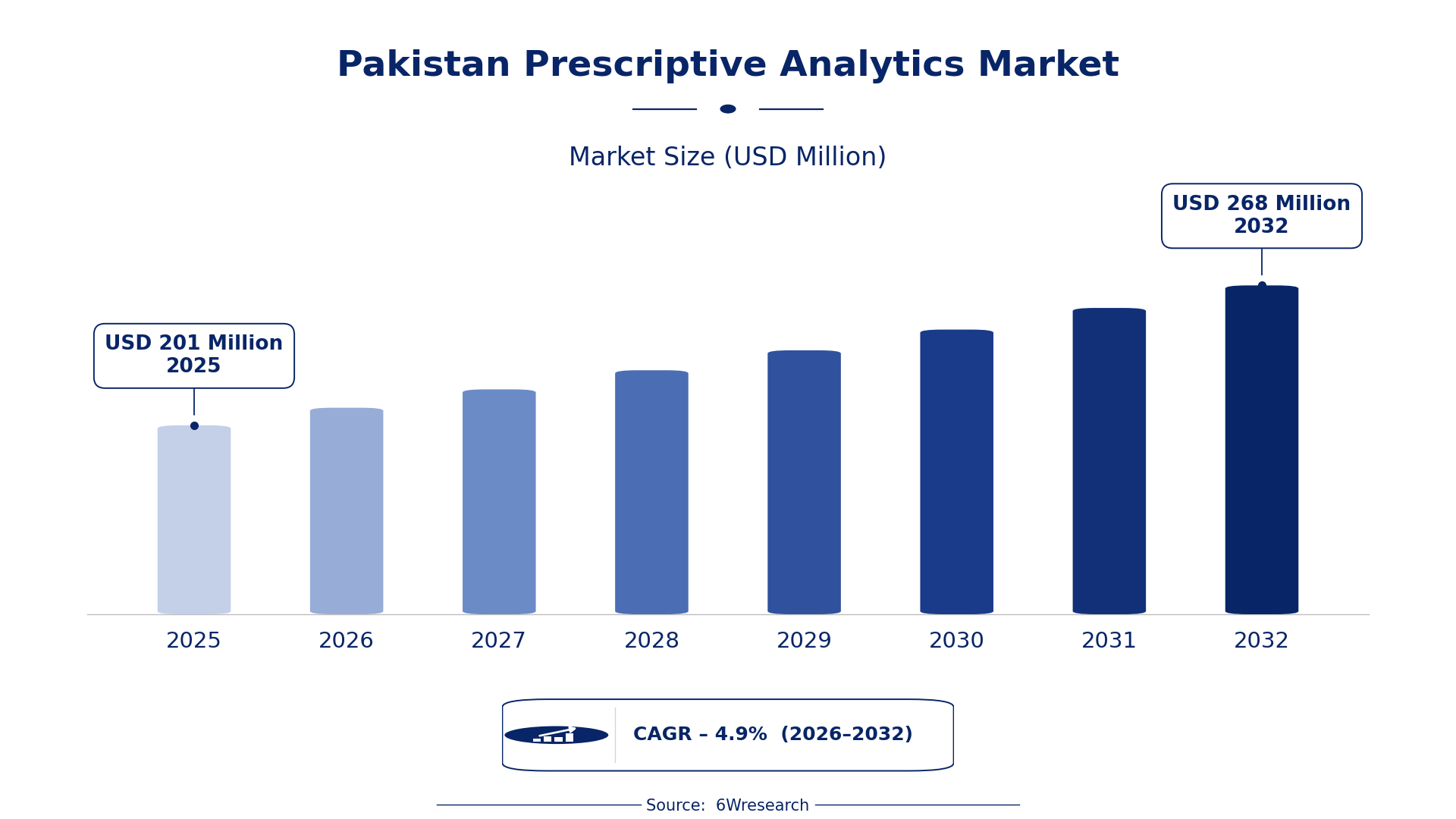
The Pakistan Prescriptive Analytics Market was estimated at USD 201 Million in 2025 and is projected to reach USD 268 Million by 2032, growing at a CAGR of 4.9% from 2026 to 2032.
Pakistan Prescriptive Analytics Market Synopsis
The demand for prescriptive analytics in Pakistan is gaining momentum as businesses increasingly recognize the importance of data-driven decision-making. This shift is particularly evident in industries such as healthcare, finance, and retail, where organizations are leveraging analytics to enhance operational efficiency and improve outcomes.
The combination of big data proliferation and advancements in analytics technologies is driving the adoption of prescriptive analytics solutions. As companies face growing competition, there’s a pressing need to transform data into actionable insights that can lead to strategic advantages.
Pakistan Prescriptive Analytics Market Year-wise Growth Rate and Key Drivers
This graph illustrates the annual growth rates of the Pakistan Prescriptive Analytics Market from 2021 to 2032, highlighting a steady upward trajectory and projected expansion over the forecast period.
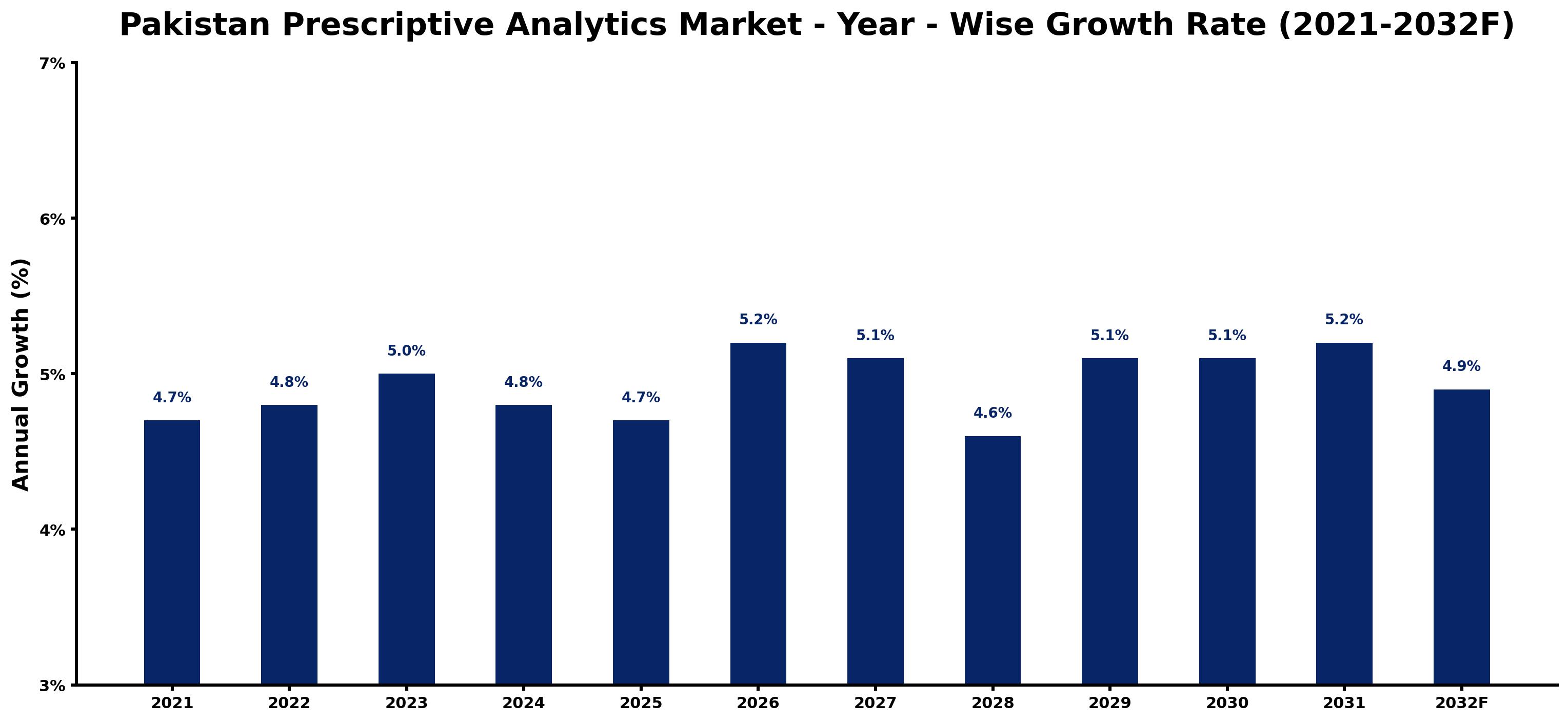
The table below presents the year‑wise growth rates along with the key drivers influencing the market
| Year | Growth Rate | Major Drivers |
| 2021 | 4.7% | Government incentives for agricultural data-driven decisions. |
| 2022 | 4.8% | Increased demand for healthcare outcomes optimization tools. |
| 2023 | 5.0% | Rise in e-commerce driving customer behavior analysis needs. |
| 2024 | 4.8% | Adoption of smart cities enhancing urban data utilization. |
| 2025 | 4.7% | Financial services pushing for predictive risk management solutions. |
| 2026 | 5.2% | Telecom sector investing in customer retention analytics. |
| 2027 | 5.1% | Government support for digital transformation in retail. |
| 2028 | 4.6% | Growing need for logistics optimization in trade sector. |
| 2029 | 5.1% | Rising interest in education technology for performance improvement. |
| 2030 | 5.1% | Evolving regulatory landscape favoring data-driven decision-making. |
| 2031 | 5.2% | Increased AI adoption enhancing predictive capabilities across industries. |
| 2032 | 4.9% | Boost in manufacturing analytics due to export market demands. |
Note: Market size estimations and growth projections presented in this report are based on 6Wresearch's proprietary forecasting methodology, utilizing the latest available industry data, government publications, and primary research inputs.
Pakistan Prescriptive Analytics Market Key Takeaways
Below are some of the specific key takeaways from the market, including:
- The market is witnessing a rise in demand for solutions that optimize business processes across multiple sectors.
- Technological advancements in machine learning and AI are enhancing the capabilities of prescriptive analytics.
- Organizations are increasingly focused on integrating prescriptive analytics with other data analytics methodologies.
- There is a growing need for skilled professionals capable of implementing these advanced analytics solutions.
- Government initiatives are playing a crucial role in fostering the growth of the prescriptive analytics market in Pakistan.
Evaluation of Restraints in Pakistan Prescriptive Analytics Market
Despite its growth potential, the Pakistan prescriptive analytics market faces several challenges. A significant hurdle is the low awareness of advanced analytics solutions among businesses, which limits adoption rates. on top of that, the shortage of skilled data scientists and analysts exacerbates this issue, making it difficult for organizations to effectively utilize prescriptive analytics. The high costs associated with implementing analytics software also deter many companies from investing in these solutions.
Pakistan Prescriptive Analytics Market Trends
Several trends are shaping the prescriptive analytics market in Pakistan. First, the integration of AI and machine learning with prescriptive analytics is gaining traction, allowing for more sophisticated decision-making frameworks. Additionally, there is an increasing emphasis on real-time data processing, enabling organizations to respond swiftly to changing market conditions. Lastly, as regulatory pressures mount, businesses are turning to prescriptive analytics to ensure compliance and optimize their operations.
Pakistan Prescriptive Analytics Market Opportunities
The future holds promising opportunities for growth within the Pakistan prescriptive analytics market. Sectors such as healthcare are ripe for innovation, where analytics can significantly improve patient outcomes and operational efficiencies. on top of that, financial institutions are leveraging prescriptive analytics for risk management and fraud detection, opening avenues for investment. The expansion of digital infrastructure will also provide the necessary foundation for broader adoption of these technologies.
Government Initiatives in the Pakistan Prescriptive Analytics Market
The Pakistani government is actively promoting the prescriptive analytics market through various policy initiatives. By encouraging the adoption of advanced data analytics solutions, the government aims to enhance decision-making across critical sectors. This proactive stance is vital for enabling organizations to harness the power of data for improved operational efficiency.
- A recently completed initiative included grants for businesses investing in prescriptive analytics technologies, enhancing their capabilities.
- A current program focuses on funding research and development in data science, aimed at improving local expertise.
- Plans are underway for a national training initiative designed to develop a skilled workforce in analytics by 2027.
- A regulatory framework promoting the use of prescriptive analytics in healthcare and finance is currently being drafted.
- Upcoming public-private partnerships are expected to facilitate better access to analytics technologies across various industries.
Future Insights of the Pakistan Prescriptive Analytics Market
Looking ahead to 2026-2032, the Pakistan prescriptive analytics market is set for steady growth. As data becomes increasingly integral to decision-making processes, organizations will seek more sophisticated analytics solutions to stay competitive. The convergence of analytics with emerging technologies will further refine business strategies, allowing companies to optimize outcomes and mitigate risks effectively.
Pakistan Prescriptive Analytics Market Latest Developments
In the past year, the Pakistan prescriptive analytics market has seen a flurry of activity, with organizations ramping up their efforts to adopt advanced analytics solutions. The push towards digitization has led to several key developments, indicating a strong commitment to data-driven decision-making.
- A leading technology vendor launched a new prescriptive analytics platform aimed at enhancing decision-making capabilities, rolled out in early 2025.
- An ongoing initiative started in mid-2025 focuses on integrating prescriptive analytics tools into existing business workflows across various sectors.
- A major collaboration between educational institutions and tech companies is underway to develop analytics training programs.
- Plans for an upcoming nationwide conference on analytics are being finalized, expected to take place in early 2026.
- Current pilot projects in the healthcare sector aim to implement prescriptive analytics for patient management and resource allocation.
Pakistan Prescriptive Analytics Market - Key Attractiveness of the Report
- 10 Years of Market Numbers
- Historical Data Starting from 2022 to 2025
- Base Year: 2025
- Forecast Data until 2032
- Key Performance Indicators Impacting the Market
- Major Upcoming Developments and Projects
Key Highlights of the Report:
- Pakistan Prescriptive Analytics Market Outlook
- Market Size of Pakistan Prescriptive Analytics Market, 2025
- Forecast of Pakistan Prescriptive Analytics Market, 2032
- Historical Data and Forecast of Pakistan Prescriptive Analytics Revenues & Volume for the Period 2022-2032F
- Pakistan Prescriptive Analytics Market Trend Evolution
- Pakistan Prescriptive Analytics Market Drivers and Challenges
- Pakistan Prescriptive Analytics Price Trends
- Pakistan Prescriptive Analytics Porter's Five Forces
- Pakistan Prescriptive Analytics Industry Life Cycle
- Historical Data and Forecast of Pakistan Prescriptive Analytics Market Revenues & Volume By Application for the Period 2022-2032F
- Historical Data and Forecast of Pakistan Prescriptive Analytics Market Revenues & Volume By Risk Management for the Period 2022-2032F
- Historical Data and Forecast of Pakistan Prescriptive Analytics Market Revenues & Volume By Operation Management for the Period 2022-2032F
- Historical Data and Forecast of Pakistan Prescriptive Analytics Market Revenues & Volume By Revenue Management for the Period 2022-2032F
- Historical Data and Forecast of Pakistan Prescriptive Analytics Market Revenues & Volume By Network Management for the Period 2022-2032F
- Historical Data and Forecast of Pakistan Prescriptive Analytics Market Revenues & Volume By Workforce Management for the Period 2022-2032F
- Historical Data and Forecast of Pakistan Prescriptive Analytics Market Revenues & Volume By Supply Chain Management for the Period 2022-2032F
- Historical Data and Forecast of Pakistan Prescriptive Analytics Market Revenues & Volume By Others for the Period 2022-2032F
- Historical Data and Forecast of Pakistan Prescriptive Analytics Market Revenues & Volume By Data Type for the Period 2022-2032F
- Historical Data and Forecast of Pakistan Prescriptive Analytics Market Revenues & Volume By Unstructured for the Period 2022-2032F
- Historical Data and Forecast of Pakistan Prescriptive Analytics Market Revenues & Volume By Semi-Structured for the Period 2022-2032F
- Historical Data and Forecast of Pakistan Prescriptive Analytics Market Revenues & Volume By Structured for the Period 2022-2032F
- Historical Data and Forecast of Pakistan Prescriptive Analytics Market Revenues & Volume By Component for the Period 2022-2032F
- Historical Data and Forecast of Pakistan Prescriptive Analytics Market Revenues & Volume By Software for the Period 2022-2032F
- Historical Data and Forecast of Pakistan Prescriptive Analytics Market Revenues & Volume By Services for the Period 2022-2032F
- Historical Data and Forecast of Pakistan Prescriptive Analytics Market Revenues & Volume By Deployment Mode for the Period 2022-2032F
- Historical Data and Forecast of Pakistan Prescriptive Analytics Market Revenues & Volume By Cloud for the Period 2022-2032F
- Historical Data and Forecast of Pakistan Prescriptive Analytics Market Revenues & Volume By On-premises for the Period 2022-2032F
- Historical Data and Forecast of Pakistan Prescriptive Analytics Market Revenues & Volume By Organization Size for the Period 2022-2032F
- Historical Data and Forecast of Pakistan Prescriptive Analytics Market Revenues & Volume By Large enterprises for the Period 2022-2032F
- Historical Data and Forecast of Pakistan Prescriptive Analytics Market Revenues & Volume By Small and medium-sized enterprises (SMEs) for the Period 2022-2032F
- Historical Data and Forecast of Pakistan Prescriptive Analytics Market Revenues & Volume By Vertical for the Period 2022-2032F
- Historical Data and Forecast of Pakistan Prescriptive Analytics Market Revenues & Volume By BFSI for the Period 2022-2032F
- Historical Data and Forecast of Pakistan Prescriptive Analytics Market Revenues & Volume By Retail and eCommerce for the Period 2022-2032F
- Historical Data and Forecast of Pakistan Prescriptive Analytics Market Revenues & Volume By Media and Entertainment for the Period 2022-2032F
- Historical Data and Forecast of Pakistan Prescriptive Analytics Market Revenues & Volume By Manufacturing for the Period 2022-2032F
- Historical Data and Forecast of Pakistan Prescriptive Analytics Market Revenues & Volume By Travel and Hospitality for the Period 2022-2032F
- Historical Data and Forecast of Pakistan Prescriptive Analytics Market Revenues & Volume By Energy and Utilities for the Period 2022-2032F
- Historical Data and Forecast of Pakistan Prescriptive Analytics Market Revenues & Volume By Telecom and IT for the Period 2022-2032F
- Pakistan Prescriptive Analytics Import Export Trade Statistics
- Market Opportunity Assessment By Application
- Market Opportunity Assessment By Data Type
- Market Opportunity Assessment By Component
- Market Opportunity Assessment By Deployment Mode
- Market Opportunity Assessment By Organization Size
- Market Opportunity Assessment By Vertical
- Pakistan Prescriptive Analytics Top Companies Market Share
- Pakistan Prescriptive Analytics Competitive Benchmarking By Technical and Operational Parameters
- Pakistan Prescriptive Analytics Company Profiles
- Pakistan Prescriptive Analytics Key Strategic Recommendations






































