Pakistan Radioactive Waste Management Market Size, Share & Growth Rate
The Pakistan Radioactive Waste Management Market was estimated at USD 312 Million in 2025 and is projected to reach USD 425 Million by 2032, growing at a CAGR of 4.5% from 2026 to 2032. This growth trajectory is primarily fueled by the escalating demand for nuclear energy and advancements in medical technologies. As the country seeks to enhance energy security and improve healthcare services, the generation of radioactive waste is on the rise, necessitating effective management practices to protect public health and the environment.
Pakistan Radioactive Waste Management Market Year-wise Growth Rate and Key Drivers
This graph highlights how the Pakistan Radioactive Waste Management Market has steadily grown over the years, supported by major growth factors.
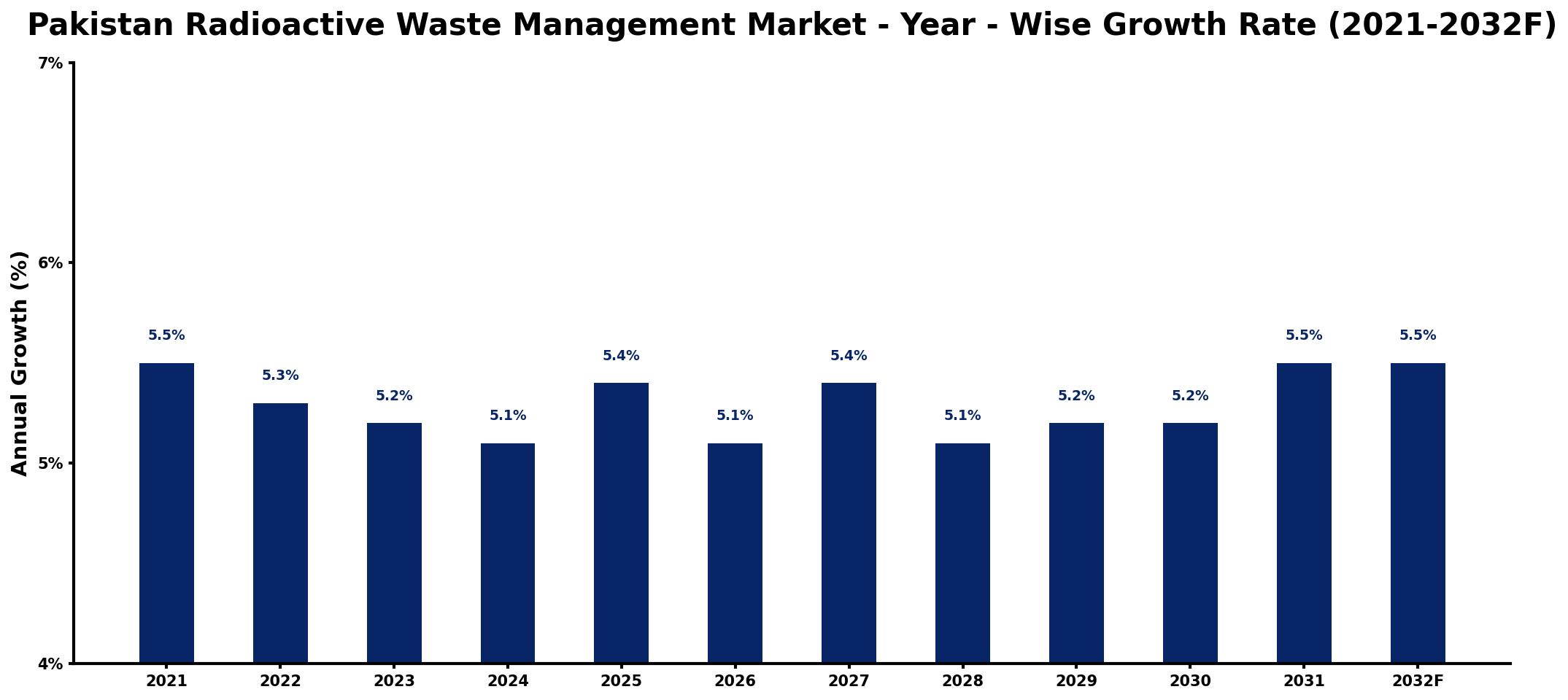
The table below presents the year‑wise growth rates along with the key drivers influencing the market
| Year | Growth Rate | Major Drivers |
| 2021 | 5.5% | Increased regulatory framework adoption |
| 2022 | 5.3% | Growing public safety awareness initiatives |
| 2023 | 5.2% | Rising energy sector investments |
| 2024 | 5.1% | Expansion of nuclear power facilities |
| 2025 | 5.4% | Strengthened international cooperation agreements |
| 2026 | 5.1% | Emergence of new technology solutions |
| 2027 | 5.4% | Increased research funding allocations |
| 2028 | 5.1% | Growing environmental sustainability focus |
| 2029 | 5.2% | Development of skilled workforce programs |
| 2030 | 5.2% | Enhanced community engagement efforts |
| 2031 | 5.5% | Increased private sector participation |
| 2032 | 5.5% | Strengthened infrastructure development projects |
Note: Market size estimations and growth projections presented in this report are based on 6Wresearch's proprietary forecasting methodology, utilizing the latest available industry data, government publications, and primary research inputs.
Pakistan Radioactive Waste Management Market Synopsis
In recent years, Pakistan has made significant strides in nuclear technology adoption across various sectors, including energy generation and healthcare. This has led to an increase in the volume of radioactive waste requiring responsible management. Effective radioactive waste disposal practices are critical to safeguarding communities and ecosystems from radiation exposure.
The market is characterized by a growing recognition of nuclear safety and compliance with international standards. This shift is not merely regulatory but reflects a broader commitment to sustainable development and environmental stewardship in Pakistan. Public awareness campaigns and international collaborations are fostering a culture of safety and responsibility in radioactive waste management.
Pakistan Radioactive Waste Management Market Key Takeaways
- Steady market growth driven by increased nuclear technology utilization across multiple sectors.
- Heightened regulatory frameworks are shaping the landscape of waste management practices.
- International collaborations enhance technology transfer and capacity-building initiatives.
- Investment in innovative waste treatment technologies is becoming increasingly vital.
- Public awareness plays a crucial role in advancing nuclear safety and waste management practices.
Evaluation of Restraints in Pakistan Radioactive Waste Management Market
Despite its growth potential, the Pakistan Radioactive Waste Management Market grapples with several significant challenges. The limited infrastructure for the safe storage and disposal of radioactive waste often hampers effective management practices. Additionally, the complexity of adhering to stringent regulatory requirements and international standards adds layers of difficulty for operators. Furthermore, the existing expertise in radioactive waste handling is often inadequate, demanding further investment in training and capacity building to meet the country's growing needs. Without targeted efforts to overcome these barriers, the market's full potential may remain unfulfilled.
Pakistan Radioactive Waste Management Market Trends
Current trends within the Pakistan Radioactive Waste Management Market highlight an increasing emphasis on sustainable waste management solutions. Innovative technologies, such as advanced waste treatment and recycling methods, are gaining traction. Furthermore, a surge in partnerships with international organizations is facilitating knowledge exchange, which is critical for local capacity development. Public-private partnerships are also emerging as a strategy to enhance investment in infrastructure and R&D initiatives.
Pakistan Radioactive Waste Management Market Opportunities
The market offers significant growth and investment opportunities, particularly in the development of specialized facilities for radioactive waste treatment and disposal. As the volume of waste generated increases, so too does the demand for state-of-the-art management solutions. There is also a burgeoning need for research into sustainable technologies that can mitigate long-term risks associated with radioactive materials. Investors and stakeholders who identify and seize these opportunities stand to benefit from the market's projected growth.
Government Initiatives in the Pakistan Radioactive Waste Management Market
The Pakistani government is proactively addressing the challenges of radioactive waste management through various policies and initiatives. Key regulations focus on the safe handling, transportation, and disposal of radioactive materials to align with global standards. Additionally, government programs are geared toward promoting R&D in waste treatment technologies, along with training initiatives to enhance the capabilities of regulatory agencies and waste management organizations. This commitment reflects a broader governmental strategy to ensure public health and environmental safety.
Future Insights of the Pakistan Radioactive Waste Management Market
Looking ahead to 2026-2032, the Pakistan Radioactive Waste Management Market is poised for transformation. The anticipated growth in the nuclear energy sector, coupled with ongoing investments in medical and industrial applications of radioactive materials, will drive demand for effective waste management solutions. As regulatory frameworks evolve, compliance and safety will become increasingly critical, fostering innovation and technological advancement. Additionally, the integration of sustainable practices will shape the industry's future, enhancing both safety and environmental stewardship.
Pakistan Radioactive Waste Management Market Latest Developments (2025 - 2026)
Recent developments in the Pakistan Radioactive Waste Management Market indicate a focused effort towards enhancing waste management infrastructure. Government agencies are engaging in collaborative projects with international bodies to adopt best practices and improve technology transfer. Meanwhile, industry stakeholders are exploring innovative solutions to optimize waste treatment processes. These initiatives are crucial in addressing the increasing volumes of radioactive waste generated across sectors, underscoring a collective commitment to safe management practices.
Pakistan Radioactive Waste Management Market - Key Attractiveness of the Report
- 10 Years of Market Numbers
- Historical Data Starting from 2022 to 2025
- Base Year: 2025
- Forecast Data until 2032
- Key Performance Indicators Impacting the Market
- Major Upcoming Developments and Projects
Key Highlights of the Report:
- Pakistan Radioactive Waste Management Market Outlook
- Market Size of Pakistan Radioactive Waste Management Market, 2025
- Forecast of Pakistan Radioactive Waste Management Market, 2032
- Historical Data and Forecast of Pakistan Radioactive Waste Management Revenues & Volume for the Period 2022-2032F
- Pakistan Radioactive Waste Management Market Trend Evolution
- Pakistan Radioactive Waste Management Market Drivers and Challenges
- Pakistan Radioactive Waste Management Price Trends
- Pakistan Radioactive Waste Management Porter's Five Forces
- Pakistan Radioactive Waste Management Industry Life Cycle
- Historical Data and Forecast of Pakistan Radioactive Waste Management Market Revenues & Volume By Type for the Period 2022-2032F
- Historical Data and Forecast of Pakistan Radioactive Waste Management Market Revenues & Volume By Exempt Waste and Very Low-Level Waste(VLLW) for the Period 2022-2032F
- Historical Data and Forecast of Pakistan Radioactive Waste Management Market Revenues & Volume By Low-Level Waste(LLW) for the Period 2022-2032F
- Historical Data and Forecast of Pakistan Radioactive Waste Management Market Revenues & Volume By Intermediate-Level Waste(ILW) for the Period 2022-2032F
- Historical Data and Forecast of Pakistan Radioactive Waste Management Market Revenues & Volume By High-Level Waste(HLW) for the Period 2022-2032F
- Historical Data and Forecast of Pakistan Radioactive Waste Management Market Revenues & Volume By Application for the Period 2022-2032F
- Historical Data and Forecast of Pakistan Radioactive Waste Management Market Revenues & Volume By Industrial for the Period 2022-2032F
- Historical Data and Forecast of Pakistan Radioactive Waste Management Market Revenues & Volume By Utility for the Period 2022-2032F
- Pakistan Radioactive Waste Management Import Export Trade Statistics
- Market Opportunity Assessment By Type
- Market Opportunity Assessment By Application
- Pakistan Radioactive Waste Management Top Companies Market Share
- Pakistan Radioactive Waste Management Competitive Benchmarking By Technical and Operational Parameters
- Pakistan Radioactive Waste Management Company Profiles
- Pakistan Radioactive Waste Management Key Strategic Recommendations






































