Pakistan Recycled Plastics Market Size, Share & Growth Rate
The Pakistan Recycled Plastics Market was estimated at USD 408 Million in 2025 and is projected to reach USD 556 Million by 2032, growing at a CAGR of 4.5% from 2026 to 2032. This growth is predominantly fueled by increasing environmental awareness among consumers and businesses, alongside government initiatives aimed at promoting recycling and sustainable practices. As industries such as packaging, construction, and automotive lean into eco-friendly solutions, the demand for recycled plastics continues to surge.
Pakistan Recycled Plastics Market Year-wise Growth Rate and Key Drivers
This graph highlights how the Pakistan Recycled Plastics Market has steadily grown over the years, supported by major growth factors.
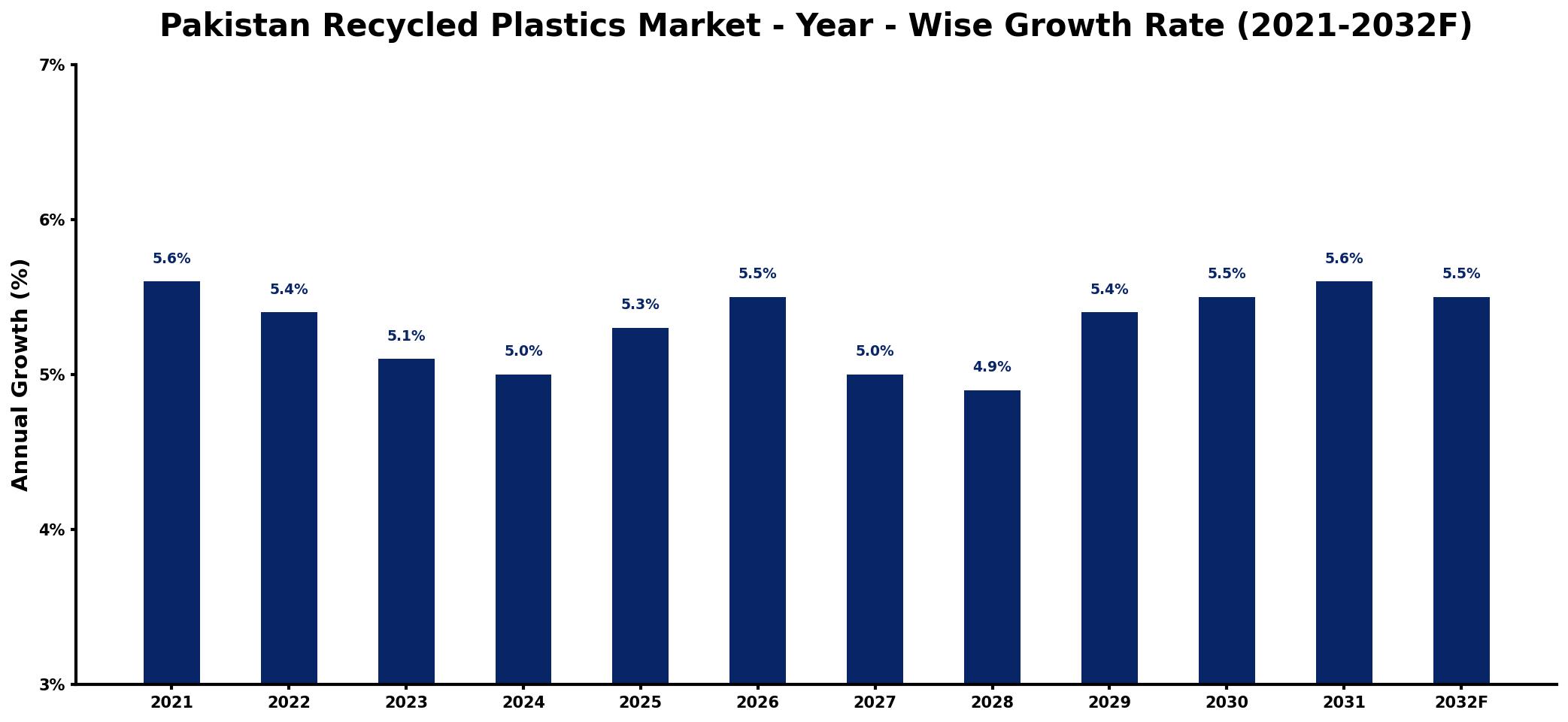
The table below presents the year‑wise growth rates along with the key drivers influencing the market
| Year | Growth Rate | Major Drivers |
| 2021 | 5.6% | Increased demand for eco-friendly solutions |
| 2022 | 5.4% | Government incentives for sustainable practices |
| 2023 | 5.1% | Rise in consumer awareness initiatives |
| 2024 | 5.0% | Expansion of waste management infrastructure |
| 2025 | 5.3% | Growth in green technology investments |
| 2026 | 5.5% | rising end-use demand growth |
| 2027 | 5.0% | Increased collaboration between industries |
| 2028 | 4.9% | Rising demand from packaging sector |
| 2029 | 5.4% | Emergence of new recycling technologies |
| 2030 | 5.5% | Strengthening of environmental regulations |
| 2031 | 5.6% | Boost in corporate sustainability commitments |
| 2032 | 5.5% | Growing interest in renewable resources |
Note: Market size estimations and growth projections presented in this report are based on 6Wresearch's proprietary forecasting methodology, utilizing the latest available industry data, government publications, and primary research inputs.
Pakistan Recycled Plastics Market Synopsis
The Pakistan Recycled Plastics Market is currently experiencing positive momentum, driven by a shift in consumer behavior towards sustainability. This trend is set against a backdrop of government initiatives that are laying the groundwork for an expanded recycling ecosystem. However, as the market progresses, it faces challenges that could hinder its potential, including inadequate infrastructure and low consumer awareness.
Looking ahead, the market is poised for significant growth, given the rising demand for recycled materials. The increasing incorporation of recycled plastics into various products speaks to a broader industry commitment to reducing plastic waste. As more companies adopt eco-friendly practices, the market is expected to evolve and expand further, creating a more sustainable landscape in Pakistan.
Pakistan Recycled Plastics Market Key Takeaways
- Rising consumer demand for sustainability is reshaping the landscape of the recycled plastics market.
- Government policies are increasingly supporting recycling initiatives, driving market growth.
- Technological advancements in recycling processes are enhancing product quality and efficiency.
- The packaging sector remains a significant driver for recycled plastics consumption.
- Investment opportunities are emerging as more industries seek to adopt eco-friendly materials.
Evaluation of Restraints in Pakistan Recycled Plastics Market
Despite its promising trajectory, the Pakistan Recycled Plastics Market faces notable restraints. A primary hurdle is the lack of awareness among consumers and businesses regarding the benefits of using recycled plastics. Additionally, the market grapples with infrastructural challenges, such as insufficient recycling facilities and collection systems, which can impede growth. The informal sectors prevalence also complicates quality control, as it operates outside regulatory oversight, further complicating standardization efforts within the industry.
Pakistan Recycled Plastics Market Trends
Several key trends are shaping the future of the Pakistan Recycled Plastics Market. A significant trend is the increasing consumer awareness about the environmental impact of plastic waste, driving demand for sustainable alternatives. The adoption of advanced recycling technologies is also gaining traction, improving efficiency and the quality of recycled materials. Additionally, the packaging industry is increasingly prioritizing eco-friendly solutions, thereby further increasing the demand for recycled plastics. These trends indicate a strong commitment from both consumers and businesses towards a more sustainable future.
Pakistan Recycled Plastics Market Opportunities
The Pakistan Recycled Plastics Market presents multiple investment opportunities, particularly in the realm of sustainability. Investors can explore avenues for establishing or enhancing recycling facilities that cater to various industries, including automotive and packaging. There is a growing demand for innovative recycling technologies that can improve quality and cost-effectiveness. As government policies increasingly support recycling initiatives, stakeholders have a favorable environment to capitalize on the demand for eco-friendly materials, resulting in both financial returns and positive environmental impacts.
Government Initiatives in the Pakistan Recycled Plastics Market
The Pakistani government has implemented a range of policies to foster the growth of the Recycled Plastics Market. Key initiatives include the Plastic Waste Management Rules, which aim to regulate plastic waste disposal and promote recycling efforts. Furthermore, the government has introduced incentives such as tax breaks and subsidies for businesses engaged in recycling activities. These policies are designed to facilitate a transition towards a more sustainable plastic industry, aligning with circular economy principles and reducing the dependency on virgin plastics.
Future Insights of the Pakistan Recycled Plastics Market
The outlook for the Pakistan Recycled Plastics Market between 2026 and 2032 is optimistic, propelled by rising environmental consciousness and government initiatives promoting recycling. As industries expand their focus on reducing plastic waste, demand for recycled materials is anticipated to grow significantly. Additionally, advancements in sorting and processing technologies are likely to enhance the usability of recycled plastics, contributing to market growth. However, addressing infrastructure challenges and raw material price volatility will be crucial to maintaining this upward momentum.
Pakistan Recycled Plastics Market Latest Developments (2025 - 2026)
In recent months, the Pakistan Recycled Plastics Market has seen an influx of activity driven by a heightened commitment to sustainability among various sectors. Companies are beginning to invest in better recycling technologies to enhance the quality and competitiveness of recycled plastics. Concurrently, public awareness campaigns aimed at educating consumers about recycling practices are gaining traction, further boosting the demand for recycled materials. These developments signal a maturing market that is responsive to both consumer needs and environmental challenges.
Pakistan Recycled Plastics Market - Key Attractiveness of the Report
- 10 Years of Market Numbers
- Historical Data Starting from 2022 to 2025
- Base Year: 2025
- Forecast Data until 2032
- Key Performance Indicators Impacting the Market
- Major Upcoming Developments and Projects
Key Highlights of the Report:
- Pakistan Recycled Plastics Market Outlook
- Market Size of Pakistan Recycled Plastics Market, 2025
- Forecast of Pakistan Recycled Plastics Market, 2032
- Historical Data and Forecast of Pakistan Recycled Plastics Revenues & Volume for the Period 2022-2032F
- Pakistan Recycled Plastics Market Trend Evolution
- Pakistan Recycled Plastics Market Drivers and Challenges
- Pakistan Recycled Plastics Price Trends
- Pakistan Recycled Plastics Porter's Five Forces
- Pakistan Recycled Plastics Industry Life Cycle
- Historical Data and Forecast of Pakistan Recycled Plastics Market Revenues & Volume By Plastic Type for the Period 2022-2032F
- Historical Data and Forecast of Pakistan Recycled Plastics Market Revenues & Volume By Polyethylene Terephthalate (Pet) for the Period 2022-2032F
- Historical Data and Forecast of Pakistan Recycled Plastics Market Revenues & Volume By High Density Polyethylene (Hdpe) for the Period 2022-2032F
- Historical Data and Forecast of Pakistan Recycled Plastics Market Revenues & Volume By Polypropylene (Pp) for the Period 2022-2032F
- Historical Data and Forecast of Pakistan Recycled Plastics Market Revenues & Volume By Low Density Polyethylene (Ldpe) for the Period 2022-2032F
- Historical Data and Forecast of Pakistan Recycled Plastics Market Revenues & Volume By Others for the Period 2022-2032F
- Historical Data and Forecast of Pakistan Recycled Plastics Market Revenues & Volume By Application for the Period 2022-2032F
- Historical Data and Forecast of Pakistan Recycled Plastics Market Revenues & Volume By Non-food Contact Packaging for the Period 2022-2032F
- Historical Data and Forecast of Pakistan Recycled Plastics Market Revenues & Volume By Food Contact Packaging for the Period 2022-2032F
- Historical Data and Forecast of Pakistan Recycled Plastics Market Revenues & Volume By Construction for the Period 2022-2032F
- Historical Data and Forecast of Pakistan Recycled Plastics Market Revenues & Volume By Automotive for the Period 2022-2032F
- Historical Data and Forecast of Pakistan Recycled Plastics Market Revenues & Volume By Others for the Period 2022-2032F
- Historical Data and Forecast of Pakistan Recycled Plastics Market Revenues & Volume By Raw Material for the Period 2022-2032F
- Historical Data and Forecast of Pakistan Recycled Plastics Market Revenues & Volume By Plastic Bottles for the Period 2022-2032F
- Historical Data and Forecast of Pakistan Recycled Plastics Market Revenues & Volume By Plastic Films for the Period 2022-2032F
- Historical Data and Forecast of Pakistan Recycled Plastics Market Revenues & Volume By Rigid Plastic And Foam for the Period 2022-2032F
- Historical Data and Forecast of Pakistan Recycled Plastics Market Revenues & Volume By Fibres for the Period 2022-2032F
- Historical Data and Forecast of Pakistan Recycled Plastics Market Revenues & Volume By Others for the Period 2022-2032F
- Pakistan Recycled Plastics Import Export Trade Statistics
- Market Opportunity Assessment By Plastic Type
- Market Opportunity Assessment By Application
- Market Opportunity Assessment By Raw Material
- Pakistan Recycled Plastics Top Companies Market Share
- Pakistan Recycled Plastics Competitive Benchmarking By Technical and Operational Parameters
- Pakistan Recycled Plastics Company Profiles
- Pakistan Recycled Plastics Key Strategic Recommendations






































