Pakistan RegTech Market Size & Growth Rate (2026-2032)
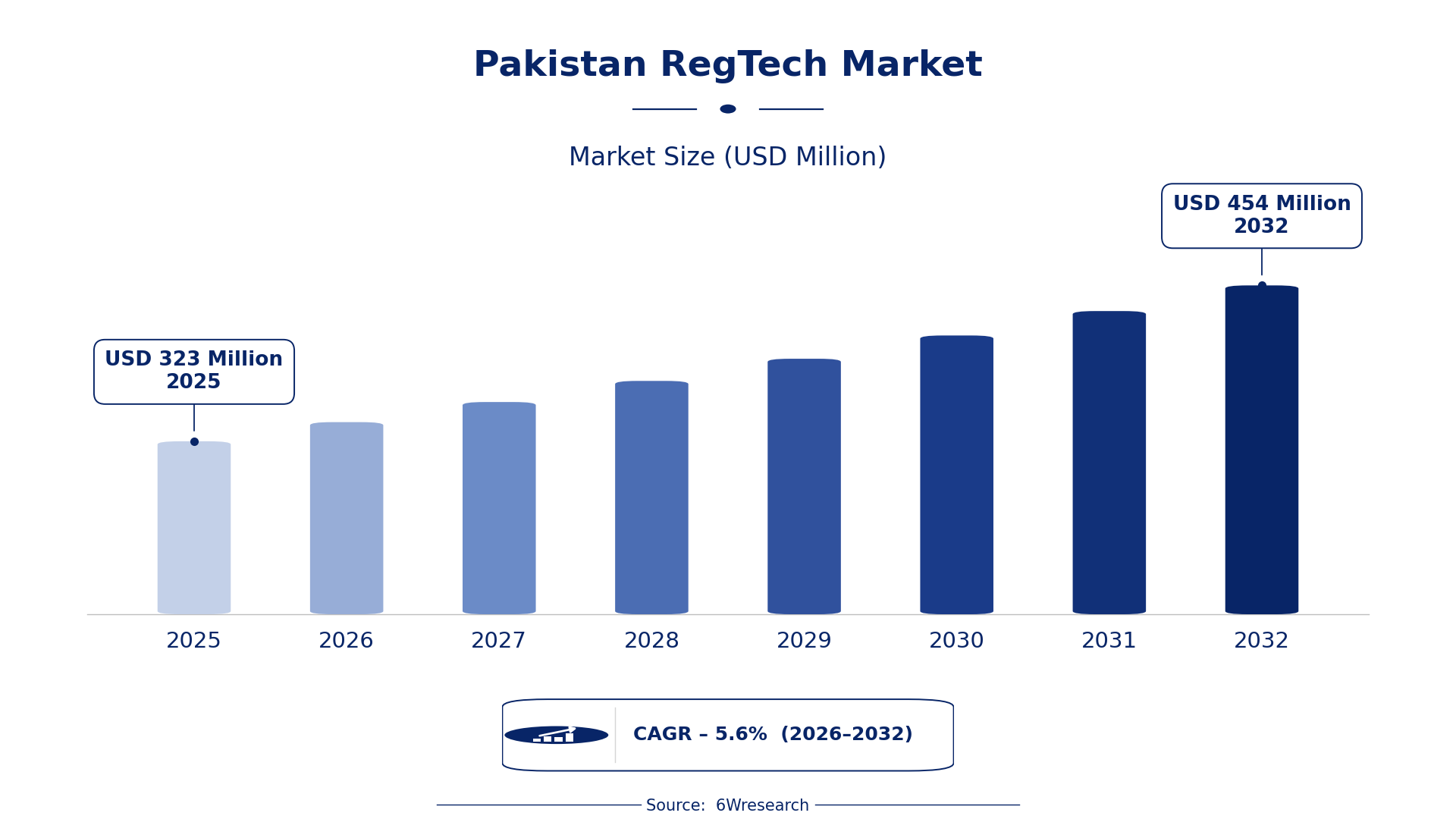
The Pakistan RegTech Market was estimated at USD 323 Million in 2025 and is projected to reach USD 454 Million by 2032, growing at a CAGR of 5.6% from 2026 to 2032.
Pakistan RegTech Market Synopsis
The Pakistan RegTech market is witnessing a transformative phase, characterized by increasing regulatory demands across multiple sectors. As organizations strive to comply with these evolving standards, the market is set to grow exponentially, with technology becoming an integral part of regulatory processes.
In the coming years, we expect to see a surge in the adoption of advanced RegTech solutions. Companies are not just looking for compliance tools; they are seeking innovative technologies like AI and blockchain to enhance efficiency and transparency in their operations.
Pakistan RegTech Market Year-wise Growth Rate and Key Drivers
This graph illustrates the annual growth rates of the Pakistan RegTech Market from 2021 to 2032, highlighting a steady upward trajectory and projected expansion over the forecast period.
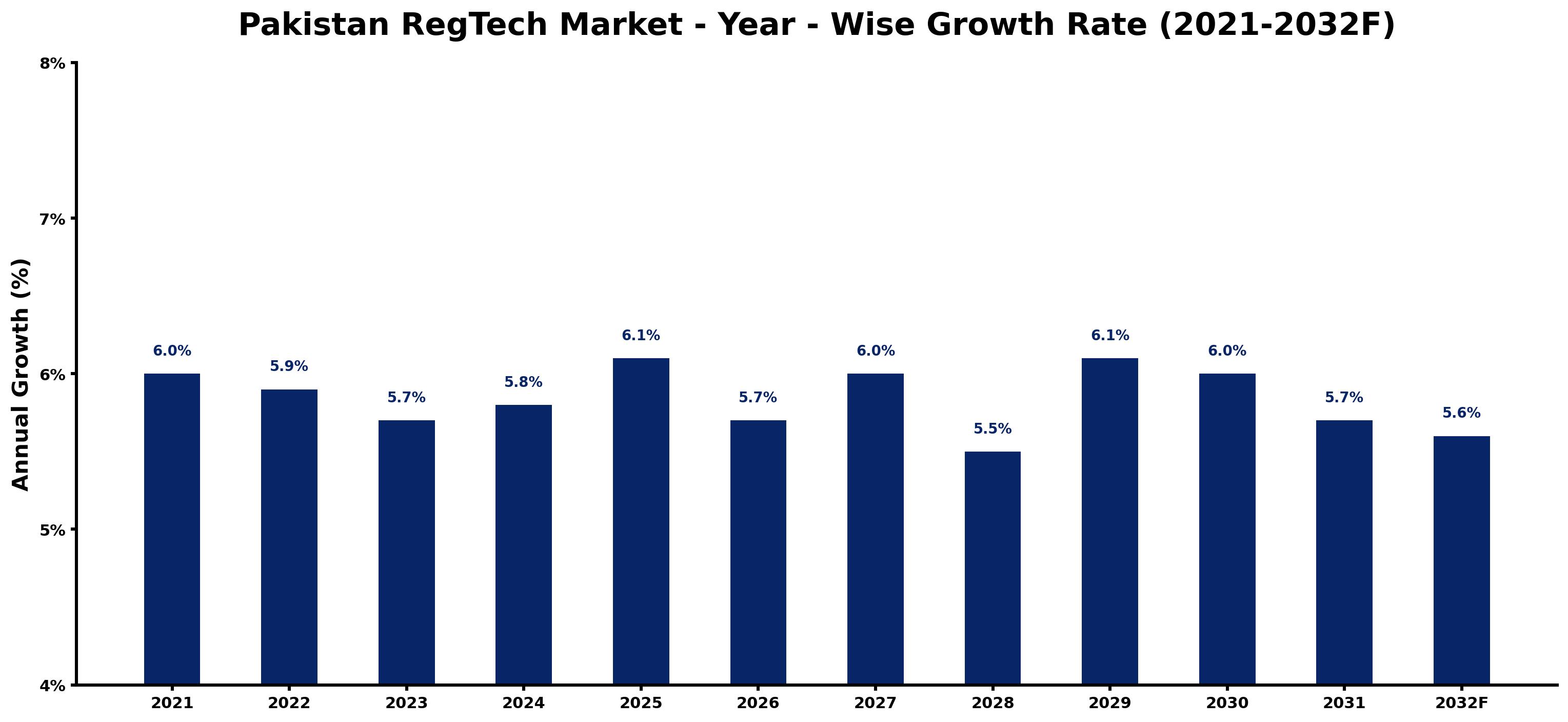
The table below presents the year‑wise growth rates along with the key drivers influencing the market
| Year | Growth Rate | Major Drivers |
| 2021 | 6.0% | Implementation of E-Mandate by State Bank of Pakistan. |
| 2022 | 5.9% | Increased focus on AML regulations by SECP. |
| 2023 | 5.7% | Growing digitization in banking sector under PSDP. |
| 2024 | 5.8% | Adoption of biometric verification by telecom operators. |
| 2025 | 6.1% | Government push for e-governance and digital transactions. |
| 2026 | 5.7% | Rising cybersecurity threats driving KYC compliance demands. |
| 2027 | 6.0% | Partnerships between banks and fintechs enhancing RegTech solutions. |
| 2028 | 5.5% | Regulatory sandbox initiatives promoting innovation in fintech. |
| 2029 | 6.1% | Emergence of local startups focused on fraud prevention. |
| 2030 | 6.0% | Increased investment in financial technologies by government. |
| 2031 | 5.7% | Demand for data privacy solutions amidst policy changes. |
| 2032 | 5.6% | Growing public awareness of regulatory compliance requirements. |
Note: Market size estimations and growth projections presented in this report are based on 6Wresearch's proprietary forecasting methodology, utilizing the latest available industry data, government publications, and primary research inputs.
Pakistan RegTech Market Key Takeaways
Below are some of the specific key takeaways from the market, including:
- Rapid growth driven by regulatory compliance requirements in banking and financial sectors.
- Increased demand for anti-money laundering (AML) and know your customer (KYC) solutions.
- Technology adoption, especially AI and blockchain, is reshaping regulatory compliance processes.
- Collaboration between RegTech startups and established financial institutions is on the rise.
- The government is actively promoting RegTech to enhance transparency and compliance.
Evaluation of Restraints in Pakistan RegTech Market
Despite the promising outlook, several factors hinder the growth of the Pakistan RegTech market. A major concern is the lack of awareness regarding regulatory technology solutions among businesses and regulators. This knowledge gap limits adoption and stifles innovation.
on top of that, the fragmented regulatory environment complicates compliance for RegTech companies, making it difficult to navigate the multitude of regulations across different sectors. Cost constraints and technical expertise also play a significant role in restricting the widespread use of advanced technologies.
Pakistan RegTech Market Trends
The market is evolving with a clear trend toward digitization and automation. Businesses are increasingly looking to streamline compliance processes, which has led to a surge in demand for sophisticated RegTech solutions. Technologies such as AI are being harnessed to enhance risk management and regulatory reporting.
Additionally, there is a marked shift towards collaborative frameworks between tech providers and regulated entities. This partnership approach is fostering innovation, allowing for more tailored solutions that meet specific compliance needs.
Pakistan RegTech Market Opportunities
Opportunities abound in the Pakistan RegTech market as businesses seek efficient compliance solutions. The rising demand for AML and KYC compliance tools presents a lucrative avenue for growth. on top of that, with the government pushing for digital transformation, there’s ample room for innovation.
Investment in advanced technologies like blockchain offers promising prospects for RegTech solutions that can enhance transparency and security. As organizations become increasingly aware of the benefits of RegTech, the market is set to experience a substantial uptick.
Government Initiatives in the Pakistan RegTech Market
Government policies are crucial in shaping the Pakistan RegTech market. With a focus on enhancing regulatory compliance and transparency in the financial sector, the government has been proactive in promoting RegTech solutions. The current regulatory posture encourages innovation, creating a conducive environment for growth.
- A regulatory framework introduced in 2025 mandating the adoption of digital compliance tools across financial institutions.
- Currently ongoing initiatives by the State Bank of Pakistan to enhance digital payment systems and encourage RegTech solutions.
- Recent guidelines issued by the Securities and Exchange Commission of Pakistan to integrate RegTech in monitoring investor activities.
- A planned public-private partnership aimed at bolstering regulatory infrastructure by 2028.
Future Insights of the Pakistan RegTech Market
Looking ahead, the Pakistan RegTech market is set for significant transformation from 2026 to 2032. Increased regulatory pressures will drive businesses to seek advanced compliance solutions, pushing the market towards rapid growth. Technological advancements, particularly in AI and blockchain, will redefine regulatory processes, making them more efficient and transparent.
As the government continues to support digital initiatives and regulatory reforms, RegTech companies will find ample opportunities to innovate and expand their offerings. The future is bright for a sector that is crucial for maintaining regulatory integrity and fostering economic growth.
Pakistan RegTech Market Latest Developments
Recent months have seen a surge in activity within the Pakistan RegTech market, with a notable focus on innovation and compliance. Companies are actively exploring new technologies to enhance their offerings while regulators are increasingly recognizing the importance of RegTech solutions in maintaining oversight.
- A major technology vendor launched an AI-driven compliance tool in early 2025, enhancing risk assessment capabilities for financial institutions.
- An initiative that began in mid-2025 focuses on integrating blockchain technology into existing regulatory frameworks to improve transparency.
- A public-sector program aimed at educating businesses about RegTech solutions is currently underway, expected to expand access by 2026.
- A rollout of a national compliance monitoring system is planned for late 2026, enhancing real-time regulatory oversight.
Pakistan RegTech Market - Key Attractiveness of the Report
- 10 Years of Market Numbers
- Historical Data Starting from 2022 to 2025
- Base Year: 2025
- Forecast Data until 2032
- Key Performance Indicators Impacting the Market
- Major Upcoming Developments and Projects
Key Highlights of the Report:
- Pakistan RegTech Market Outlook
- Market Size of Pakistan RegTech Market, 2025
- Forecast of Pakistan RegTech Market, 2032
- Historical Data and Forecast of Pakistan RegTech Revenues & Volume for the Period 2022-2032F
- Pakistan RegTech Market Trend Evolution
- Pakistan RegTech Market Drivers and Challenges
- Pakistan RegTech Price Trends
- Pakistan RegTech Porter's Five Forces
- Pakistan RegTech Industry Life Cycle
- Historical Data and Forecast of Pakistan RegTech Market Revenues & Volume By Component for the Period 2022-2032F
- Historical Data and Forecast of Pakistan RegTech Market Revenues & Volume By Solutions for the Period 2022-2032F
- Historical Data and Forecast of Pakistan RegTech Market Revenues & Volume By Services for the Period 2022-2032F
- Historical Data and Forecast of Pakistan RegTech Market Revenues & Volume By Application for the Period 2022-2032F
- Historical Data and Forecast of Pakistan RegTech Market Revenues & Volume By Risk & Compliance Management for the Period 2022-2032F
- Historical Data and Forecast of Pakistan RegTech Market Revenues & Volume By Identity Management for the Period 2022-2032F
- Historical Data and Forecast of Pakistan RegTech Market Revenues & Volume By Regulatory Reporting for the Period 2022-2032F
- Historical Data and Forecast of Pakistan RegTech Market Revenues & Volume By AML and Fraud Management for the Period 2022-2032F
- Historical Data and Forecast of Pakistan RegTech Market Revenues & Volume By Regulatory Intelligence for the Period 2022-2032F
- Historical Data and Forecast of Pakistan RegTech Market Revenues & Volume By Organization Size for the Period 2022-2032F
- Historical Data and Forecast of Pakistan RegTech Market Revenues & Volume By SMEs for the Period 2022-2032F
- Historical Data and Forecast of Pakistan RegTech Market Revenues & Volume By Large Enterprises for the Period 2022-2032F
- Historical Data and Forecast of Pakistan RegTech Market Revenues & Volume By Deployment Mode for the Period 2022-2032F
- Historical Data and Forecast of Pakistan RegTech Market Revenues & Volume By On-Premises for the Period 2022-2032F
- Historical Data and Forecast of Pakistan RegTech Market Revenues & Volume By Cloud for the Period 2022-2032F
- Historical Data and Forecast of Pakistan RegTech Market Revenues & Volume By Vertical for the Period 2022-2032F
- Historical Data and Forecast of Pakistan RegTech Market Revenues & Volume By Banking for the Period 2022-2032F
- Historical Data and Forecast of Pakistan RegTech Market Revenues & Volume By Insurance for the Period 2022-2032F
- Historical Data and Forecast of Pakistan RegTech Market Revenues & Volume By Non-Financial for the Period 2022-2032F
- Pakistan RegTech Import Export Trade Statistics
- Market Opportunity Assessment By Component
- Market Opportunity Assessment By Application
- Market Opportunity Assessment By Organization Size
- Market Opportunity Assessment By Deployment Mode
- Market Opportunity Assessment By Vertical
- Pakistan RegTech Top Companies Market Share
- Pakistan RegTech Competitive Benchmarking By Technical and Operational Parameters
- Pakistan RegTech Company Profiles
- Pakistan RegTech Key Strategic Recommendations






































