Pakistan Smart Doorbell Market Size, Share & Growth Rate
The Pakistan Smart Doorbell Market was estimated at USD 1485 Million in 2025 and is projected to reach USD 2659 Million by 2032, growing at a CAGR of 8.7% from 2026 to 2032. This remarkable growth trajectory is fueled by a burgeoning urban population increasingly prioritizing home security, coupled with a surge in disposable incomes that allows for investments in smart home technologies. The convergence of these factors creates an opportune environment for innovations in home security solutions.
Pakistan Smart Doorbell Market Year-wise Growth Rate and Key Drivers
This graph highlights how the Pakistan Smart Doorbell Market has steadily grown over the years, supported by major growth factors.
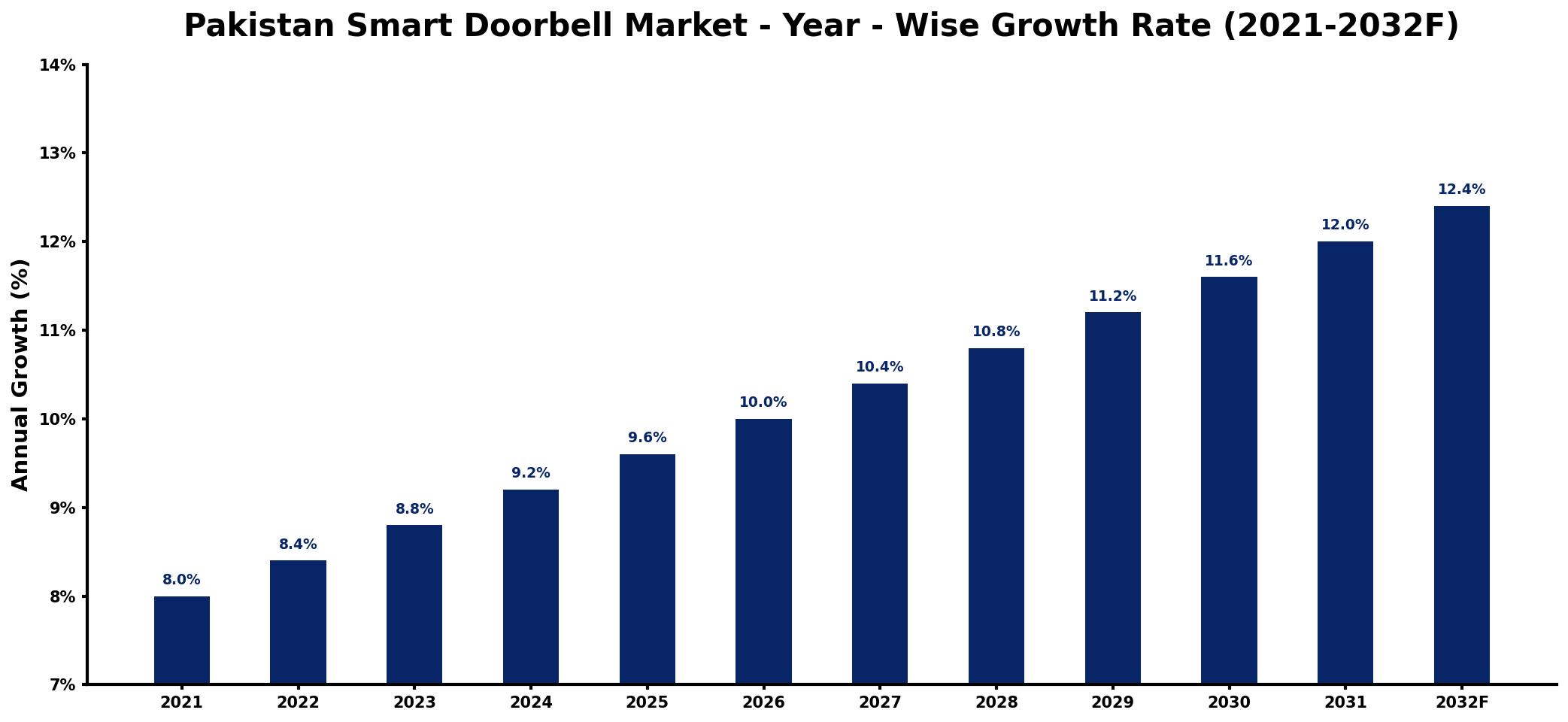
The table below presents the year‑wise growth rates along with the key drivers influencing the market
| Year | Growth Rate | Major Drivers |
| 2021 | 8.0% | Rising home security demand |
| 2022 | 8.4% | rising infrastructure development spending |
| 2023 | 8.8% | Increased consumer technology awareness |
| 2024 | 9.2% | Expansion of urban residential projects |
| 2025 | 9.6% | Higher disposable income levels |
| 2026 | 10.0% | Advancements in wireless technology |
| 2027 | 10.4% | Growing interest in remote monitoring |
| 2028 | 10.8% | Surge in e-commerce transactions |
| 2029 | 11.2% | Enhanced focus on home automation |
| 2030 | 11.6% | Development of IoT infrastructure |
| 2031 | 12.0% | Increase in safety regulations |
| 2032 | 12.4% | Rising demand for energy efficiency |
Note: Market size estimations and growth projections presented in this report are based on 6Wresearch's proprietary forecasting methodology, utilizing the latest available industry data, government publications, and primary research inputs.
Pakistan Smart Doorbell Market Synopsis
The strongest force shaping the Pakistan Smart Doorbell Market today is the rising demand for enhanced home security solutions. As urban areas expand and crime rates fluctuate, homeowners are becoming increasingly vigilant about protecting their properties, seeking advanced features that smart doorbells provide.
Furthermore, the growing penetration of smartphones and internet connectivity in Pakistan is driving the adoption of smart doorbells. As users become more familiar with connected devices, the desire for seamless integration with existing smart home ecosystems continues to rise, enhancing the overall appeal of smart doorbell systems.
Pakistan Smart Doorbell Market Key Takeaways
- The market is poised for significant growth, driven by urbanization and rising disposable incomes.
- Increasing consumer awareness about home security is propelling demand for smart doorbells.
- Integration with other smart home devices is becoming a critical purchasing factor for consumers.
- Innovative features such as two-way audio and HD video recording are key differentiators in product offerings.
- Product affordability and reliable internet connectivity remain essential for widespread adoption.
Evaluation of Restraints in Pakistan Smart Doorbell Market
Despite the favorable market outlook, several restraints are hindering growth in the Pakistan Smart Doorbell Market. Limited consumer awareness surrounding smart home technology poses a significant challenge; many potential buyers are unfamiliar with the capabilities and benefits that smart doorbells provide. Privacy concerns associated with data sharing and remote access also contribute to apprehensions among consumers. Additionally, affordability remains a barrier in rural areas, where disposable income levels are lower, and the need for reliable internet connectivity complicates the use of smart doorbells, restricting their functionality.
Pakistan Smart Doorbell Market Trends
The demand for smart doorbells is evolving, with several key trends shaping the market. Increased consumer interest in features such as high-definition video capture, motion detection, and remote access has led to a more competitive landscape. Companies are investing in integrating their products with popular virtual assistants like Amazon Alexa and Google Assistant, making smart doorbells an integral part of the smart home ecosystem. Furthermore, the availability of cloud storage options for recorded footage has emerged as a sought-after feature, ensuring users can maintain security without relying solely on local storage solutions.
Pakistan Smart Doorbell Market Opportunities
The Pakistan Smart Doorbell Market presents attractive investment opportunities, driven primarily by the increasing inclination towards smart home technologies. Companies that focus on creating affordable and reliable smart doorbell solutions tailored to local market preferences are well-positioned for growth. Additionally, forming partnerships with local retailers and e-commerce platforms can enhance reach and visibility. Strategic marketing campaigns that emphasize the benefits of smart doorbells in enhancing home security and lifestyle modernization will likely attract the attention of prospective consumers, further stimulating market demand.
Government Initiatives in the Pakistan Smart Doorbell Market
While there are no specific policies addressing the Smart Doorbell market directly, the Pakistani government's broader efforts towards digitalization and smart city projects are expected to positively influence this sector. Initiatives aimed at improving internet infrastructure and increasing e-commerce capabilities are creating a supportive environment for the adoption of smart home devices. The push for technological advancement among the population is likely to foster interest in smart doorbells, thereby facilitating market growth.
Future Insights of the Pakistan Smart Doorbell Market
The future outlook for the Pakistan Smart Doorbell Market is promising, driven by increasing urbanization and a growing emphasis on home security. As technology continues to advance, we can expect smarter features, such as AI capabilities, that will further enhance user experience and security. The rising consumer demand for comprehensive smart home solutions suggests that companies will need to focus on innovation, customization, and strategic partnerships to capture the burgeoning market effectively. Overall, as consumer adoption of smart home technologies grows, the smart doorbell market is positioned for robust expansion over the coming years.
Pakistan Smart Doorbell Market Latest Developments (2025 - 2026)
Recent industry developments indicate an increased focus on enhancing product features and integration capabilities among smart doorbell manufacturers. Companies are exploring partnerships to improve compatibility with other smart home devices, while user feedback is being utilized to refine product offerings. There has been a noticeable uptick in marketing campaigns aimed at raising consumer awareness about smart doorbells and their benefits. Additionally, efforts to improve internet connectivity in urban areas are expected to bolster sales in the coming years.
Pakistan Smart Doorbell Market - Key Attractiveness of the Report
- 10 Years of Market Numbers
- Historical Data Starting from 2022 to 2025
- Base Year: 2025
- Forecast Data until 2032
- Key Performance Indicators Impacting the Market
- Major Upcoming Developments and Projects
Key Highlights of the Report:
- Pakistan Smart Doorbell Market Outlook
- Market Size of Pakistan Smart Doorbell Market, 2025
- Forecast of Pakistan Smart Doorbell Market, 2032
- Historical Data and Forecast of Pakistan Smart Doorbell Revenues & Volume for the Period 2022-2032F
- Pakistan Smart Doorbell Market Trend Evolution
- Pakistan Smart Doorbell Market Drivers and Challenges
- Pakistan Smart Doorbell Price Trends
- Pakistan Smart Doorbell Porter's Five Forces
- Pakistan Smart Doorbell Industry Life Cycle
- Historical Data and Forecast of Pakistan Smart Doorbell Market Revenues & Volume By Product Type for the Period 2022-2032F
- Historical Data and Forecast of Pakistan Smart Doorbell Market Revenues & Volume By Wired Doorbell for the Period 2022-2032F
- Historical Data and Forecast of Pakistan Smart Doorbell Market Revenues & Volume By Wireless Doorbell for the Period 2022-2032F
- Historical Data and Forecast of Pakistan Smart Doorbell Market Revenues & Volume By Distribution Channel for the Period 2022-2032F
- Historical Data and Forecast of Pakistan Smart Doorbell Market Revenues & Volume By Online for the Period 2022-2032F
- Historical Data and Forecast of Pakistan Smart Doorbell Market Revenues & Volume By Offline for the Period 2022-2032F
- Historical Data and Forecast of Pakistan Smart Doorbell Market Revenues & Volume By End User for the Period 2022-2032F
- Historical Data and Forecast of Pakistan Smart Doorbell Market Revenues & Volume By Residential for the Period 2022-2032F
- Historical Data and Forecast of Pakistan Smart Doorbell Market Revenues & Volume By Commercial for the Period 2022-2032F
- Pakistan Smart Doorbell Import Export Trade Statistics
- Market Opportunity Assessment By Product Type
- Market Opportunity Assessment By Distribution Channel
- Market Opportunity Assessment By End User
- Pakistan Smart Doorbell Top Companies Market Share
- Pakistan Smart Doorbell Competitive Benchmarking By Technical and Operational Parameters
- Pakistan Smart Doorbell Company Profiles
- Pakistan Smart Doorbell Key Strategic Recommendations






































