Pakistan Smart Waste Management Market Size & Growth Rate (2026-2032)
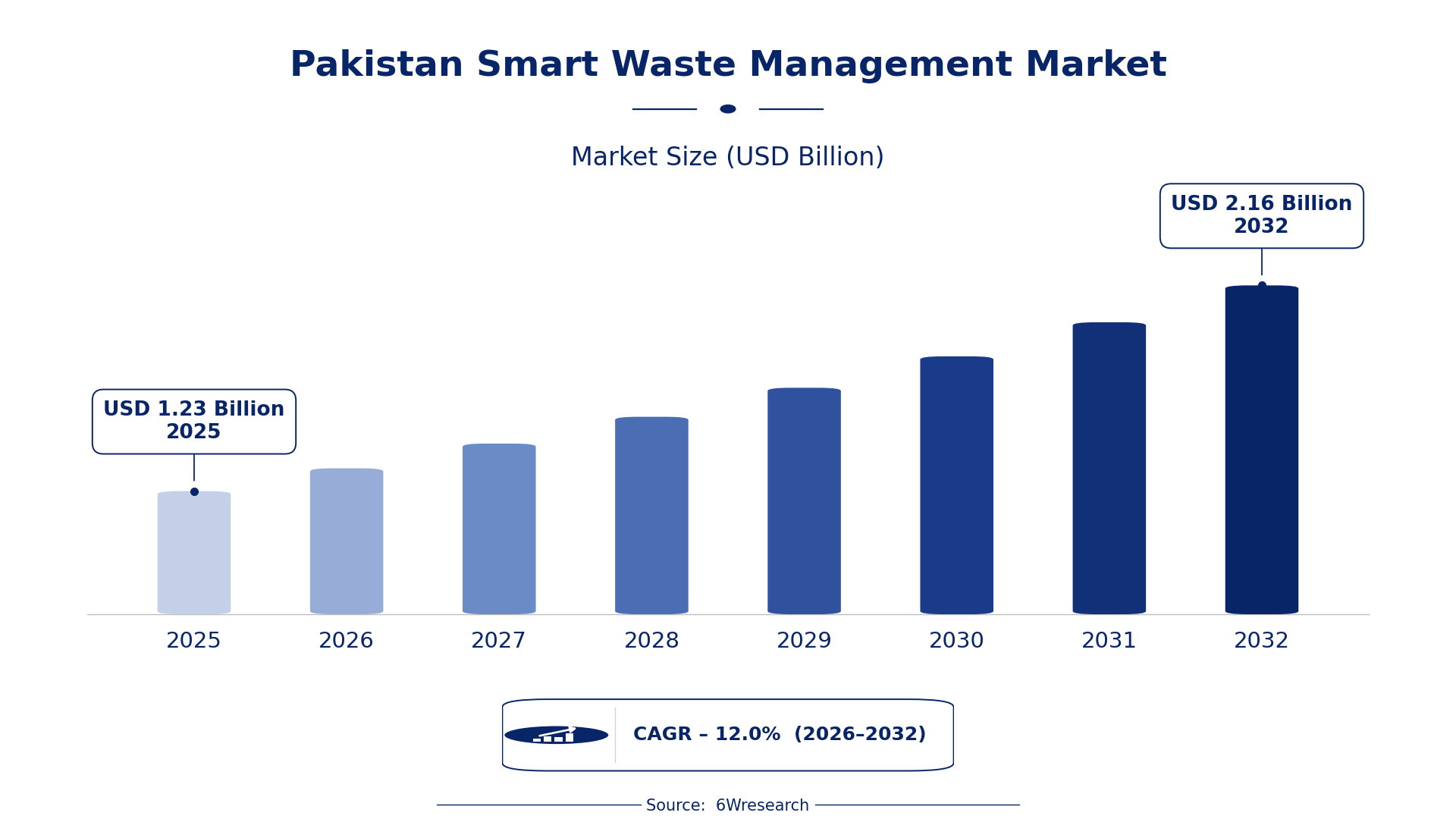
The Pakistan Smart Waste Management Market was estimated at USD 1233 Million in 2025 and is projected to reach USD 2160 Million by 2032, growing at a CAGR of 12.0% from 2026 to 2032.
Pakistan Smart Waste Management Market Synopsis
Pakistan faces a mounting waste crisis, with urban areas generating increasing volumes of refuse. The adoption of smart waste management solutions is crucial for municipalities to keep pace with this rapid urbanization while enhancing environmental sustainability.
Innovative technologies such as IoT sensors and data analytics are being employed to optimize waste collection and processing. This shift not only reduces operational costs but also enables cities to implement more efficient waste segregation and recycling initiatives.
Pakistan Smart Waste Management Market Year-wise Growth Rate and Key Drivers
This graph illustrates the annual growth rates of the Pakistan Smart Waste Management Market from 2021 to 2032, highlighting a steady upward trajectory and projected expansion over the forecast period.
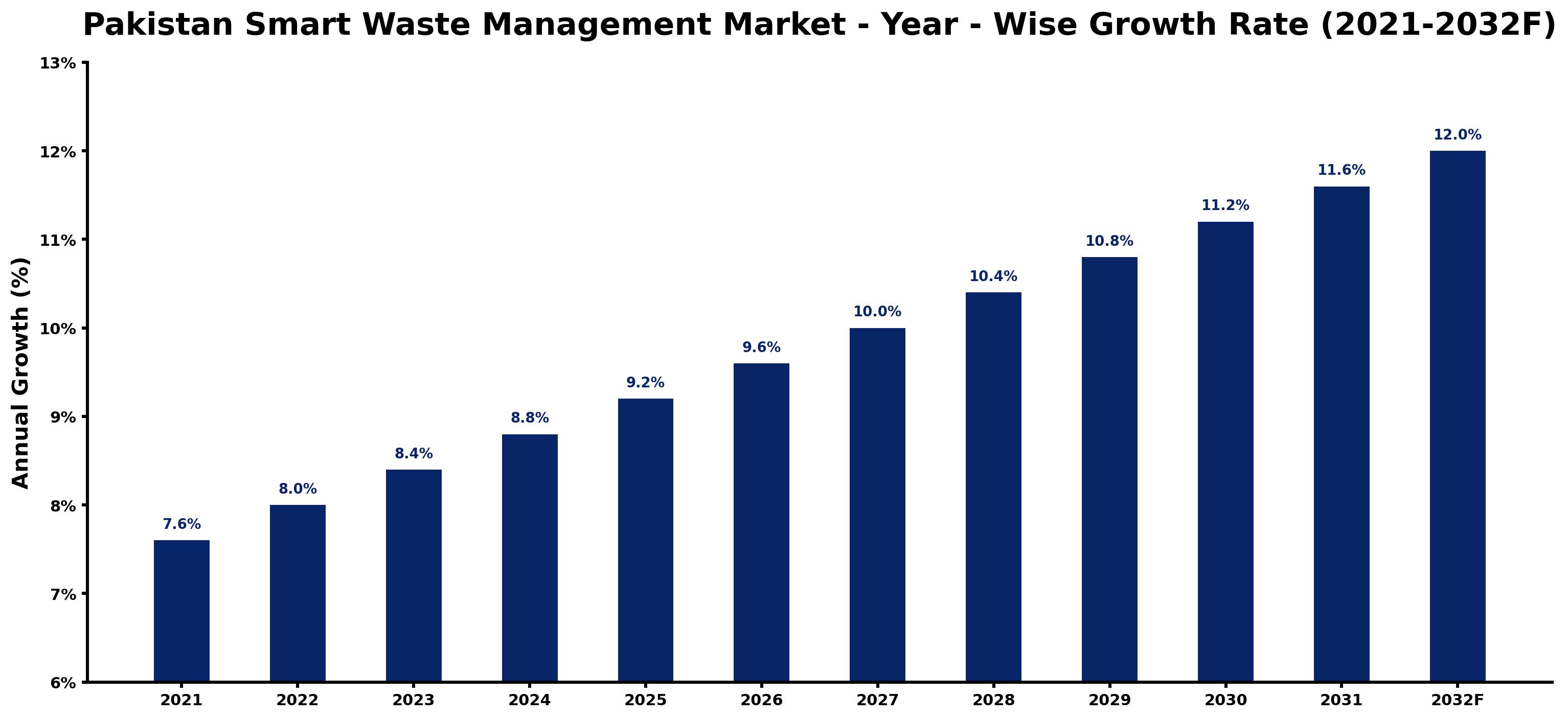
The table below presents the year‑wise growth rates along with the key drivers influencing the market
| Year | Growth Rate | Major Drivers |
| 2021 | 7.6% | Punjab's Circular Economy Initiative boosting waste management innovation |
| 2022 | 8.0% | Increasing urbanization in Karachi driving waste collection demand |
| 2023 | 8.4% | Government grants for smart waste technologies in Lahore |
| 2024 | 8.8% | Karachi Clean Green Program expanding smart solutions initiative |
| 2025 | 9.2% | Rising environmental awareness campaigns enhancing public participation |
| 2026 | 9.6% | Adoption of IoT for waste monitoring by municipalities |
| 2027 | 10.0% | Cross-border partnerships for advanced waste processing initiatives |
| 2028 | 10.4% | Investments in recycling facilities by local enterprises increasing |
| 2029 | 10.8% | National Waste Management Policy promoting smart solutions adoption |
| 2030 | 11.2% | Emergence of tech startups focused on waste analytics |
| 2031 | 11.6% | ISLAMABAD 2030 Master Plan calls for waste automation |
| 2032 | 12.0% | Government-supported tech incubators fostering waste management innovation |
Note: Market size estimations and growth projections presented in this report are based on 6Wresearch's proprietary forecasting methodology, utilizing the latest available industry data, government publications, and primary research inputs.
Pakistan Smart Waste Management Market Key Takeaways
Below are some of the specific key takeaways from the market, including:
- The market is driven by urbanization and the urgent need for efficient waste management systems.
- Smart technologies such as IoT and AI are increasingly being integrated into waste management practices.
- Government initiatives focused on sustainability and smart city development are propelling market growth.
- Partnerships between technology providers and local municipalities are becoming more common.
- Challenges in public awareness and infrastructure investment continue to hinder progress.
Evaluation of Restraints in Pakistan Smart Waste Management Market
Despite its potential, the Pakistan Smart Waste Management Market is constrained by several factors. Limited public awareness about the benefits of smart technologies hampers their adoption, resulting in a slow transition from traditional waste management practices. on top of that, inadequate infrastructure and insufficient funding present significant barriers to effective implementation. The lack of a coherent regulatory framework complicates matters, creating inconsistencies in waste collection and processing. To overcome these challenges, a concerted effort is needed to enhance public education, secure government support for infrastructure, and establish robust waste management policies.
Pakistan Smart Waste Management Market Trends
Several key trends are influencing the Pakistan Smart Waste Management Market. The integration of IoT-enabled smart bins is revolutionizing waste collection by providing real-time data to optimize routes and schedules. As awareness of environmental sustainability grows, both government and private sectors are investing heavily in smart waste management technologies. Additionally, the rise of AI-driven analytics is enabling better decision-making processes, fostering a more proactive approach to waste management.
Pakistan Smart Waste Management Market Opportunities
Opportunities for growth in the Pakistan Smart Waste Management Market are abundant. Collaborative partnerships between technology providers and local governments can drive the development of integrated waste management systems tailored to urban needs. The introduction of waste-to-energy technologies is another promising avenue, addressing both waste disposal and energy generation. As municipalities strive for cleaner environments, there’s a strong push for innovative solutions that can enhance waste segregation and recycling efforts.
Government Initiatives in the Pakistan Smart Waste Management Market
The Pakistani government is actively shaping the smart waste management sector through a variety of initiatives aimed at improving waste management practices nationwide. Recent policies emphasize sustainable urban development and the adoption of innovative technologies to tackle waste challenges effectively.
- A recently completed National Solid Waste Management Strategy aims to enhance waste collection and disposal systems across both urban and rural areas.
- The ongoing Clean Green Pakistan program encourages waste segregation at the source and promotes recycling initiatives.
- A planned public-private partnership is set to develop smart waste management solutions, expected to commence in early 2026.
- The Prime Minister's Clean Green Pakistan Index, launched in late 2024, ranks cities on their waste management performance.
- A new regulatory framework is under consideration, intended to streamline waste management processes and enforce compliance, with expected rollout by mid-2026.
Future Insights of the Pakistan Smart Waste Management Market
Looking ahead to 2026-2032, the Pakistan Smart Waste Management Market is set for substantial expansion. The increasing population and urban density necessitate innovative waste management solutions to ensure public health and environmental safety. Enhanced technology adoption will enable municipalities to optimize waste collection and processing, leading to lower operational costs and improved service delivery. Government support for infrastructure development and regulatory reforms will further drive the market, positioning it for continued growth.
Pakistan Smart Waste Management Market Latest Developments
Recent activity in the Pakistan Smart Waste Management Market has reflected a growing commitment to technology-driven solutions. The past year has seen advancements in smart waste management systems that promise to reshape urban waste handling.
- A major technology vendor launched a pilot project featuring IoT-enabled waste bins in Karachi, which began in Q1 2025 and has shown promising results in optimizing collection routes.
- An ongoing initiative to implement AI-driven analytics for waste processing is currently underway in Lahore, with expected completion by late 2025.
- A new partnership between local governments and tech firms is planned to expand waste-to-energy facilities, with discussions ongoing since early 2025.
- A recently initiated public awareness campaign aims to educate citizens about the importance of waste segregation, expected to conclude by mid-2025.
- An upgrade of waste management infrastructure in Islamabad, which started in early 2025, is anticipated to enhance overall efficiency and service delivery.
Pakistan Smart Waste Management Market - Key Attractiveness of the Report
- 10 Years of Market Numbers
- Historical Data Starting from 2022 to 2025
- Base Year: 2025
- Forecast Data until 2032
- Key Performance Indicators Impacting the Market
- Major Upcoming Developments and Projects
Key Highlights of the Report:
- Pakistan Smart Waste Management Market Outlook
- Market Size of Pakistan Smart Waste Management Market, 2025
- Forecast of Pakistan Smart Waste Management Market, 2032
- Historical Data and Forecast of Pakistan Smart Waste Management Revenues & Volume for the Period 2022-2032F
- Pakistan Smart Waste Management Market Trend Evolution
- Pakistan Smart Waste Management Market Drivers and Challenges
- Pakistan Smart Waste Management Price Trends
- Pakistan Smart Waste Management Porter's Five Forces
- Pakistan Smart Waste Management Industry Life Cycle
- Historical Data and Forecast of Pakistan Smart Waste Management Market Revenues & Volume By Solution for the Period 2022-2032F
- Historical Data and Forecast of Pakistan Smart Waste Management Market Revenues & Volume By Optimization Solutions for the Period 2022-2032F
- Historical Data and Forecast of Pakistan Smart Waste Management Market Revenues & Volume By Analytics and Reporting Solutions for the Period 2022-2032F
- Historical Data and Forecast of Pakistan Smart Waste Management Market Revenues & Volume By Asset Management for the Period 2022-2032F
- Historical Data and Forecast of Pakistan Smart Waste Management Market Revenues & Volume By Network Management for the Period 2022-2032F
- Historical Data and Forecast of Pakistan Smart Waste Management Market Revenues & Volume By Others for the Period 2022-2032F
- Historical Data and Forecast of Pakistan Smart Waste Management Market Revenues & Volume By Service for the Period 2022-2032F
- Historical Data and Forecast of Pakistan Smart Waste Management Market Revenues & Volume By Professional Services for the Period 2022-2032F
- Historical Data and Forecast of Pakistan Smart Waste Management Market Revenues & Volume By Managed Services for the Period 2022-2032F
- Historical Data and Forecast of Pakistan Smart Waste Management Market Revenues & Volume By Application for the Period 2022-2032F
- Historical Data and Forecast of Pakistan Smart Waste Management Market Revenues & Volume By Food & Retail for the Period 2022-2032F
- Historical Data and Forecast of Pakistan Smart Waste Management Market Revenues & Volume By Construction for the Period 2022-2032F
- Historical Data and Forecast of Pakistan Smart Waste Management Market Revenues & Volume By Manufacturing & Industrial for the Period 2022-2032F
- Historical Data and Forecast of Pakistan Smart Waste Management Market Revenues & Volume By HealthCare for the Period 2022-2032F
- Historical Data and Forecast of Pakistan Smart Waste Management Market Revenues & Volume By Municipalities for the Period 2022-2032F
- Historical Data and Forecast of Pakistan Smart Waste Management Market Revenues & Volume By Colleges & Universities for the Period 2022-2032F
- Pakistan Smart Waste Management Import Export Trade Statistics
- Market Opportunity Assessment By Solution
- Market Opportunity Assessment By Service
- Market Opportunity Assessment By Application
- Pakistan Smart Waste Management Top Companies Market Share
- Pakistan Smart Waste Management Competitive Benchmarking By Technical and Operational Parameters
- Pakistan Smart Waste Management Company Profiles
- Pakistan Smart Waste Management Key Strategic Recommendations






































