Pakistan Smart Weapons Market Size, Share & Growth Rate
The Pakistan Smart Weapons Market was estimated at USD 569 Million in 2025 and is projected to reach USD 1064 Million by 2032, growing at a CAGR of 9.4% from 2026 to 2032. This growth trajectory is propelled by the increasing defense budget allocation aimed at modernizing military capabilities and countering evolving security threats. Additionally, the push towards indigenization and strategic partnerships with international defense firms is further bolstering the market as Pakistan seeks to enhance its technological edge.
Pakistan Smart Weapons Market Year-wise Growth Rate and Key Drivers
This graph highlights how the Pakistan Smart Weapons Market has steadily grown over the years, supported by major growth factors.
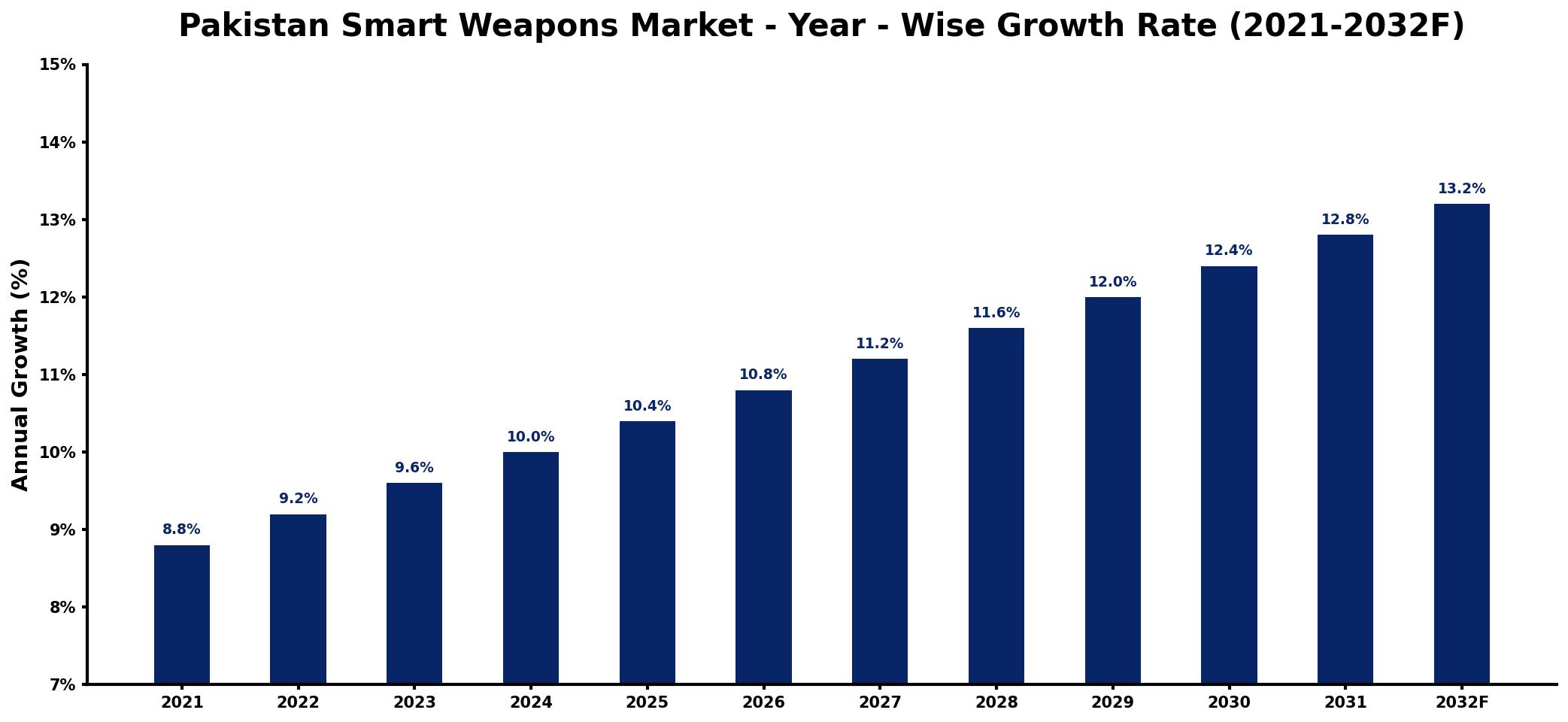
The table below presents the year‑wise growth rates along with the key drivers influencing the market
| Year | Growth Rate | Major Drivers |
| 2021 | 8.8% | growing emerging market penetration |
| 2022 | 9.2% | Rising regional security concerns |
| 2023 | 9.6% | Advancements in military technology |
| 2024 | 10.0% | Growing demand for modernization |
| 2025 | 10.4% | Enhanced strategic partnerships emerging |
| 2026 | 10.8% | Strengthened military capabilities focus |
| 2027 | 11.2% | Increased private sector investments |
| 2028 | 11.6% | Expansion of defense manufacturing base |
| 2029 | 12.0% | Emergence of innovative defense solutions |
| 2030 | 12.4% | Heightened geopolitical tensions driving demand |
| 2031 | 12.8% | Growing emphasis on R&D initiatives |
| 2032 | 13.2% | Strengthened international collaboration efforts |
Note: Market size estimations and growth projections presented in this report are based on 6Wresearch's proprietary forecasting methodology, utilizing the latest available industry data, government publications, and primary research inputs.
Pakistan Smart Weapons Market Synopsis
The demand for precision-guided munitions and advanced missile systems is on the rise in Pakistan, driven by the military's commitment to modernizing its arsenal. This shift is crucial for improving operational effectiveness and ensuring national security amidst a changing geopolitical landscape.
Moreover, collaborations with international defense contractors have led to technological advancements in smart weapon systems. These partnerships allow for knowledge transfer and the development of indigenous capabilities, which are essential for bolstering Pakistan's self-sufficiency in defense.
Pakistan Smart Weapons Market Key Takeaways
- The market is driven by increasing defense spending and a focus on modernization.
- Precision-guided munitions are gaining prominence as a vital component of military strategy.
- Indigenous development of smart weapons is being prioritized to reduce dependency on imports.
- Collaboration with foreign defense firms is enhancing technological capabilities.
- The market is poised for significant growth, offering attractive investment opportunities.
Evaluation of Restraints in Pakistan Smart Weapons Market
Despite the positive outlook, several factors present challenges to the Pakistan Smart Weapons Market. Technological limitations hinder rapid advancements in indigenous development, and reliance on foreign suppliers may lead to delays and potential vulnerabilities. Additionally, budget constraints can restrict funding for high-cost systems, impacting modernization initiatives. Effective training and skill development for military personnel are also critical, as the successful integration of smart weapons systems requires specialized knowledge and operational expertise.
Pakistan Smart Weapons Market Trends
The market is witnessing a significant shift towards the integration of smart technologies in weapon systems, with a particular focus on GPS guidance systems and advanced sensors. The emphasis on interoperability with existing military systems is also notable, ensuring that new technologies seamlessly complement current defense capabilities. Moreover, the trend towards greater domestic production reflects Pakistan's commitment to self-reliance and sovereignty in defense matters.
Pakistan Smart Weapons Market Opportunities
Investment opportunities in the Pakistan Smart Weapons Market are compelling, especially for firms willing to collaborate with local manufacturers. There is a growing market for precision-guided munitions, smart bombs, and advanced missile systems, driven by Pakistan's security needs. Additionally, engaging in joint research and development initiatives can enhance the country's indigenous capabilities, positioning investors strategically in the evolving defense landscape.
Government Initiatives in the Pakistan Smart Weapons Market
Government policies significantly influence the Pakistan Smart Weapons Market, focusing on enhancing national security and defense capabilities. There are active initiatives promoting partnerships with international defense suppliers to procure advanced technologies. Additionally, the government is investing in domestic production through collaborations with local industries, aiming to foster innovation and self-reliance. Training programs for military personnel are also being enhanced to ensure effective utilization of smart weapons in operations.
Future Insights of the Pakistan Smart Weapons Market
Looking ahead to 2026-2032, the Pakistan Smart Weapons Market is set for robust growth. The escalating need for advanced military technologies will drive demand for smart weapons, as will ongoing investments in modernization initiatives. Moreover, as indigenous production capabilities advance and external partnerships strengthen, the market will likely see a diversification of available systems. This dynamic environment presents considerable opportunities for both local and international defense companies.
Pakistan Smart Weapons Market Latest Developments (2025 - 2026)
Recent developments in the Pakistan Smart Weapons Market highlight a strong commitment to modernization and strategic partnerships. The focus has increasingly shifted toward enhancing domestic production capabilities through collaborations with international defense firms. Initiatives to upgrade existing systems and incorporate advanced technologies are in progress, indicating a proactive approach to meet contemporary security challenges.
Pakistan Smart Weapons Market - Key Attractiveness of the Report
- 10 Years of Market Numbers
- Historical Data Starting from 2022 to 2025
- Base Year: 2025
- Forecast Data until 2032
- Key Performance Indicators Impacting the Market
- Major Upcoming Developments and Projects
Key Highlights of the Report:
- Pakistan Smart Weapons Market Outlook
- Market Size of Pakistan Smart Weapons Market, 2025
- Forecast of Pakistan Smart Weapons Market, 2032
- Historical Data and Forecast of Pakistan Smart Weapons Revenues & Volume for the Period 2022-2032F
- Pakistan Smart Weapons Market Trend Evolution
- Pakistan Smart Weapons Market Drivers and Challenges
- Pakistan Smart Weapons Price Trends
- Pakistan Smart Weapons Porter's Five Forces
- Pakistan Smart Weapons Industry Life Cycle
- Historical Data and Forecast of Pakistan Smart Weapons Market Revenues & Volume By Product for the Period 2022-2032F
- Historical Data and Forecast of Pakistan Smart Weapons Market Revenues & Volume By Missiles for the Period 2022-2032F
- Historical Data and Forecast of Pakistan Smart Weapons Market Revenues & Volume By Munitions for the Period 2022-2032F
- Historical Data and Forecast of Pakistan Smart Weapons Market Revenues & Volume By Guided Projectiles for the Period 2022-2032F
- Historical Data and Forecast of Pakistan Smart Weapons Market Revenues & Volume By Guided Rockets for the Period 2022-2032F
- Historical Data and Forecast of Pakistan Smart Weapons Market Revenues & Volume By Guided Firearms for the Period 2022-2032F
- Historical Data and Forecast of Pakistan Smart Weapons Market Revenues & Volume By Directed Energy Weapons for the Period 2022-2032F
- Historical Data and Forecast of Pakistan Smart Weapons Market Revenues & Volume By Technology for the Period 2022-2032F
- Historical Data and Forecast of Pakistan Smart Weapons Market Revenues & Volume By Laser for the Period 2022-2032F
- Historical Data and Forecast of Pakistan Smart Weapons Market Revenues & Volume By Infrared for the Period 2022-2032F
- Historical Data and Forecast of Pakistan Smart Weapons Market Revenues & Volume By Radar for the Period 2022-2032F
- Historical Data and Forecast of Pakistan Smart Weapons Market Revenues & Volume By GPS for the Period 2022-2032F
- Historical Data and Forecast of Pakistan Smart Weapons Market Revenues & Volume By Others for the Period 2022-2032F
- Historical Data and Forecast of Pakistan Smart Weapons Market Revenues & Volume By Platform for the Period 2022-2032F
- Historical Data and Forecast of Pakistan Smart Weapons Market Revenues & Volume By Air for the Period 2022-2032F
- Historical Data and Forecast of Pakistan Smart Weapons Market Revenues & Volume By Land for the Period 2022-2032F
- Historical Data and Forecast of Pakistan Smart Weapons Market Revenues & Volume By Naval for the Period 2022-2032F
- Pakistan Smart Weapons Import Export Trade Statistics
- Market Opportunity Assessment By Product
- Market Opportunity Assessment By Technology
- Market Opportunity Assessment By Platform
- Pakistan Smart Weapons Top Companies Market Share
- Pakistan Smart Weapons Competitive Benchmarking By Technical and Operational Parameters
- Pakistan Smart Weapons Company Profiles
- Pakistan Smart Weapons Key Strategic Recommendations






































