Pakistan Soap Market: Import Trend Analysis
Pakistan soap market saw a notable import trend from 2023 to 2024, with a growth rate of 51.39%. However, the compound annual growth rate (CAGR) for 2020-2024 was -3.25%. This fluctuation could be attributed to shifting consumer preferences or changes in trade policies impacting imports.
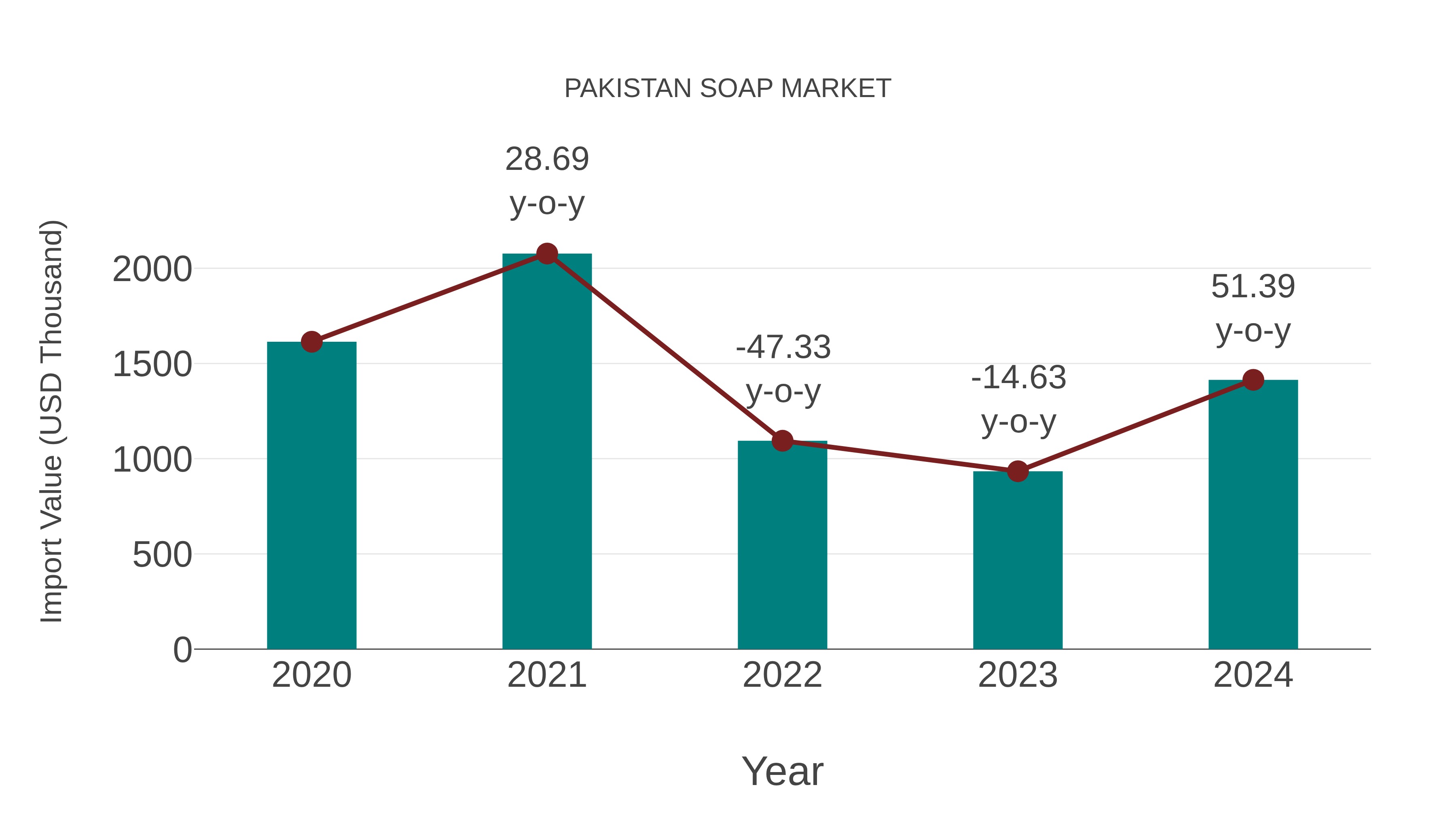
Pakistan Soap Market Growth Rate
According to 6Wresearch internal database and industry insights, the Pakistan Soap Market is projected to grow at a compound annual growth rate (CAGR) of 4.9% during the forecast period from 2026 to 2032.
Topics Covered in the Pakistan Soap Market Report
The Pakistan Soap Market report thoroughly covers the market by type, application, and distribution channel. It provides a detailed and unbiased analysis of ongoing market trends, opportunities, challenges, and market drivers, helping stakeholders align strategies with current and future market dynamics.
Pakistan Soap Market Highlights
| Report Name | Pakistan Soap Market |
| Forecast period | 2026-2032 |
| CAGR | 4.9% |
| Growing Sector | Consumer Goods and Personal Care |
Pakistan Soap Market Synopsis
The Pakistan Soap Market is expected to grow steadily on account of increased demand for hygiene products across households and commercial sectors. This growth is also influenced by an increase in the use of soap for personal hygiene and the popularity of liquid soap formulations. The growing retail sector, including online distribution channels, along with rising awareness about cleanliness, is also expected to contribute to industry development. The increasing disposable income and changing consumer preferences toward premium soap products will further stimulate the market.
Evaluation of Growth Drivers in the Pakistan Soap Market
Below mentioned are some prominent drivers and their impact on the Pakistan Soap Market dynamics:
| Drivers | Primary Segment Affected | Why It Matters (Evidence) |
| Growth of Hygiene Awareness | By Application (Household) | Post-pandemic, hygiene practices have become a major focus, resulting in higher demand for soap. |
| Rise in Disposable Income | By Application (Commercial) | More spending on personal care products as income level increases. |
| Demand for Premium Products | By Type (Liquid Soap, Bar Soap) | Consumers are shifting toward premium and organic soap options. |
| Expansion of Modern Trade | By Distribution Channel (Modern Trade) | Modern trade and supermarkets are becoming popular retail destinations for soap. |
| E-commerce Growth | By Distribution Channel (Online) | The growing e-commerce industry is making soap products easily accessible. |
The Pakistan Soap Market is projected to grow at a CAGR of 4.9% during the forecast period (2026–2032), backed by some major factors, such as the increasing hygiene awareness and the growing demand for personal care products. The demand for both bar soap and liquid soap, especially in the household and commercial sector, is on the rise. The trend towards higher-quality and natural ingredients in soaps is also supporting this growth. Also, the rise of retail and e-commerce distribution channels, as well as the increasing demand for premium and organic soap offerings, is likely to boost Pakistan Soap Market growth.
Restraints in the Pakistan Soap Market
Below mentioned are some major restraints and their influence on the Pakistan Soap Market dynamics:
| Restraints | Primary Segment Affected | What This Means (Evidence) |
| Price Sensitivity | By Type (Bar Soap, Liquid Soap) | Price sensitivity among consumers in Pakistan may limit the growth of premium soap products. |
| Raw Material Price Volatility | By Type (Bar Soap, Liquid Soap) | Volatile prices of raw materials, such as oils and fats, can affect the cost of soap production. |
| Regulatory Pressures | By Application (Household) | The soap industry is facing increased regulatory requirements, which include environmental concerns about packaging waste. |
| Environmental Concerns | By Application (Commercial) | Concerns about the environmental impact of soap packaging are rising. |
| Competition from Local and Unbranded Products | By Distribution Channel (Traditional Trade) | In the traditional trade segment, unbranded soaps continue to hold a significant market share, offering lower-priced alternatives. |
Challenges in the Pakistan Soap Market
On the other side, the Pakistan Soap Market has a number of challenges. These challenges are price sensitivity, which affects the growth of premium soap segments, and volatility in the prices of raw materials such as oils. Regulatory pressures, including the growing demand for eco-friendly packaging and more stringent product safety standards, are expected to increase operational costs for manufacturers. Besides that, the competitive landscape is intensifying with local and unbranded soap products being highly preferred in traditional markets, thus limiting market share for premium brands.
Trends Shaping the Pakistan Soap Market Growth
Below mentioned are some major trends driving the Pakistan Soap Market growth:
- Increasing Demand for Liquid Soap: Consumers are shifting towards liquid soap instead of bar soap due to convenience and hygiene reasons, especially in urban areas.
- Rising Preference for Organic and Natural Soaps: Consumers are likely to spend on organic, cruelty-free, and chemical-free soap products, resulting in the growth of premium offerings.
- Surge of E-commerce Platforms: Purchasing a variety of soap with price comparison feature has become easy due to rising online retail platforms in the country.
Major Investment Opportunities in the Pakistan Soap Market
Below are some major investment opportunities that could increase the Pakistan Soap Market share:
- Investing in Organic and Premium Soap Products: With rising consumer interest in natural and organic products, there is an opportunity to tap into the premium soap segment.
- Increasing Expanding Distribution Channels: There is a growing popularity of online retail, which provides significant opportunities to invest in digital distribution channels for soap products.
- Building Manufacturing Facilities: The growth of the retail and e-commerce sectors in the country presents prominent opportunities for new soap manufacturing plants.
Top 5 Leading Players in the Pakistan Soap Market
Here are some top companies contributing to Pakistan's soap market share:
1. Unilever Pakistan Limited
| Company Name | Unilever Pakistan Limited |
|---|---|
| Established Year | 1948 |
| Headquarters | Karachi, Pakistan |
| Official Website | Click Here |
Unilever is the undisputed leader in the Pakistani soap market, commanding over 60% of the total share. Its "Power Brands" like Lux and Lifebuoy are the highest-selling soaps in the country, with Lux dominating the beauty segment and Lifebuoy leading in health and hygiene. The company has a massive manufacturing footprint and an unparalleled distribution network that reaches the most remote rural areas.
2. Reckitt Benckiser Pakistan Limited
| Company Name | Reckitt Benckiser Pakistan Limited |
|---|---|
| Established Year | 1951 |
| Headquarters | Karachi, Pakistan |
| Official Website | Click Here |
Reckitt holds a significant position in the medicated soap segment through its flagship brand, Dettol. Dettol is one of the most trusted names for germ protection in Pakistan, consistently ranking among the top three soap brands by market share. The company focuses heavily on health-centric marketing and partnerships with medical associations to maintain its authority in the personal hygiene space.
3. Colgate-Palmolive (Pakistan) Limited
| Company Name | Colgate-Palmolive (Pakistan) Limited |
|---|---|
| Established Year | 1977 |
| Headquarters | Karachi, Pakistan |
| Official Website | Click Here |
A joint venture between the Lakson Group and Colgate-Palmolive USA, this company is a major player in both the beauty and antibacterial segments. Its brand Palmolive is highly popular for its moisturizing and natural-ingredient-based formulations, while Safeguard (licensed via P&G historically, though Colgate-Palmolive remains a dominant local force in personal care) remains a fierce competitor in the family protection category.
4. Nimir Industrial Chemicals Limited
| Company Name | Nimir Industrial Chemicals Limited |
|---|---|
| Established Year | 1964 |
| Headquarters | Lahore, Pakistan |
| Official Website | Click Here |
Nimir has recently emerged as a formidable manufacturing powerhouse. In a strategic move in late 2024, the company acquired Procter & Gamble’s (P&G) soap manufacturing facility in Pakistan. This acquisition has solidified Nimir's role as both a leading producer of soap noodles (the raw material for soap) and a major manufacturer of finished bar soaps for various domestic and international brands.
5. Zulfeqar Industries Limited
| Company Name | Zulfeqar Industries Limited |
|---|---|
| Established Year | 1952 |
| Headquarters | Karachi, Pakistan |
| Official Website | Click Here |
Zulfeqar Industries is a prominent indigenous manufacturer best known for its flagship brand, Capri. Capri has maintained a loyal consumer base for decades by positioning itself as a high-quality beauty soap enriched with natural oils. The brand is celebrated for its distinctive fragrance and affordable pricing, making it a staple in the "value-for-money" beauty segment across Pakistan.
Government Regulations in the Pakistan Soap Market
According to Pakistan government data, here are some authorities that have imposed several regulations to ensure the safety and quality of soap products in the market. These rules primarily focus on ingredient transparency, product labeling, and environmental concerns. Manufacturers need to follow strict product safety standards to make sure that soaps are free from harmful chemicals, especially for products aimed at children and sensitive skin. Lastly, there are increasing pressures for the adoption of eco-friendly packaging solutions due to the growing environmental concerns regarding plastic waste.
Future Insights of the Pakistan Soap Market
The future of the Pakistan Soap Market looks promising, which is underpinned by the rising hygiene awareness and the growing consumer’s choice for premium and organic soap products. Due to increased disposable incomes, the rapid rise of e-commerce channels, and a shift towards higher-quality personal care items, consumers are more inclined to prefer premium soaps, including organic and natural options. The retail industry is also widening, with more supermarkets, hypermarkets, and online platforms offering a broader range of soap products, which makes them more accessible to urban and rural populations alike.
Market Segmentation Analysis
The report offers a comprehensive study of the following market segments and their leading categories:
Bar Soap to Lead the Market – By Type
According to Ashutosh, Senior Research Analyst at 6Wresearch, Bar soap remains the dominant segment in the Pakistan Soap Market, largely on account of its widespread use and lower cost compared to liquid soap. Bar soaps are particularly popular in rural and semi-urban areas where they are opting for their affordability and practicality.
Household Application to Lead the Market – By Application
The household category is the largest consumer of soap products in the country. This dominance is underpinned by increased awareness of personal hygiene and the necessity of soap in daily routines. With the rising focus on cleanliness and health, household consumption of bar soap and liquid soap has increased.
Modern Trade to Lead the Market – By Distribution Channel
Modern trade, including supermarkets, hypermarkets, and retail chains, leads the distribution channel segment in the Pakistan Soap Market. The increasing number of organized retail outlets and the growing urban population contribute to the rising sales of soap in this channel.
Key Attractiveness of the Report
- 10 Years of Market Numbers
- Historical Data Starting from 2022 to 2025
- Base Year: 2025
- Forecast Data until 2032
- Key Performance Indicators Impacting the Market
- Major Upcoming Developments and Projects
Key Highlights of the Report:
- Pakistan Soap Market Outlook
- Market Size of Pakistan Soap Market, 2025
- Forecast of Pakistan Soap Market, 2032
- Historical Data and Forecast of Pakistan Soap Revenues & Volume for the Period 2022 - 2032F
- Pakistan Soap Market Trend Evolution
- Pakistan Soap Market Drivers and Challenges
- Pakistan Soap Price Trends
- Pakistan Soap Porter's Five Forces
- Pakistan Soap Industry Life Cycle
- Historical Data and Forecast of Pakistan Soap Market Revenues & Volume By Type for the Period 2022 - 2032F
- Historical Data and Forecast of Pakistan Soap Market Revenues & Volume By Bar Soap for the Period 2022 - 2032F
- Historical Data and Forecast of Pakistan Soap Market Revenues & Volume By Liquid Soap for the Period 2022 - 2032F
- Historical Data and Forecast of Pakistan Soap Market Revenues & Volume By Application for the Period 2022 - 2032F
- Historical Data and Forecast of Pakistan Soap Market Revenues & Volume By Household for the Period 2022 - 2032F
- Historical Data and Forecast of Pakistan Soap Market Revenues & Volume By Commercial for the Period 2022 - 2032F
- Historical Data and Forecast of Pakistan Soap Market Revenues & Volume By Other for the Period 2022 - 2032F
- Historical Data and Forecast of Pakistan Soap Market Revenues & Volume By Distribution Channel for the Period 2022 - 2032F
- Historical Data and Forecast of Pakistan Soap Market Revenues & Volume By Modern Trade for the Period 2022 - 2032F
- Historical Data and Forecast of Pakistan Soap Market Revenues & Volume By Traditional Trade for the Period 2022 - 2032F
- Historical Data and Forecast of Pakistan Soap Market Revenues & Volume By Online for the Period 2022 - 2032F
- Pakistan Soap Import Export Trade Statistics
- Market Opportunity Assessment By Type
- Market Opportunity Assessment By Application
- Market Opportunity Assessment By Distribution Channel
- Pakistan Soap Top Companies Market Share
- Pakistan Soap Competitive Benchmarking By Technical and Operational Parameters
- Pakistan Soap Company Profiles
- Pakistan Soap Key Strategic Recommendations
Market Covered
The market report has been segmented and sub segmented into the following categories:
By Type
- Bar Soap
- Liquid Soap
By Application
- Household
- Commercial
- Other
By Distribution Channel
- Modern Trade
- Traditional Trade
- Online






































