Pakistan Spices Market: Import Trend Analysis
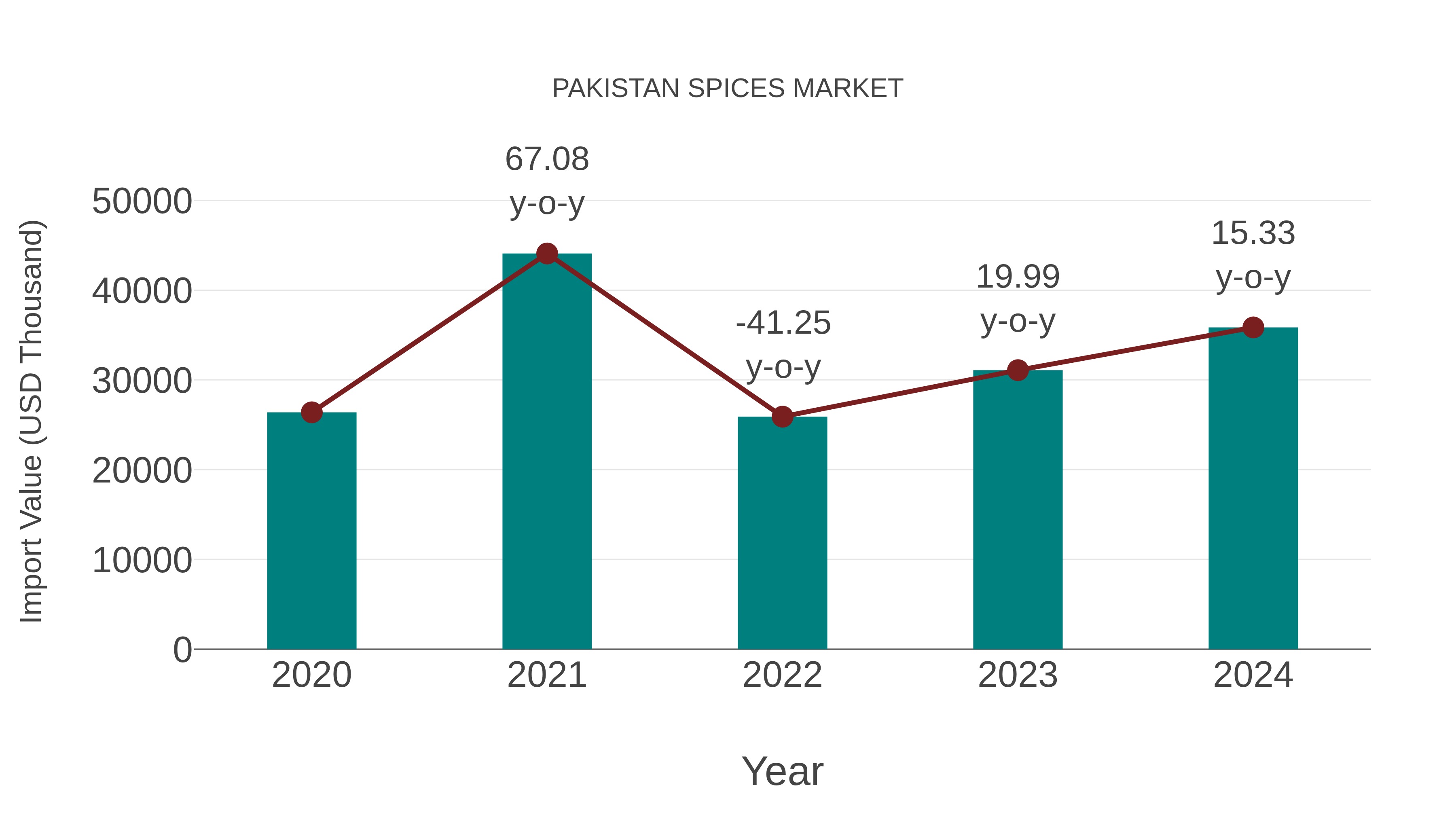
Pakistan spices market witnessed a notable import trend, with a growth rate of 15.33% from 2023 to 2024. The compound annual growth rate (CAGR) for imports between 2020 and 2024 stood at 7.96%. This surge can be attributed to increasing consumer demand for diverse culinary experiences and a shift towards healthier food options.
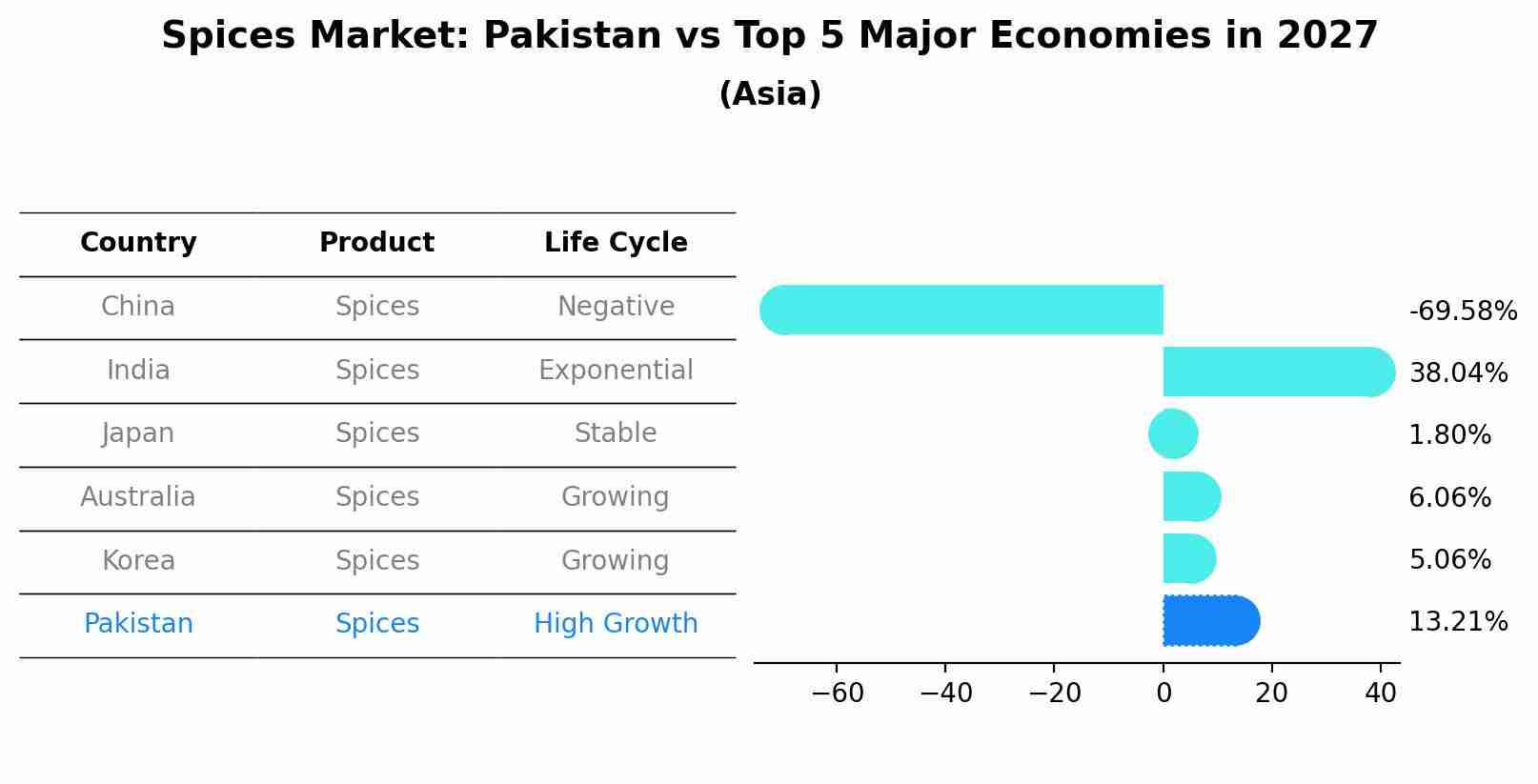
Spices Market: Pakistan vs Top 5 Major Economies in 2027 (Asia)
Pakistan's Spices market is anticipated to experience a high growth rate of 13.21% by 2027, reflecting trends observed in the largest economy China, followed by India, Japan, Australia and South Korea.
Pakistan Spices Market Growth Rate
According to 6Wresearch internal database and industry insights, the Pakistan Spices Market is projected to grow at a compound annual growth rate (CAGR) of 5.9% during the forecast period (2026-2032).
Topics Covered in the Pakistan Spices Market Report
The Pakistan Spices Market report thoroughly covers the market by Product, Form, Category and Distribution Channel. The market report provides an unbiased and detailed analysis of ongoing market trends, opportunities/high growth areas, and market drivers, which help stakeholders devise and align their market strategies according to the current and future market dynamics.
Pakistan Spices Market Highlights
| Report Name |
Pakistan Spices Market |
| Forecast period | 2026-2032 |
| CAGR | 5.9% |
| Growing Sector |
Packaged & Branded Spices |
Pakistan Spices Market Synopsis
Pakistan Spices Industry is experiencing steady growth supported by strong culinary traditions, increasing domestic consumption, and rising demand for processed and packaged spices, while consumers are gradually shifting toward branded and hygienically packed products for better quality assurance, alongside expanding export opportunities and improvements in supply chain infrastructure that are collectively contributing to the overall development and modernization of the spice industry across the country.
Evaluation of Growth Drivers in the Pakistan Spices Market
Below mentioned are some prominent drivers and their influence on the market dynamics:
| Drivers | Primary Segments Affected | Why it Matters (Evidence) |
| Rising Domestic Consumption | All Products, Powder | High usage of spices in daily cooking boosts demand. |
| Packaged Food Sector Growth | Powder, Retail | Standardization of spices is necessary for processed foods. |
| Export Potential Expansion | Whole, Organic | Spice demand in the global market increases exports. |
| Trend towards Branding | Powder, Traditional | Health and safety standards drive consumer preference. |
| Expansion of Retail Channels | Store-based, All Products | Supermarkets increase accessibility and product visibility. |
Pakistan Spices Market is expected to grow at the CAGR of 5.9% during the forecast period of 2026-2032. Growth in the industry is fueled by growing consumption of spices for both home and industrial use, growing demands for branded/spiced food products, and increasing export possibilities. Moreover, developments in retail infrastructure are also contributing to further growth of the market in Pakistan.
Evaluation of Restraints in the Pakistan Spices Market
Below mentioned are some major restraints and their influence on the market dynamics:
| Restraints | Primary Segments Affected | What This Means (Evidence) |
| Price Volatility of Raw Materials | All Products | Fluctuating crop yields affect pricing stability. |
| Standardization Absence | Complete, Traditional | Variability affects competitiveness in exports. |
| Processing Facility Limitations | Flour, Small-Scale | Businesses encounter difficulties growing their operations. |
| Adulteration Worries | Flour, Commercial | Consumer trust is eroded by quality concerns. |
| Distribution Challenges | All Sectors | Availability problems arise due to logistics. |
Pakistan Spices Market Challenges
However, despite continuous growth of the Pakistan spices market, the following are some of the main problems that face the industry, namely price changes in raw materials, lack of standard processing facilities, adulteration, and quality problems, and besides that, many small producers face difficulties due to lack of funds and modern methods of production, as well as inefficiency of supply chains.
Pakistan Spices Market Trends
Key evolving trends in the Pakistan Spices Market are as follows:
- Increased Preference for Packaged Spices: There is an increasing preference among consumers for packaged spices that offer hygiene, quality, and prolonged shelf life.
- Increasing Usage of Organic Spices: Due to health considerations, there is an increased consumption of organic and chemical-free spices.
- Growth of Online Shopping Portals: Online portals provide greater accessibility when it comes to purchasing spices.
- Advancements in Packaging: There are advancements being made in packaging systems.
Investment Opportunities in the Pakistan Spices Market
Opportunities that may emerge in the Pakistan Spices Market are:
- Development of Spice Processing Units – Building state-of-the-art units for the cleaning, grinding, and packing of spices.
- Organic Spices Cultivation – Creating farms that can cater to the rising needs for organic spices globally.
- Export Focused Supply Chain – Building infrastructures that help with exporting spices.
- E-commerce Platforms – Creating websites for spice business.
Top 5 Leading Players in the Pakistan Spices Market
Major companies operating in the Pakistan Spices Market include:
1. National Foods Limited
| Company Name | National Foods Limited |
|---|---|
| Established Year | 1970 |
| Headquarters | Karachi, Pakistan |
| Official Website | Click Here |
National Foods is a leading spice manufacturer offering a wide range of packaged spices and seasoning products, focusing on quality, innovation, and strong distribution networks to meet growing consumer demand across domestic and international markets.
2. Shan Foods
| Company Name | Shan Foods |
|---|---|
| Established Year | 1981 |
| Headquarters | Karachi, Pakistan |
| Official Website | - |
Shan Foods provides a diverse portfolio of spice mixes and seasonings, known for maintaining authentic flavors while leveraging modern packaging and distribution techniques to expand its presence in both local and global markets.
3. Mehran Spice & Food Industries
| Company Name | Mehran Spice & Food Industries |
|---|---|
| Established Year | 1975 |
| Headquarters | Karachi, Pakistan |
| Official Website | Click Here |
Mehran specializes in producing high-quality spices and food products, focusing on consistency, hygiene, and innovation, while catering to both domestic consumers and export markets through an extensive distribution network.
4. Kolson (United Industries Limited)
| Company Name | Kolson (United Industries Limited) |
|---|---|
| Established Year | 1990 |
| Headquarters | Karachi, Pakistan |
| Official Website | - |
Kolson offers spice products alongside processed foods, emphasizing product quality and affordability, while continuously expanding its product portfolio to meet evolving consumer preferences in Pakistan’s growing food industry.
5. Ahmed Foods
| Company Name | Ahmed Foods |
|---|---|
| Established Year | 1952 |
| Headquarters | Karachi, Pakistan |
| Official Website | Click Here |
Ahmed Foods manufactures spices and condiments with a strong focus on quality assurance and traditional flavors, while leveraging modern production techniques to cater to both domestic and export markets efficiently.
Government Regulations Introduced in the Pakistan Spices Market
According to Pakistan Government Data, Improvement of the quality of spices, development of better processing practices, and preparation for export have been the focus of various programs implemented by the government, including the Punjab Agriculture Policy of 2018 and the food safety regulation measures enforced by the Pakistan Standards and Quality Control Authority. Other important initiatives include the provision of funds through the “Kissan Package” to farmers.
Future Insights of the Pakistan Spices Market
Pakistan Spices Industry is expected to witness sustained growth driven by increasing consumer preference for packaged and branded products, expanding export markets, and advancements in processing and packaging technologies, while ongoing government support and private sector investments are likely to enhance production capabilities and supply chain efficiency, ultimately creating new opportunities and supporting long-term Pakistan Spices Market Growth across both domestic and international markets.
Market Segmentation Analysis
The report offers a comprehensive study of the subsequent market segments and their leading categories:
Turmeric Segment to Dominate the Market – By Product
According to Nikita, Senior Research Analyst, 6Wresearch, turmeric is expected to dominate the Pakistan Spices Market Share due to its widespread use in daily cooking, medicinal properties, and strong domestic demand, while its increasing application in health and wellness products further strengthens its market position.
Powder Segment to Rule the Market – By Form
Spice powders lead the Pakistan Spices market because of the ease of use and long shelf life of these forms, and the rising preference among customers for ready-to-use spice powders.
Conventional Segment to Lead the Market – By Category
The conventional category leads the Pakistan Spices market because of their relatively low prices and broad availability. Organic spices are gaining popularity, yet they still appeal to small consumer segments only.
Store-Based Segment to Dominate the Market – By Channel
The store-based distribution channel leads the Pakistan Spices Market Share because consumers still tend to buy spices at grocery stores or supermarket chains.
Key Attractiveness of the Report
- 10 Years of Market Numbers.
- Historical Data Starting from 2022 to 2025.
- Base Year: 2025.
- Forecast Data until 2032.
- Key Performance Indicators Impacting the Market.
- Major Upcoming Developments and Projects.
Key Highlights of the Report:
- Pakistan Spices Market Outlook
- Market Size of Pakistan Spices Market, 2025
- Forecast of Pakistan Spices Market, 2032
- Historical Data and Forecast of Pakistan Spices Revenues & Volume for the Period 2022 - 2032F
- Pakistan Spices Market Trend Evolution
- Pakistan Spices Market Drivers and Challenges
- Pakistan Spices Price Trends
- Pakistan Spices Porter's Five Forces
- Pakistan Spices Industry Life Cycle
- Historical Data and Forecast of Pakistan Spices Market Revenues & Volume By Product for the Period 2022 - 2032F
- Historical Data and Forecast of Pakistan Spices Market Revenues & Volume By Pepper for the Period 2022 - 2032F
- Historical Data and Forecast of Pakistan Spices Market Revenues & Volume By Ginger for the Period 2022 - 2032F
- Historical Data and Forecast of Pakistan Spices Market Revenues & Volume By Cinnamon for the Period 2022 - 2032F
- Historical Data and Forecast of Pakistan Spices Market Revenues & Volume By Cumin for the Period 2022 - 2032F
- Historical Data and Forecast of Pakistan Spices Market Revenues & Volume By Turmeric for the Period 2022 - 2032F
- Historical Data and Forecast of Pakistan Spices Market Revenues & Volume By Cardamom for the Period 2022 - 2032F
- Historical Data and Forecast of Pakistan Spices Market Revenues & Volume By Coriander for the Period 2022 - 2032F
- Historical Data and Forecast of Pakistan Pepper Spices Market Revenues & Volume By Others for the Period 2022 - 2032F
- Historical Data and Forecast of Pakistan Spices Market Revenues & Volume By Form for the Period 2022 - 2032F
- Historical Data and Forecast of Pakistan Spices Market Revenues & Volume By Powder for the Period 2022 - 2032F
- Historical Data and Forecast of Pakistan Spices Market Revenues & Volume By Whole for the Period 2022 - 2032F
- Historical Data and Forecast of Pakistan Spices Market Revenues & Volume By Chopped/Crushed for the Period 2022 - 2032F
- Historical Data and Forecast of Pakistan Spices Market Revenues & Volume By Category for the Period 2022 - 2032F
- Historical Data and Forecast of Pakistan Spices Market Revenues & Volume By Organic for the Period 2022 - 2032F
- Historical Data and Forecast of Pakistan Spices Market Revenues & Volume By Conventional for the Period 2022 - 2032F
- Historical Data and Forecast of Pakistan Spices Market Revenues & Volume By Distribution Channel for the Period 2022 - 2032F
- Historical Data and Forecast of Pakistan Spices Market Revenues & Volume By Store based for the Period 2022 - 2032F
- Historical Data and Forecast of Pakistan Spices Market Revenues & Volume By Non-Store based for the Period 2022 - 2032F
- Pakistan Spices Import Export Trade Statistics
- Market Opportunity Assessment By Product
- Market Opportunity Assessment By Form
- Market Opportunity Assessment By Category
- Market Opportunity Assessment By Distribution Channel
- Pakistan Spices Top Companies Market Share
- Pakistan Spices Competitive Benchmarking By Technical and Operational Parameters
- Pakistan Spices Company Profiles
- Pakistan Spices Key Strategic Recommendations
Market Covered
The report offers a comprehensive study of the subsequent market segments:
By Product
- Pepper
- Ginger
- Cinnamon
- Cumin
- Turmeric
- Cardamom
- Coriander
- Others
By Form
- Powder
- Whole
- Chopped/Crushed
By Category
- Organic
- Conventional
- By Distribution Channel
- Store based
- Non-Store based






































