Pakistan Spinning Machinery Market Size, Share & Growth Rate
The Pakistan Spinning Machinery Market was estimated at USD 1490 Million in 2025 and is projected to reach USD 2150 Million by 2032, growing at a CAGR of 5.4% from 2026 to 2032. This growth trajectory is fueled by an ever-increasing demand for textiles, both within Pakistan and across global markets. Additionally, advancements in spinning technology that enhance efficiency and productivity are playing a vital role in driving market expansion.
Pakistan Spinning Machinery Market Year-wise Growth Rate and Key Drivers
This graph highlights how the Pakistan Spinning Machinery Market has steadily grown over the years, supported by major growth factors.
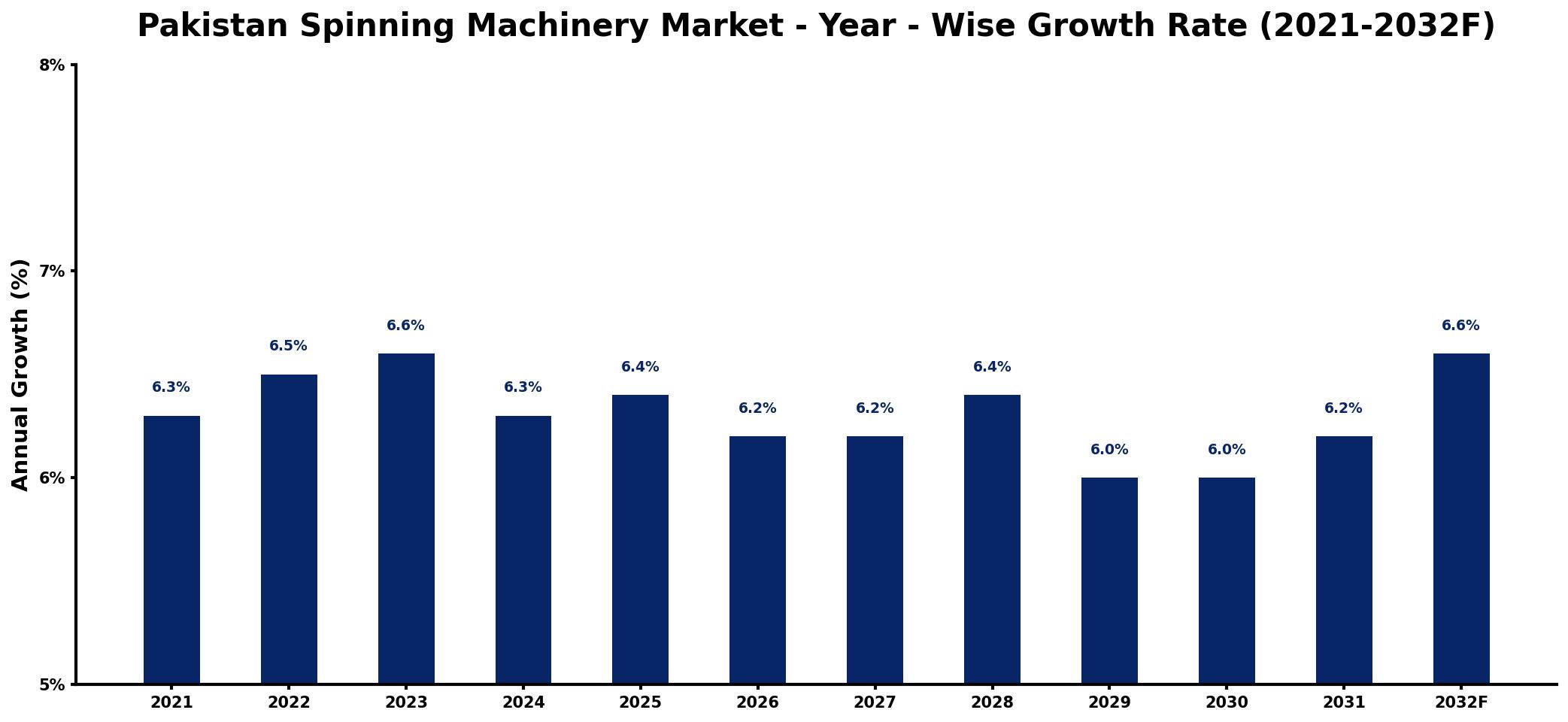
The table below presents the year‑wise growth rates along with the key drivers influencing the market
| Year | Growth Rate | Major Drivers |
| 2021 | 6.3% | Rising textile sector investments |
| 2022 | 6.5% | Increased export opportunities emerging |
| 2023 | 6.6% | Growing domestic manufacturing capabilities |
| 2024 | 6.3% | Expansion of industrial production facilities |
| 2025 | 6.4% | Higher demand for sustainable practices |
| 2026 | 6.2% | Technological advancements attracting investments |
| 2027 | 6.2% | Emerging markets boosting production needs |
| 2028 | 6.4% | Strengthening supply chain efficiencies |
| 2029 | 6.0% | Focus on automation integration strategies |
| 2030 | 6.0% | Diversification into new product lines |
| 2031 | 6.2% | Government incentives for modernization |
| 2032 | 6.6% | Collaborations enhancing industry innovation |
Note: Market size estimations and growth projections presented in this report are based on 6Wresearch's proprietary forecasting methodology, utilizing the latest available industry data, government publications, and primary research inputs.
Pakistan Spinning Machinery Market Synopsis
The Pakistan Spinning Machinery Market is a vital component of the nations textile industry, significantly influencing economic growth. Currently, the market is characterized by a blend of local and international manufacturers competing fiercely to capture market share.
As technological innovations emerge, the industry is witnessing a shift towards more efficient machinery types, such as ring and compact spinning machines. This evolution is driven by the need for enhanced productivity and cost-effectiveness in textile production.
Pakistan Spinning Machinery Market Key Takeaways
- The market is experiencing a robust growth rate, driven by increasing textile demands.
- Technological advancements are reshaping spinning machinery, emphasizing automation and sustainability.
- Local manufacturers are competing with international suppliers to enhance market dynamics.
- Investment opportunities are ripe for those offering innovative and efficient solutions.
- Government policies are increasingly supportive of modernization and investment in the sector.
Evaluation of Restraints in Pakistan Spinning Machinery Market
Despite the positive growth trajectory, the Pakistan Spinning Machinery Market faces several challenges that could limit its potential. Intense competition from neighboring textile-producing countries makes it imperative for local manufacturers to innovate continuously. Fluctuating prices of raw materials can impact profit margins, while energy shortages pose risks to production efficiency. Furthermore, the need for skilled labor in adopting advanced technologies remains a pressing issue that requires attention. Addressing these limitations is crucial for maintaining competitiveness in the global market.
Pakistan Spinning Machinery Market Trends
Current trends in the Pakistan Spinning Machinery Market indicate a strong shift towards automation and digitalization. Manufacturers are increasingly investing in smart machines equipped with real-time monitoring and predictive maintenance capabilities. This technological evolution enhances operational efficiencies and reduces downtime. Moreover, sustainability is becoming a central theme, with eco-friendly machinery that minimizes energy consumption gaining traction. The industry is also leaning towards versatile spinning equipment that can accommodate a diverse range of fibers and yarn counts, meeting the nuanced demands of the market.
Pakistan Spinning Machinery Market Opportunities
Opportunities within the Pakistan Spinning Machinery Market are abundant, especially as the textile sector continues to grow. There is a pressing need for modern spinning machinery that can increase productivity and ensure high-quality output. Investors can capitalize on this demand by supplying cutting-edge machinery that features automation and energy efficiency. Moreover, entering the market with maintenance services or tailored solutions for local textile producers can also prove lucrative as they strive to enhance their operational capabilities.
Government Initiatives in the Pakistan Spinning Machinery Market
The government of Pakistan has been proactive in fostering a conducive environment for the spinning machinery sector. Policies aimed at offering subsidies and incentives encourage investments while improving access to credit for spinning mills. Additionally, tax breaks have been introduced to facilitate modernization and technological advancement in machinery. The government is also focused on enhancing infrastructure and providing training programs to upskill the workforce, which is vital for sustaining the competitive edge of the spinning industry.
Future Insights of the Pakistan Spinning Machinery Market
Looking ahead to 2026-2032, the Pakistan Spinning Machinery Market is expected to maintain a steady growth trajectory. This is attributed to the continuous demand for textiles driven by a growing population and rising disposable incomes. As the industry increasingly prioritizes sustainability and efficiency, advanced spinning technologies will become integral to meeting production needs. The supportive government policies and evolving market dynamics are likely to create an environment ripe for growth, attracting both local and foreign investments.
Pakistan Spinning Machinery Market Latest Developments (2025 - 2026)
Recent developments in the Pakistan Spinning Machinery Market indicate a strong focus on the integration of smart technologies. Manufacturers are exploring innovative solutions that enhance production efficiency, particularly in response to growing environmental concerns. Furthermore, local firms are beginning to collaborate with international technology providers to expand their capabilities and modernize their offerings. This trend signals a progressive shift towards high-tech, sustainable machinery tailored for the evolving textile landscape.
Pakistan Spinning Machinery Market - Key Attractiveness of the Report
- 10 Years of Market Numbers
- Historical Data Starting from 2022 to 2025
- Base Year: 2025
- Forecast Data until 2032
- Key Performance Indicators Impacting the Market
- Major Upcoming Developments and Projects
Key Highlights of the Report:
- Pakistan Spinning Machinery Market Outlook
- Market Size of Pakistan Spinning Machinery Market, 2025
- Forecast of Pakistan Spinning Machinery Market, 2032
- Historical Data and Forecast of Pakistan Spinning Machinery Revenues & Volume for the Period 2022-2032F
- Pakistan Spinning Machinery Market Trend Evolution
- Pakistan Spinning Machinery Market Drivers and Challenges
- Pakistan Spinning Machinery Price Trends
- Pakistan Spinning Machinery Porter's Five Forces
- Pakistan Spinning Machinery Industry Life Cycle
- Historical Data and Forecast of Pakistan Spinning Machinery Market Revenues & Volume By Type for the Period 2022-2032F
- Historical Data and Forecast of Pakistan Spinning Machinery Market Revenues & Volume By Ring for the Period 2022-2032F
- Historical Data and Forecast of Pakistan Spinning Machinery Market Revenues & Volume By Rotor Spinning for the Period 2022-2032F
- Historical Data and Forecast of Pakistan Spinning Machinery Market Revenues & Volume By Material for the Period 2022-2032F
- Historical Data and Forecast of Pakistan Spinning Machinery Market Revenues & Volume By Natural for the Period 2022-2032F
- Historical Data and Forecast of Pakistan Spinning Machinery Market Revenues & Volume By Synthetic for the Period 2022-2032F
- Historical Data and Forecast of Pakistan Spinning Machinery Market Revenues & Volume By Others for the Period 2022-2032F
- Historical Data and Forecast of Pakistan Spinning Machinery Market Revenues & Volume By End-Use Industry for the Period 2022-2032F
- Historical Data and Forecast of Pakistan Spinning Machinery Market Revenues & Volume By Clothing for the Period 2022-2032F
- Historical Data and Forecast of Pakistan Spinning Machinery Market Revenues & Volume By Textile for the Period 2022-2032F
- Historical Data and Forecast of Pakistan Spinning Machinery Market Revenues & Volume By Other Industry for the Period 2022-2032F
- Pakistan Spinning Machinery Import Export Trade Statistics
- Market Opportunity Assessment By Type
- Market Opportunity Assessment By Material
- Market Opportunity Assessment By End-Use Industry
- Pakistan Spinning Machinery Top Companies Market Share
- Pakistan Spinning Machinery Competitive Benchmarking By Technical and Operational Parameters
- Pakistan Spinning Machinery Company Profiles
- Pakistan Spinning Machinery Key Strategic Recommendations






































