Pakistan Telecom Service Assurance Market Size, Share & Growth Rate
The Pakistan Telecom Service Assurance Market was estimated at USD 169 Million in 2025 and is projected to reach USD 227 Million by 2032, growing at a CAGR of 4.3% from 2026 to 2032. This growth is primarily fueled by the increasing deployment of advanced technologies such as 5G and IoT, which necessitate enhanced service assurance solutions to maintain optimal network performance. As consumer demand for reliable connectivity rises, telecom providers are increasingly focused on investing in innovative service assurance capabilities.
Pakistan Telecom Service Assurance Market Year-wise Growth Rate and Key Drivers
This graph highlights how the Pakistan Telecom Service Assurance Market has steadily grown over the years, supported by major growth factors.
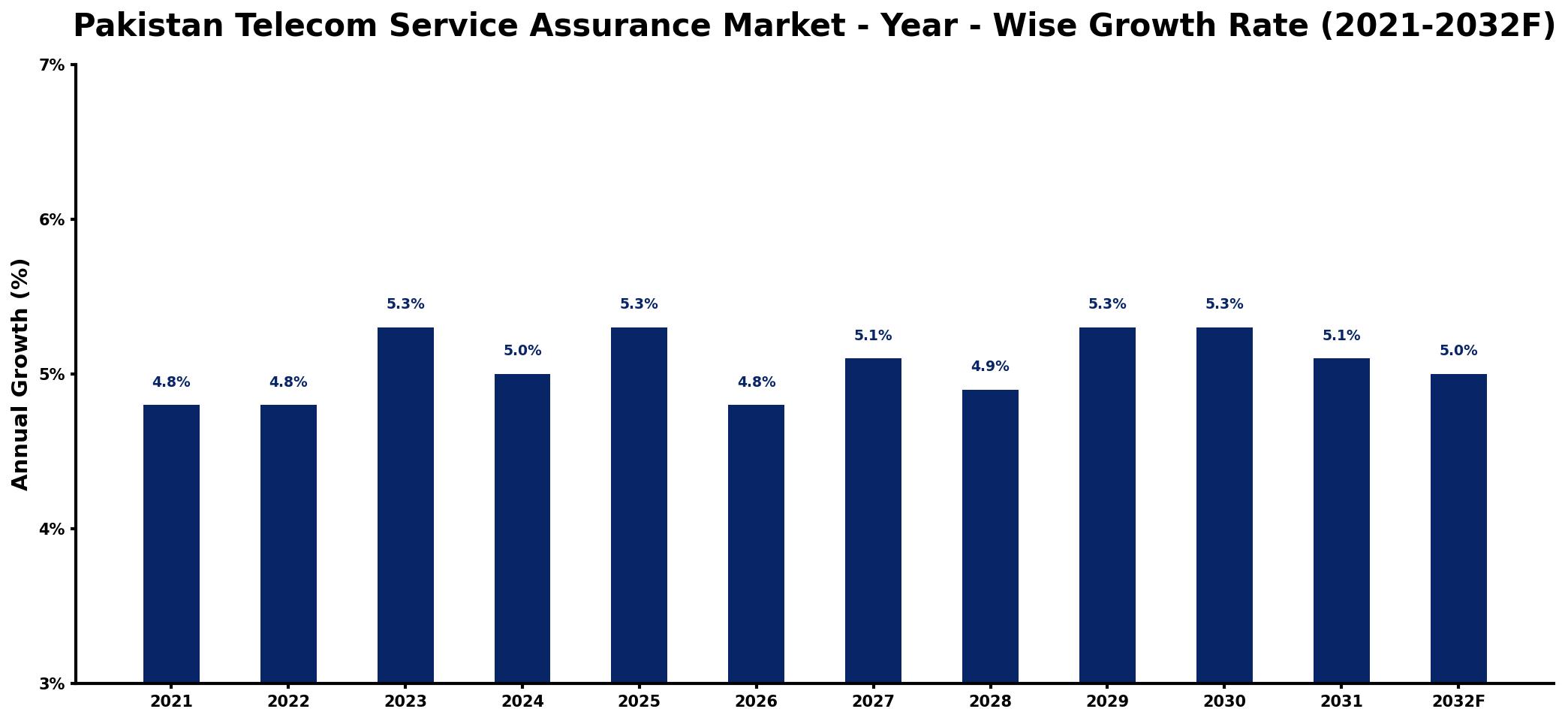
The table below presents the year‑wise growth rates along with the key drivers influencing the market
| Year | Growth Rate | Major Drivers |
| 2021 | 4.8% | increased consumer technology adoption |
| 2022 | 4.8% | growing demand for connectivity solutions |
| 2023 | 5.3% | rise in digital transformation initiatives |
| 2024 | 5.0% | expansion of mobile broadband infrastructure |
| 2025 | 5.3% | increased investment in network upgrades |
| 2026 | 4.8% | growing importance of cybersecurity measures |
| 2027 | 5.1% | enhanced focus on customer experience |
| 2028 | 4.9% | development of smart city projects |
| 2029 | 5.3% | growing popularity of IoT applications |
| 2030 | 5.3% | increased capital investment inflows |
| 2031 | 5.1% | increased regulatory support for innovation |
| 2032 | 5.0% | rising demand for 5G technology |
Note: Market size estimations and growth projections presented in this report are based on 6Wresearch's proprietary forecasting methodology, utilizing the latest available industry data, government publications, and primary research inputs.
Pakistan Telecom Service Assurance Market Synopsis
The Pakistan Telecom Service Assurance Market is currently undergoing a transformation driven by technological advancements and consumer expectations. With the rise of 5G and IoT technologies, telecom companies are prioritizing service quality and customer experience to stay competitive in a rapidly evolving digital landscape.
Real-time monitoring and predictive analytics are becoming crucial elements in the service assurance toolkit. As service providers embrace automation and artificial intelligence, they are better positioned to proactively address network issues before they escalate, ultimately fostering enhanced customer satisfaction.
Pakistan Telecom Service Assurance Market Key Takeaways
- The market is set for steady growth, driven by the deployment of advanced technologies such as 5G and IoT.
- Investments in service assurance solutions are becoming critical for telecom operators aiming to enhance customer experience.
- Real-time monitoring and predictive analytics are key features that are gaining traction in the market.
- Managed services are increasingly sought after as operators look to streamline operations and manage costs.
- Regulatory policies play a vital role in shaping the landscape, promoting competition and consumer protection.
Evaluation of Restraints in Pakistan Telecom Service Assurance Market
Despite the positive trajectory, the Pakistan Telecom Service Assurance Market faces notable restraints. Intense competition among service providers results in pricing pressures, which can affect profitability. The continuous need for investment in sophisticated technologies places a financial burden on operators, many of whom are navigating an ever-increasing complexity in network management. This complexity arises from the introduction of new services and a growing number of devices. Furthermore, the challenges posed by cyber threats necessitate a robust security approach, adding yet another layer of difficulty for telecom operators.
Pakistan Telecom Service Assurance Market Trends
Current trends indicate a marked shift towards the integration of artificial intelligence and machine learning in service assurance strategies. These technologies are pivotal in providing real-time analytics and proactive troubleshooting capabilities, allowing operators to minimize downtime and improve service reliability. Additionally, the adoption of cloud-based solutions is on the rise, enabling telecom companies to scale their services efficiently and flexibly, adapting quickly to changing customer demands.
Pakistan Telecom Service Assurance Market Opportunities
The market presents substantial investment opportunities, particularly in areas such as network monitoring and quality of service management. As telecom operators focus on enhancing service availability, there is a clear demand for advanced service assurance solutions that facilitate improved operational efficiency and customer satisfaction. With the growing emphasis on intelligent automation and data-driven insights, investors have a unique opportunity to capitalize on the transformative technologies that are reshaping the telecom landscape in Pakistan.
Government Initiatives in the Pakistan Telecom Service Assurance Market
Government initiatives, spearheaded by the Pakistan Telecommunication Authority (PTA), play a critical role in fostering a competitive and consumer-friendly telecom environment. Regulations aim to ensure quality service delivery, protect consumer rights, and promote fair competition among service providers. Furthermore, initiatives aimed at bolstering telecom infrastructure investment and enhancing digital connectivity serve to support the ongoing development of the Telecom Service Assurance Market.
Future Insights of the Pakistan Telecom Service Assurance Market
Looking ahead to 2026-2032, the Pakistan Telecom Service Assurance Market is expected to grow significantly, underpinned by rising demand for high-quality telecom services. The expansion of 4G/5G networks will drive the need for sophisticated service assurance solutions to maintain connectivity and performance. Moreover, advancements in artificial intelligence and machine learning will revolutionize service assurance methodologies, emphasizing proactive and predictive management. As operators strive to meet evolving consumer needs, the market will likely experience sustained growth and innovation.
Pakistan Telecom Service Assurance Market Latest Developments (2025 - 2026)
Recent developments within the Pakistan Telecom Service Assurance Market indicate a strategic shift towards enhanced automation and AI integration. Many service providers are actively engaging in initiatives aimed at fortifying network security, adapting to emerging cyber threats. Additionally, there is an observable trend towards adopting cloud-based solutions, facilitating improved scalability and flexibility in service management, which aligns with the growing demand for seamless connectivity and enhanced customer experience.
Pakistan Telecom Service Assurance Market - Key Attractiveness of the Report
- 10 Years of Market Numbers
- Historical Data Starting from 2022 to 2025
- Base Year: 2025
- Forecast Data until 2032
- Key Performance Indicators Impacting the Market
- Major Upcoming Developments and Projects
Key Highlights of the Report:
- Pakistan Telecom Service Assurance Market Outlook
- Market Size of Pakistan Telecom Service Assurance Market, 2025
- Forecast of Pakistan Telecom Service Assurance Market, 2032
- Historical Data and Forecast of Pakistan Telecom Service Assurance Revenues & Volume for the Period 2022-2032F
- Pakistan Telecom Service Assurance Market Trend Evolution
- Pakistan Telecom Service Assurance Market Drivers and Challenges
- Pakistan Telecom Service Assurance Price Trends
- Pakistan Telecom Service Assurance Porter's Five Forces
- Pakistan Telecom Service Assurance Industry Life Cycle
- Historical Data and Forecast of Pakistan Telecom Service Assurance Market Revenues & Volume By Component for the Period 2022-2032F
- Historical Data and Forecast of Pakistan Telecom Service Assurance Market Revenues & Volume By Solutions (Fault and Event Management, Performance Management, and Quality and Service Management) for the Period 2022-2032F
- Historical Data and Forecast of Pakistan Telecom Service Assurance Market Revenues & Volume By Services (Professional, Managed) for the Period 2022-2032F
- Historical Data and Forecast of Pakistan Telecom Service Assurance Market Revenues & Volume By Operator Type for the Period 2022-2032F
- Historical Data and Forecast of Pakistan Telecom Service Assurance Market Revenues & Volume By Mobile Operator for the Period 2022-2032F
- Historical Data and Forecast of Pakistan Telecom Service Assurance Market Revenues & Volume By Fixed Operator for the Period 2022-2032F
- Historical Data and Forecast of Pakistan Telecom Service Assurance Market Revenues & Volume By Deployment Type for the Period 2022-2032F
- Historical Data and Forecast of Pakistan Telecom Service Assurance Market Revenues & Volume By On-Premises for the Period 2022-2032F
- Historical Data and Forecast of Pakistan Telecom Service Assurance Market Revenues & Volume By Cloud for the Period 2022-2032F
- Historical Data and Forecast of Pakistan Telecom Service Assurance Market Revenues & Volume By Organization Size for the Period 2022-2032F
- Historical Data and Forecast of Pakistan Telecom Service Assurance Market Revenues & Volume By Small and Medium Enterprises for the Period 2022-2032F
- Historical Data and Forecast of Pakistan Telecom Service Assurance Market Revenues & Volume By Large Enterprises for the Period 2022-2032F
- Pakistan Telecom Service Assurance Import Export Trade Statistics
- Market Opportunity Assessment By Component
- Market Opportunity Assessment By Operator Type
- Market Opportunity Assessment By Deployment Type
- Market Opportunity Assessment By Organization Size
- Pakistan Telecom Service Assurance Top Companies Market Share
- Pakistan Telecom Service Assurance Competitive Benchmarking By Technical and Operational Parameters
- Pakistan Telecom Service Assurance Company Profiles
- Pakistan Telecom Service Assurance Key Strategic Recommendations






































