Pakistan Toys and Games Market Size, Share & Growth Rate
The Pakistan Toys and Games Market was estimated at USD 246 Million in 2025 and is projected to reach USD 324 Million by 2032, growing at a CAGR of 4.0% from 2026 to 2032. This growth trajectory is primarily driven by the nation's youthful demographic, rising disposable incomes, and a marked shift towards e-commerce as a preferred shopping channel. As parents become increasingly discerning about educational value, the demand for interactive and STEM-focused toys is also on the rise.
Pakistan Toys and Games Market Year-wise Growth Rate and Key Drivers
This graph highlights how the Pakistan Toys and Games Market has steadily grown over the years, supported by major growth factors.
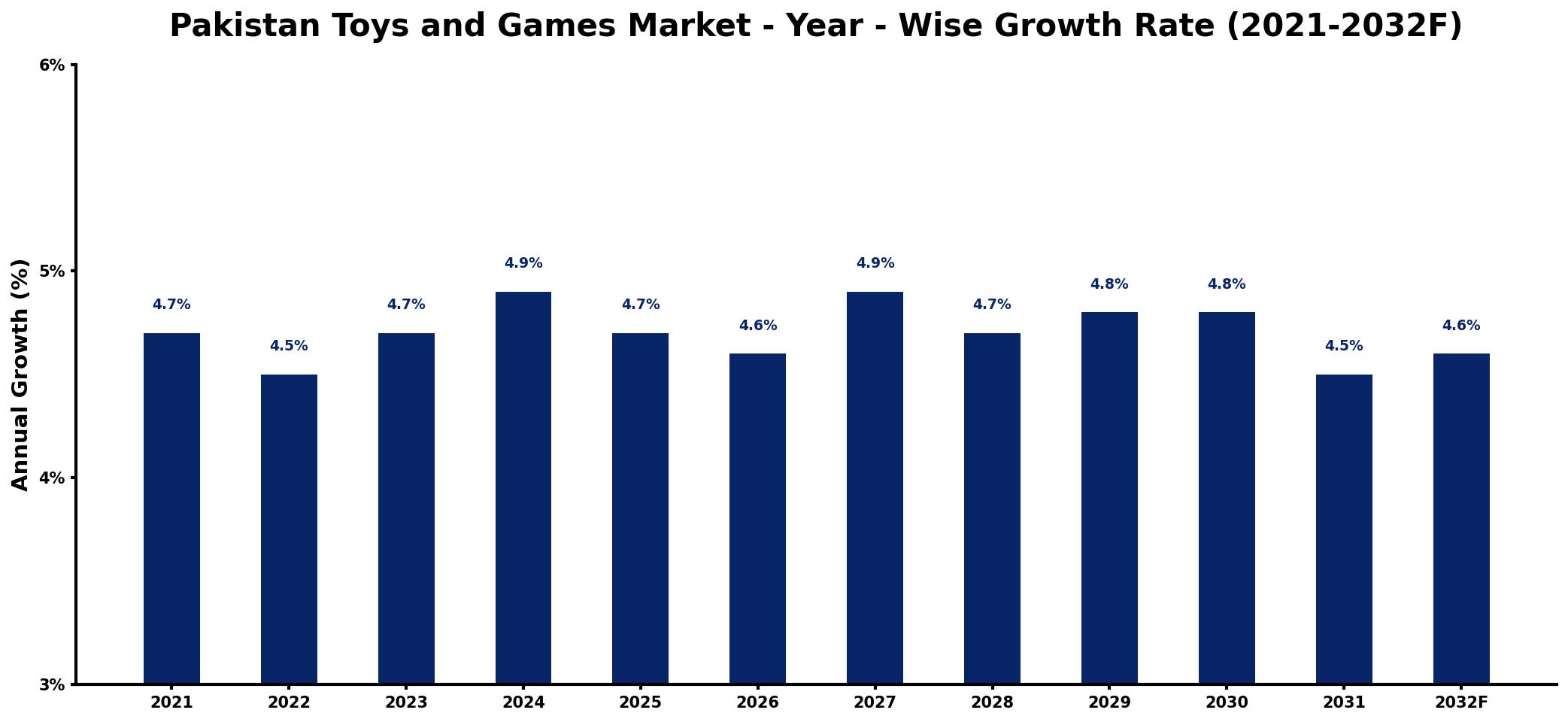
The table below presents the year‑wise growth rates along with the key drivers influencing the market
| Year | Growth Rate | Major Drivers |
| 2021 | 4.7% | Rising disposable income levels |
| 2022 | 4.5% | Growing urban population trends |
| 2023 | 4.7% | Increased focus on education |
| 2024 | 4.9% | Expansion of e-commerce platforms |
| 2025 | 4.7% | Higher investment in manufacturing |
| 2026 | 4.6% | Innovations in product design |
| 2027 | 4.9% | Emerging middle class demographics |
| 2028 | 4.7% | Strengthening retail distribution networks |
| 2029 | 4.8% | Surge in online shopping habits |
| 2030 | 4.8% | Growing interest in sustainability |
| 2031 | 4.5% | Enhanced marketing strategies adopted |
| 2032 | 4.6% | Improved consumer awareness levels |
Note: Market size estimations and growth projections presented in this report are based on 6Wresearch's proprietary forecasting methodology, utilizing the latest available industry data, government publications, and primary research inputs.
Pakistan Toys and Games Market Synopsis
The growing preference for educational toys represents the strongest force currently shaping the Pakistan Toys and Games Market. Parents are actively seeking products that not only entertain but also promote cognitive development and skill acquisition in their children.
Simultaneously, the surge in online shopping is revolutionizing how consumers access toys and games. With an expanding number of e-commerce platforms and a growing acceptance of digital transactions, the convenience of purchasing toys online is reshaping consumer behavior.
Pakistan Toys and Games Market Key Takeaways
- The market is driven by a young population and increasing disposable income, enhancing demand for diverse toys.
- Educational and interactive toys are currently trending, with parents prioritizing learning experiences for their children.
- E-commerce growth is reshaping distribution channels, allowing easier access to a wider range of products.
- Traditional toys remain popular, but competition from digital entertainment options is rising.
- Counterfeit products and quality concerns represent significant challenges, impacting brand trust in the market.
Evaluation of Restraints in Pakistan Toys and Games Market
Despite its growth potential, the Pakistan Toys and Games Market faces significant restraints. The prevalence of counterfeit products poses a substantial threat, diminishing consumer trust and negatively affecting legitimate businesses. Moreover, inadequate regulation and quality control exacerbate safety concerns among consumers. High import duties and limited access to reliable distribution channels can further hinder market expansion. Additionally, competition from digital entertainment alternatives captures a growing share of children's attention, complicating strategies for traditional toy manufacturers.
Pakistan Toys and Games Market Trends
Currently, there is a notable shift towards educational and interactive toys that engage children in creative learning processes. STEM toys, which focus on science, technology, engineering, and mathematics, are gaining significant traction as parents increasingly prioritize educational value over mere entertainment. Furthermore, licensed merchandise, tied to popular media franchises, continues to dominate sales, appealing to children's familiarity with beloved characters and themes.
The online sales channel is experiencing rapid growth, bolstered by enhanced internet access and increased consumer comfort with digital shopping. This trend underscores a broader movement towards convenience and accessibility, as families opt for the ease of purchasing toys and games from the comfort of their homes.
Pakistan Toys and Games Market Opportunities
The potential for growth in the Pakistan Toys and Games Market is substantial. Investors should consider entering the market by manufacturing or importing a diverse array of products tailored to local preferences, particularly focusing on educational and interactive toys. Capitalizing on the rising trend of online shopping, establishing e-commerce platforms dedicated to toys could yield significant returns. Moreover, forging collaborations with local distributors or international brands can facilitate market entry and expansion, aligning product offerings with the evolving consumer demands.
Government Initiatives in the Pakistan Toys and Games Market
The Pakistani government has implemented various initiatives to promote a safer and more regulated toys and games market. This includes establishing the Pakistan Standards and Quality Control Authority (PSQCA) to ensure compliance with safety standards. Policies encouraging local manufacturing are also in place, providing incentives to domestic producers. Furthermore, initiatives aimed at fostering the development of educational toys that reflect local culture and values underscore the government's commitment to enhancing child development through appropriate toys and games.
Future Insights of the Pakistan Toys and Games Market
Looking ahead to 2026-2032, the Pakistan Toys and Games Market is expected to experience continued growth fueled by urbanization and a burgeoning middle class. With a youthful demographic, demand for a broad spectrum of toys is anticipated to rise significantly. As digital and e-commerce channels become more entrenched, market access will likely improve, providing a conducive environment for innovation and strategic marketing efforts. This landscape presents fertile ground for companies aiming to adapt to the evolving tastes and preferences of Pakistani consumers.
Pakistan Toys and Games Market Latest Developments (2025 - 2026)
In recent months, the Pakistan Toys and Games Market has seen a marked increase in the introduction of educational products that emphasize STEM learning. Companies are also actively enhancing their online presence, with many launching targeted marketing campaigns to capture the interest of tech-savvy consumers. Collaborative ventures between local manufacturers and international brands are beginning to emerge, aiming to offer more diverse product lines tailored to regional preferences. As consumer awareness about product safety rises, manufacturers are also beginning to prioritize compliance with safety standards to build trust.
Pakistan Toys and Games Market - Key Attractiveness of the Report
- 10 Years of Market Numbers
- Historical Data Starting from 2022 to 2025
- Base Year: 2025
- Forecast Data until 2032
- Key Performance Indicators Impacting the Market
- Major Upcoming Developments and Projects
Key Highlights of the Report:
- Pakistan ToysandGames Market Outlook
- Market Size of Pakistan ToysandGames Market, 2025
- Forecast of Pakistan ToysandGames Market, 2032
- Historical Data and Forecast of Pakistan ToysandGames Revenues & Volume for the Period 2022-2032F
- Pakistan ToysandGames Market Trend Evolution
- Pakistan ToysandGames Market Drivers and Challenges
- Pakistan ToysandGames Price Trends
- Pakistan ToysandGames Porter's Five Forces
- Pakistan ToysandGames Industry Life Cycle
- Historical Data and Forecast of Pakistan ToysandGames Market Revenues & Volume By Product Type for the Period 2022-2032F
- Historical Data and Forecast of Pakistan ToysandGames Market Revenues & Volume By Games and Puzzles for the Period 2022-2032F
- Historical Data and Forecast of Pakistan ToysandGames Market Revenues & Volume By Video Games for the Period 2022-2032F
- Historical Data and Forecast of Pakistan ToysandGames Market Revenues & Volume By Construction Toys for the Period 2022-2032F
- Historical Data and Forecast of Pakistan ToysandGames Market Revenues & Volume By Dolls and Accessories for the Period 2022-2032F
- Historical Data and Forecast of Pakistan ToysandGames Market Revenues & Volume By Outdoor and Sports Toys for the Period 2022-2032F
- Historical Data and Forecast of Pakistan ToysandGames Market Revenues & Volume By Other for the Period 2022-2032F
- Historical Data and Forecast of Pakistan ToysandGames Market Revenues & Volume By Distribution Channel for the Period 2022-2032F
- Historical Data and Forecast of Pakistan ToysandGames Market Revenues & Volume By Online Channel for the Period 2022-2032F
- Historical Data and Forecast of Pakistan ToysandGames Market Revenues & Volume By Offline Channel for the Period 2022-2032F
- Pakistan ToysandGames Import Export Trade Statistics
- Market Opportunity Assessment By Product Type
- Market Opportunity Assessment By Distribution Channel
- Pakistan ToysandGames Top Companies Market Share
- Pakistan ToysandGames Competitive Benchmarking By Technical and Operational Parameters
- Pakistan ToysandGames Company Profiles
- Pakistan ToysandGames Key Strategic Recommendations






































