Pakistan Transaction Monitoring Market Size & Growth Rate (2026-2032)
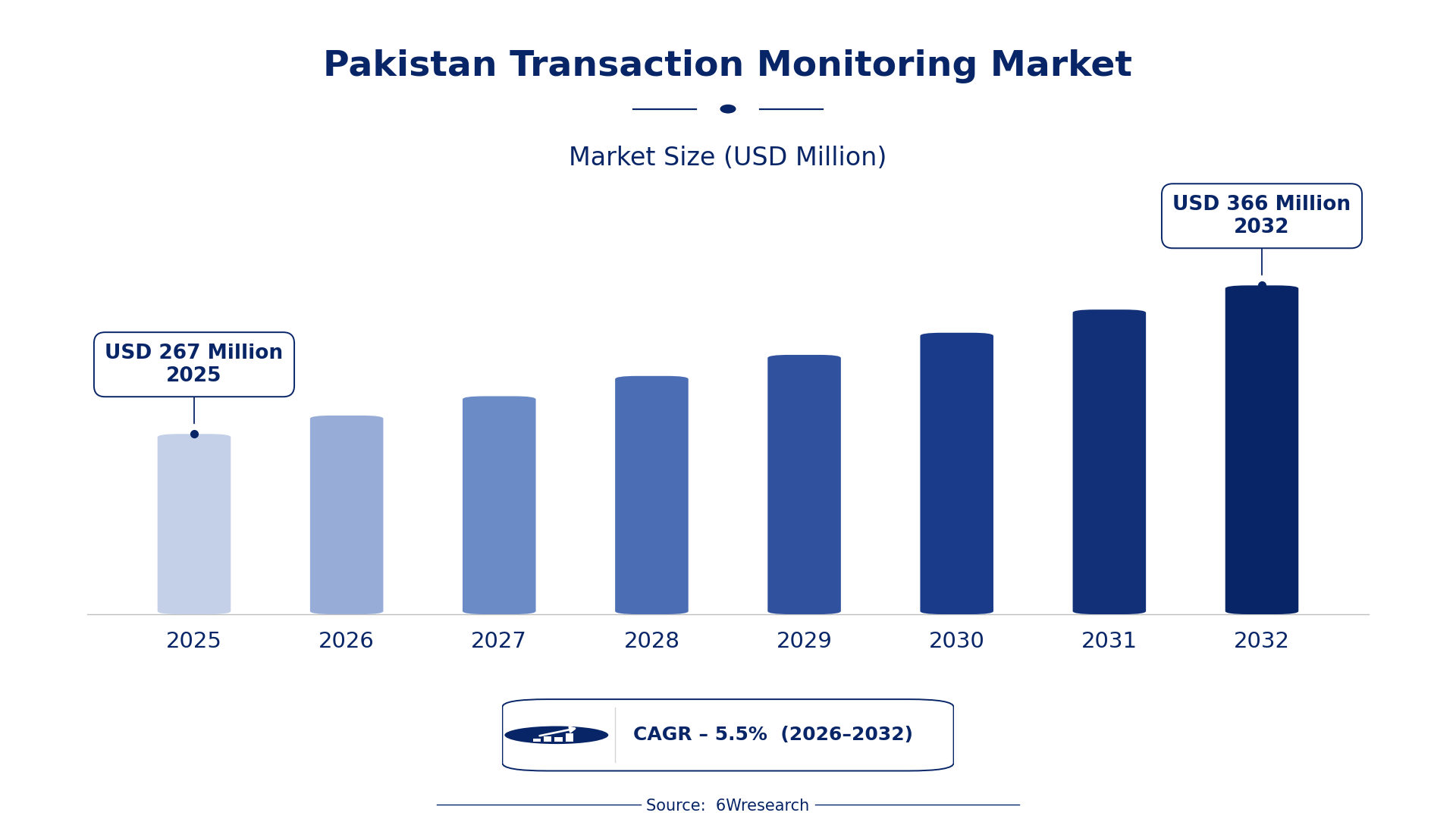
The Pakistan Transaction Monitoring Market was estimated at USD 267 Million in 2025 and is projected to reach USD 366 Million by 2032, growing at a CAGR of 5.5% from 2026 to 2032.
Pakistan Transaction Monitoring Market Synopsis
The strongest force shaping the Pakistan Transaction Monitoring Market is the increasing regulatory scrutiny aimed at combating financial crimes. With rising instances of money laundering and fraud, financial institutions are compelled to adopt comprehensive monitoring solutions to stay compliant and protect their operations.
Driven by enhanced awareness of risks, the demand for sophisticated transaction monitoring systems continues to expand. These systems utilize advanced analytics and machine learning, not just to meet compliance requirements, but also to identify and mitigate potential threats before they escalate into serious issues.
Pakistan Transaction Monitoring Market Year-wise Growth Rate and Key Drivers
This graph illustrates the annual growth rates of the Pakistan Transaction Monitoring Market from 2021 to 2032, highlighting a steady upward trajectory and projected expansion over the forecast period.
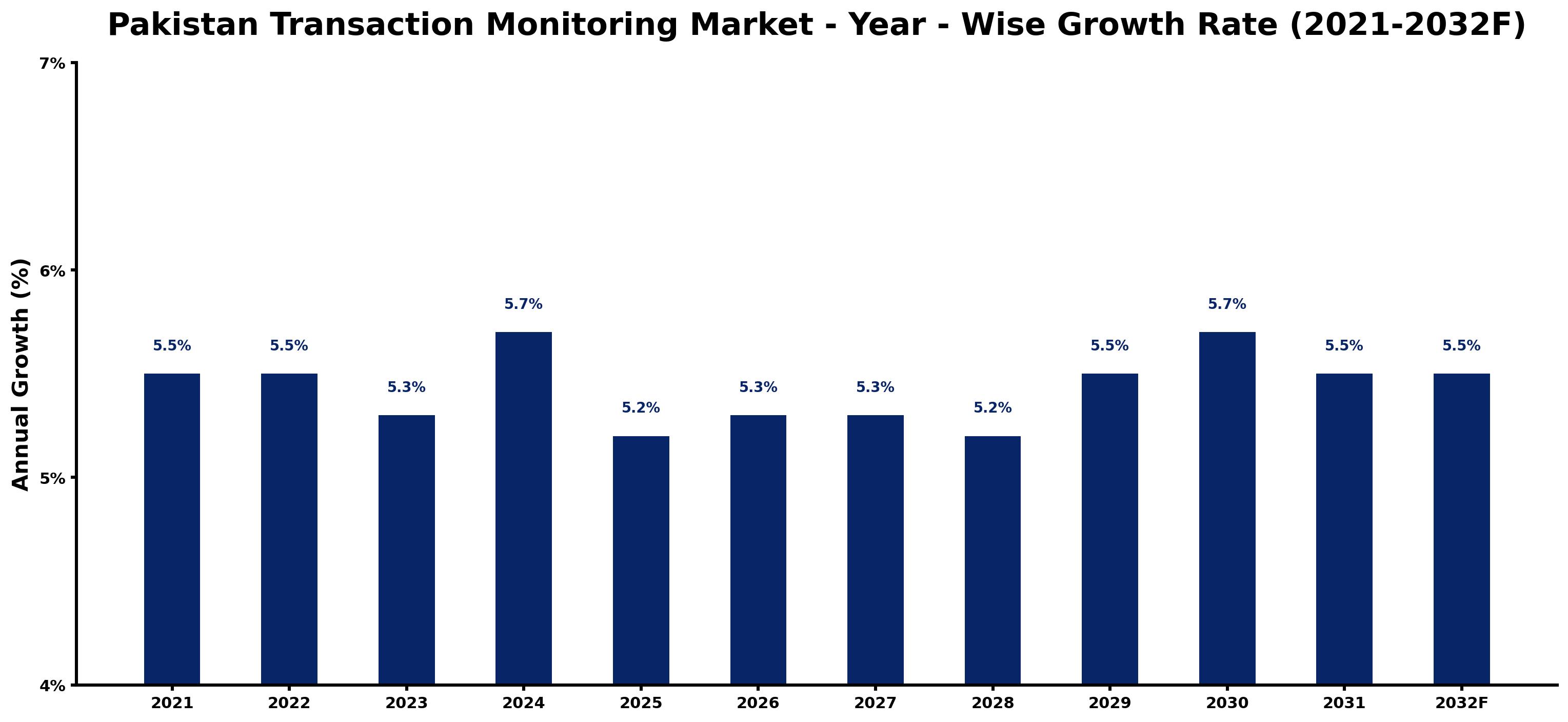
The table below presents the year‑wise growth rates along with the key drivers influencing the market
| Year | Growth Rate | Major Drivers |
| 2021 | 5.5% | State Bank of Pakistan's anti-money laundering regulations. |
| 2022 | 5.5% | Increased biometric identification for enhanced transaction security. |
| 2023 | 5.3% | Growing e-commerce sector necessitating robust transaction monitoring. |
| 2024 | 5.7% | Rise in cross-border transactions demanding compliance measures. |
| 2025 | 5.2% | Increased awareness of financial fraud risk among consumers. |
| 2026 | 5.3% | Digital payment adoption driving demand for monitoring solutions. |
| 2027 | 5.3% | Government initiatives promoting financial transparency and accountability. |
| 2028 | 5.2% | Collaboration with international organizations for compliance improvements. |
| 2029 | 5.5% | Rising smartphone penetration enhancing mobile transaction monitoring. |
| 2030 | 5.7% | Development of local fintech startups driving innovation. |
| 2031 | 5.5% | Strengthened consumer protection laws addressing transaction integrity. |
| 2032 | 5.5% | Local banks increasing investment in technology-driven solutions. |
Note: Market size estimations and growth projections presented in this report are based on 6Wresearch's proprietary forecasting methodology, utilizing the latest available industry data, government publications, and primary research inputs.
Pakistan Transaction Monitoring Market Key Takeaways
Below are some of the specific key takeaways from the market, including:
- Increasing instances of financial crime necessitate effective monitoring solutions.
- Regulatory frameworks are evolving, emphasizing compliance and reporting obligations.
- The lack of skilled personnel in financial institutions is hindering market growth.
- Advanced analytics and machine learning are becoming essential tools for detecting fraud.
- Government initiatives are pushing for technology adoption in AML processes.
Evaluation of Restraints in Pakistan Transaction Monitoring Market
The Pakistan Transaction Monitoring Market faces substantial restraints that impede its growth trajectory. A primary concern is the high cost associated with the implementation of advanced monitoring systems, which often discourages financial institutions from investing adequately in compliance technology. Many prioritize immediate cost savings over long-term investments in robust monitoring solutions. Additionally, the shortage of skilled professionals trained in using these systems limits the effectiveness of existing technologies. This dual challenge of cost and expertise creates significant hurdles for market participants striving to enhance their transaction monitoring capabilities.
Pakistan Transaction Monitoring Market Trends
A few key trends are shaping the Pakistan Transaction Monitoring Market. The rapid digitization of financial services is leading to an exponential increase in transaction volumes, compelling institutions to adopt automated monitoring solutions to manage risk effectively. Meanwhile, the integration of artificial intelligence in transaction monitoring systems is gaining traction, enhancing their ability to detect unusual patterns and anomalies. on top of that, as regulatory pressures intensify, many institutions are investing in compliance-driven technology that aligns with global standards.
Pakistan Transaction Monitoring Market Opportunities
Opportunities in the Pakistan Transaction Monitoring Market are abundant, particularly in developing innovative solutions tailored to the local context. With a burgeoning fintech ecosystem, there is significant potential for collaboration between traditional banks and technology providers to build more effective monitoring systems. Additionally, as regulations become stricter, there’s an opening for consulting services that help financial institutions navigate compliance complexities. Growing public awareness of financial crimes further amplifies the need for sophisticated solutions, presenting a lucrative avenue for market players.
Government Initiatives in the Pakistan Transaction Monitoring Market
Government initiatives play a crucial role in shaping the trajectory of the Pakistan Transaction Monitoring Market. The regulatory environment is becoming increasingly stringent, highlighting the importance of anti-money laundering (AML) efforts and financial crime prevention. Public policy is actively encouraging technology adoption to ensure compliance with international standards, enhancing the overall integrity of the financial system.
- A regulatory framework introduced in 2025 mandating enhanced transaction monitoring capabilities for financial institutions.
- Current initiatives are underway to establish a national database for tracking suspicious transactions across the banking sector.
- Planned public-private partnerships aimed at training personnel in compliance and monitoring technologies expected to launch in 2026.
- Ongoing efforts to improve KYC (Know Your Customer) guidelines and reporting obligations for banks to combat illicit financial activities.
- Recently completed workshops and seminars promoting awareness of AML regulations among banking sector employees.
Future Insights of the Pakistan Transaction Monitoring Market
Looking ahead, the Pakistan Transaction Monitoring Market is set to experience substantial growth driven by the ongoing digital transformation of financial services. The rising need for compliance, coupled with technological advancements, will encourage institutions to invest in more sophisticated monitoring systems. As financial crimes evolve, so too must the technologies designed to combat them. The market will likely witness increased collaboration between banks and tech firms, aimed at developing next-generation solutions that enhance detection and prevention capabilities.
Pakistan Transaction Monitoring Market Latest Developments
Over the past year, the Pakistan Transaction Monitoring Market has seen a flurry of activity focused on enhancing compliance measures and adopting new technologies. Financial institutions are increasingly prioritizing investments in advanced transaction monitoring solutions to keep pace with regulatory requirements and rising financial crime rates.
- An initiative that began in early 2023 focuses on integrating machine learning algorithms into existing monitoring frameworks, with rollout currently ongoing.
- Recent workshops were held in mid-2023, aiming to enhance the capabilities of compliance personnel across major banks.
- A partnership formed in late 2022 between a regional bank and a tech provider is set to deliver a new transaction monitoring platform expected to launch by the end of 2023.
- An upcoming regulatory review scheduled for early 2024 aims to further tighten KYC and AML requirements across the financial sector.
- By mid-2023, several banks began upgrading their transaction monitoring systems to comply with newly established government guidelines.
Pakistan Transaction Monitoring Market - Key Attractiveness of the Report
- 10 Years of Market Numbers
- Historical Data Starting from 2022 to 2025
- Base Year: 2025
- Forecast Data until 2032
- Key Performance Indicators Impacting the Market
- Major Upcoming Developments and Projects
Key Highlights of the Report:
- Pakistan Transaction Monitoring Market Outlook
- Market Size of Pakistan Transaction Monitoring Market, 2025
- Forecast of Pakistan Transaction Monitoring Market, 2032
- Historical Data and Forecast of Pakistan Transaction Monitoring Revenues & Volume for the Period 2022-2032F
- Pakistan Transaction Monitoring Market Trend Evolution
- Pakistan Transaction Monitoring Market Drivers and Challenges
- Pakistan Transaction Monitoring Price Trends
- Pakistan Transaction Monitoring Porter's Five Forces
- Pakistan Transaction Monitoring Industry Life Cycle
- Historical Data and Forecast of Pakistan Transaction Monitoring Market Revenues & Volume By Application Area for the Period 2022-2032F
- Historical Data and Forecast of Pakistan Transaction Monitoring Market Revenues & Volume By AML for the Period 2022-2032F
- Historical Data and Forecast of Pakistan Transaction Monitoring Market Revenues & Volume By FDP for the Period 2022-2032F
- Historical Data and Forecast of Pakistan Transaction Monitoring Market Revenues & Volume By Compliance Management for the Period 2022-2032F
- Historical Data and Forecast of Pakistan Transaction Monitoring Market Revenues & Volume By Customer Identity Management for the Period 2022-2032F
- Historical Data and Forecast of Pakistan Transaction Monitoring Market Revenues & Volume By Component for the Period 2022-2032F
- Historical Data and Forecast of Pakistan Transaction Monitoring Market Revenues & Volume By Solution for the Period 2022-2032F
- Historical Data and Forecast of Pakistan Transaction Monitoring Market Revenues & Volume By Services for the Period 2022-2032F
- Historical Data and Forecast of Pakistan Transaction Monitoring Market Revenues & Volume By Function for the Period 2022-2032F
- Historical Data and Forecast of Pakistan Transaction Monitoring Market Revenues & Volume By Case Management for the Period 2022-2032F
- Historical Data and Forecast of Pakistan Transaction Monitoring Market Revenues & Volume By KYC/Customer Onboarding for the Period 2022-2032F
- Historical Data and Forecast of Pakistan Transaction Monitoring Market Revenues & Volume By Dashboard and Reporting for the Period 2022-2032F
- Historical Data and Forecast of Pakistan Transaction Monitoring Market Revenues & Volume By Watch List Screening for the Period 2022-2032F
- Historical Data and Forecast of Pakistan Transaction Monitoring Market Revenues & Volume By Deployment Mode for the Period 2022-2032F
- Historical Data and Forecast of Pakistan Transaction Monitoring Market Revenues & Volume By On-Premises for the Period 2022-2032F
- Historical Data and Forecast of Pakistan Transaction Monitoring Market Revenues & Volume By Cloud for the Period 2022-2032F
- Historical Data and Forecast of Pakistan Transaction Monitoring Market Revenues & Volume By Organization Size for the Period 2022-2032F
- Historical Data and Forecast of Pakistan Transaction Monitoring Market Revenues & Volume By SMEs for the Period 2022-2032F
- Historical Data and Forecast of Pakistan Transaction Monitoring Market Revenues & Volume By Large Enterprises for the Period 2022-2032F
- Historical Data and Forecast of Pakistan Transaction Monitoring Market Revenues & Volume By Vertical for the Period 2022-2032F
- Historical Data and Forecast of Pakistan Transaction Monitoring Market Revenues & Volume By Banking, Financial Services, and Insurance for the Period 2022-2032F
- Historical Data and Forecast of Pakistan Transaction Monitoring Market Revenues & Volume By Government and Defense for the Period 2022-2032F
- Historical Data and Forecast of Pakistan Transaction Monitoring Market Revenues & Volume By IT and Telecom for the Period 2022-2032F
- Historical Data and Forecast of Pakistan Transaction Monitoring Market Revenues & Volume By Retail for the Period 2022-2032F
- Historical Data and Forecast of Pakistan Transaction Monitoring Market Revenues & Volume By Healthcare for the Period 2022-2032F
- Historical Data and Forecast of Pakistan Transaction Monitoring Market Revenues & Volume By Energy and Utilities for the Period 2022-2032F
- Historical Data and Forecast of Pakistan Transaction Monitoring Market Revenues & Volume By Manufacturing for the Period 2022-2032F
- Historical Data and Forecast of Pakistan Transaction Monitoring Market Revenues & Volume By Others for the Period 2022-2032F
- Pakistan Transaction Monitoring Import Export Trade Statistics
- Market Opportunity Assessment By Application Area
- Market Opportunity Assessment By Component
- Market Opportunity Assessment By Function
- Market Opportunity Assessment By Deployment Mode
- Market Opportunity Assessment By Organization Size
- Market Opportunity Assessment By Vertical
- Pakistan Transaction Monitoring Top Companies Market Share
- Pakistan Transaction Monitoring Competitive Benchmarking By Technical and Operational Parameters
- Pakistan Transaction Monitoring Company Profiles
- Pakistan Transaction Monitoring Key Strategic Recommendations






































