Pakistan Trolley Market Size, Share & Growth Rate
The Pakistan Trolley Market was estimated at USD 366 Million in 2025 and is projected to reach USD 483 Million by 2032, growing at a CAGR of 4.0% from 2026 to 2032. This anticipated growth is primarily driven by the rapid urbanization taking place across the country, coupled with a burgeoning retail and logistics sector. As businesses seek to enhance their operational efficiency through effective material handling solutions, the demand for various trolley types continues to surge.
Pakistan Trolley Market Year-wise Growth Rate and Key Drivers
This graph highlights how the Pakistan Trolley Market has steadily grown over the years, supported by major growth factors.
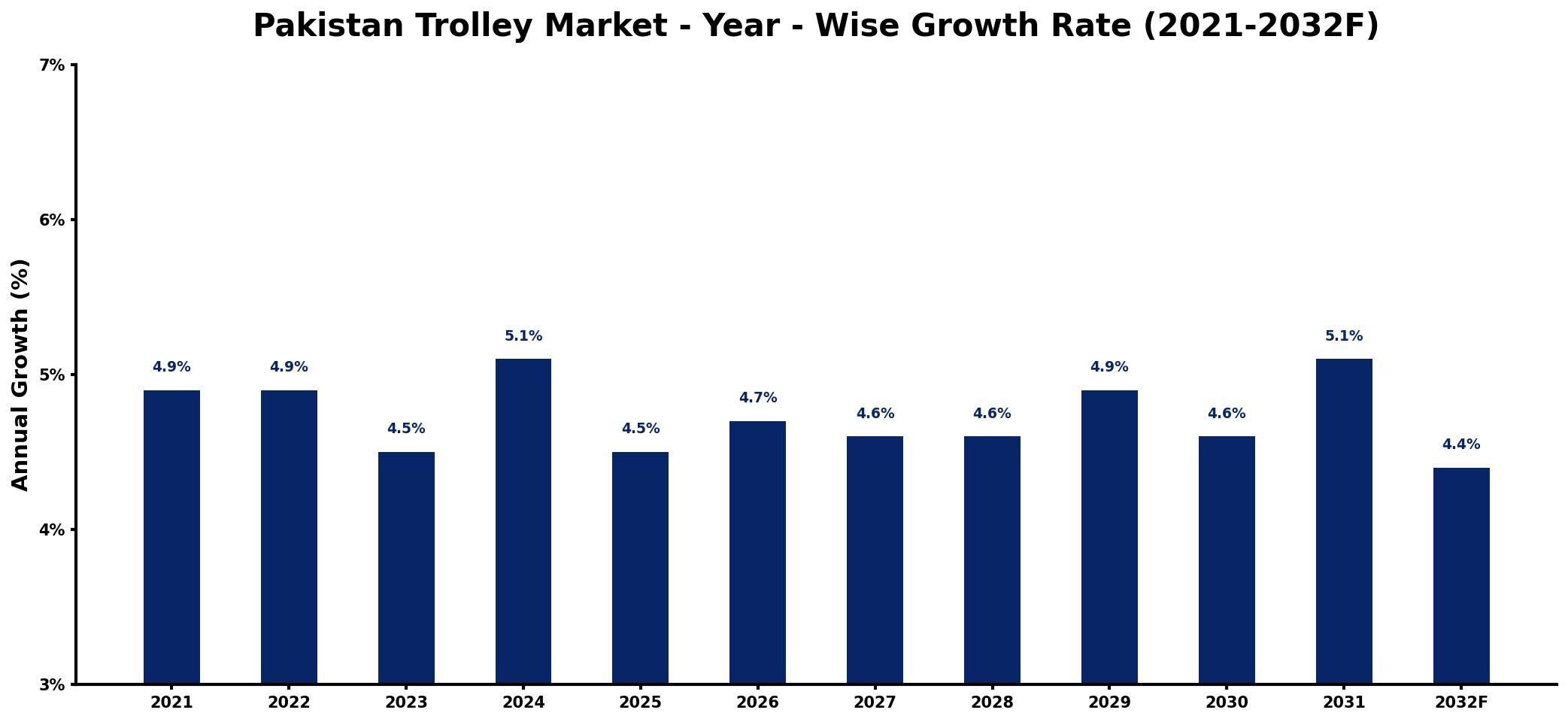
The table below presents the year‑wise growth rates along with the key drivers influencing the market
| Year | Growth Rate | Major Drivers |
| 2021 | 4.9% | Rising consumer demand for logistics |
| 2022 | 4.9% | Increased investment in infrastructure development |
| 2023 | 4.5% | Growing e-commerce fueling transport needs |
| 2024 | 5.1% | Expansion of retail supply chains |
| 2025 | 4.5% | Surge in urbanization driving logistics |
| 2026 | 4.7% | improved processing technologies adoption |
| 2027 | 4.6% | Growing demand for last-mile delivery |
| 2028 | 4.6% | Increased agricultural production requiring transport |
| 2029 | 4.9% | growing commercial sector adoption |
| 2030 | 4.6% | rising export shipment volumes |
| 2031 | 5.1% | Increased government support for transport |
| 2032 | 4.4% | increased pharmaceutical industry usage |
Note: Market size estimations and growth projections presented in this report are based on 6Wresearch's proprietary forecasting methodology, utilizing the latest available industry data, government publications, and primary research inputs.
Pakistan Trolley Market Synopsis
Urbanization stands as the most influential force shaping the Pakistan Trolley Market today. As cities expand, the need for effective transportation of goods within warehouses, supermarkets, and distribution centers has never been more critical. This growing demand aligns with the rise of e-commerce and modern retail formats, necessitating efficient logistical operations.
Moreover, the logistics sector's expansion has highlighted the importance of trolleys in enhancing productivity and operational flexibility. Trolleys are not merely tools; they symbolize a transition towards more efficient and sophisticated material handling practices, positioning them as indispensable assets in both commercial and industrial settings.
Pakistan Trolley Market Key Takeaways
- The market is currently driven by urbanization and the rapid growth of the retail and logistics sectors.
- Import dependence is a significant barrier, contributing to higher costs and supply chain complexities.
- Government initiatives are emphasizing safety, technology adoption, and sustainable solutions in trolley manufacturing.
- Increased e-commerce activities are elevating the demand for trolleys across various industries.
- Challenges in local production capabilities present opportunities for strategic investments and development.
Evaluation of Restraints in Pakistan Trolley Market
The Pakistan Trolley Market faces several restraints that are holding back its potential growth. Chief among these is the high cost of manufacturing, which is exacerbated by the limited local production capabilities. Reliance on imported materials leads to inflated costs, rendering trolleys less accessible for many businesses. Furthermore, the lack of awareness regarding advanced trolley options and their benefits hampers broader adoption. Educating stakeholders about these advantages is crucial to unlocking the market's full potential.
Pakistan Trolley Market Trends
Key trends are emerging in the Pakistan Trolley Market that reflect broader industry shifts. The push towards automation in logistics is prompting the incorporation of smart technology in trolley designs. Additionally, the preference for eco-friendly materials is gaining traction, as businesses prioritize sustainability in their operations. This shift not only aligns with global trends but also caters to a growing consumer base that values environmental responsibility.
Pakistan Trolley Market Opportunities
The evolving landscape of the Pakistan Trolley Market is rife with opportunities for growth and investment. Companies that can leverage innovative manufacturing techniques and capitalize on local production capabilities stand to gain a competitive edge. Additionally, engaging in partnerships for technological advancement and exploring new distribution channels can unlock additional revenue streams. The rising demand for specialized trolleys tailored to specific industries also presents a fertile ground for strategic diversification.
Government Initiatives in the Pakistan Trolley Market
The government has taken various initiatives to bolster the Pakistan Trolley Market, focusing on public safety, urban planning, and market regulation. Regulatory frameworks are being established to ensure trolley design standards meet safety requirements. Furthermore, the government is promoting technology adoption in manufacturing processes, which is expected to enhance production efficiency and quality. Skills development programs in urban transportation planning aim to facilitate better integration of trolley systems within existing infrastructure, ultimately improving mobility in urban areas.
Future Insights of the Pakistan Trolley Market
Looking ahead to 2026-2032, the Pakistan Trolley Market is positioned for steady growth. The convergence of rising urban populations and the increasing emphasis on efficient material handling solutions will likely enhance market demand. Moreover, advancements in trolley technology, particularly those focused on automation and sustainability, will further drive interest. As the logistics and retail sectors continue to expand, the role of trolleys as integral tools for operational success cannot be overstated.
Pakistan Trolley Market Latest Developments (2025 - 2026)
Recent developments in the Pakistan Trolley Market reflect a dynamic industry responding to the demands of modernization and efficiency. Manufacturers are increasingly investing in smart trolley designs that incorporate technological innovations to enhance usability and safety. Furthermore, industry stakeholders are collaborating to raise awareness about the advantages of advanced trolleys, aiming to improve adoption rates across various sectors.
Pakistan Trolley Market - Key Attractiveness of the Report
- 10 Years of Market Numbers
- Historical Data Starting from 2022 to 2025
- Base Year: 2025
- Forecast Data until 2032
- Key Performance Indicators Impacting the Market
- Major Upcoming Developments and Projects
Key Highlights of the Report:
- Pakistan Trolley Market Outlook
- Market Size of Pakistan Trolley Market, 2025
- Forecast of Pakistan Trolley Market, 2032
- Historical Data and Forecast of Pakistan Trolley Revenues & Volume for the Period 2022-2032F
- Pakistan Trolley Market Trend Evolution
- Pakistan Trolley Market Drivers and Challenges
- Pakistan Trolley Price Trends
- Pakistan Trolley Porter's Five Forces
- Pakistan Trolley Industry Life Cycle
- Historical Data and Forecast of Pakistan Trolley Market Revenues & Volume By Product for the Period 2022-2032F
- Historical Data and Forecast of Pakistan Trolley Market Revenues & Volume By Manual for the Period 2022-2032F
- Historical Data and Forecast of Pakistan Trolley Market Revenues & Volume By Electric for the Period 2022-2032F
- Historical Data and Forecast of Pakistan Trolley Market Revenues & Volume By Application for the Period 2022-2032F
- Historical Data and Forecast of Pakistan Trolley Market Revenues & Volume By Commercial for the Period 2022-2032F
- Historical Data and Forecast of Pakistan Trolley Market Revenues & Volume By Non-commercial for the Period 2022-2032F
- Historical Data and Forecast of Pakistan Trolley Market Revenues & Volume By Distribution for the Period 2022-2032F
- Historical Data and Forecast of Pakistan Trolley Market Revenues & Volume By Offline for the Period 2022-2032F
- Historical Data and Forecast of Pakistan Trolley Market Revenues & Volume By Online for the Period 2022-2032F
- Pakistan Trolley Import Export Trade Statistics
- Market Opportunity Assessment By Product
- Market Opportunity Assessment By Application
- Market Opportunity Assessment By Distribution
- Pakistan Trolley Top Companies Market Share
- Pakistan Trolley Competitive Benchmarking By Technical and Operational Parameters
- Pakistan Trolley Company Profiles
- Pakistan Trolley Key Strategic Recommendations






































