Pakistan Ultrasonic Cleaning Equipment Market Size, Share & Growth Rate
The Pakistan Ultrasonic Cleaning Equipment Market was estimated at USD 1214 Million in 2025 and is projected to reach USD 1747 Million by 2032, growing at a CAGR of 5.3% from 2026 to 2032. This growth trajectory is driven by the increasing industrialization across the nation and the escalating demand for sophisticated cleaning technologies that adhere to higher hygiene and quality standards. Key sectors like healthcare, automotive, and electronics are particularly contributing to this momentum, embracing ultrasonic cleaning as a solution for intricate cleaning needs.
Pakistan Ultrasonic Cleaning Equipment Market Year-wise Growth Rate and Key Drivers
This graph highlights how the Pakistan Ultrasonic Cleaning Equipment Market has steadily grown over the years, supported by major growth factors.
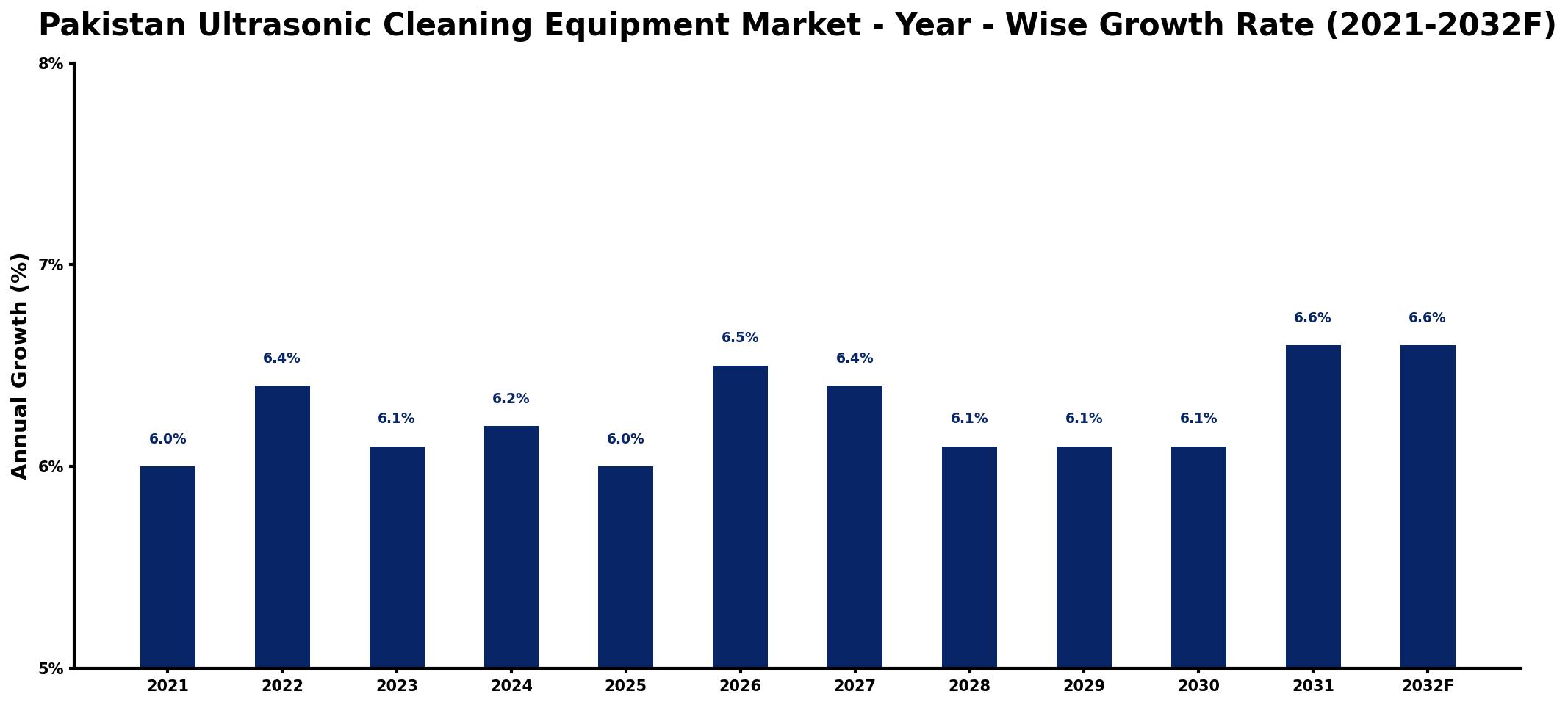
The table below presents the year‑wise growth rates along with the key drivers influencing the market
| Year | Growth Rate | Major Drivers |
| 2021 | 6.0% | Increased industrial manufacturing activity |
| 2022 | 6.4% | Growing healthcare sector investments |
| 2023 | 6.1% | Rising demand from automotive industry |
| 2024 | 6.2% | Expansion in electronics manufacturing |
| 2025 | 6.0% | Surge in jewelry production needs |
| 2026 | 6.5% | Enhanced focus on environmental regulations |
| 2027 | 6.4% | Growth in food processing sector |
| 2028 | 6.1% | Increased adoption in laboratories |
| 2029 | 6.1% | Higher demand from aerospace industry |
| 2030 | 6.1% | Expansion of research and development |
| 2031 | 6.6% | Rising awareness of hygiene standards |
| 2032 | 6.6% | Increased focus on precision engineering |
Note: Market size estimations and growth projections presented in this report are based on 6Wresearch's proprietary forecasting methodology, utilizing the latest available industry data, government publications, and primary research inputs.
Pakistan Ultrasonic Cleaning Equipment Market Synopsis
In Pakistan, the ultrasonic cleaning equipment market is witnessing a dynamic transformation, propelled by growing awareness of its advantages in various industries. Particularly in healthcare and automotive sectors, the demand for cleaner, safer, and more efficient cleaning solutions is escalating, creating significant opportunities for ultrasonic technology adoption.
This shift is further supported by increasing regulations emphasizing hygiene and quality. The ability of ultrasonic cleaning systems to reduce chemical usage while providing thorough cleaning makes them an attractive solution for manufacturers aiming to enhance their operational efficiency without compromising on environmental sustainability.
Pakistan Ultrasonic Cleaning Equipment Market Key Takeaways
- Significant growth is anticipated, with a projected market size increase from USD 1214 Million in 2025 to USD 1747 Million by 2032.
- Key industries driving demand include healthcare, automotive, and electronics, where precision cleaning is essential.
- Environmental concerns are promoting the adoption of ultrasonic cleaning technology due to its reduced chemical footprint.
- Government initiatives aim to bolster manufacturing efficiency and promote environmentally friendly practices.
- Limited local manufacturing facilities pose challenges, with high dependency on imports affecting pricing and availability.
Evaluation of Restraints in Pakistan Ultrasonic Cleaning Equipment Market
Despite its promising outlook, the Pakistan Ultrasonic Cleaning Equipment Market faces several constraints. A significant barrier is the high cost associated with advanced ultrasonic cleaning systems, making initial investments challenging for smaller enterprises. Additionally, a lack of local manufacturing capabilities contributes to elevated prices and supply chain risks, as reliance on imported equipment can cause delays and market disruptions. Furthermore, there is a general lack of awareness regarding the benefits of ultrasonic cleaning, which hampers broader adoption across various sectors.
Pakistan Ultrasonic Cleaning Equipment Market Trends
Recent trends in the Pakistan Ultrasonic Cleaning Equipment Market highlight a shift toward automation and integration of smart technologies. As industries become more digitized, there is an increasing interest in incorporating sensors and IoT capabilities into ultrasonic cleaning systems. This not only enhances operational efficiency but also allows for real-time monitoring and management of cleaning processes. Additionally, sustainability trends are compelling businesses to seek more eco-friendly cleaning solutions, further driving interest in ultrasonic technologies.
Pakistan Ultrasonic Cleaning Equipment Market Opportunities
The market is ripe with opportunities, particularly in niche applications such as medical device cleaning and high-precision component cleaning in the automotive sector. Companies that focus on developing custom solutions for these specialized cleaning requirements can tap into a lucrative customer base. Furthermore, increasing public and private investments in healthcare infrastructure present an avenue for growth, as healthcare providers seek advanced cleaning technologies to maintain high standards of hygiene.
Government Initiatives in the Pakistan Ultrasonic Cleaning Equipment Market
The government of Pakistan is actively promoting initiatives aimed at enhancing manufacturing efficiency and environmental sustainability. Regulatory frameworks focusing on industrial hygiene and occupational safety are encouraging the adoption of advanced cleaning technologies, including ultrasonic systems. Programs aimed at facilitating technological upgrades within industries highlight the government's commitment to improving workplace safety and productivity, aligning with global trends in industrial cleaning.
Future Insights of the Pakistan Ultrasonic Cleaning Equipment Market
Looking ahead to the period between 2026 and 2032, the Pakistan Ultrasonic Cleaning Equipment Market is expected to undergo significant evolution. The integration of advanced technologies, such as automation and digital monitoring, will likely redefine cleaning processes across industries. As awareness around the benefits of ultrasonic cleaning increases, coupled with ongoing industrialization and regulatory support, the market is poised for substantial growth, enhancing its role in improving operational efficiencies and environmental outcomes.
Pakistan Ultrasonic Cleaning Equipment Market Latest Developments (2025 - 2026)
Recent developments in the Pakistan Ultrasonic Cleaning Equipment Market reflect a growing focus on sustainability and efficiency. Companies are increasingly exploring partnerships for technological collaboration to enhance their product offerings. Additionally, investment in training programs for workforce development in industrial hygiene management is gaining traction, ensuring that skilled professionals are available to operate advanced cleaning systems effectively. These trends indicate a commitment to leveraging ultrasonic technology for improved industrial practices.
Pakistan Ultrasonic Cleaning Equipment Market - Key Attractiveness of the Report
- 10 Years of Market Numbers
- Historical Data Starting from 2022 to 2025
- Base Year: 2025
- Forecast Data until 2032
- Key Performance Indicators Impacting the Market
- Major Upcoming Developments and Projects
Key Highlights of the Report:
- Pakistan Ultrasonic Cleaning Equipment Market Outlook
- Market Size of Pakistan Ultrasonic Cleaning Equipment Market, 2025
- Forecast of Pakistan Ultrasonic Cleaning Equipment Market, 2032
- Historical Data and Forecast of Pakistan Ultrasonic Cleaning Equipment Revenues & Volume for the Period 2022-2032F
- Pakistan Ultrasonic Cleaning Equipment Market Trend Evolution
- Pakistan Ultrasonic Cleaning Equipment Market Drivers and Challenges
- Pakistan Ultrasonic Cleaning Equipment Price Trends
- Pakistan Ultrasonic Cleaning Equipment Porter's Five Forces
- Pakistan Ultrasonic Cleaning Equipment Industry Life Cycle
- Historical Data and Forecast of Pakistan Ultrasonic Cleaning Equipment Market Revenues & Volume By Type for the Period 2022-2032F
- Historical Data and Forecast of Pakistan Ultrasonic Cleaning Equipment Market Revenues & Volume By Standalone for the Period 2022-2032F
- Historical Data and Forecast of Pakistan Ultrasonic Cleaning Equipment Market Revenues & Volume By Benchtop for the Period 2022-2032F
- Historical Data and Forecast of Pakistan Ultrasonic Cleaning Equipment Market Revenues & Volume By Multistage for the Period 2022-2032F
- Historical Data and Forecast of Pakistan Ultrasonic Cleaning Equipment Market Revenues & Volume By Application for the Period 2022-2032F
- Historical Data and Forecast of Pakistan Ultrasonic Cleaning Equipment Market Revenues & Volume By Automotive for the Period 2022-2032F
- Historical Data and Forecast of Pakistan Ultrasonic Cleaning Equipment Market Revenues & Volume By Healthcare for the Period 2022-2032F
- Historical Data and Forecast of Pakistan Ultrasonic Cleaning Equipment Market Revenues & Volume By Electrical & Electronics for the Period 2022-2032F
- Historical Data and Forecast of Pakistan Ultrasonic Cleaning Equipment Market Revenues & Volume By Aerospace & Defense for the Period 2022-2032F
- Historical Data and Forecast of Pakistan Ultrasonic Cleaning Equipment Market Revenues & Volume By Others for the Period 2022-2032F
- Pakistan Ultrasonic Cleaning Equipment Import Export Trade Statistics
- Market Opportunity Assessment By Type
- Market Opportunity Assessment By Application
- Pakistan Ultrasonic Cleaning Equipment Top Companies Market Share
- Pakistan Ultrasonic Cleaning Equipment Competitive Benchmarking By Technical and Operational Parameters
- Pakistan Ultrasonic Cleaning Equipment Company Profiles
- Pakistan Ultrasonic Cleaning Equipment Key Strategic Recommendations






































