Pakistan Unified Network Management Market Size & Growth Rate (2026-2032)
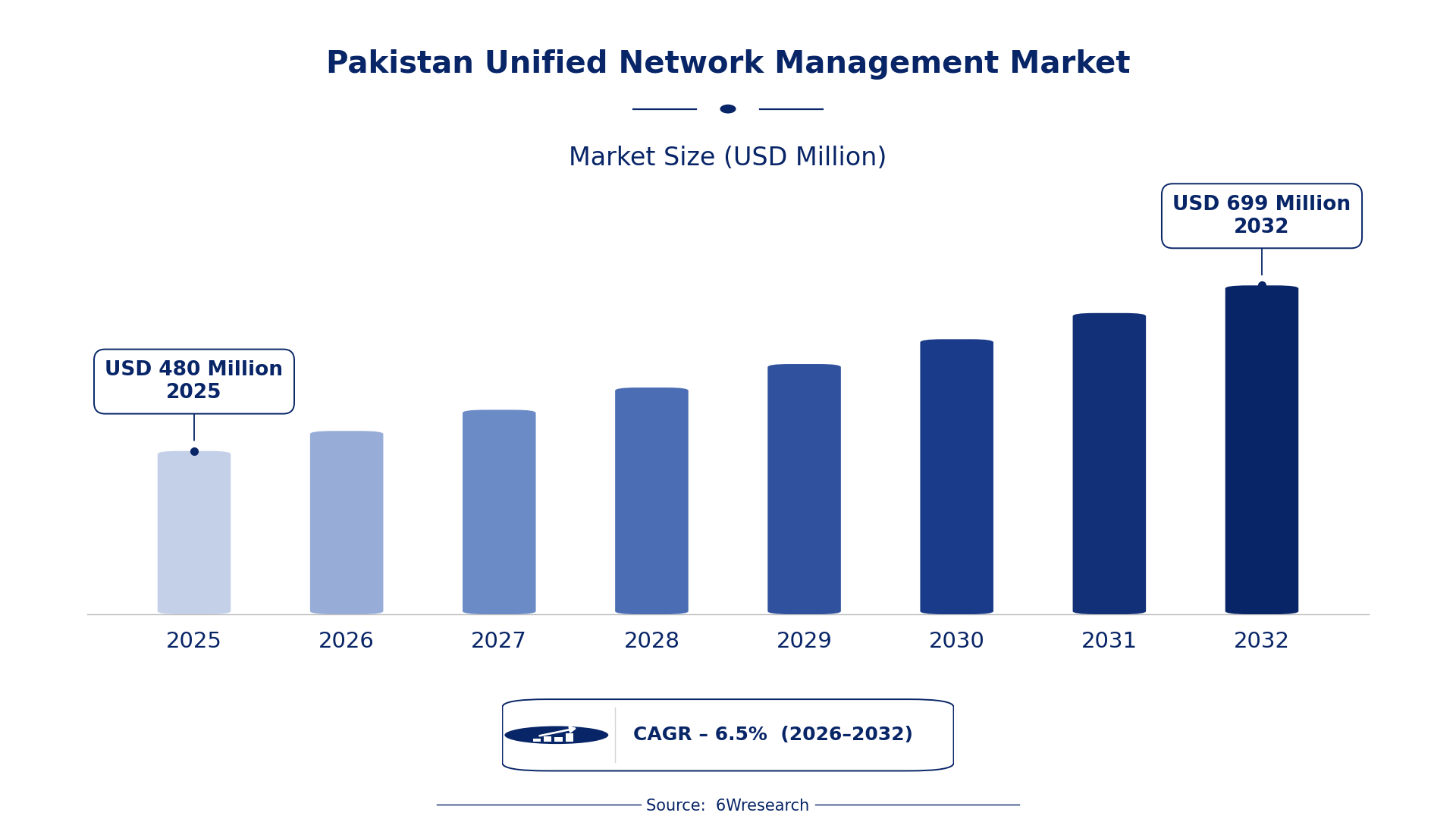
The Pakistan Unified Network Management Market was estimated at USD 480 Million in 2025 and is projected to reach USD 699 Million by 2032, growing at a CAGR of 6.5% from 2026 to 2032.
Pakistan Unified Network Management Market Synopsis
The Unified Network Management Market in Pakistan is currently witnessing a surge driven by the complexities of managing expansive digital infrastructures. Organizations are increasingly adopting centralized solutions that allow for efficient monitoring and optimization of network performance, significantly improving operational reliability.
As the number of connected devices grows alongside rapid digitalization, the demand for sophisticated network management tools is becoming critical. With a focus on enhancing security and operational efficiency, businesses are prioritizing investments in unified network management solutions to streamline their network operations.
Pakistan Unified Network Management Market Year-wise Growth Rate and Key Drivers
This graph illustrates the annual growth rates of the Pakistan Unified Network Management Market from 2021 to 2032, highlighting a steady upward trajectory and projected expansion over the forecast period.
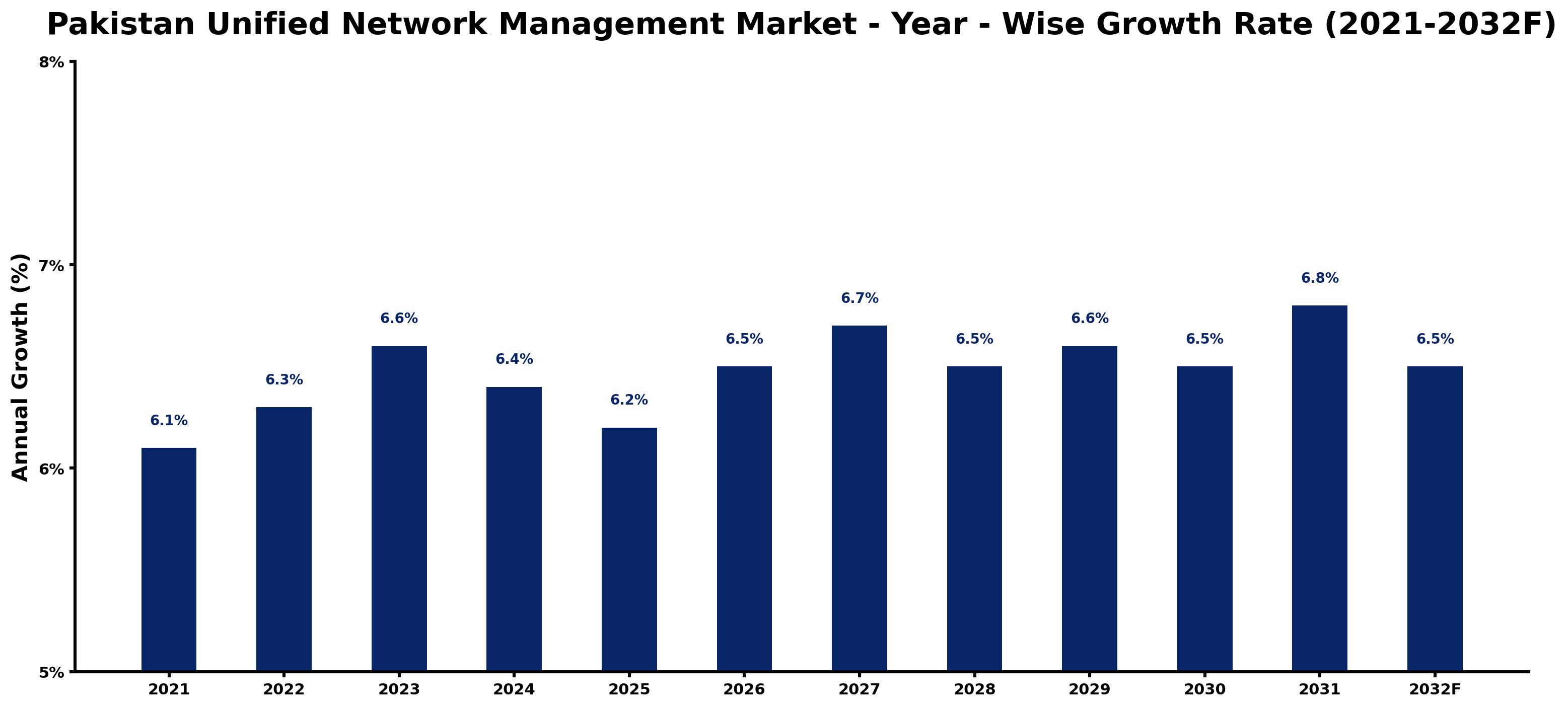
The table below presents the year‑wise growth rates along with the key drivers influencing the market
| Year | Growth Rate | Major Drivers |
| 2021 | 6.1% | Increased demand for remote work infrastructure post-COVID. |
| 2022 | 6.3% | Pakistan Telecommunication Authority launched 5G spectrum auction. |
| 2023 | 6.6% | Rising cybersecurity regulations boost unified management services. |
| 2024 | 6.4% | Government's Digital Pakistan framework enhances tech investment. |
| 2025 | 6.2% | Growing e-commerce sector drives network management solutions. |
| 2026 | 6.5% | Increased mobile internet penetration fuels service demand. |
| 2027 | 6.7% | Telecom operators upgrade networks for improved service delivery. |
| 2028 | 6.5% | Adoption of IoT in industries accelerates network integration. |
| 2029 | 6.6% | Emergence of smart city projects necessitates unified management. |
| 2030 | 6.5% | Increased cloud adoption propels network management advancements. |
| 2031 | 6.8% | Government initiatives bolster cybersecurity framework and compliance. |
| 2032 | 6.5% | Rise in digital payment platforms necessitates secure networks. |
Note: Market size estimations and growth projections presented in this report are based on 6Wresearch's proprietary forecasting methodology, utilizing the latest available industry data, government publications, and primary research inputs.
Pakistan Unified Network Management Market Key Takeaways
Below are some of the specific key takeaways from the market, including:
- The market is increasingly driven by the proliferation of IoT devices and cloud services.
- Organizations are prioritizing centralized management to enhance network security and performance.
- High costs and a lack of local expertise remain obstacles to wider adoption.
- Government policies are evolving to support digital infrastructure improvements.
- Growing awareness of unified network management benefits is paving the way for market expansion.
Evaluation of Restraints in Pakistan Unified Network Management Market
Despite the upward trajectory of the Pakistan Unified Network Management Market, several hurdles impede its growth. One primary challenge is the high cost associated with advanced network management solutions, which can deter smaller organizations from investing in these necessary tools. on top of that, the lack of local expertise in managing and implementing these systems leads to dependency on imports, further inflating costs and introducing supply chain vulnerabilities.
Additionally, many businesses remain unaware of the substantial benefits that unified network management can offer. This limited understanding hampers market growth, as organizations may overlook the potential for enhanced network performance and security.
Pakistan Unified Network Management Market Trends
Several trends are currently shaping the Pakistan Unified Network Management Market. The increasing adoption of cloud services and SD-WAN technology is prompting organizations to seek integrated management solutions that simplify network administration. on top of that, the rise in IoT connectivity is creating a pressing need for efficient monitoring and management tools to handle the growing volume of devices.
There's also a noticeable shift towards automation in network management. Organizations are investing in solutions that offer automated monitoring and configuration, enabling faster response times and reducing operational overhead. This trend is expected to gain momentum as businesses strive for greater efficiency and agility.
Pakistan Unified Network Management Market Opportunities
The Unified Network Management Market in Pakistan is ripe with opportunities for growth and investment. Organizations looking to modernize their network infrastructures are increasingly open to adopting advanced management solutions. This is particularly true for industries such as telecommunications and finance, which are under pressure to improve network reliability and security.
on top of that, as government initiatives continue to support digital transformation, companies that provide tailored network management solutions stand to benefit significantly. Emerging technologies like artificial intelligence and machine learning are also opening new avenues for innovative network management capabilities, offering businesses a chance to enhance their operational efficiency.
Government Initiatives in the Pakistan Unified Network Management Market
Government policies are crucial in shaping the Pakistan Unified Network Management Market, focusing on enhancing telecommunications infrastructure and digital connectivity. Regulatory frameworks are being established to standardize network management practices and promote the adoption of modern technologies. These initiatives aim to improve overall network reliability and support the growth of Pakistan's digital economy.
- A national digital infrastructure upgrade programme was launched in early 2023 to enhance broadband access across urban and rural areas.
- Currently, there is an ongoing initiative focused on skill development in telecom engineering to address the shortage of local expertise in network management.
- In 2024, a regulatory framework is expected to be introduced, mandating improved network management standards for telecommunications providers.
- Future plans include a public-private partnership aimed at expanding telecom infrastructure access by 2026, targeting underserved regions.
Future Insights of the Pakistan Unified Network Management Market
Looking ahead to 2026-2032, the Pakistan Unified Network Management Market is expected to undergo significant transformation. As organizations continue to adopt digital technologies, the demand for integrated network management solutions will escalate. With a clear focus on enhancing security, efficiency, and operational reliability, companies will increasingly prioritize investments in this area.
The market's growth will be supported by government initiatives aimed at promoting digital infrastructure and increasing public awareness of unified network management's benefits. This alignment of public policy and market needs positions the sector for sustained growth and innovation in the coming years.
Pakistan Unified Network Management Market Latest Developments
Recent activity in the Pakistan Unified Network Management Market indicates a strong trend toward modernization and enhanced capabilities. Over the past year, organizations have been actively seeking solutions that provide comprehensive monitoring and management of their network infrastructures. This shift reflects the urgency of addressing the complexities associated with an increasing number of connected devices.
- A major technology vendor announced the rollout of an advanced network monitoring solution in Q1 2023, aimed at optimizing performance across diverse network environments.
- A leading regional operator is currently integrating automated configuration tools into its existing network management system, enhancing operational efficiency as of mid-2023.
- In early 2023, a collaborative initiative was launched by several telecom companies to standardize network management practices across the industry.
- Plans are underway for a new cloud-based network management service expected to launch by late 2024, catering specifically to the burgeoning IoT market.
Pakistan Unified Network Management Market - Key Attractiveness of the Report
- 10 Years of Market Numbers
- Historical Data Starting from 2022 to 2025
- Base Year: 2025
- Forecast Data until 2032
- Key Performance Indicators Impacting the Market
- Major Upcoming Developments and Projects
Key Highlights of the Report:
- Pakistan Unified Network Management Market Outlook
- Market Size of Pakistan Unified Network Management Market, 2025
- Forecast of Pakistan Unified Network Management Market, 2032
- Historical Data and Forecast of Pakistan Unified Network Management Revenues & Volume for the Period 2022-2032F
- Pakistan Unified Network Management Market Trend Evolution
- Pakistan Unified Network Management Market Drivers and Challenges
- Pakistan Unified Network Management Price Trends
- Pakistan Unified Network Management Porter's Five Forces
- Pakistan Unified Network Management Industry Life Cycle
- Historical Data and Forecast of Pakistan Unified Network Management Market Revenues & Volume By Networking Type for the Period 2022-2032F
- Historical Data and Forecast of Pakistan Unified Network Management Market Revenues & Volume By Wireline Network Management for the Period 2022-2032F
- Historical Data and Forecast of Pakistan Unified Network Management Market Revenues & Volume By Wireless Network Management for the Period 2022-2032F
- Historical Data and Forecast of Pakistan Unified Network Management Market Revenues & Volume By Solution for the Period 2022-2032F
- Historical Data and Forecast of Pakistan Unified Network Management Market Revenues & Volume By Network Traffic Management for the Period 2022-2032F
- Historical Data and Forecast of Pakistan Unified Network Management Market Revenues & Volume By Network Monitoring Management for the Period 2022-2032F
- Historical Data and Forecast of Pakistan Unified Network Management Market Revenues & Volume By Network Security Management for the Period 2022-2032F
- Historical Data and Forecast of Pakistan Unified Network Management Market Revenues & Volume By Network Application Management for the Period 2022-2032F
- Historical Data and Forecast of Pakistan Unified Network Management Market Revenues & Volume By Configuration and Server Management for the Period 2022-2032F
- Historical Data and Forecast of Pakistan Unified Network Management Market Revenues & Volume By Others (IP Address Management and Network Device Management) for the Period 2022-2032F
- Historical Data and Forecast of Pakistan Unified Network Management Market Revenues & Volume By Service for the Period 2022-2032F
- Historical Data and Forecast of Pakistan Unified Network Management Market Revenues & Volume By Training and Support for the Period 2022-2032F
- Historical Data and Forecast of Pakistan Unified Network Management Market Revenues & Volume By Consulting for the Period 2022-2032F
- Historical Data and Forecast of Pakistan Unified Network Management Market Revenues & Volume By Managed and Integration service for the Period 2022-2032F
- Historical Data and Forecast of Pakistan Unified Network Management Market Revenues & Volume By Deployment Type for the Period 2022-2032F
- Historical Data and Forecast of Pakistan Unified Network Management Market Revenues & Volume By On-Cloud for the Period 2022-2032F
- Historical Data and Forecast of Pakistan Unified Network Management Market Revenues & Volume By On-Premises for the Period 2022-2032F
- Historical Data and Forecast of Pakistan Unified Network Management Market Revenues & Volume By User Type for the Period 2022-2032F
- Historical Data and Forecast of Pakistan Unified Network Management Market Revenues & Volume By Large Enterprises for the Period 2022-2032F
- Historical Data and Forecast of Pakistan Unified Network Management Market Revenues & Volume By Small and Medium Enterprises for the Period 2022-2032F
- Historical Data and Forecast of Pakistan Unified Network Management Market Revenues & Volume By Industry Vertical for the Period 2022-2032F
- Historical Data and Forecast of Pakistan Unified Network Management Market Revenues & Volume By BFSI for the Period 2022-2032F
- Historical Data and Forecast of Pakistan Unified Network Management Market Revenues & Volume By High-Tech and Telecom for the Period 2022-2032F
- Historical Data and Forecast of Pakistan Unified Network Management Market Revenues & Volume By Retail and Consumer Goods for the Period 2022-2032F
- Historical Data and Forecast of Pakistan Unified Network Management Market Revenues & Volume By Travel and Hospitality for the Period 2022-2032F
- Historical Data and Forecast of Pakistan Unified Network Management Market Revenues & Volume By Government for the Period 2022-2032F
- Historical Data and Forecast of Pakistan Unified Network Management Market Revenues & Volume By Media and Entertainment for the Period 2022-2032F
- Historical Data and Forecast of Pakistan Unified Network Management Market Revenues & Volume By Healthcare for the Period 2022-2032F
- Historical Data and Forecast of Pakistan Unified Network Management Market Revenues & Volume By Education for the Period 2022-2032F
- Pakistan Unified Network Management Import Export Trade Statistics
- Market Opportunity Assessment By Networking Type
- Market Opportunity Assessment By Solution
- Market Opportunity Assessment By Service
- Market Opportunity Assessment By Deployment Type
- Market Opportunity Assessment By User Type
- Market Opportunity Assessment By Industry Vertical
- Pakistan Unified Network Management Top Companies Market Share
- Pakistan Unified Network Management Competitive Benchmarking By Technical and Operational Parameters
- Pakistan Unified Network Management Company Profiles
- Pakistan Unified Network Management Key Strategic Recommendations






































