Pakistan Urinalysis Market Size, Share & Growth Rate
The Pakistan Urinalysis Market was estimated at USD 791 Million in 2025 and is projected to reach USD 1127 Million by 2032, growing at a CAGR of 5.2% from 2026 to 2032. This growth trajectory is being fueled by the increasing prevalence of urinary tract infections and chronic kidney diseases, underscoring the rising demand for early detection and preventive healthcare solutions. Additionally, government initiatives aimed at enhancing healthcare infrastructure and the growing adoption of advanced urinalysis technologies further contribute to the market's positive outlook.
Pakistan Urinalysis Market Growth Rate Analysis (2021-2032)
The Pakistan Urinalysis Market has experienced a stable yet dynamic growth pattern, with an annual increase of 6.3% in 2021 followed by 5.9% in 2022. A renewed surge to 6.4% in 2023 can be attributed to heightened consumer awareness regarding preventive healthcare and the growing investments in medical infrastructure. The market is projected to maintain similar growth rates through 2027, hovering around 6.0-6.3%, indicating a strong consumer demand bolstered by advancements in urinalysis technology and increased government support for healthcare initiatives. Fluctuations, such as the slight dip to 5.9% in 2028 and 2029, may reflect a temporary market saturation, but the overall trend remains positive as digitalization and modernization reshape diagnostic practices across the nation.
Pakistan Urinalysis Market Year-wise Growth Rate and Key Drivers
This graph highlights how the Pakistan Urinalysis Market has steadily grown over the past five years, supported by major growth factors.
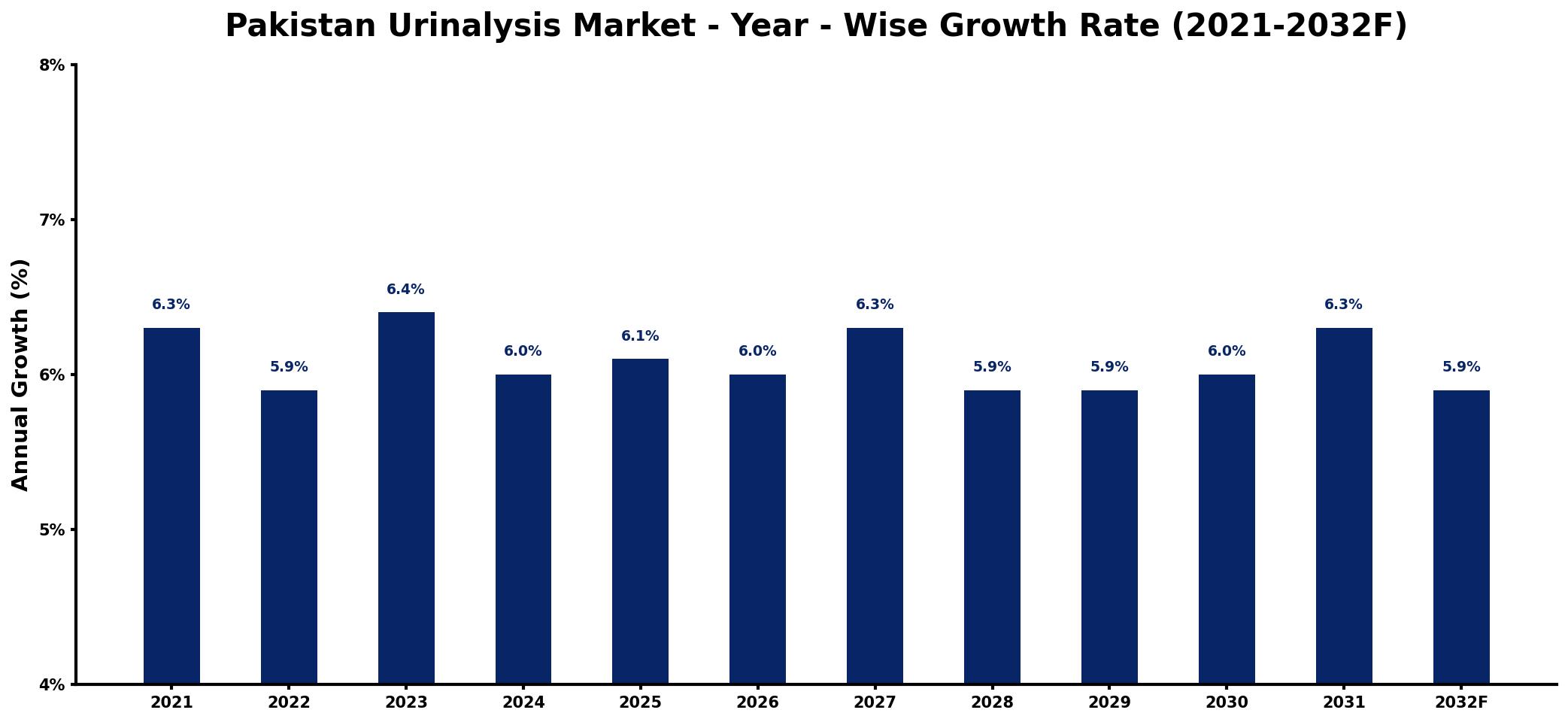
The table below presents the year‑wise growth rates along with the key drivers influencing the market
| Year | Growth Rate | Major Drivers |
| 2021 | 6.3% | Rising healthcare awareness among population |
| 2022 | 5.9% | Increased investments in diagnostics sector |
| 2023 | 6.4% | Growing prevalence of kidney diseases |
| 2024 | 6.0% | Expansion of healthcare infrastructure projects |
| 2025 | 6.1% | Surge in preventive healthcare initiatives |
| 2026 | 6.0% | Technological advancements in testing methods |
| 2027 | 6.3% | expanding industrial usage applications |
| 2028 | 5.9% | growing emerging market penetration |
| 2029 | 5.9% | Increased collaboration with research institutions |
| 2030 | 6.0% | rising demand from electronics |
| 2031 | 6.3% | Growing adoption of telehealth services |
| 2032 | 5.9% | Emerging markets for diagnostic solutions |
Note: Market size estimations and growth projections presented in this report are based on 6Wresearch's proprietary forecasting methodology, utilizing the latest available industry data, government publications, and primary research inputs.
Pakistan Urinalysis Market Synopsis
The Pakistan Urinalysis Market has recently gained momentum as healthcare awareness improves among the population. As more people recognize the significance of routine health screenings, particularly for urinary issues, the market is transitioning toward more innovative and efficient testing solutions. This shift aligns with the increasing need for early detection methods for various medical conditions.
Looking ahead, the landscape of the Pakistan Urinalysis Market promises further advancements driven by technological innovation. With a strong push towards point-of-care testing and a focus on enhancing patient convenience, the market is well-positioned to meet the evolving healthcare demands of the population. However, addressing challenges such as accessibility in rural regions will be critical for sustained growth.
Pakistan Urinalysis Market Key Takeaways
- Growing awareness of preventive healthcare is driving demand for urinalysis tests.
- The market is adapting to new technologies such as point-of-care testing and AI integration.
- Government initiatives are focused on improving healthcare infrastructure and access to services.
- Investment opportunities exist in developing user-friendly and affordable urinalysis solutions.
- Challenges related to rural access and counterfeit products persist, impacting market reliability.
Evaluation of Restraints in Pakistan Urinalysis Market
Despite the market's promising growth prospects, several constraints must be addressed to realize its full potential. Limited awareness about the importance of regular urinalysis testing among healthcare professionals and the general population is a significant barrier. Additionally, access to advanced testing technologies remains uneven, especially in rural areas where healthcare infrastructure is lacking. This disparity results in inconsistent testing quality, which can undermine diagnostic accuracy and patient trust. Furthermore, the presence of counterfeit products complicates the landscape, necessitating regulatory measures and public education to ensure reliability and safety in urinalysis services.
Pakistan Urinalysis Market Trends
Several trends are shaping the Pakistan Urinalysis Market, notably the rise of point-of-care testing devices. These innovations allow for quicker, more efficient results that improve patient care and satisfaction. Additionally, a pronounced focus on preventive healthcare is leading to a spike in routine urinalysis tests, empowering early detection of critical conditions. The integration of digital tools and automation, including artificial intelligence and machine learning, is enhancing analytical accuracy, offering the potential for more streamlined and effective testing processes.
Pakistan Urinalysis Market Opportunities
The increasing prevalence of chronic diseases in Pakistan presents ample investment opportunities within the Urinalysis Market. Investors can capitalize on the demand for innovative testing technologies, particularly those that cater to point-of-care needs. Expanding distribution networks and forming strategic partnerships with healthcare providers can facilitate market penetration. Moreover, there is a significant opportunity to introduce affordable, localized solutions that meet the unique requirements of the Pakistani population, thereby driving broader adoption of urinalysis testing across various demographics.
Government Initiatives in the Pakistan Urinalysis Market
The government of Pakistan has undertaken several initiatives aimed at bolstering the urinalysis market. The Drug Regulatory Authority of Pakistan (DRAP) plays a critical role in overseeing the registration and manufacturing of urinalysis products, ensuring they meet safety and quality standards. Recent policies also promote domestic production of urinalysis equipment, encouraging local manufacturing to improve accessibility. Furthermore, efforts to enhance market surveillance and regulate imports aim to curb the infiltration of counterfeit products, thereby ensuring patient safety and maintaining public health.
Future Insights of the Pakistan Urinalysis Market
The Pakistan Urinalysis Market is poised for a promising future, primarily driven by a rising awareness of preventive healthcare and the ongoing increase in chronic health issues. Between 2026 and 2032, significant advancements in technology will continue to shape market growth, particularly through the proliferation of point-of-care testing solutions. While challenges related to affordability and access in underserved regions must be addressed, the overall trend towards embracing efficient, convenient testing solutions signifies a robust market expansion ahead.
Pakistan Urinalysis Market Latest Developments (2025 - 2026)
Recent developments in the Pakistan Urinalysis Market indicate a strong movement toward enhanced healthcare delivery. Innovations in point-of-care testing devices have been rolled out, focusing on user-friendly interfaces and rapid results. Moreover, there is an ongoing shift towards digital health solutions, with more healthcare providers adopting automated processes for urinalysis. This transition is aimed at improving diagnostic accuracy and patient outcomes, signaling a significant evolution in the market's operational landscape.
Pakistan Urinalysis Market - Key Attractiveness of the Report
- 10 Years of Market Numbers
- Historical Data Starting from 2022 to 2025
- Base Year: 2025
- Forecast Data until 2032
- Key Performance Indicators Impacting the Market
- Major Upcoming Developments and Projects
Key Highlights of the Report:
- Pakistan Urinalysis Market Outlook
- Market Size of Pakistan Urinalysis Market, 2025
- Forecast of Pakistan Urinalysis Market, 2032
- Historical Data and Forecast of Pakistan Urinalysis Revenues & Volume for the Period 2022-2032F
- Pakistan Urinalysis Market Trend Evolution
- Pakistan Urinalysis Market Drivers and Challenges
- Pakistan Urinalysis Price Trends
- Pakistan Urinalysis Porter's Five Forces
- Pakistan Urinalysis Industry Life Cycle
- Historical Data and Forecast of Pakistan Urinalysis Market Revenues & Volume By Product Type for the Period 2022-2032F
- Historical Data and Forecast of Pakistan Urinalysis Market Revenues & Volume By Instruments for the Period 2022-2032F
- Historical Data and Forecast of Pakistan Urinalysis Market Revenues & Volume By Consumables for the Period 2022-2032F
- Historical Data and Forecast of Pakistan Urinalysis Market Revenues & Volume By Application for the Period 2022-2032F
- Historical Data and Forecast of Pakistan Urinalysis Market Revenues & Volume By Urinary Tract Infection for the Period 2022-2032F
- Historical Data and Forecast of Pakistan Urinalysis Market Revenues & Volume By Diabetes for the Period 2022-2032F
- Historical Data and Forecast of Pakistan Urinalysis Market Revenues & Volume By Kidney Diseases for the Period 2022-2032F
- Historical Data and Forecast of Pakistan Urinalysis Market Revenues & Volume By Hypertension for the Period 2022-2032F
- Historical Data and Forecast of Pakistan Urinalysis Market Revenues & Volume By Liver Diseases for the Period 2022-2032F
- Historical Data and Forecast of Pakistan Urinalysis Market Revenues & Volume By End-User for the Period 2022-2032F
- Historical Data and Forecast of Pakistan Urinalysis Market Revenues & Volume By Hospitals for the Period 2022-2032F
- Historical Data and Forecast of Pakistan Urinalysis Market Revenues & Volume By Clinical Laboratories for the Period 2022-2032F
- Historical Data and Forecast of Pakistan Urinalysis Market Revenues & Volume By Home Healthcare for the Period 2022-2032F
- Historical Data and Forecast of Pakistan Urinalysis Market Revenues & Volume By Research for the Period 2022-2032F
- Historical Data and Forecast of Pakistan Urinalysis Market Revenues & Volume By Academics for the Period 2022-2032F
- Pakistan Urinalysis Import Export Trade Statistics
- Market Opportunity Assessment By Product Type
- Market Opportunity Assessment By Application
- Market Opportunity Assessment By End-User
- Pakistan Urinalysis Top Companies Market Share
- Pakistan Urinalysis Competitive Benchmarking By Technical and Operational Parameters
- Pakistan Urinalysis Company Profiles
- Pakistan Urinalysis Key Strategic Recommendations






































