Pakistan Video Conferencing Market Size & Growth Rate (2026-2032)
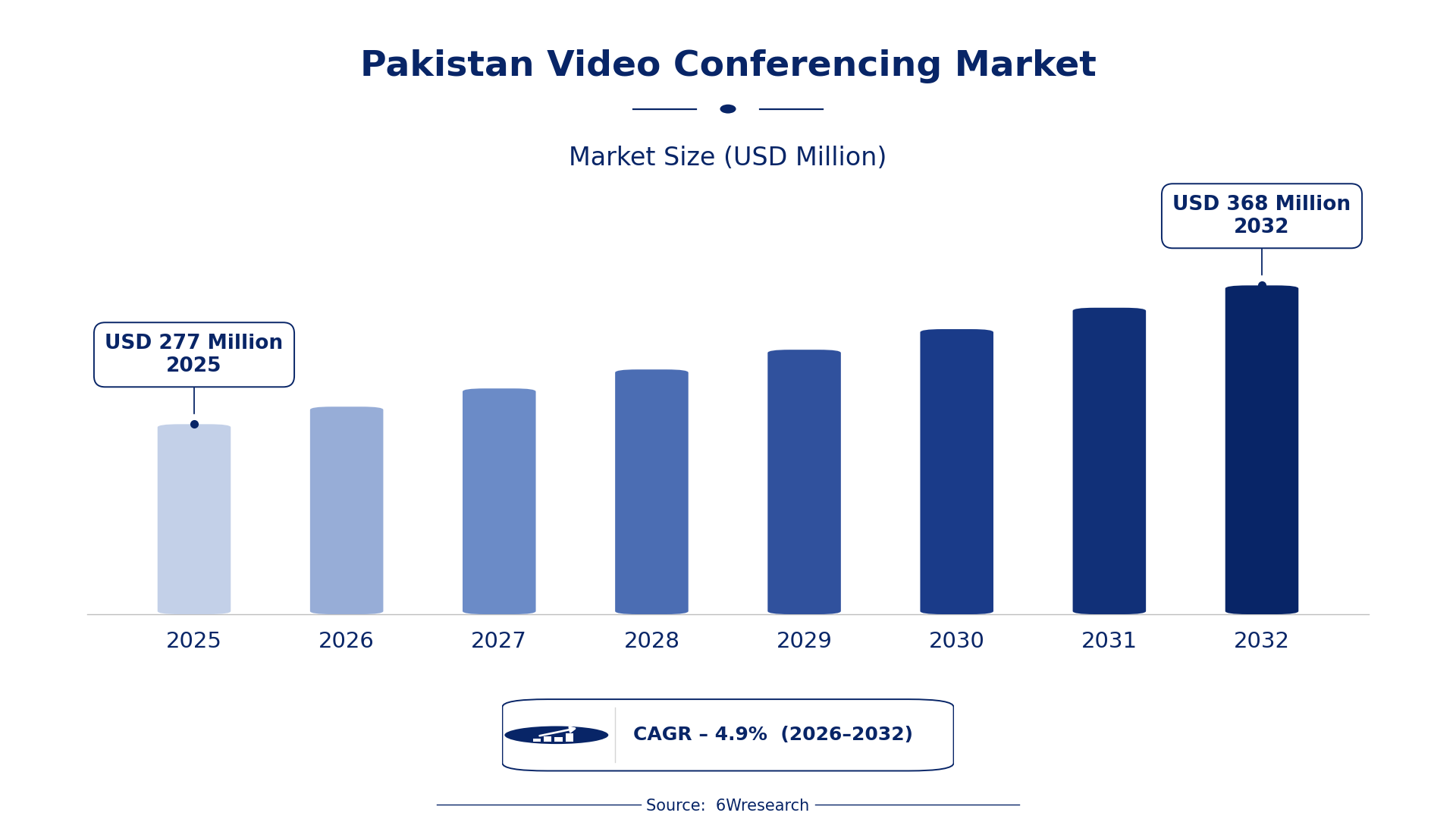
The Pakistan Video Conferencing Market was estimated at USD 277 Million in 2025 and is projected to reach USD 368 Million by 2032, growing at a CAGR of 4.9% from 2026 to 2032.
Pakistan Video Conferencing Market Synopsis
The adoption of video conferencing in Pakistan is increasingly becoming a necessity for businesses aiming to streamline communication in remote settings. As organizations across various sectors recognize the importance of staying connected, the demand for effective virtual collaboration tools has surged.
This market is not just about technology; it reflects a shift in the way organizations operate. Companies are increasingly prioritizing video conferencing as a cost-effective solution that enhances productivity while reducing travel expenses, a trend that has only intensified post-pandemic.
Pakistan Video Conferencing Market Year-wise Growth Rate and Key Drivers
This graph illustrates the annual growth rates of the Pakistan Video Conferencing Market from 2021 to 2032, highlighting a steady upward trajectory and projected expansion over the forecast period.
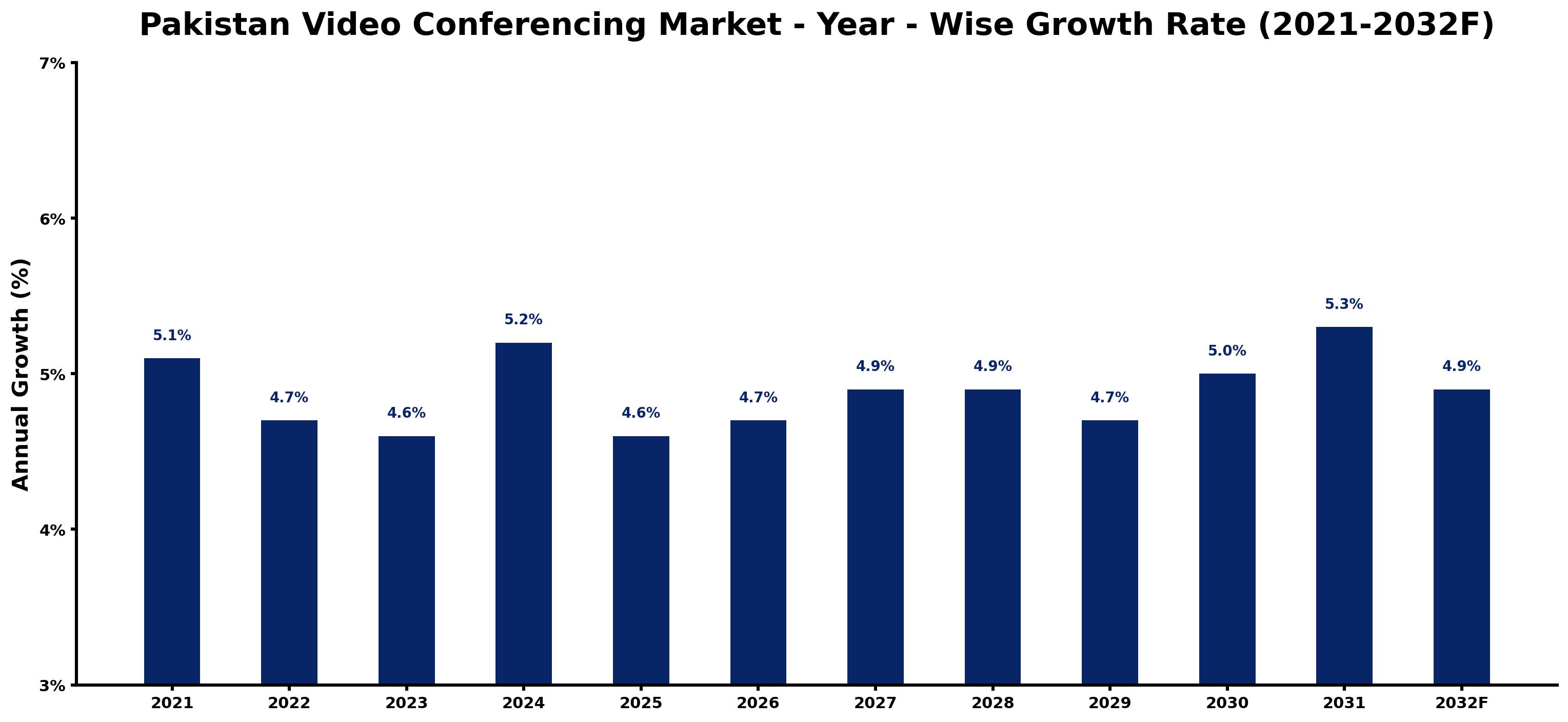
The table below presents the year‑wise growth rates along with the key drivers influencing the market
| Year | Growth Rate | Major Drivers |
| 2021 | 5.1% | Higher internet penetration boosts remote collaboration solutions. |
| 2022 | 4.7% | Government digitalization initiatives increase video adoption in enterprises. |
| 2023 | 4.6% | Growing tech-savvy youth population drives video conferencing usage. |
| 2024 | 5.2% | Local startups promoting virtual meetings for SMEs increase demand. |
| 2025 | 4.6% | Increased cross-border trade boosts need for virtual consultations. |
| 2026 | 4.7% | Corporate training programs leverage video tools for efficiency. |
| 2027 | 4.9% | Educational institutions adopt online platforms for interactive learning. |
| 2028 | 4.9% | Government initiatives support telehealth services via video technologies. |
| 2029 | 4.7% | Rising freelance workforce increases demand for online collaboration. |
| 2030 | 5.0% | Businesses adopting hybrid models drive video conferencing growth. |
| 2031 | 5.3% | Telecom infrastructure upgrades enhance video call quality. |
| 2032 | 4.9% | Increased cybersecurity regulations bolster trust in video platforms. |
Note: Market size estimations and growth projections presented in this report are based on 6Wresearch's proprietary forecasting methodology, utilizing the latest available industry data, government publications, and primary research inputs.
Pakistan Video Conferencing Market Key Takeaways
Below are some of the specific key takeaways from the market, including:
- The market is experiencing strong growth driven by remote work adoption and technological advancements.
- Cloud-based solutions are becoming a standard due to their flexibility and scalability.
- High costs and limited local expertise are significant barriers to wider adoption.
- Government initiatives are shaping the regulatory environment and promoting digital infrastructure development.
- The COVID-19 pandemic has fundamentally changed perceptions of remote communication tools.
Evaluation of Restraints in Pakistan Video Conferencing Market
Despite the promising growth, several factors are holding the market back. High costs associated with advanced video conferencing solutions limit accessibility for many businesses, particularly small and medium enterprises. The reliance on imports for critical components creates additional financial pressure and vulnerability in the supply chain. on top of that, a lack of awareness regarding the benefits of video conferencing hampers broader market penetration. Organizations must overcome these hurdles to fully capitalize on the potential of virtual communication.
Pakistan Video Conferencing Market Trends
Current trends indicate a shift towards integrated communication platforms that combine video conferencing with other collaborative tools. Organizations are increasingly interested in AI-enhanced features that provide intelligent meeting insights and improved user experience. The emphasis on mobile compatibility is growing as users seek flexibility in how they connect. Additionally, the focus on security and data privacy is becoming paramount as businesses navigate remote work challenges.
Pakistan Video Conferencing Market Opportunities
There are significant growth opportunities in the Pakistan Video Conferencing Market, particularly in sectors like education, healthcare, and corporate training. The increasing trend of digital transformation presents a chance for providers to offer tailored solutions that address specific industry needs. Investments in local manufacturing capabilities could also reduce costs and enhance supply chain resilience. on top of that, as government policies evolve to support digital infrastructure, businesses can expect more favorable conditions for growth.
Government Initiatives in the Pakistan Video Conferencing Market
Government policies are crucial in shaping the future of the Pakistan Video Conferencing Market. The focus on enhancing telecommunications regulation and developing digital infrastructure is evident. These initiatives not only facilitate the adoption of video conferencing solutions but also support the broader objectives of improving business efficiency and economic connectivity.
- A national digital infrastructure upgrade programme now in its rollout phase aims to enhance broadband connectivity across urban and rural areas.
- A regulatory framework introduced in 2025 mandating data privacy compliance for video conferencing services is currently in the implementation stage.
- An ongoing initiative focuses on providing training and resources to local businesses to improve digital communication skills.
- A planned public-private initiative is expected to expand telecom infrastructure access by 2028, enhancing video conferencing capabilities nationwide.
Future Insights of the Pakistan Video Conferencing Market
Looking ahead to 2026-2032, the Pakistan Video Conferencing Market is expected to evolve significantly. As organizations increasingly integrate remote work into their operational strategies, the demand for advanced video conferencing solutions will likely rise. Innovations in AI, data analytics, and cloud technology will play a key role in shaping user experiences. The interplay between government support and market demand will drive growth, positioning video conferencing as an essential tool in the business communication arsenal.
Pakistan Video Conferencing Market Latest Developments
Recent industry activity in the Pakistan Video Conferencing Market reflects a growing recognition of the importance of effective virtual communication tools. Over the past year, several initiatives have been launched to improve accessibility and enhance user experience across various sectors.
- A major technology vendor launched a new cloud-based video conferencing platform in early 2025, featuring enhanced security and user-friendly interfaces.
- An initiative that began in mid-2025 aims to provide subsidized video conferencing solutions for educational institutions and non-profits.
- A collaboration between tech firms and telecom providers is currently underway, focusing on improving bandwidth for video conferencing applications.
- A rollout expected to begin in the second half of 2026 will introduce a government-supported training program for businesses to optimize their video conferencing capabilities.
Pakistan Video Conferencing Market - Key Attractiveness of the Report
- 10 Years of Market Numbers
- Historical Data Starting from 2022 to 2025
- Base Year: 2025
- Forecast Data until 2032
- Key Performance Indicators Impacting the Market
- Major Upcoming Developments and Projects
Key Highlights of the Report:
- Pakistan Video Conferencing Market Outlook
- Market Size of Pakistan Video Conferencing Market, 2022
- Forecast of Pakistan Video Conferencing Market, 2032
- Historical Data and Forecast of Pakistan Video Conferencing Revenues & Volume for the Period 2022-2032F
- Pakistan Video Conferencing Market Trend Evolution
- Pakistan Video Conferencing Market Drivers and Challenges
- Pakistan Video Conferencing Price Trends
- Pakistan Video Conferencing Porter's Five Forces
- Pakistan Video Conferencing Industry Life Cycle
- Historical Data and Forecast of Pakistan Video Conferencing Market Revenues & Volume By Component for the Period 2022-2032F
- Historical Data and Forecast of Pakistan Video Conferencing Market Revenues & Volume By Hardware for the Period 2022-2032F
- Historical Data and Forecast of Pakistan Video Conferencing Market Revenues & Volume By Solutions for the Period 2022-2032F
- Historical Data and Forecast of Pakistan Video Conferencing Market Revenues & Volume By Services for the Period 2022-2032F
- Historical Data and Forecast of Pakistan Video Conferencing Market Revenues & Volume By Application for the Period 2022-2032F
- Historical Data and Forecast of Pakistan Video Conferencing Market Revenues & Volume By Corporate Communications for the Period 2022-2032F
- Historical Data and Forecast of Pakistan Video Conferencing Market Revenues & Volume By Training for the Period 2022-2032F
- Historical Data and Forecast of Pakistan Video Conferencing Market Revenues & Volume By Development for the Period 2022-2032F
- Historical Data and Forecast of Pakistan Video Conferencing Market Revenues & Volume By Marketing & Client Engagement for the Period 2022-2032F
- Historical Data and Forecast of Pakistan Video Conferencing Market Revenues & Volume By Deployment Mode for the Period 2022-2032F
- Historical Data and Forecast of Pakistan Video Conferencing Market Revenues & Volume By On-premises for the Period 2022-2032F
- Historical Data and Forecast of Pakistan Video Conferencing Market Revenues & Volume By Cloud for the Period 2022-2032F
- Historical Data and Forecast of Pakistan Video Conferencing Market Revenues & Volume By Vertical for the Period 2022-2032F
- Historical Data and Forecast of Pakistan Video Conferencing Market Revenues & Volume By BFSI for the Period 2022-2032F
- Historical Data and Forecast of Pakistan Video Conferencing Market Revenues & Volume By IT and Telecom for the Period 2022-2032F
- Historical Data and Forecast of Pakistan Video Conferencing Market Revenues & Volume By Healthcare & Lifescience for the Period 2022-2032F
- Historical Data and Forecast of Pakistan Video Conferencing Market Revenues & Volume By Education for the Period 2022-2032F
- Historical Data and Forecast of Pakistan Video Conferencing Market Revenues & Volume By Media and Entertainment for the Period 2022-2032F
- Historical Data and Forecast of Pakistan Video Conferencing Market Revenues & Volume By Other Verticals for the Period 2022-2032F
- Pakistan Video Conferencing Import Export Trade Statistics
- Market Opportunity Assessment By Component
- Market Opportunity Assessment By Application
- Market Opportunity Assessment By Deployment Mode
- Market Opportunity Assessment By Vertical
- Pakistan Video Conferencing Top Companies Market Share
- Pakistan Video Conferencing Competitive Benchmarking By Technical and Operational Parameters
- Pakistan Video Conferencing Company Profiles
- Pakistan Video Conferencing Key Strategic Recommendations






































