Pakistan Warehousing and Storage Market Size, Share & Growth Rate
The Pakistan Warehousing and Storage Market was estimated at USD 179 Million in 2025 and is projected to reach USD 198 Million by 2032, growing at a CAGR of 1.5% from 2026 to 2032. This modest growth trajectory is driven by an increasing demand for effective storage solutions amidst the booming e-commerce landscape and the rising complexities of supply chains. As retail and manufacturing sectors expand, the need for organized warehousing facilities becomes critical, further propelling market dynamics.
Pakistan Warehousing and Storage Market Year-wise Growth Rate and Key Drivers
This graph highlights how the Pakistan Warehousing and Storage Market has steadily grown over the years, supported by major growth factors.
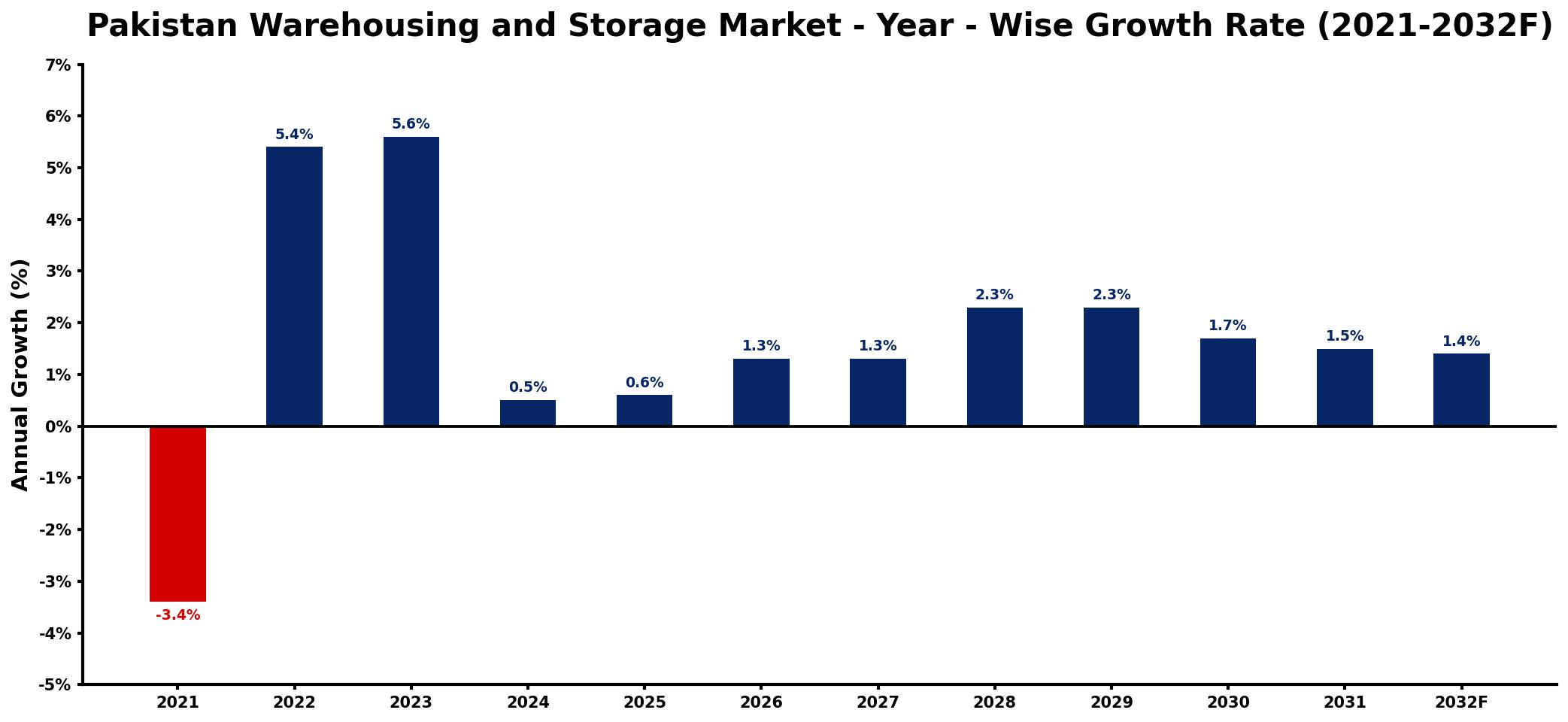
The table below presents the year‑wise growth rates along with the key drivers influencing the market
| Year | Growth Rate | Major Drivers |
| 2021 | -3.4% | Supply chain disruptions impact operations |
| 2022 | 5.4% | E-commerce sector experiences rapid growth |
| 2023 | 5.6% | Increased investments in logistics infrastructure |
| 2024 | 0.5% | increased production capacity utilization |
| 2025 | 0.6% | Expansion of retail distribution networks |
| 2026 | 1.3% | Emergence of urban logistics hubs |
| 2027 | 1.3% | Technological advancements enhance efficiency |
| 2028 | 2.3% | Growing trend towards automation adoption |
| 2029 | 2.3% | Increased focus on sustainability initiatives |
| 2030 | 1.7% | Demand for last-mile delivery services |
| 2031 | 1.5% | Growth in cross-border trade activities |
| 2032 | 1.4% | Rising consumer preferences for convenience |
Note: Market size estimations and growth projections presented in this report are based on 6Wresearch's proprietary forecasting methodology, utilizing the latest available industry data, government publications, and primary research inputs.
Pakistan Warehousing and Storage Market Synopsis
In recent years, the Pakistan Warehousing and Storage Market has witnessed significant transformation, largely influenced by the rapid expansion of e-commerce and a growing retail sector. Businesses are increasingly recognizing the necessity for well-organized storage solutions to enhance their logistics operations and improve inventory management.
Moreover, ongoing investments in infrastructure development are playing a pivotal role in shaping the market landscape. These enhancements not only facilitate better logistics frameworks but also encourage the adoption of advanced technologies, which are essential for meeting the evolving demands of inventory handling and distribution.
Pakistan Warehousing and Storage Market Key Takeaways
- The market is projected to grow from USD 179 Million in 2025 to USD 198 Million by 2032, at a CAGR of 1.5%.
- Rising e-commerce and retail activities are the primary drivers of demand for warehousing solutions.
- Challenges include inadequate infrastructure and high real estate costs affecting modern storage availability.
- Government policies are aimed at improving logistics efficiency through infrastructure investment.
- The focus on technology adoption in inventory management is reshaping market dynamics.
Evaluation of Restraints in Pakistan Warehousing and Storage Market
Despite the optimistic growth outlook, several constraints hinder the full potential of the Pakistan Warehousing and Storage Market. A significant challenge is the country's inadequate infrastructure, which affects the functionality and efficiency of storage facilities. High real estate costs further limit the availability of modern warehousing options equipped with necessary technologies like climate control and sophisticated inventory management systems. Additionally, the fragmented logistics networks and regulatory hurdles complicate operational processes, making it challenging for businesses to optimize their warehousing strategies.
Pakistan Warehousing and Storage Market Trends
Key trends influencing the Pakistan Warehousing and Storage Market include the rising integration of technology in warehousing operations and an increasing emphasis on sustainability practices. Companies are adopting automated systems and IoT-based solutions to streamline inventory management and enhance operational efficiency. Furthermore, with the global shift towards environmentally sustainable practices, there is a growing interest in implementing green building standards in storage facilities.
Pakistan Warehousing and Storage Market Opportunities
The market presents substantial growth and investment opportunities, particularly in the development of modern warehousing facilities equipped with cutting-edge technology. As e-commerce continues to flourish, businesses that focus on creating efficient and organized storage solutions will be better positioned to capture market share. Additionally, the increasing consumer demand for quick and reliable delivery services underscores the necessity for strategic partnerships within the logistics and warehousing sectors.
Government Initiatives in the Pakistan Warehousing and Storage Market
The Pakistani government is increasingly recognizing the significance of the warehousing sector and is implementing policies aimed at bolstering logistics infrastructure. Initiatives focus on establishing standards for warehouse operations and promoting investment in technological advancements. Additionally, regulatory frameworks are being enhanced to streamline licensing requirements for storage facilities, facilitating better compliance and operational efficiency in the market.
Future Insights of the Pakistan Warehousing and Storage Market
Looking ahead to the period from 2026 to 2032, the Pakistan Warehousing and Storage Market is poised for gradual growth driven by continued urbanization and industrial expansion. As logistics networks become increasingly integrated, the demand for innovative storage solutions is expected to escalate. The adoption of smart technologies will likely redefine warehousing practices, ensuring that businesses remain competitive in a rapidly evolving landscape. Furthermore, with government support focused on enhancing infrastructure, the markets operational capabilities are set to improve significantly.
Pakistan Warehousing and Storage Market Latest Developments (2025 - 2026)
In recent months, the warehousing industry in Pakistan has seen a surge in investments aimed at modernizing storage facilities. Key players are exploring partnerships to enhance logistics capabilities, which is crucial for meeting the demands of the e-commerce sector. Additionally, advancements in technology are being integrated into existing systems to improve efficiency and operational performance. Recent government initiatives have also placed a spotlight on developing better regulatory frameworks to support this growth.
Pakistan Warehousing and Storage Market - Key Attractiveness of the Report
- 10 Years of Market Numbers
- Historical Data Starting from 2022 to 2025
- Base Year: 2025
- Forecast Data until 2032
- Key Performance Indicators Impacting the Market
- Major Upcoming Developments and Projects
Key Highlights of the Report:
- Pakistan Warehousing and Storage Market Outlook
- Market Size of Pakistan Warehousing and Storage Market, 2025
- Forecast of Pakistan Warehousing and Storage Market, 2032
- Historical Data and Forecast of Pakistan Warehousing and Storage Revenues & Volume for the Period 2022-2032F
- Pakistan Warehousing and Storage Market Trend Evolution
- Pakistan Warehousing and Storage Market Drivers and Challenges
- Pakistan Warehousing and Storage Price Trends
- Pakistan Warehousing and Storage Porter's Five Forces
- Pakistan Warehousing and Storage Industry Life Cycle
- Historical Data and Forecast of Pakistan Warehousing and Storage Market Revenues & Volume By Type for the Period 2022-2032F
- Historical Data and Forecast of Pakistan Warehousing and Storage Market Revenues & Volume By General Warehousing and Storage for the Period 2022-2032F
- Historical Data and Forecast of Pakistan Warehousing and Storage Market Revenues & Volume By Refrigerated Warehousing and Storage for the Period 2022-2032F
- Historical Data and Forecast of Pakistan Warehousing and Storage Market Revenues & Volume By Farm Product Warehousing and Storage for the Period 2022-2032F
- Historical Data and Forecast of Pakistan Warehousing and Storage Market Revenues & Volume By Ownership for the Period 2022-2032F
- Historical Data and Forecast of Pakistan Warehousing and Storage Market Revenues & Volume By Private Warehouses for the Period 2022-2032F
- Historical Data and Forecast of Pakistan Warehousing and Storage Market Revenues & Volume By Public Warehouses for the Period 2022-2032F
- Historical Data and Forecast of Pakistan Warehousing and Storage Market Revenues & Volume By Bonded Warehouses for the Period 2022-2032F
- Historical Data and Forecast of Pakistan Warehousing and Storage Market Revenues & Volume By End-Use for the Period 2022-2032F
- Historical Data and Forecast of Pakistan Warehousing and Storage Market Revenues & Volume By Manufacturing for the Period 2022-2032F
- Historical Data and Forecast of Pakistan Warehousing and Storage Market Revenues & Volume By Consumer Goods for the Period 2022-2032F
- Historical Data and Forecast of Pakistan Warehousing and Storage Market Revenues & Volume By Retail for the Period 2022-2032F
- Historical Data and Forecast of Pakistan Warehousing and Storage Market Revenues & Volume By Food and Beverage for the Period 2022-2032F
- Historical Data and Forecast of Pakistan Warehousing and Storage Market Revenues & Volume By IT Hardware for the Period 2022-2032F
- Historical Data and Forecast of Pakistan Warehousing and Storage Market Revenues & Volume By Healthcare for the Period 2022-2032F
- Historical Data and Forecast of Pakistan Warehousing and Storage Market Revenues & Volume By Chemicals for the Period 2022-2032F
- Historical Data and Forecast of Pakistan Warehousing and Storage Market Revenues & Volume By Others for the Period 2022-2032F
- Pakistan Warehousing and Storage Import Export Trade Statistics
- Market Opportunity Assessment By Type
- Market Opportunity Assessment By Ownership
- Market Opportunity Assessment By End-Use
- Pakistan Warehousing and Storage Top Companies Market Share
- Pakistan Warehousing and Storage Competitive Benchmarking By Technical and Operational Parameters
- Pakistan Warehousing and Storage Company Profiles
- Pakistan Warehousing and Storage Key Strategic Recommendations






































