Pakistan Welding Consumables Market Size, Share & Growth Rate
The Pakistan Welding Consumables Market was estimated at USD 176 Million in 2025 and is projected to reach USD 237 Million by 2032, growing at a CAGR of 4.3% from 2026 to 2032. This growth trajectory is primarily driven by the surging demand from critical sectors such as construction and manufacturing. As infrastructure development accelerates and industrial activities expand, the need for high-quality welding solutions becomes increasingly paramount, leading to enhanced investments in advanced welding technologies.
Pakistan Welding Consumables Market Year-wise Growth Rate and Key Drivers
This graph highlights how the Pakistan Welding Consumables Market has steadily grown over the years, supported by major growth factors.
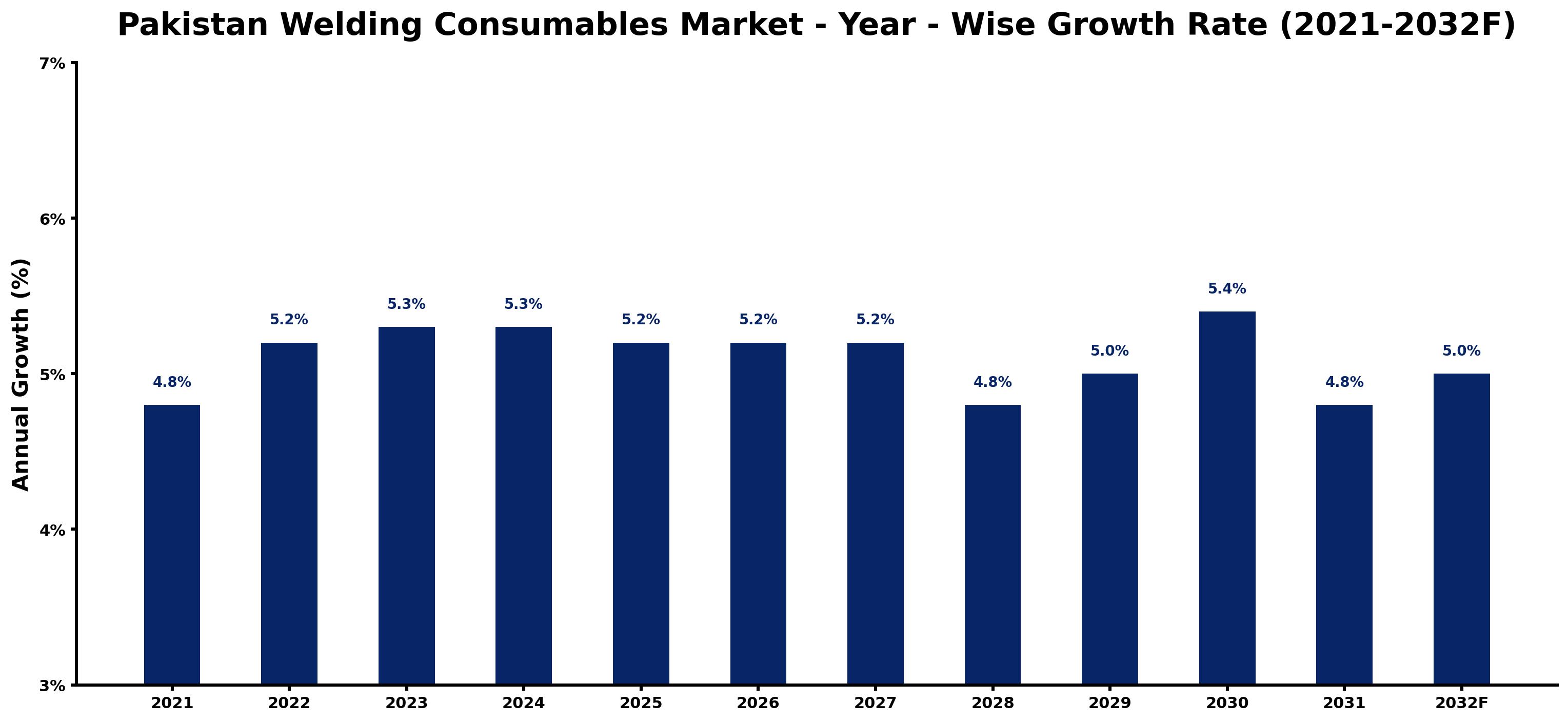
The table below presents the year‑wise growth rates along with the key drivers influencing the market
| Year | Growth Rate | Major Drivers |
| 2021 | 4.8% | Increasing industrial infrastructure investments |
| 2022 | 5.2% | Increasing adoption of advanced technologies |
| 2023 | 5.3% | Expansion of transportation and logistics networks |
| 2024 | 5.3% | Rising electricity demand across industries |
| 2025 | 5.2% | Expansion of commercial construction activities |
| 2026 | 5.2% | Increasing adoption of advanced technologies |
| 2027 | 5.2% | Growing urbanization and commercial development |
| 2028 | 4.8% | Increasing industrial infrastructure investments |
| 2029 | 5.0% | Expansion of manufacturing activities |
| 2030 | 5.4% | Expansion of manufacturing activities |
| 2031 | 4.8% | Growing renewable energy integration projects |
| 2032 | 5.0% | Increasing adoption of advanced technologies |
Note - Market size estimations and growth projections presented in this report are based on 6Wresearch’s advanced forecasting approach, validated with industry datasets as of June 2026.
Pakistan Welding Consumables Market Synopsis
The welding consumables landscape in Pakistan is currently experiencing a robust upswing. The market's growth is predominantly fueled by increased construction activities and a burgeoning manufacturing sector, which together drive the demand for reliable and effective welding materials.
Moreover, technological advancements in welding processes and materials are paving the way for enhanced performance and durability. This shift not only improves operational efficiencies but also aligns with the growing emphasis on energy efficiency and environmental sustainability in welding practices.
Pakistan Welding Consumables Market Key Takeaways
- Significant market expansion driven by infrastructure and industrial growth.
- Technological advancements enhancing performance and efficiency in welding.
- Rising awareness about the importance of quality consumables in ensuring safety.
- Challenges stemming from high import dependency and local manufacturing limitations.
- Government initiatives promoting advanced welding practices and compliance standards.
Evaluation of Restraints in Pakistan Welding Consumables Market
Despite its promising growth outlook, the Pakistan Welding Consumables Market is constrained by several factors. The high cost of imported welding materials leads to inflated prices and can limit access for smaller businesses. Furthermore, the local manufacturing capacity remains underdeveloped, resulting in a reliance on imports that heighten supply chain vulnerabilities. Additionally, there is a significant gap in awareness regarding the benefits of high-quality welding consumables, which hinders broader adoption across the industry.
Pakistan Welding Consumables Market Trends
Current trends in the Pakistan Welding Consumables Market reflect a shift towards more advanced and eco-friendly welding solutions. The integration of automation and robotics in welding processes is gaining traction, enhancing precision and reducing labor costs. Moreover, the industry is witnessing a growing demand for sustainable consumables that minimize environmental impact, aligning with global best practices.
Pakistan Welding Consumables Market Opportunities
The market presents ample opportunities for growth, particularly in the renewable energy sector, where the need for robust welding solutions is paramount. Additionally, investments in modernizing manufacturing facilities and enhancing local production capabilities offer a pathway to reduce import dependency. The ongoing expansion in construction projects across urban centers serves as a critical driver for increased consumption of welding materials.
Government Initiatives in the Pakistan Welding Consumables Market
The Pakistani government is actively supporting the welding consumables market through policy frameworks that emphasize safety, quality, and environmental regulations. Initiatives focus on encouraging compliance with international quality standards for welding materials and promoting the adoption of innovative technologies. Such measures not only aim to enhance industrial productivity but also seek to ensure worker safety and minimize environmental footprints.
Future Insights of the Pakistan Welding Consumables Market
Looking ahead to 2026-2032, the Pakistan Welding Consumables Market is poised for significant advancements. As industries increasingly prioritize quality and sustainability, the demand for high-performance welding consumables will rise. The focus on local manufacturing capabilities will also strengthen, supported by favorable government policies and the need for greater self-sufficiency. Consequently, investments in research and development are likely to propel the market forward, fostering innovation and enhancing competitiveness in the regional landscape.
Pakistan Welding Consumables Market Latest Developments (May 2025 - June 2026)
Recent developments in the Pakistan Welding Consumables Market indicate a growing emphasis on sustainability and technological integration. Industry stakeholders are increasingly prioritizing eco-friendly materials and processes. Furthermore, there has been a notable uptick in collaboration among businesses to enhance local manufacturing capabilities and reduce reliance on imports. Additionally, training initiatives aimed at improving workforce skills in advanced welding techniques are gaining traction.
Pakistan Welding Consumables Market - Key Attractiveness of the Report
- 10 Years of Market Numbers
- Historical Data Starting from 2022 to 2025
- Base Year: 2025
- Forecast Data until 2032
- Key Performance Indicators Impacting the Market
- Major Upcoming Developments and Projects
Key Highlights of the Report:
- Pakistan Welding Consumables Market Outlook
- Market Size of Pakistan Welding Consumables Market, 2025
- Forecast of Pakistan Welding Consumables Market, 2032
- Historical Data and Forecast of Pakistan Welding Consumables Revenues & Volume for the Period 2022-2032F
- Pakistan Welding Consumables Market Trend Evolution
- Pakistan Welding Consumables Market Drivers and Challenges
- Pakistan Welding Consumables Price Trends
- Pakistan Welding Consumables Porter's Five Forces
- Pakistan Welding Consumables Industry Life Cycle
- Historical Data and Forecast of Pakistan Welding Consumables Market Revenues & Volume By Type for the Period 2022-2032F
- Historical Data and Forecast of Pakistan Welding Consumables Market Revenues & Volume By Stick Electrodes for the Period 2022-2032F
- Historical Data and Forecast of Pakistan Welding Consumables Market Revenues & Volume By Solid Wires for the Period 2022-2032F
- Historical Data and Forecast of Pakistan Welding Consumables Market Revenues & Volume By Flux Cored Wires for the Period 2022-2032F
- Historical Data and Forecast of Pakistan Welding Consumables Market Revenues & Volume By SAW Wires & Fluxes for the Period 2022-2032F
- Historical Data and Forecast of Pakistan Welding Consumables Market Revenues & Volume By End-user Industry for the Period 2022-2032F
- Historical Data and Forecast of Pakistan Welding Consumables Market Revenues & Volume By Aerospace & Defense for the Period 2022-2032F
- Historical Data and Forecast of Pakistan Welding Consumables Market Revenues & Volume By Automotive & Transportation for the Period 2022-2032F
- Historical Data and Forecast of Pakistan Welding Consumables Market Revenues & Volume By Construction for the Period 2022-2032F
- Historical Data and Forecast of Pakistan Welding Consumables Market Revenues & Volume By Energy for the Period 2022-2032F
- Historical Data and Forecast of Pakistan Welding Consumables Market Revenues & Volume By Heavy Machinery for the Period 2022-2032F
- Historical Data and Forecast of Pakistan Welding Consumables Market Revenues & Volume By Shipbuilding for the Period 2022-2032F
- Historical Data and Forecast of Pakistan Welding Consumables Market Revenues & Volume By Process & Others for the Period 2022-2032F
- Historical Data and Forecast of Pakistan Welding Consumables Market Revenues & Volume By Welding Technique for the Period 2022-2032F
- Historical Data and Forecast of Pakistan Welding Consumables Market Revenues & Volume By Arc Welding for the Period 2022-2032F
- Historical Data and Forecast of Pakistan Welding Consumables Market Revenues & Volume By Resistance Welding for the Period 2022-2032F
- Historical Data and Forecast of Pakistan Welding Consumables Market Revenues & Volume By Oxy-fuel Welding for the Period 2022-2032F
- Historical Data and Forecast of Pakistan Welding Consumables Market Revenues & Volume By Laser-beam Welding for the Period 2022-2032F
- Historical Data and Forecast of Pakistan Welding Consumables Market Revenues & Volume By Others for the Period 2022-2032F
- Pakistan Welding Consumables Import Export Trade Statistics
- Market Opportunity Assessment By Type
- Market Opportunity Assessment By End-user Industry
- Market Opportunity Assessment By Welding Technique
- Pakistan Welding Consumables Top Companies Market Share
- Pakistan Welding Consumables Competitive Benchmarking By Technical and Operational Parameters
- Pakistan Welding Consumables Company Profiles
- Pakistan Welding Consumables Key Strategic Recommendations






































