Pakistan Wooden Furniture Market Size, Share & Growth Rate
The Pakistan Wooden Furniture Market was estimated at USD 386 Million in 2025 and is projected to reach USD 531 Million by 2032, growing at a CAGR of 4.7% from 2026 to 2032. This growth trajectory is largely fueled by rising disposable incomes among consumers, which has increased demand for higher-quality and aesthetically pleasing furniture. Additionally, advancements in manufacturing technologies and a growing emphasis on sustainable materials are enhancing the market's overall appeal, making it more attractive for both consumers and investors alike.
Pakistan Wooden Furniture Market Growth Rate Analysis (2021-2032)
The Pakistan Wooden Furniture Market has showcased a stable growth pattern, starting with a 5.3% increase in 2021, rising to 5.7% in 2022. This growth can largely be attributed to a surge in consumer demand for sustainable and locally produced furniture, coupled with an increase in disposable incomes. The growth rate moderated to 5.3% in 2023, reflecting slight fluctuations in raw material costs and production disruptions. However, the market is projected to stabilize again, with growth rates hovering around 5.4% to 5.7% from 2024 through 2029. Increased investments in technology and infrastructure are expected to further drive efficiency and enhance product diversity, positioning the sector for continued stability despite minor dips in later years.
Pakistan Wooden Furniture Market Year-wise Growth Rate and Key Drivers
This graph highlights how the Pakistan Wooden Furniture Market has steadily grown over the past five years, supported by major growth factors.
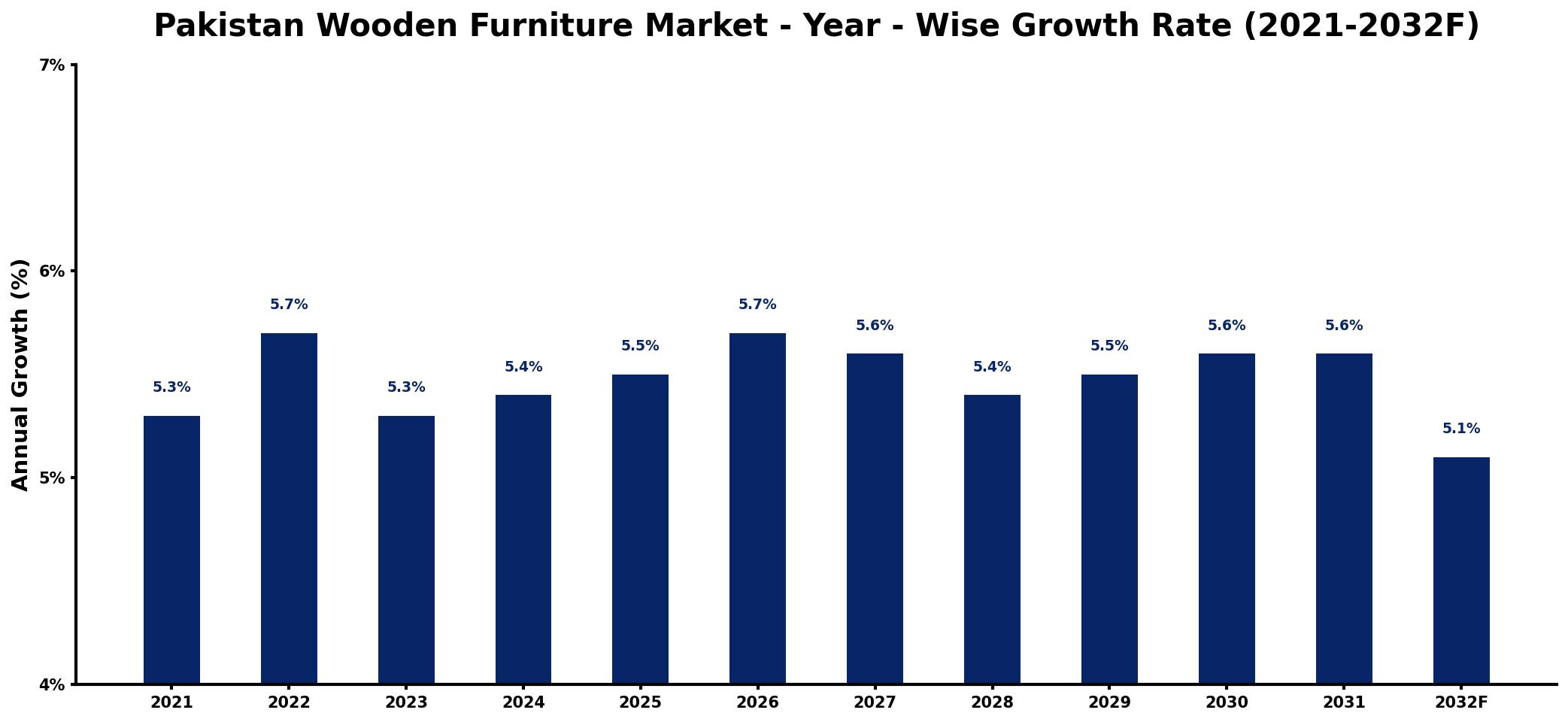
The table below presents the year‑wise growth rates along with the key drivers influencing the market
| Year | Growth Rate | Major Drivers |
| 2021 | 5.3% | Rising disposable income levels |
| 2022 | 5.7% | Increased urban housing projects |
| 2023 | 5.3% | Growing e-commerce platforms adoption |
| 2024 | 5.4% | Surge in home renovation activities |
| 2025 | 5.5% | Expansion of local manufacturing units |
| 2026 | 5.7% | Increased focus on sustainable sourcing |
| 2027 | 5.6% | Demand for customized interior solutions |
| 2028 | 5.4% | Growth in export opportunities |
| 2029 | 5.5% | Emergence of online design services |
| 2030 | 5.6% | Rising popularity of artisanal products |
| 2031 | 5.6% | Increased investments in technology |
| 2032 | 5.1% | Diversification of supply chain networks |
Note: Market size estimations and growth projections presented in this report are based on 6Wresearch's proprietary forecasting methodology, utilizing the latest available industry data, government publications, and primary research inputs.
Pakistan Wooden Furniture Market Synopsis
In recent years, the Pakistan Wooden Furniture Market has demonstrated substantial momentum, driven primarily by the burgeoning real estate and hospitality sectors. As home decoration and renovation projects surge in popularity, consumers are increasingly turning towards wooden furniture for its elegance and durability.
Looking ahead, the market faces the dual challenge of fluctuating raw material costs and competition from alternative materials. However, the sustained preference for natural and sustainable furnishings positions the wooden furniture segment for continued growth amidst these pressures, aligning with consumer trends and environmental awareness.
Pakistan Wooden Furniture Market Key Takeaways
- The market is set for significant growth, projected to reach USD 531 Million by 2032.
- Increasing disposable incomes are propelling demand for high-quality furniture.
- Consumer preference is shifting towards sustainable and eco-friendly options.
- Fluctuating costs of raw materials remain a crucial challenge for manufacturers.
- Government policies are reinforcing quality standards and promoting local craftsmanship.
Evaluation of Restraints in Pakistan Wooden Furniture Market
Despite its promising outlook, the Pakistan Wooden Furniture Market grapples with significant restraints that inhibit its potential. Fluctuating costs of raw materials, particularly the availability of quality timber species, can undermine manufacturing consistency and profitability. Furthermore, the reliance on imported wood can expose local manufacturers to international price volatility, posing additional financial risks. Environmental regulations mandating sustainable practices necessitate considerable investment in innovative production technologies, adding to the operational complexities faced by businesses in this sector.
Pakistan Wooden Furniture Market Trends
Several trends are currently shaping the Pakistan Wooden Furniture Market, with a notable increase in consumer interest towards bespoke and artisanal furniture. This shift is fueled by a desire for unique, high-quality products that reflect personal style. Additionally, advancements in digital technology are paving the way for enhanced design capabilities and customization options in furniture production.
The sustainability movement is another defining trend, with consumers increasingly opting for eco-friendly materials and practices. As awareness of environmental issues grows, brands that prioritize sustainable sourcing and production methods are gaining a competitive edge in the market.
Pakistan Wooden Furniture Market Opportunities
The Pakistan Wooden Furniture Market presents myriad growth opportunities, particularly in the realms of e-commerce and export potential. Online platforms are becoming increasingly vital for reaching broader customer bases, allowing businesses to showcase their unique offerings and enhance sales. Furthermore, tapping into international markets can offer lucrative avenues for expansion, particularly for high-quality handcrafted items.
Investment in innovative manufacturing technologies that streamline production processes can also drive efficiency and profitability. Emphasizing collaboration with local artisans can yield bespoke products that cater to niche markets, further diversifying revenue streams.
Government Initiatives in the Pakistan Wooden Furniture Market
Government initiatives are pivotal in shaping the Pakistan Wooden Furniture Market. By implementing policies that promote local craftsmanship and sustainable manufacturing practices, the government is seeking to bolster the industrys growth. Regulations surrounding quality standards ensure that products meet safety and durability criteria, providing consumers with reliable options. Furthermore, incentives for sustainable production can encourage manufacturers to invest in eco-friendly materials, aligning industry practices with global sustainability goals.
Future Insights of the Pakistan Wooden Furniture Market
As we look towards the future, the Pakistan Wooden Furniture Market is anticipated to evolve significantly between 2026 and 2032. Increasing urbanization and a growing middle class are likely to elevate demand for quality furniture in both residential and commercial sectors. The rising trend of remote work may further influence furniture choices, with a particular focus on home office setups. With a continued emphasis on sustainability and innovative design, the market is poised for resilient growth, adapting to the changing preferences of consumers.
Pakistan Wooden Furniture Market Latest Developments (2025 - 2026)
In recent months, the Pakistan Wooden Furniture Market has experienced notable shifts, driven by increasing collaboration between artisans and designers to create distinctive products. The growing trend of eco-friendly furnishings has prompted several manufacturers to invest in sustainable practices. Additionally, e-commerce platforms are gaining traction as vital channels for consumer engagement and sales, making furniture shopping more accessible. There's also been a focus on enhancing local supply chains to reduce dependency on imported materials, thereby bolstering the domestic manufacturing ecosystem.
Pakistan Wooden Furniture Market - Key Attractiveness of the Report
- 10 Years of Market Numbers
- Historical Data Starting from 2022 to 2025
- Base Year: 2025
- Forecast Data until 2032
- Key Performance Indicators Impacting the Market
- Major Upcoming Developments and Projects
Key Highlights of the Report:
- Pakistan Wooden Furniture Market Outlook
- Market Size of Pakistan Wooden Furniture Market, 2025
- Forecast of Pakistan Wooden Furniture Market, 2032
- Historical Data and Forecast of Pakistan Wooden Furniture Revenues & Volume for the Period 2022-2032F
- Pakistan Wooden Furniture Market Trend Evolution
- Pakistan Wooden Furniture Market Drivers and Challenges
- Pakistan Wooden Furniture Price Trends
- Pakistan Wooden Furniture Porter's Five Forces
- Pakistan Wooden Furniture Industry Life Cycle
- Historical Data and Forecast of Pakistan Wooden Furniture Market Revenues & Volume By Type for the Period 2022-2032F
- Historical Data and Forecast of Pakistan Wooden Furniture Market Revenues & Volume By Hardwood for the Period 2022-2032F
- Historical Data and Forecast of Pakistan Wooden Furniture Market Revenues & Volume By Softwood for the Period 2022-2032F
- Historical Data and Forecast of Pakistan Wooden Furniture Market Revenues & Volume By Material for the Period 2022-2032F
- Historical Data and Forecast of Pakistan Wooden Furniture Market Revenues & Volume By Plywood for the Period 2022-2032F
- Historical Data and Forecast of Pakistan Wooden Furniture Market Revenues & Volume By Laminates for the Period 2022-2032F
- Historical Data and Forecast of Pakistan Wooden Furniture Market Revenues & Volume By MDF for the Period 2022-2032F
- Historical Data and Forecast of Pakistan Wooden Furniture Market Revenues & Volume By Other Materials for the Period 2022-2032F
- Historical Data and Forecast of Pakistan Wooden Furniture Market Revenues & Volume By Product for the Period 2022-2032F
- Historical Data and Forecast of Pakistan Wooden Furniture Market Revenues & Volume By Bedroom for the Period 2022-2032F
- Historical Data and Forecast of Pakistan Wooden Furniture Market Revenues & Volume By Seating for the Period 2022-2032F
- Historical Data and Forecast of Pakistan Wooden Furniture Market Revenues & Volume By Kitchen for the Period 2022-2032F
- Historical Data and Forecast of Pakistan Wooden Furniture Market Revenues & Volume By Other Products for the Period 2022-2032F
- Historical Data and Forecast of Pakistan Wooden Furniture Market Revenues & Volume By Application for the Period 2022-2032F
- Historical Data and Forecast of Pakistan Wooden Furniture Market Revenues & Volume By Residential for the Period 2022-2032F
- Historical Data and Forecast of Pakistan Wooden Furniture Market Revenues & Volume By Commercial for the Period 2022-2032F
- Historical Data and Forecast of Pakistan Wooden Furniture Market Revenues & Volume By Distribution Channel for the Period 2022-2032F
- Historical Data and Forecast of Pakistan Wooden Furniture Market Revenues & Volume By Offline for the Period 2022-2032F
- Historical Data and Forecast of Pakistan Wooden Furniture Market Revenues & Volume By Online for the Period 2022-2032F
- Pakistan Wooden Furniture Import Export Trade Statistics
- Market Opportunity Assessment By Type
- Market Opportunity Assessment By Material
- Market Opportunity Assessment By Product
- Market Opportunity Assessment By Application
- Market Opportunity Assessment By Distribution Channel
- Pakistan Wooden Furniture Top Companies Market Share
- Pakistan Wooden Furniture Competitive Benchmarking By Technical and Operational Parameters
- Pakistan Wooden Furniture Company Profiles
- Pakistan Wooden Furniture Key Strategic Recommendations






































