Papua New Guinea Flour Market Size Growth Rate
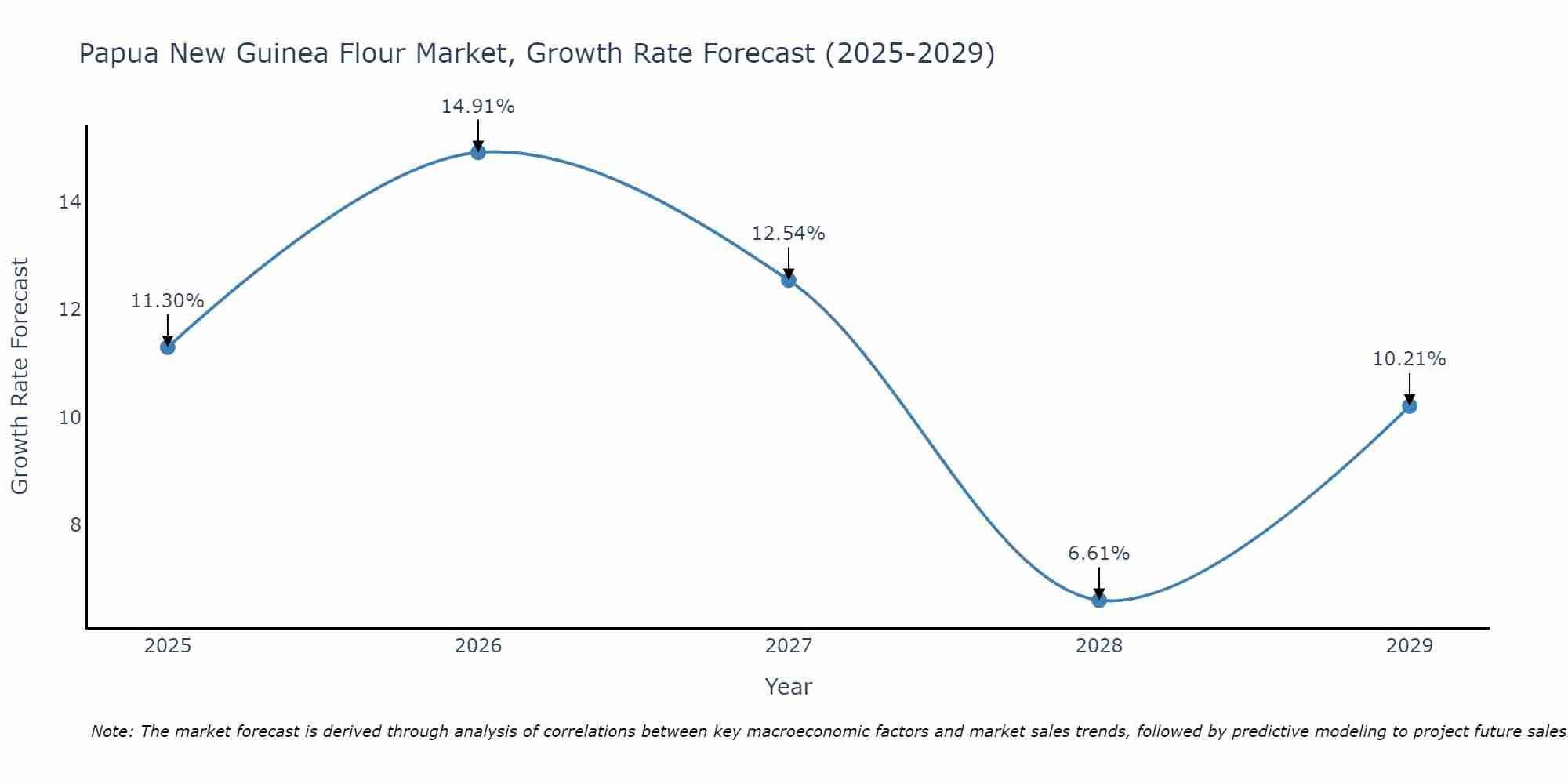
The Papua New Guinea Flour Market is projected to witness mixed growth rate patterns during 2025 to 2029. Growth accelerates to 14.91% in 2026, following an initial rate of 11.30%, before easing to 10.21% at the end of the period.
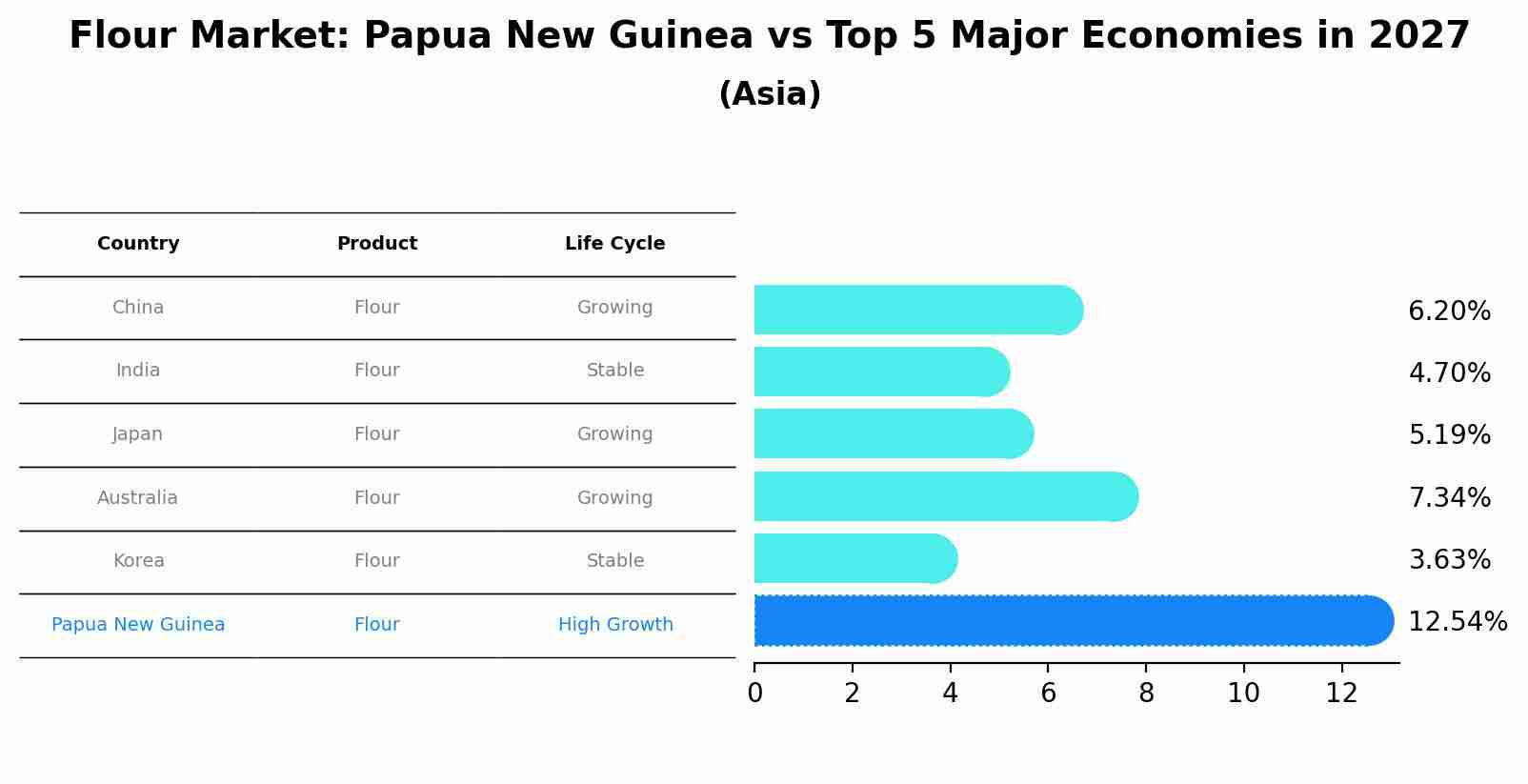
Flour Market: Papua New Guinea vs Top 5 Major Economies in 2027 (Asia)
In the Asia region, the Flour market in Papua New Guinea is projected to expand at a high growth rate of 12.54% by 2027. The largest economy is China, followed by India, Japan, Australia and South Korea.
Papua New Guinea Flour Market Highlights
| Report Name | Papua New Guinea Flour Market |
| Forecast period | 2025-2029 |
| CAGR | 10.21% |
| Growing Sector | Bread & Bakery and Packaged Food Processing |
Five-Year Growth Trajectory of the Papua New Guinea Flour Market with Core Drivers
Below mentioned are the evaluation of year-wise growth rate along with key drivers:
| Years | Est. Annual Growth | Growth Drivers |
| 2020 | 0.027 | Potent flour demand in rural and urban markets due to the ongoing staple need despite economic changes. |
| 2021 | 0.031 | Retail formalization and packaging augmentation raised consumer access to branded and fortified flour. |
| 2022 | 0.038 | Cross-border wheat imports and allocation of money in milling capacity eased supply chain disruptions. |
| 2023 | 0.042 | The increase in bakery products and processed noodle consumption spurred the industrial flour demand. |
| 2024 | 0.047 | Increasing disposable income and the transition to more fortified, value-added flour offerings increased overall market growth. |
Topics Covered in the Papua New Guinea Flour Market Report
The Papua New Guinea Flour Market report thoroughly covers the market by raw material, applications, and technology. The market report provides an unbiased and detailed analysis of ongoing market trends, opportunities/high growth areas, and market drivers, which would help stakeholders to devise and align their market strategies according to the current and future market dynamics.
Papua New Guinea Flour Market Synopsis
The Papua New Guinea Flour Market is predicted to get major growth spurred by the increasing demand for fortified flour, rising bakery consumption, and the expansion of fast-food outlets in urban areas. The local milling industry is as both domestic and international players allocate money in new technology and infrastructure to cater to the rising demand for processed food products. The government’s efforts to improve food security and the introduction of quality assurance programs for wheat flour are anticipated to further profiler the market’s growth.
Evaluation of Growth Drivers in the Papua New Guinea Flour Market
Below mentioned are some prominent drivers and their influence to the market dynamics:
| Drivers | Primary Segments Affected | Why It Matters (Evidence) |
| Urbanization and Changing Consumption Patterns | Bread & Bakery Products; Noodles & Pasta | The rising urban population in PNG increases the need for packaged bread, biscuits, and noodles, propelling flour consumption. |
| Government Food Security Initiatives | All Applications | The Food Security Policy 2021–2030 focusses self-sufficiency and enhance nutritional standards, which will increase demand for fortified flour. |
| Improved Infrastructure and Milling Technology | All Segments | The development of modern flour mills in PNG is improving production efficiency and flour consistency, assisting the bakery sector. |
| Expansion of Bakery and Fast-Food Chains | Bread & Bakery; Noodles & Pasta | Rising consumer interest in fast food and bakery items is spurring industrial flour sales, particularly for noodles and bread. |
| Health and Nutrition Awareness | Animal Feed; Noodles & Pasta | Rising awareness about nutrition increases requirement for fortified and multi-grain flour varieties across different market segments. |
The Papua New Guinea Flour Market size is projected to grow at the CAGR of 10.21% during the forecast period of 2025–2029. Flour consumption is rising due to increasing need for bakery products, noodles, and fortified flour options in urban and rural households. Additionally, government initiatives and infrastructure advancements are underpinning market growth. Moreover, the increasing demand for healthier and more nutritious food options is bolstering the transition towards whole grain and multi-grain flour varieties, further contributing to market expansion.
Evaluation of Restraints in the Papua New Guinea Flour Market
Below mentioned are some major restraints and their influence to the market dynamics:
| Restraints | Primary Segments Affected | What This Means (Evidence) |
| Dependence on Wheat Imports | Wheat-based Flour Applications | Dependency on wheat imports exposes the flour market to cost changes and delays in cross-border shipments, affecting price structures. |
| Limited Local Milling Capacity | Bread & Bakery Products | The lack of local mills limits the ability to meet increasing demand, especially in rural areas. Smaller mills also struggle to adopt modern technology. |
| High Transportation Costs | Industrial & SME Mills | The price of diesel and road infrastructure challenges raises transportation expenses, particularly for mills in remote areas. |
| Lack of Access to Financing for SMEs | Local Flour Mills | Small-scale millers face difficulties in accessing affordable capital, obstructing their ability to improve equipment and expand capacity. |
| Climate Conditions Affecting Wheat Supply | Wheat-based Flour Products | Changes in climate conditions can negatively affect local wheat production, which in turn impacts supply dependency for millers. |
Papua New Guinea Flour Market Challenges
Despite the growing demand, the Papua New Guinea Flour Market faces challenges such as dependency on wheat imports, changing global wheat cost, and inadequate infrastructure. Additionally, the lack of access to financing for small and medium flour mills prevents necessary technological upgrades and increased milling capacity. The high price of fuel for transportation further raises operational prices, especially in remote areas.
Papua New Guinea Flour Market Trends
Several prominent trends reshaping the market growth include:
- Fortified Flour Demand: The increased focus on nutritional content and fortification (iron, folic acid) to augment public health is leading to increasing consumer need for fortified flour.
- Rise of Packaged and Branded Flour: Consumers are highly opting for packaged, branded flour products in urban areas owing to convenience and assurance of quality.
- Increase in Multi-Grain Flour Options: As consumers become more health-aware, a transition towards healthier, multi-grain flours (including rice, maize, and sorghum) is emerging.
- Advancements in Milling Technology: For better extraction rates and augmented flour quality is on the rise, particularly in industrial mills, deployment of modern roller mills and automated systems
Investment Opportunities in the Papua New Guinea Flour Industry
Some prominent investment opportunities in the market include:
- Modernization of Milling Infrastructure: To augment product quality and rise the production capacity allocate money in high-efficiency roller mills and automated fortification systems to augment product quality and rise the production capacity.
- Regional Warehousing and Logistics Hubs: To decrease transportation price and augment supply chain efficiency, especially in rural and remote areas, create storage and distribution hubs.
- Branded Flour Products Development: To offer to the offer to the increasing demand for fortified, multi-grain, and gluten-free flour options establish new product lines that.
- SME Financing Programs: For capacity expansion and infrastructure upgrades, give financial support and low-interest loans to small mills.
Top 5 Leading Players in the Papua New Guinea Flour Market
Some leading players operating in the Papua New Guinea Flour Market include:
1. Olam Agri
| Company Name | Olam Agri |
| Established Year | 1989 |
| Headquarters | Singapore |
| Official Website | Click Here |
Olam Agri supplies premium wheat flour across the Pacific region, with modern processing and fortification capabilities that cater to PNG’s flour market.
2. Flour Mills of Nigeria Plc
| Company Name | Flour Mills of Nigeria Plc |
| Established Year | 1960 |
| Headquarters | Lagos, Nigeria |
| Official Website | - |
Flour Mills of Nigeria is increasing its presence in PNG through cross-border trade, encouraging the local bakery industry with dependable flour supply.
3. Seaboard Overseas and Trading Group
| Company Name | Seaboard Overseas and Trading Group |
| Established Year | 1918 |
| Headquarters | Merriam, Kansas, USA |
| Official Website | Click Here |
Seaboard is a leading player in flour milling in the Pacific region and supplies various types of flour for both domestic and industrial use in PNG.
4. Groupe Mimran (Grands Moulins d’Afrique)
| Company Name | Groupe Mimran (Grands Moulins d’Afrique) |
| Established Year | 1956 |
| Headquarters | Paris, France |
| Official Website | - |
Groupe Mimran provides high-quality flour products and manages a strong distribution chain catering PNG’s baking and food production industries.
5. Bühler Group
| Company Name | Bühler Group |
| Established Year | 1860 |
| Headquarters | Uzwil, Switzerland |
| Official Website | Click Here |
Bühler gives state-of-the-art milling technology and services that help augment yield and flour quality in PNG’s flour production systems.
Government Regulations Introduced in the Papua New Guinea Flour Market
According to Papua New Guinea’s government data, numerous initiatives have been introduced that ha the objective at enhancing food production and security. These initiatives consist of encouraging the fortification of wheat flour with essential nutrients like iron and folic acid under the National Nutrition Policy. The government also promotes private sector participation in milling and distribution, encouraging the industry through subsidies and financing for local millers to deploy modern technologies and augment production quality.
Future Insights of the Papua New Guinea Flour Market
The Papua New Guinea Flour Market Growth is anticipated to increase due to the continuous urbanization, increasing consumer demand for packaged and fortified flour, and the increase of bakery and food processing sectors. The steady growth in industrial milling capacity, coupled with rising focus on product fortification, will persist to support market expansion. To decrease prices and augment supply chain reliability, positioning the sector for sustained growth technological improvements in milling equipment and augmented logistical support will help in this.
Market Segmentation Analysis
The report offers a comprehensive study of the subsequent market segments and their leading categories.
Wheat to Dominate the Market – By Raw Material
According to Parth, Senior Research Analyst at 6Wresearch, wheat is the leading raw material in the flour market, used extensively for bread, noodles, and biscuits. Its versatility, along with potent regional import channels, makes it the dominant raw material for flour production. Thus, it holds the largest Papua New Guinea Flour Market Share.
Bread & Bakery Products to Dominate the Market – By Applications
Bread & Bakery Products leads the Papua New Guinea Flour Industry, supported by the rising need for bread and cakes in urban centers, along with an increasing bakery industry offering to the fast-food sector.
Dry Technology to Dominate the Market – By Technology
Dry Technology leads due to its suitability for the existing infrastructure in PNG, catering cost-effective solutions for flour extraction with minimal water consumption.
Key Attractiveness of the Report
- 10 Years of Market Numbers.
- Historical Data Starting from 2021 to 2024.
- Base Year: 2024.
- Forecast Data until 2029.
- Key Performance Indicators Impacting the Market.
- Major Upcoming Developments and Projects.
Key Highlights of the Report:
- Papua New Guinea Flour Market Outlook
- Market Size of Papua New Guinea Flour Market, 2025
- Forecast of Papua New Guinea Flour Market, 2029
- Historical Data and Forecast of Papua New Guinea Flour Revenues & Volume for the Period 2019-2029
- Papua New Guinea Flour Market Trend Evolution
- Papua New Guinea Flour Market Drivers and Challenges
- Papua New Guinea Flour Price Trends
- Papua New Guinea Flour Porter`s Five Forces
- Papua New Guinea Flour Industry Life Cycle
- Historical Data and Forecast of Papua New Guinea Flour Market Revenues & Volume By Raw Material for the Period 2019-2029
- Historical Data and Forecast of Papua New Guinea Flour Market Revenues & Volume By Wheat for the Period 2019-2029
- Historical Data and Forecast of Papua New Guinea Flour Market Revenues & Volume By Rice for the Period 2019-2029
- Historical Data and Forecast of Papua New Guinea Flour Market Revenues & Volume By Maize for the Period 2019-2029
- Historical Data and Forecast of Papua New Guinea Flour Market Revenues & Volume By Others for the Period 2019-2029
- Historical Data and Forecast of Papua New Guinea Flour Market Revenues & Volume By Applications for the Period 2019-2029
- Historical Data and Forecast of Papua New Guinea Flour Market Revenues & Volume By Bread & Bakery Products for the Period 2019-2029
- Historical Data and Forecast of Papua New Guinea Flour Market Revenues & Volume By Noodles & Pasta for the Period 2019-2029
- Historical Data and Forecast of Papua New Guinea Flour Market Revenues & Volume By Animal Feed for the Period 2019-2029
- Historical Data and Forecast of Papua New Guinea Flour Market Revenues & Volume By Wafers, Crackers, & Biscuits for the Period 2019-2029
- Historical Data and Forecast of Papua New Guinea Flour Market Revenues & Volume By Non-Food Application for the Period 2019-2029
- Historical Data and Forecast of Papua New Guinea Flour Market Revenues & Volume By Others for the Period 2019-2029
- Historical Data and Forecast of Papua New Guinea Flour Market Revenues & Volume By Technology for the Period 2019-2029
- Historical Data and Forecast of Papua New Guinea Flour Market Revenues & Volume By Dry Technology for the Period 2019-2029
- Historical Data and Forecast of Papua New Guinea Flour Market Revenues & Volume By Wet Technology for the Period 2019-2029
- Papua New Guinea Flour Import Export Trade Statistics
- Market Opportunity Assessment By Raw Material
- Market Opportunity Assessment By Applications
- Market Opportunity Assessment By Technology
- Papua New Guinea Flour Top Companies Market Share
- Papua New Guinea Flour Competitive Benchmarking By Technical and Operational Parameters
- Papua New Guinea Flour Company Profiles
- Papua New Guinea Flour Key Strategic Recommendations
Market Covered
The report offers a comprehensive study of the subsequent market segments:
By Raw Material
- Wheat
- Rice
- Maize
- Others
By Applications
- Bread & Bakery Products
- Noodles & Pasta
- Animal Feed
- Wafers, Crackers, & Biscuits
- Non-Food Application
- Others
By Technology
- Dry Technology
- Wet Technology






































