Paraguay Construction Machinery Market Growth Rate Analysis (2025 - 2031)
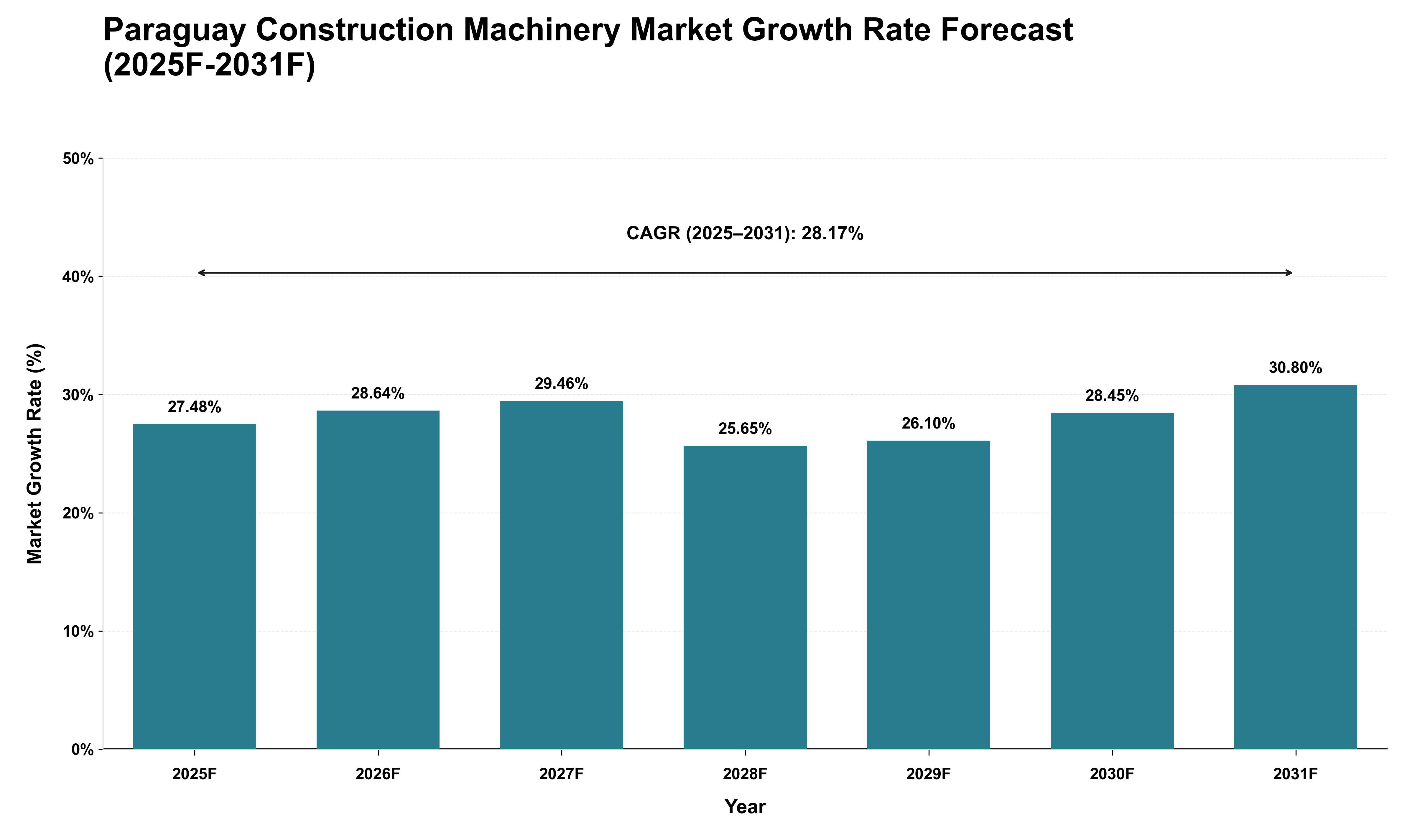
The Paraguay construction machinery market is projected to experience a robust compound annual growth rate of 28.17% from 2025 to 2031, reflecting significant demand driven by infrastructure development and urbanization. The annual growth rates indicate a dynamic environment, with peaks in 2027 and 2031 at 29.46% and 30.80%, respectively, suggesting an accelerating investment in construction technologies as the economy expands. This trend will likely be influenced by increasing import dependencies for advanced machinery, as local production may not fully meet the rising demand for innovative equipment. Additionally, cyclical trends in global commodity prices could impact construction activity levels, further driving the need for efficient machinery solutions. As firms seek to enhance productivity through technological advancements and product substitution, the market will likely witness a shift towards more sophisticated machinery that aligns with evolving construction practices and regulatory standards.
Key Highlights of the Report:
- Paraguay Construction Machinery Market Outlook
- Market Size of Paraguay Construction Machinery Market, 2024
- Forecast of Paraguay Construction Machinery Market, 2031
- Historical Data and Forecast of Paraguay Construction Machinery Revenues & Volume for the Period 2021- 2031
- Paraguay Construction Machinery Market Trend Evolution
- Paraguay Construction Machinery Market Drivers and Challenges
- Paraguay Construction Machinery Price Trends
- Paraguay Construction Machinery Porter's Five Forces
- Paraguay Construction Machinery Industry Life Cycle
- Historical Data and Forecast of Paraguay Construction Machinery Market Revenues & Volume By Machine Type for the Period 2021- 2031
- Historical Data and Forecast of Paraguay Construction Machinery Market Revenues & Volume By Cranes for the Period 2021- 2031
- Historical Data and Forecast of Paraguay Construction Machinery Market Revenues & Volume By Excavators for the Period 2021- 2031
- Historical Data and Forecast of Paraguay Construction Machinery Market Revenues & Volume By Loaders for the Period 2021- 2031
- Historical Data and Forecast of Paraguay Construction Machinery Market Revenues & Volume By Backhoe for the Period 2021- 2031
- Historical Data and Forecast of Paraguay Construction Machinery Market Revenues & Volume By Motor Graders for the Period 2021- 2031
- Historical Data and Forecast of Paraguay Construction Machinery Market Revenues & Volume By Other Machine Types for the Period 2021- 2031
- Historical Data and Forecast of Paraguay Construction Machinery Market Revenues & Volume By Application for the Period 2021- 2031
- Historical Data and Forecast of Paraguay Construction Machinery Market Revenues & Volume By Concrete and Road Construction for the Period 2021- 2031
- Historical Data and Forecast of Paraguay Construction Machinery Market Revenues & Volume By Earth Moving for the Period 2021- 2031
- Historical Data and Forecast of Paraguay Construction Machinery Market Revenues & Volume By Material Handling for the Period 2021- 2031
- Paraguay Construction Machinery Import Export Trade Statistics
- Market Opportunity Assessment By Machine Type
- Market Opportunity Assessment By Application
- Paraguay Construction Machinery Top Companies Market Share
- Paraguay Construction Machinery Competitive Benchmarking By Technical and Operational Parameters
- Paraguay Construction Machinery Company Profiles
- Paraguay Construction Machinery Key Strategic Recommendations






































