Paraguay Split Air Conditioners Market Growth Rate Analysis (2025 - 2031)
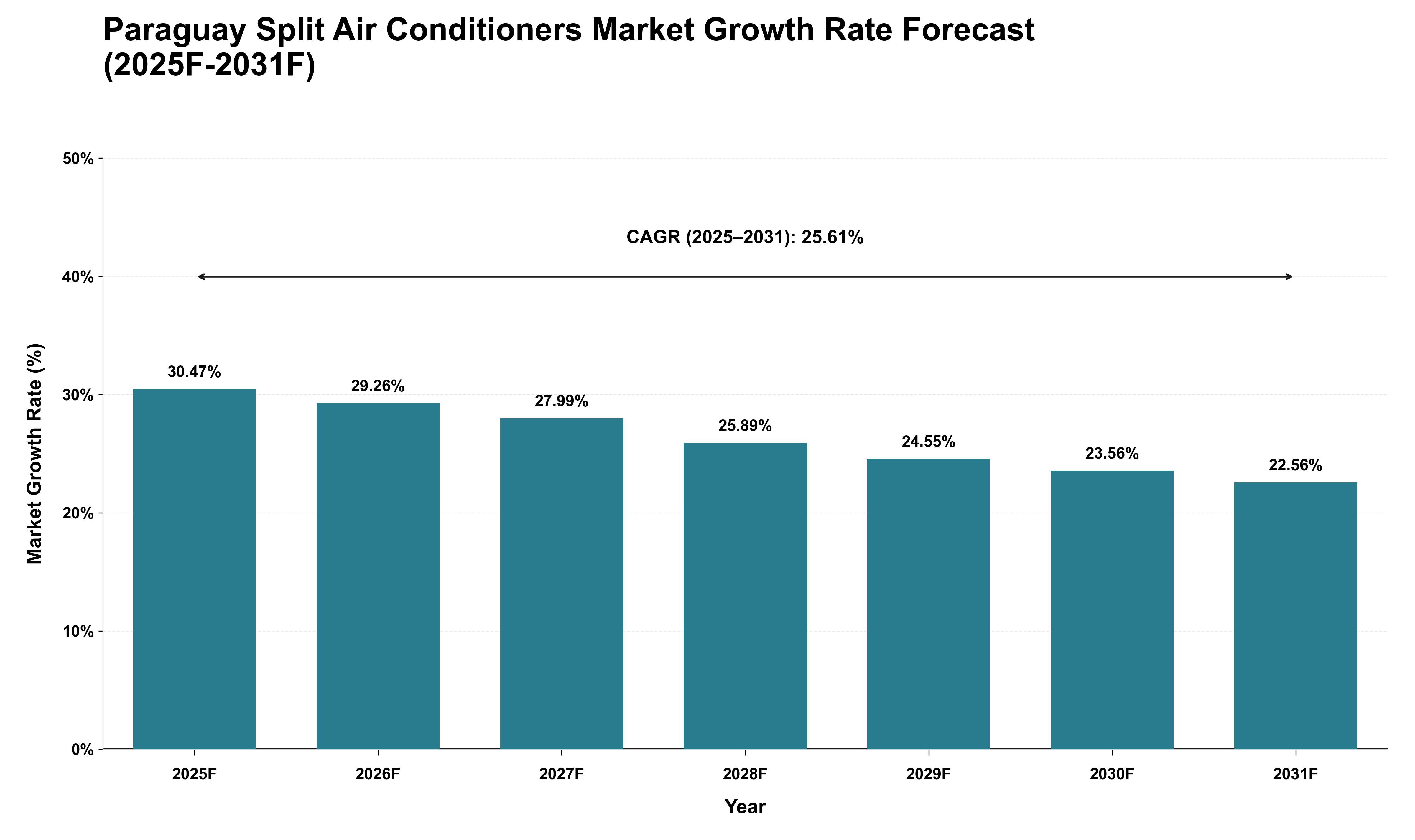
The Paraguay split air conditioners market will experience significant growth driven by evolving consumer preferences and increasing urbanization, which will enhance demand for cooling solutions. The forecasted CAGR of 25.61% reflects a robust trajectory, with annual growth rates peaking at 30.47% in 2025 before gradually declining to 22.56% by 2031. This trend will be influenced by raw material availability and pricing dynamics, particularly as the global supply chain stabilizes post-pandemic disruptions. Import dependencies on key components such as refrigerants and electronic parts will shape pricing strategies, potentially leading to fluctuations in production costs that manufacturers must navigate. Additionally, the anticipated rise in disposable incomes will enable broader access to air conditioning technology, further propelling market expansion while necessitating strategic sourcing of materials to mitigate cost pressures and ensure competitive pricing throughout the forecast period.
Key Highlights of the Report:
- Paraguay Split Air conditioners Market Outlook
- Market Size of Paraguay Split Air conditioners Market, 2024
- Forecast of Paraguay Split Air conditioners Market, 2031
- Historical Data and Forecast of Paraguay Split Air conditioners Revenues & Volume for the Period 2021-2031
- Paraguay Split Air conditioners Market Trend Evolution
- Paraguay Split Air conditioners Market Drivers and Challenges
- Paraguay Split Air conditioners Price Trends
- Paraguay Split Air conditioners Porter`s Five Forces
- Paraguay Split Air conditioners Industry Life Cycle
- Historical Data and Forecast of Paraguay Split Air conditioners Market Revenues & Volume By Product Type for the Period 2021-2031
- Historical Data and Forecast of Paraguay Split Air conditioners Market Revenues & Volume By Ductless for the Period 2021-2031
- Historical Data and Forecast of Paraguay Split Air conditioners Market Revenues & Volume By VRF for the Period 2021-2031
- Historical Data and Forecast of Paraguay Split Air conditioners Market Revenues & Volume By Ducted for the Period 2021-2031
- Historical Data and Forecast of Paraguay Split Air conditioners Market Revenues & Volume By Application for the Period 2021-2031
- Historical Data and Forecast of Paraguay Split Air conditioners Market Revenues & Volume By Residential for the Period 2021-2031
- Historical Data and Forecast of Paraguay Split Air conditioners Market Revenues & Volume By Commercial for the Period 2021-2031
- Paraguay Split Air conditioners Import Export Trade Statistics
- Market Opportunity Assessment By Product Type
- Market Opportunity Assessment By Application
- Paraguay Split Air conditioners Top Companies Market Share
- Paraguay Split Air conditioners Competitive Benchmarking By Technical and Operational Parameters
- Paraguay Split Air conditioners Company Profiles
- Paraguay Split Air conditioners Key Strategic Recommendations






































